
Technology
Amazon’s Massive Distribution Network in One Giant Visualization

View a high resolution version of this graphic.

Amazon’s Massive Distribution Network in One Visualization
View the high resolution version of today’s graphic by clicking here.
Last year, Amazon shipped over 5 billion (with a “B”) Prime packages, and the retail giant’s ecommerce market share in the U.S. is on the verge of surpassing 50%.
Moving that kind of volume takes an impressive amount of technical sophistication, manpower, and distribution infrastructure. While Amazon does lean on third parties for deliveries and warehousing, the company is also building an increasingly expansive distribution network in an attempt to manage the entire process.
Today’s visualization, which uses comprehensive data from MWPVL International, examines the estimated 124 million square feet of active space in the U.S., as well as the 40 million in Amazon’s construction pipeline.
To create our graphical footprint of Amazon’s warehouses in the infographic, we’ve used satellite imagery of every Amazon facility in the U.S. and stitched it all together.
Pieces of the Puzzle
There are a few types of facilities that make up the vast network of Amazon’s warehouses:
Crossdock Centers
Containers from foreign vendors can be held at a crossdock facility until more stock is needed at the fulfillment center. This is the back-end of the distribution chain.
Fulfillment Centers
Fulfillment centers are the most common type of facility in Amazon’s distribution empire, but they serve a wide variety of purposes.
Amazon began building its distribution network in 1997, starting with two fulfillment centers in Seattle and Delaware. The two spaces would be tiny compared to today’s standards at 93,000 and 202,000 square feet, respectively. Now, there is nearly 100 million square feet of active fulfillment center space, with another 35 million on the way.
Sortation Centers
These facilities are responsible for sorting packages by zip code which are then typically delivered to USPS sites. Since being introduced in 2014, sortation centers have allowed Amazon to speed up the delivery process and to help control the distribution process up to “the last mile”.
Delivery Stations
In urban areas, delivery stations are often the last step in the chain before packages reach a customer. Courier companies – and increasingly Amazon Flex drivers – typically handle these short-range deliveries. These stations are often located near airports.
Prime Now Hubs
These smaller locations are specifically designed for speed. Prime Now hubs carry a more limited selection of items – including Whole Foods inventory – that are delivered within two hours of clicking “buy”. There are currently around 50 of these facilities in urban areas around the United States, but that number is expected to increase dramatically in the near future.
Prime Air Hub
Amazon doesn’t own its own airport yet, but the recently announced $1.5B international Prime Air Hub is a step in that direction.
The 210-acre parcels will help Amazon expand its Prime Air fleet while reducing its reliance on companies like UPS and FedEx. Kentucky is a natural choice for the hub as there are already 11 fulfillment centers in the state.
Fighting for the Last Mile
Over the years, Amazon has optimized every aspect of the distribution system, but one final hurdle remains.
Conquering the last mile – the final leg before a package reaches its destination – has proven tricky, in part because USPS already has a well-honed strategy for delivering to all the nation’s residents.
The company’s earnest recruitment drive for Amazon Flex is the latest in a long line of attempts to decrease reliance on third parties for package delivery. Also, by tapping into on-demand labor, Amazon hopes to reduce costs and have more flexibility during volume surges like Black Friday.
This desire to own the entire process is being reflected in the company’s roster of distribution facilities. The massive fulfillment centers aren’t going anywhere, but we may see a lot more smaller delivery hubs in cities and towns across America.


Technology
How People Are Actually Using AI at Work in 2026
Employees now use AI more for decision-making and reasoning than routine admin tasks.


How People Are Actually Using AI at Work in 2026
See visuals like this from many other data creators on our Voronoi app. Download it for free on iOS or Android and discover incredible data-driven charts from a variety of trusted sources.
Key Takeaways
- Decision-making is now the #1 workplace AI use case at 28% of activity.
- Workers use AI more for reasoning and analysis than for routine admin tasks.
- Documentation and information gathering remain major everyday AI workflows.
The biggest use case for AI at work isn’t writing emails or generating images. It’s helping people make decisions.
According to the Microsoft Work Trend Index, decision-making accounts for 28% of workplace AI activity across more than 100,000 Microsoft 365 Copilot chats analyzed globally in February 2026.
The findings suggest workplace AI is evolving beyond simple productivity tasks. Instead of functioning mainly as an automation tool, AI is increasingly being used to analyze information, evaluate options, and support human judgment.
That shift challenges one of the biggest assumptions around AI adoption: that repetitive admin work would dominate office AI usage.
How AI is Actually Being Used at Work
Here’s a breakdown of the most common ways workers are using AI today.
| Activity | Share of Activities 2026 | Category |
|---|---|---|
| Decision-making | 27.5% | Analyzing, reasoning, and deciding |
| Data analysis | 5.5% | Analyzing, reasoning, and deciding |
| Creative thinking | 4.9% | Analyzing, reasoning, and deciding |
| Information processing | 3.1% | Analyzing, reasoning, and deciding |
| Quality assessment | 2.8% | Analyzing, reasoning, and deciding |
| Compliance review | 2.5% | Analyzing, reasoning, and deciding |
| Work planning | 1.0% | Analyzing, reasoning, and deciding |
| Strategy development | 1.0% | Analyzing, reasoning, and deciding |
| Scheduling | 0.4% | Analyzing, reasoning, and deciding |
| Knowledge updating | 0.3% | Analyzing, reasoning, and deciding |
| Team communication | 8.4% | Interacting with others |
| Information interpretation | 4.5% | Interacting with others |
| Admin work | 1.4% | Interacting with others |
| Ext communication | 1.3% | Interacting with others |
| Public engagement | 0.7% | Interacting with others |
| Advising others | 0.6% | Interacting with others |
| Conflict resolution | 0.5% | Interacting with others |
| Coaching others | 0.4% | Interacting with others |
| Relationship building | 0.3% | Interacting with others |
| Persuasion & influence | 0.3% | Interacting with others |
| Staffing | 0.3% | Interacting with others |
| Caregiving support | 0.3% | Interacting with others |
| Teaching & training | 0.1% | Interacting with others |
| Documentation | 11.7% | Producing work |
| Computer work | 4.7% | Producing work |
| Object handling | 0.3% | Producing work |
| Getting information | 13.0% | Information gathering |
| Estimation | 1.3% | Information gathering |
| Process monitoring | 0.5% | Information gathering |
| Identification | 0.2% | Information gathering |
| Equipment inspection | 0.2% | Information gathering |
AI Is Replacing Less Routine Work Than Expected
Decision-making alone represents a larger share of workplace AI activity than many traditional office tasks combined, including documentation, scheduling, and administrative work.
That runs counter to many early predictions about AI adoption. Initial concerns focused heavily on automating repetitive office tasks, but workers are increasingly using AI for higher-level thinking: analyzing information, weighing tradeoffs, and making decisions faster.
At the same time, communication-heavy work remains relatively limited by comparison. Tasks like advising others, conflict resolution, coaching, and public engagement collectively account for only a small share of overall AI usage.
The data suggests AI currently performs best in structured thinking tasks, while relationship-driven work remains far more human.
Why Documentation Still Matters
Even as AI expands into decision-making and analysis, traditional productivity tasks remain a major part of daily usage.
Documentation accounts for 12% of workplace AI activity, while finding information makes up another 13%.
That reflects how quickly AI tools are becoming embedded into everyday office workflows, from summarizing meetings and drafting reports to researching information and organizing internal knowledge.
For many workers, AI is no longer a specialized tool. It is increasingly becoming part of the default workday.
What This Says About the Future of Work
The first wave of workplace AI focused heavily on generating content such as emails, meeting summaries, and documents. Now, the technology is increasingly being used for something broader: helping people think through decisions.
If these trends continue, the workplace of the future may rely less on AI to fully automate jobs and more on AI to enhance how people think, analyze, and make decisions every day.
Learn More on the Voronoi App 
To learn more about this topic, check out this graphic on the smartest AI models in 2026.
Technology
Mapped: AI Adoption by Country in 2026
Which countries are leading AI adoption in 2026? This map reveals the global leaders and the fastest-growing markets.

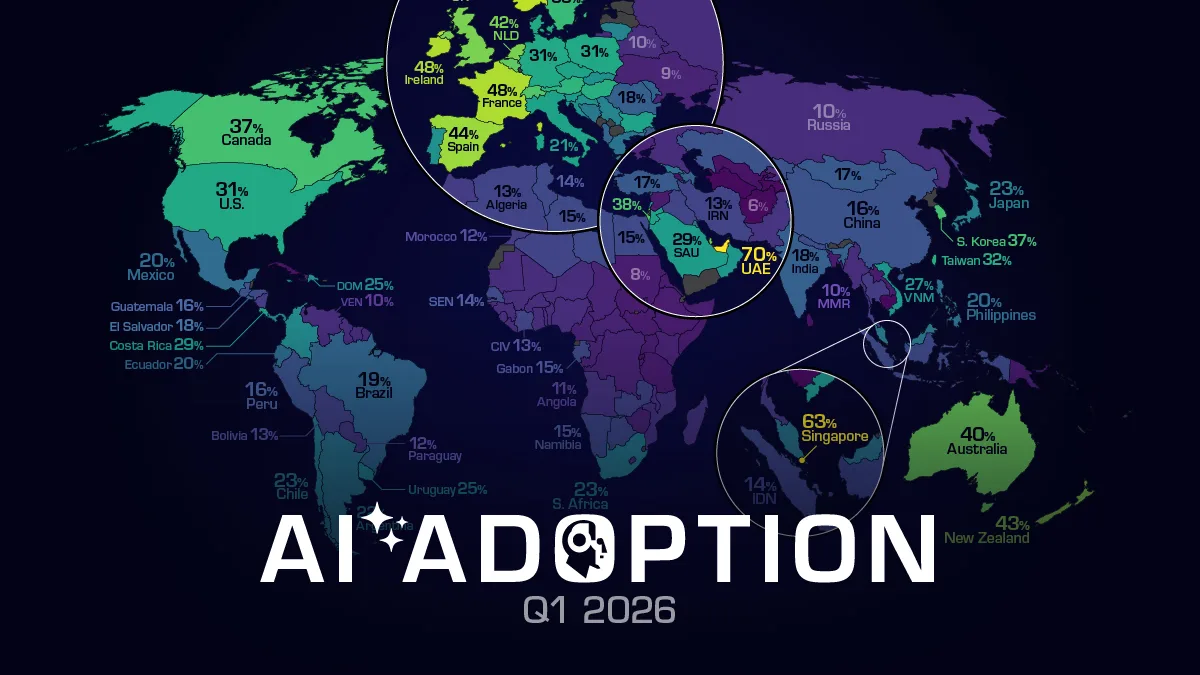
Mapped: AI Adoption by Country in 2026
See visuals like this from many other data creators on our Voronoi app. Download it for free on iOS or Android and discover incredible data-driven charts from a variety of trusted sources.
Key Takeaways
- The UAE leads global AI usage, with 70% of working-age adults regularly using AI tools.
- Singapore ranks second at 63%, while the U.S. trails more than 20 countries despite leading AI development.
- Europe accounts for 11 of the world’s top 20 AI adoption markets.
AI may be dominated by American companies, but the countries using it the most are much smaller economies.
This map shows the share of each country’s working-age population using AI tools in Q1 2026, based on Microsoft estimates of users engaging with AI for at least 90 minutes per month. Globally, 17.8% of working-age adults now use AI regularly.
The UAE leads the world by a wide margin, with more than 70% adoption, followed by Singapore at 63%. Meanwhile, the U.S. ranks outside the global top 20 despite being home to many of the world’s leading AI firms.
Europe also emerges as a major AI adoption hub, with countries including Norway, Ireland, France, Spain, and the Netherlands all posting usage rates above 40%.
Smaller Economies Are Winning the AI Race
The rankings suggest that building the world’s leading AI models does not automatically translate into widespread everyday usage.
Smaller economies like the UAE and Singapore have moved faster to integrate AI across business, education, and government services through centralized digital strategies and heavy infrastructure investment.
| Rank (2026) | Country | Q1 2026 | H1 2025 |
|---|---|---|---|
| 1 | 🇦🇪 UAE | 70.1% | 59.4% |
| 2 | 🇸🇬 Singapore | 63.4% | 58.6% |
| 3 | 🇳🇴 Norway | 48.6% | 45.3% |
| 4 | 🇮🇪 Ireland | 48.4% | 41.7% |
| 5 | 🇫🇷 France | 47.8% | 40.9% |
| 6 | 🇪🇸 Spain | 44.2% | 39.7% |
| 7 | 🇳🇿 New Zealand | 43.0% | 37.6% |
| 8 | 🇬🇧 UK | 42.2% | 36.4% |
| 9 | 🇳🇱 Netherlands | 42.1% | 36.3% |
| 10 | 🇶🇦 Qatar | 41.8% | 35.7% |
| 11 | 🇦🇺 Australia | 39.5% | 34.5% |
| 12 | 🇧🇪 Belgium | 39.0% | 33.5% |
| 13 | 🇮🇱 Israel | 38.1% | 33.9% |
| 14 | 🇨🇭 Switzerland | 37.8% | 32.4% |
| 15 | 🇨🇦 Canada | 37.3% | 33.5% |
| 16 | 🇰🇷 South Korea | 37.1% | 25.9% |
| 17 | 🇸🇪 Sweden | 36.1% | 31.2% |
| 18 | 🇦🇹 Austria | 34.1% | 29.1% |
| 19 | 🇭🇺 Hungary | 32.2% | 27.9% |
| 20 | 🇹🇼 Taiwan | 31.8% | 26.4% |
| 21 | 🇺🇸 U.S. | 31.3% | 26.3% |
| 22 | 🇩🇰 Denmark | 31.2% | 26.6% |
| 23 | 🇩🇪 Germany | 31.1% | 26.5% |
| 24 | 🇵🇱 Poland | 31.0% | 26.4% |
| 25 | 🇮🇹 Italy | 30.2% | 25.8% |
| 26 | 🇨🇿 Czechia | 30.1% | 26.0% |
| 27 | 🇯🇴 Jordan | 29.7% | 25.4% |
| 28 | 🇧🇬 Bulgaria | 29.7% | 25.4% |
| 29 | 🇫🇮 Finland | 29.5% | 25.6% |
| 30 | 🇸🇦 Saudi Arabia | 29.4% | 23.7% |
| 31 | 🇸🇮 Slovenia | 29.0% | 24.6% |
| 32 | 🇨🇷 Costa Rica | 28.5% | 25.1% |
| 33 | 🇱🇧 Lebanon | 27.3% | 24.8% |
| 34 | 🇻🇳 Vietnam | 26.5% | 21.2% |
| 35 | 🇴🇲 Oman | 26.5% | 22.6% |
| 36 | 🇵🇹 Portugal | 26.4% | 22.4% |
| 37 | 🇭🇷 Croatia | 26.1% | 21.8% |
| 38 | 🇸🇰 Slovakia | 26.1% | 22.1% |
| 39 | 🇩🇴 Dominican Republic | 24.8% | 22.0% |
| 40 | 🇺🇾 Uruguay | 24.6% | 20.9% |
| 41 | 🇨🇴 Colombia | 24.5% | 20.4% |
| 42 | 🇱🇹 Lithuania | 24.3% | 21.0% |
| 43 | 🇷🇸 Serbia | 24.1% | 19.7% |
| 44 | 🇯🇲 Jamaica | 24.0% | 22.2% |
| 45 | 🇵🇦 Panama | 23.3% | 20.3% |
| 46 | 🇿🇦 South Africa | 23.1% | 19.3% |
| 47 | 🇨🇱 Chile | 22.7% | 19.6% |
| 48 | 🇯🇵 Japan | 22.5% | 16.7% |
| 49 | 🇧🇦 Bosnia And Herzegovina | 22.1% | 18.2% |
| 50 | 🇦🇷 Argentina | 21.9% | 17.8% |
| 51 | 🇲🇾 Malaysia | 21.8% | 18.3% |
| 52 | 🇰🇼 Kuwait | 21.1% | 17.7% |
| 53 | 🇬🇷 Greece | 20.8% | 17.7% |
| 54 | 🇬🇪 Georgia | 20.5% | 17.3% |
| 55 | 🇲🇽 Mexico | 20.1% | 16.7% |
| 56 | 🇵🇭 Philippines | 20.1% | 17.1% |
| 57 | 🇪🇨 Ecuador | 19.5% | 17.0% |
| 58 | 🇧🇷 Brazil | 19.1% | 15.6% |
| 59 | 🇦🇱 Albania | 18.5% | 15.8% |
| 60 | 🇲🇩 Moldova | 18.5% | 16.6% |
| 61 | 🇸🇻 El Salvador | 18.3% | 14.6% |
| 62 | 🇦🇿 Azerbaijan | 17.7% | 14.2% |
| 63 | 🇮🇳 India | 17.6% | 14.2% |
| 64 | 🇷🇴 Romania | 17.5% | 15.3% |
| 65 | 🇹🇷 Turkey | 17.4% | 13.4% |
| 66 | 🇲🇳 Mongolia | 16.7% | 12.6% |
| 67 | 🇬🇹 Guatemala | 16.4% | 13.7% |
| 68 | 🇵🇪 Peru | 16.4% | 13.4% |
| 69 | 🇨🇳 China | 16.4% | 15.4% |
| 70 | 🇰🇿 Kazakhstan | 15.9% | 12.7% |
| 71 | 🇳🇦 Namibia | 15.1% | 13.0% |
| 72 | 🇬🇦 Gabon | 15.0% | 12.3% |
| 73 | 🇱🇾 Libya | 15.0% | 12.7% |
| 74 | 🇪🇬 Egypt | 14.8% | 12.5% |
| 75 | 🇧🇼 Botswana | 14.8% | 12.8% |
| 76 | 🇳🇵 Nepal | 14.2% | 12.3% |
| 77 | 🇮🇩 Indonesia | 14.1% | 11.7% |
| 78 | 🇭🇳 Honduras | 14.0% | 12.4% |
| 79 | 🇸🇳 Senegal | 13.9% | 12.4% |
| 80 | 🇹🇳 Tunisia | 13.5% | 12.3% |
| 81 | 🇩🇿 Algeria | 13.2% | 11.3% |
| 82 | 🇿🇲 Zambia | 13.1% | 11.7% |
| 83 | 🇨🇮 Cote D'Ivoire | 13.1% | 10.8% |
| 84 | 🇧🇴 Bolivia | 12.7% | 10.9% |
| 85 | 🇮🇷 Iran | 12.6% | 9.6% |
| 86 | 🇮🇶 Iraq | 12.5% | 10.3% |
| 87 | 🇹🇭 Thailand | 12.4% | 9.1% |
| 88 | 🇵🇾 Paraguay | 12.2% | 10.1% |
| 89 | 🇳🇮 Nicaragua | 11.8% | 10.0% |
| 90 | 🇲🇦 Morocco | 11.7% | 10.5% |
| 91 | 🇬🇲 Gambia | 11.4% | 10.6% |
| 92 | 🇵🇰 Pakistan | 11.4% | 9.7% |
| 93 | 🇦🇴 Angola | 10.9% | 8.9% |
| 94 | 🇲🇬 Madagascar | 10.9% | 8.9% |
| 95 | 🇲🇼 Malawi | 10.9% | 8.9% |
| 96 | 🇲🇿 Mozambique | 10.9% | 8.9% |
| 97 | 🇬🇫 French Guiana | 10.3% | 8.3% |
| 98 | 🇬🇾 Guyana | 10.3% | 8.3% |
| 99 | 🇸🇷 Suriname | 10.3% | 8.3% |
| 100 | 🇻🇪 Venezuela | 10.3% | 8.3% |
| 101 | 🇧🇯 Benin | 10.1% | 8.7% |
| 102 | 🇧🇫 Burkina Faso | 10.1% | 8.7% |
| 103 | 🇬🇭 Ghana | 10.1% | 8.7% |
| 104 | 🇬🇳 Guinea | 10.1% | 8.7% |
| 105 | 🇬🇼 Guinea-Bissau | 10.1% | 8.7% |
| 106 | 🇱🇷 Liberia | 10.1% | 8.7% |
| 107 | 🇲🇱 Mali | 10.1% | 8.7% |
| 108 | 🇲🇷 Mauritania | 10.1% | 8.7% |
| 109 | 🇳🇪 Niger | 10.1% | 8.7% |
| 110 | 🇳🇬 Nigeria | 10.1% | 8.7% |
| 111 | 🇸🇱 Sierra Leone | 10.1% | 8.7% |
| 112 | 🇲🇲 Myanmar | 10.0% | 8.4% |
| 113 | 🇱🇸 Lesotho | 9.8% | 8.8% |
| 114 | 🇧🇾 Belarus | 9.6% | 7.6% |
| 115 | 🇰🇬 Kyrgyzstan | 9.5% | 7.6% |
| 116 | 🇷🇺 Russia | 9.5% | 7.6% |
| 117 | 🇺🇦 Ukraine | 9.4% | 9.1% |
| 118 | 🇰🇪 Kenya | 8.7% | 7.8% |
| 119 | 🇨🇲 Cameroon | 8.7% | 7.0% |
| 120 | 🇨🇫 Central African Republic | 8.7% | 7.0% |
| 121 | 🇹🇩 Chad | 8.7% | 7.0% |
| 122 | 🇨🇬 Congo | 8.7% | 7.0% |
| 123 | 🇨🇩 Democratic Republic Of The Congo | 8.7% | 7.0% |
| 124 | 🇿🇼 Zimbabwe | 8.5% | 6.9% |
| 125 | 🇭🇹 Haiti | 8.5% | 7.1% |
| 126 | 🇱🇦 Laos | 7.8% | 6.0% |
| 127 | 🇧🇩 Bangladesh | 7.8% | 6.5% |
| 128 | 🇵🇬 Papua New Guinea | 7.7% | 7.2% |
| 129 | 🇧🇮 Burundi | 7.6% | 6.4% |
| 130 | 🇪🇷 Eritrea | 7.6% | 6.4% |
| 131 | 🇪🇹 Ethiopia | 7.6% | 6.4% |
| 132 | 🇸🇴 Somalia | 7.6% | 6.4% |
| 133 | 🇸🇸 South Sudan | 7.6% | 6.4% |
| 134 | 🇸🇩 Sudan | 7.6% | 6.4% |
| 135 | 🇹🇿 Tanzania | 7.6% | 6.4% |
| 136 | 🇺🇬 Uganda | 7.6% | 6.4% |
| 137 | 🇸🇾 Syria | 7.5% | 6.7% |
| 138 | 🇦🇲 Armenia | 7.4% | 6.2% |
| 139 | 🇱🇰 Sri Lanka | 7.3% | 6.2% |
| 140 | 🇷🇼 Rwanda | 7.2% | 6.0% |
| 141 | 🇺🇿 Uzbekistan | 7.2% | 5.7% |
| 142 | 🇨🇺 Cuba | 6.7% | 5.7% |
| 143 | 🇦🇫 Afghanistan | 6.1% | 5.1% |
| 144 | 🇹🇯 Tajikistan | 6.1% | 5.1% |
| 145 | 🇹🇲 Turkmenistan | 6.1% | 5.1% |
| 146 | 🇰🇭 Cambodia | 5.7% | 4.6% |
Europe’s strong performance also reflects widespread enterprise digitization, advanced broadband infrastructure, and highly digital workforces.
By contrast, many emerging economies remain in the early stages of adoption, creating a widening global AI gap that could reshape productivity and economic competitiveness over the next decade.
America Leads AI Development, Not Usage
At 31.3%, the U.S. trails 20 other countries in AI adoption despite leading the world in AI investment and infrastructure.
One reason is scale. Rolling out AI tools across a massive workforce is far more difficult than in smaller, digitally centralized economies like Singapore or the UAE. But the rankings also suggest that building the world’s best AI models does not automatically translate into widespread everyday usage.
The data also highlights a growing divide between building AI and actually using it. While America dominates AI model development, chip design, and venture funding, several smaller economies are integrating AI into everyday work at a faster pace.
AI adoption is also highly uneven across the country. Regions with dense tech ecosystems and high concentrations of digital talent are seeing significantly stronger usage rates than less digitized states. One separate study found that 22.4% of workers in Washington state use AI, compared with just 13.1% in South Dakota.
Asia Is Becoming the Fastest-Growing AI Region
Asia already accounts for 10 of the world’s 15 fastest-growing AI markets, according to Microsoft’s data.
AI usage in South Korea increased 43.2% between the first half of 2025 and Q1 2026, the largest increase globally. Thailand (36.2%), Japan (34.1%), and Mongolia (32.2%) are also seeing rapid adoption. By comparison, U.S. growth increased 19% over the period.
The surge also reflects major improvements in non-English AI performance, making AI tools far more useful across Asian markets over the past year. The region is also investing heavily in digital infrastructure.
China remains relatively low at 16%, but its scale means even modest increases in adoption could rapidly add hundreds of millions of new AI users. Like the U.S., it plays a leading role in AI model performance, particularly in open-source models, yet actual adoption remains lower than many regional peers.
AI Adoption Could Deepen the Next Economic Divide
The map highlights a growing global split between countries rapidly integrating AI and those still lagging behind.
Higher-adoption economies tend to share several traits: strong internet infrastructure, service-heavy economies, high digital literacy, and significant investment in cloud computing and AI education.
Meanwhile, lower-income regions across Africa and parts of South Asia continue to face barriers including internet access, device affordability, and limited enterprise AI integration.
As AI becomes more embedded in everyday work, adoption gaps could increasingly shape which countries gain the biggest productivity and economic advantages over the next decade, similar to how internet adoption reshaped global competitiveness in the early digital era.
Learn More on the Voronoi App
To learn more about this topic, check out this graphic on memory chip makers by market cap.
-
 Economy2 weeks ago
Ranked: The 30 Highest-Paying Jobs in America
-
Maps2 weeks ago
Mapped: America’s Most-Spoken Languages After English and Spanish
-
Politics1 week ago
Ranked: The World’s Most & Least Free Countries
-
Environment2 weeks ago
Ranked: Countries With the Highest Water Use Per Person
-
Economy1 week ago
Ranked: The World’s Biggest Economies by 2031
-
population2 weeks ago
The Fertility Rate of Every Country in the World
-
Energy2 days ago
Ranked: Who Controls the World’s Uranium Supply?
-
Maps2 weeks ago
Mapped: America’s Best Companies by Home State


