
Umbriel Moon Facts
By : John Whitworth / Updated : Jul 16th, 2026 23:49

Contents
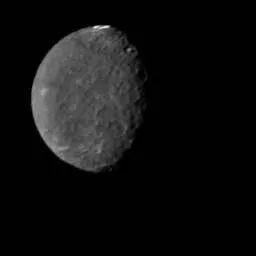
Umbriel is one of the 27moons discovered orbiting the planet Uranus. Umbriel was discovered in 1851 by W. Lassell.
Umbriel's mass is estimated/calculated at 1,221,414,772,974,210,000,000 kg. Its density has been calculated at being 1.459 g/cm^3. Umbriel volume is 837,313,109.00 (km^3). Umbriel's equatorial radius is 585.00km. The escape velocity of Umbriel is 1,901 km/h. The escape velocity is the speed an object needs to be travelling in order to break free from the objects gravity. The larger an object is, the more velocity (speed) is needed to break free from the object.
The mass of the object is calculated at being 1,221,414,772,974,210,000,000 kg (10^15). The equatorial circumference of Umbriel is 3673.8 km. The surface area of Umbriel is 4,296,116.52 Km^2. The surface gravity of the Umbriel is 0.238 m/s². For comparison, the Earth's surface gravity is 9.807 m/s². The larger an object is, the stronger the surface gravity is.The Mean Orbit Velocity (M.O.V.) is the speed at which it orbits is 16804.60 km/h. The average distance of the object from its parent is 266000.00km.
Umbriel Mythology
Whilst most of the moons in are named after Greek or Roman mythological characters, the moons of Uranus are the exception. The practice of naming after myths hadn't just established when Umbriel and four other Uranian moons were discovered. The moons of Uranus are named after characters from William Shakespeare or from Alexander Pope's poem 'Rape of the Lock'. The term Rape doesn't refer to the sexual crime but means snatch, grab, or carry off.
Umbriel comes from the poem rather than from William Shakespeare. The name comes from Umbra meaning shadow. The name is fitting because it is the darkest of the moons of Uranus.
Orbital Details
Umbriel orbital period, i.e. the period it takes to complete an orbit round Uranus is 4.14418 days. The figure is also known as the sidereel period. The figure comes from N.A.S.A.. The orbital inclination of Umbriel, the angle at which Umbriel orbits to the orbital plane, is 0.13 degrees. The orbital eccentricity is 0.0039 of Umbriel, the degree at which Umbriel orbits close to a circular (0) orbit as opposed to an elliptical (1). The semi-major axis of the orbit is 266 10^3Km, which is the furthest point from the centre to the edge of an elliptical point.
Facts and Figures
| Year of Discovery | 1851 |
| Discoverer | W. Lassell |
| Type | Moon |
| Mass | 1,221,414,772,974,210,000,000 kg |
| Density (g/cm^3) | 1.459 |
| Volume (km^3) | 837313109 |
| Orbital Direction | Prograde, same as the parents direction |
| Radius (Size) | 585.00 km |
| Equatorial Radius (km) | 585.00 |
| Escape Velocity (km/h) | 1,901 |
| Mass | 1,221,414,772,974,210,000,000 kg (10^15) |
| Equatorial Circumference (km) | 3673.8 |
| Surface Area (km^2) | 4,296,116.52 |
| Surface Gravity (m/s²) | 0.238 |
| Mean Orbit Velocity (km/h) | 16804.60 |
| Average Orbit Distance (km) | 266000.00 |
| Orbital Period (days) | 4.14418 |
| Orbital Inclination | 0.13° |
| Orbital Eccentricity | 0.0039 |
| Semi-Major Axis (10^3 km) | 266 |
| Source(s) | N.A.S.A. Solar System |
| N.S.S.D.C. |

