
Leonids Meteor Shower
By : John Whitworth / Updated : Jul 16th, 2026 23:49
Contents
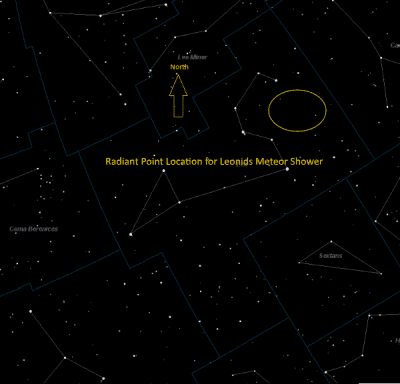
The Leonids Meteor Shower radiate point east of Adhafera , just around about where the Lion's Head is. It is a heavy meteor shower compared to other meteor showers such as Piscis Austrinids.
The comet associated with the Meteor Shower is a short term comet which orbits the Sun every 33 years. Some comets journey can take thousands of years to complete an orbit which is why Tempel-Tuttle is referred to as a short term one. When the comet comes close to The Sun, the meteor shower can be quite spectacular such as in 1833.
How to find the Leonids Meteor Shower
Northern Hemisphere
The Leonids are not visible in the night sky until about 11 p.m. You will need to look in a North-Easterly direction. If you can locate Ursa Major, look down from there and you should see it. The meteor shower should be visible until it becomes light.
Southern Hemisphere
The Leonids are not visible until 2 -3 o'clock in the morning in a near north-easterly direction. They will continue to rise into the sky until you will not be able to see them due to the light of the Sun causing them to be blocked out.
The Solar Longitude (Abbrev: S.L., λ ☉) is 235 degrees, this value is the the date of maximum activity. It is measured as a degree with zero degree indicating spring equinox (roughly March 21st/22nd). 90 is the Summer Solstice, 180 is the Autumn Equinox and 270 is the Winter Solstice. This degree is independent of the calendar. AMS.
Leonids Zenith Hourly Rate
The Zenith Hourly Rate or how many you expect to see during the hour is 100. The ZHR can radically increase if the comet or associated object is close by. The speed/velocity of the Leonids Meteor Shower particles is 70 km/s.
The population index of the Leonids meteor shower is 3. The population index refers to the magnitude distribution of the meteorites, the smaller the index, the brighter the meteors are, the higher, the dimmer the meteors are. For this particular meteor shower, bright meteors are more frequent.

