Here are innovative solutions for your biggest challenges in Electronics and Software - Power Supplies and Management, Board-Level Electronics, Components and Batteries. You’ll find applications essential to military, aviation, medical and automotive design engineering.
Is commercial success of autonomous trucks closer than we think?...Caterpillar launches an AI assistant...lifelike simulation automates middle‐mile autonomy. Read these stories and more in...
Understanding and mitigating multipaction is critical for ensuring reliability and performance in high-power RF and microwave systems. In this white...
As AI workloads move deeper into edge environments, embedded systems face faster-changing power demands, concentrated thermal loads, and tighter SWaP constraints. In this Inside Story,...
Scientists at Heriot‑Watt University have demonstrated in a world-first, that light can be used to control every aspect of how electromagnetic waves...
Reliable power integrity is essential in AI data centers where massive current demands and fast transients push power delivery networks to their limits. Accurately measuring these...
Researchers in the School of Engineering at Tufts University have developed a proof-of-concept for efficient AI systems that could use 100 times less energy than current ones while at the same time provide more accurate results on tasks.
Developed in part by NASA, the Search and Rescue Satellite-Aided Tracking (SARSAT) technology carried by multiple satellites in middle- and low-Earth orbit, is now helping save lives in sea and on land.
ARIES, the Advanced Research on Integrated Energy Systems platform, can simulate the electrical brains behind a single device or an entire country. Read on to learn more.
Defense startup unveils autonomous fighter jet…advanced radar boosts Ukrainian air defense…NASA technology powers fire‐fighting drones. Read all about it in this compendium of articles from...
See the product of the month: Pickering Interfaces' Test System Architect, a free online graphical toolset designed to simplify signal path design for electronic test systems.
As interest in wearable technology has surged, research into creating energy-storage devices that can be woven into textiles has also increased. Researchers at North Carolina State University have now identified a “sweet spot” at which the length of a threadlike energy storage technology called a “yarn-shaped supercapacitor” yields the highest and most efficient flow of energy per unit length. Read on to learn more.
A research team led by Dr. Sunghoon Hur of the Electronic and Hybrid Materials Research Center at the Korea Institute of Science and Technology and Professor Hyun-Cheol Song of Korea University has developed a biocompatible ultrasonic receiver that maintains its performance even when bent. Read on to learn more.
Researchers from the University of Tokyo, as part of a multi-institution team, have created an electromagnetic wave absorber for waves between 0.1–1 terahertz (THz). This greatly expands the range of the terahertz frequency which could be commercially used in the future. Read on to learn more.
A research team innovatively proposed the “Integrated Battery Large Model,” establishing the first AI-driven paradigm covering the entire lifecycle of the Li-ion battery industry, providing a novel technological path for the industry’s intelligent upgrade. Read on to learn more about the Battery Large Model system.
Replacing an outdated solution with a next-generation MES can radically improve user experience and eliminate obsolete IT languages, operating systems, and hardware platforms. It can expand functionality in a single system and keep pace with change, supporting the entire processing lifecycle. Read on to learn more.
Edge AI is beginning to incorporate compact generative approaches to support greater autonomy. This shift is accelerating the adoption of COTS edge AI accelerators as an alternative to centralized processing and legacy radiation-hardened compute architectures. Read on to learn more.
See what's new on the market, including The Imaging Source's Aptiris, USB 3.1 autofocus cameras designed for dynamic machine vision applications; Würth Elektronik's Proteus-IV and Ophelia-IV components, two new high-performance RF modules based on the latest Nordic nRF54L15-SoC semiconductor; Novotechnik U.S.'s Vert-X 13E Series of touchless rotary sensors; and much more.
A research team from Huawei’s advanced wireless labs in Canada and China has published a blueprint for a 6G core network that can generate, update, and execute its own control procedures without human intervention. Read on to learn more.
See the products of tomorrow, including a new material that can use sunlight and water to convert carbon dioxide into carbon monoxide; a novel design for solar-powered data centers that will orbit the Earth and could realistically scale to meet the growing demand for AI computing while reducing the environmental impact of data centers; and more.
The race to develop sixth-generation (6G) mobile networks is accelerating, with commercialization expected by 2030. Read on to learn how some researchers are exploring the integration of edge AI and space–ground integrated networks (SGINs) to extend AI services globally.
A team of researchers from the U.S. Department of Energy Ames National Laboratory developed a magnetocaloric heat pump that matches current vapor-compression heat pumps for weight, cost, and performance. Read on to learn more about it.
Scientists are striving to discover new semiconductor materials that could boost the efficiency of solar cells and other electronics. But the pace of innovation is bottlenecked by the speed at which researchers can manually measure important material properties. A fully autonomous robotic system developed by MIT researchers could speed things up. Read on to learn more.
A team led by Professor Yan Lu, Helmholtz-Zentrum Berlin, and Professor Arne Thomas, Technical University of Berlin, has developed a material that enhances the capacity and stability of lithium-sulfur batteries. Read on to learn more.
See the new products, including EBE Elektro Bau Elemente GmbH's capacitive level sensor technology based on corTEC® technology for applications where conventional level sensors reach their limits; Abaco Systems' VP241, a SOSA-aligned 3U VPX FPGA carrier card designed to deliver unmatched flexibility for next-generation embedded computing applications; Emerson's Rosemount™ QX1000 Continuous Gas Analyzer; and more.
A University of Houston engineer has developed a method to detect possible damage in concealed cold-formed steel construction framing materials hidden behind walls, without having to tear the walls open. Read on to learn more.
Wide-scale applications for Micro-Electromechanical Systems (MEMS) became practical in the 1980s when they started being fabricated with the same silicon wafer processes as semiconductor chips. Once they could be mass produced, they found a major market in automobile safety systems as inertial sensors for airbag deployment. Then came the introduction of smart phones in the late 2000s. Read on to learn where they're heading.
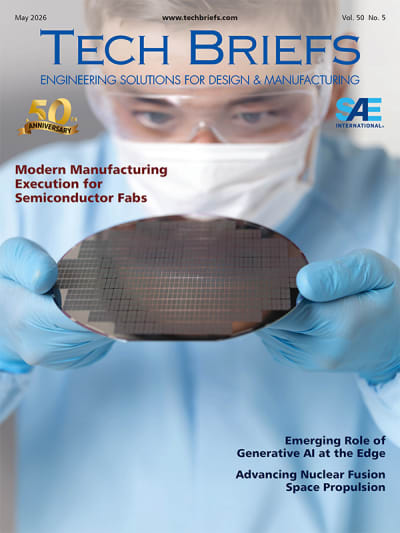


 Blog: AR/AI
 Blog: Design
 Quiz: Manned Systems
 Podcasts: Electronics & Computers
 Application Briefs: Connectivity
 INSIDER: Photonics/Optics
 Summits: Power
 Webinars: Power
 Webinars: Software
 Webinars: Electronics & Computers
 Webinars: Test & Measurement
 Editorial Webinars: Defense


