Skip to Main Content

Caltech Library News

Showing 10 of 202 Results

06/26/2026
Tom Morrell
No Subjects

Caltech Library is pleased to announce expanded storage allocations for the CaltechDATA repository, made possible through a National Science Foundation Campus Cyberinfrastructure grant. All researchers at Caltech can now upload up to 1 TB of data for free. CaltechDATA is the institutional data and software repository for Caltech and can host research data files that are ready to be shared with the scientific and broader communities. 


Our expanded storage allocations are possible due to the Open Storage Network, which is a shared approach for managing research data storage. We have also been able to collaborate on improvements that support hosting large files in the InvenioRDM repository platform, which powers CaltechDATA.


CaltechDATA can host a wide variety of datasets, from individual files to complex curated resources such as the Total Carbon Column Observing Network. CaltechDATA already hosts some large data collections, including the Caltech High Throughput Experimentation (HTE) Materials Experiment and Analysis Database and the Caltech Tomography Archive.  We are able to host other large data collections for a $200 / TB one-time upload fee. Please contact us at data@caltech.edu if you have a large data collection you’d like to share.


This blog post is based upon work supported by the National Science Foundation under Grant 2322420. Any opinions, findings, and conclusions or recommendations expressed in this blog post are those of the author and do not necessarily reflect the views of the National Science Foundation.

06/25/2026
Adriana Popescu
No Subjects
Adriana Popescu

With the summer solstice now behind us, I cannot but take a few minutes to reflect on the past academic year and my first year as University Librarian at Caltech. For me, this was the year of firsts: meeting faculty, students, and staff; first presentation to the Faculty Board; first time hosting the 3MT competition; first all-library staff retreat; first Caltech commencement. Beyond the excitement of the new and of discovering nuances of Caltech’s ethos, I learned so much from all these first experiences about what makes Caltech, Caltech; and I savored each moment. 

The past year marked several firsts (and hopefully not lasts) for Caltech Library as well. We had our first Giving Day on April 27, when alumni, staff, students, and faculty recognized our role and our contributions with gifts that will be put to good use. We are grateful for the support and aim to grow the seeds planted at Giving Day into a sustained fundraising effort. 

This was also the year in which Caltech launched its two-year Integrated Core, focusing on energy, energy policy, and sustainability, as a pilot alternative to the standard core curriculum. The Archives has been central to the courses’ interdisciplinary exploration of the history of water and power in the LA basin and to helping students discover Caltech’s vital, multifaceted role in building the energy infrastructure that powered Los Angeles. 

With the recent profusion of head-spinning changes in federal guidelines and workflows for grant applications and reporting, the library’s Research Services team has been challenged to respond quickly and knowledgably to inquiries stemming from the sometimes-confusing new policies and directives issued by government agencies. And each inquiry tackled was a first of its kind. 

The year has also been marked by ongoing discussions and debates around the promise and potential pitfalls of GenAI and what it all means for our work.  Work in libraries has been shaped by technological innovation for centuries, so what we see happening now in academic libraries and higher education is not new to librarians. Hence, we have embarked on exploring and testing the promise of GenAI in activities and projects unique to Caltech. Thanks to a team effort encompassing the Digital Library developers and the Archives staff, the library now has a working prototype for using AI tools in an archives processing workflow for generating metadata from digitized content and a workflow for integrating computer files into an archival hierarchy defined by paper files.  This is quite a notable development and a first step in harnessing the potential of AI to help us make research content more discoverable and accessible to scholars. 

This past year the Caltech Library has leaned more than ever into the opportunities afforded us as members of the Statewide California Electronic Library Consortium (SCELC) and joined a large cohort of libraries under the SCELC umbrella in the collective effort to develop and enhance our existing open-source library management system, FOLIO. Through Our SCELC affiliation we were also able to enter into an agreement with the American Chemical Society that waives article processing fees for Caltech authors who want to publish their research openly.

Leveraging communities of practice and seeking partnerships with like-minded institutions committed to the open sharing of knowledge and expertise is allowing us to upgrade the aging infrastructure hosting the Caltech repositories. As stewards of Caltech’s knowledge, we seek opportunities and solutions that enable us to improve our platforms, services, and programs in the most efficient and fiscally responsible way. 

And while we take pride in first explorations, experimentations, and solutions to challenges, we are equally proud of the work we have consistently done over the years that has earned us recognition and appreciation from our user community.

We are proud of our readiness and ability to find and deliver in record time materials in the many formats needed for teaching and research—and to do it all with a smile and the satisfaction of knowing that we have made a difference. 

We are happy that we can still support students during finals with nourishment breaks and that we can continue to offer events such as movie nights and creative activities in the TechHub. The health and well-being of the Caltech community is important to us, and we are delighted when we partner with campus organizations that share our commitment. 

While there is not much happening in the classrooms over the summer, we know that research is always ongoing in the labs, and we are here to answer questions, provide guidance, and, when offered the opportunity, to partner.  Throughout this time, we are also laying out plans and ideas for new ways to support the Caltech community in the next academic year. 

To our graduates, we are proud to have known you and supported you, and as you take flight, remember that librarians ready to help and assist are everywhere. ChatGPT, Gemini, or Claude may be just a click away, but librarians can advise on how to engage responsibly, ethically, and effectively with artificial intelligence in your work, learning, research or communication. It is well worth it, wherever you may find yourselves, to get to know your resident librarian.

Enjoy a happy and restorative summer!
06/08/2026
Heidi Aspaturian
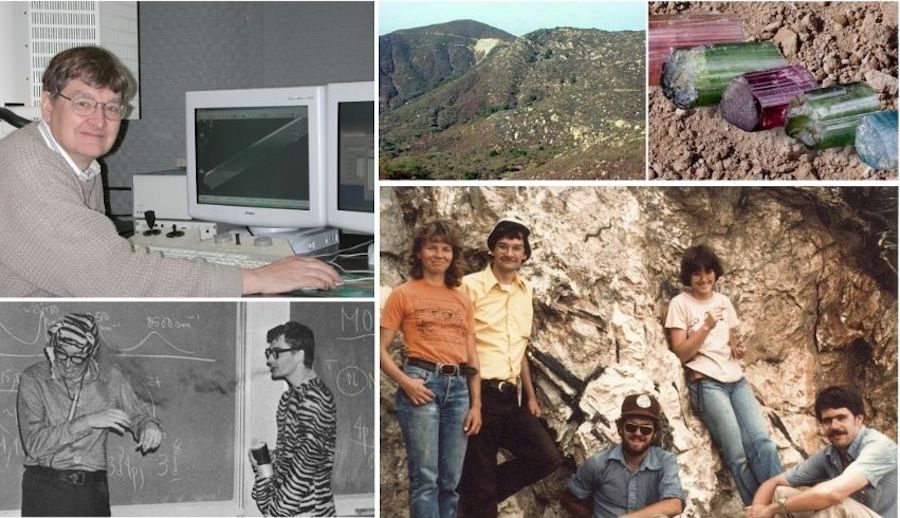
Collage of images of George Rossman and students, as well as gems and Pala Mine Site in San Diego

Professor of Mineralogy, Emeritus, George Rossman (1944–2026), whose history of having “no formal training whatsoever in geology” never stood in the way of his becoming an internationally renowned authority in the field of mineralogy, talks about his life and career in a four-part interview series.

Born and raised in Eau Claire, Wisconsin, Rossman was still in grade school when his early fascination with the rainbow array of colors he found in rocks and minerals developed into a more mature understanding that “the rocks I was picking up were part of chemistry.”  He experimented with explosives and corrosives as well as less hazardous substances at home in a makeshift laboratory, won prizes in science competitions, and earned his BS degree in chemistry and math at Wisconsin State University, where his professors encouraged him to pursue graduate study at a place “I’d never heard of” in Pasadena, California.  At Caltech, where he did thesis work in inorganic chemistry, his self-taught expertise in rock and mineral science caught the eye of the Institute’s geologists, from whom he often borrowed samples for his research. His advisor Harry Gray put him in charge of his instrumentation lab and made him his TA in a gonzo reinvention of Caltech’s introductory chemistry course that combined boisterous, high-powered instruction with showstopping demonstrations of chemical reactions. Rossman soon gained a reputation as a dynamic, inspiring teacher. He turned down multiple job offers to accept a temporary position as a Caltech instructor in mineralogy because “it sounded like fun”—a trial run that evolved into more than fifty years on the professorial faculty.

Throughout his career Rossman returned to the question that had intrigued him since childhood—what accounts of the diversity of color in gems and minerals.

Throughout his research career Rossman returned to the question that had intrigued him since childhood—what accounts for the diversity of color in gems and minerals. He drew on his training in chemistry, introducing optical and infrared spectroscopy to address these and other problems that mineralogy’s traditional reliance on crystallography “was unable to answer easily or satisfactorily.” He describes how these techniques enabled him and his students to conduct atomic-level investigations of how naturally occurring phenomena such as trace elements, radiation, and temperature changes bestow color on tourmaline, sapphire, topaz, diamond, and rose quartz, among others, and how reproducing these conditions artificially has gained traction in the gem industry. His spectroscopic methods also enabled the detection of hydrogen and water in minerals long assumed to be “dry”—a finding with significant implications for understanding hidden reservoirs of water deep within the earth—and extended to studies of lunar materials and Martian meteorites. He discusses collaborations with Caltech colleagues, gemologists, and, above all, decades of students, whose contributions he singles out for special credit. 

Other topics include his role as curator of Caltech’s gem and mineral collection, his interactions with beleaguered Ukrainian scientists, and a detective-like foray into the somewhat dubious origins of the official “rare gem” of the 2008 Summer Olympics. Field expeditions near and far, from Pala, California—a rich source of Rossman’s favorite gem, tourmaline—to gold and ametrine deposits along the Amazon, to the remote jade and ruby mines of Myanmar—add a touch of Raiders of the Lost Ark adventure to this retrospective.

05/22/2026
Tom Morrell

CaltechDATA will be closed for new uploads and record updates on Tuesday, May 26 as we conduct a major system upgrade. Please complete any uploads before Tuesday. We will send out another email once the migration is completed. The new version of CaltechDATA includes a number of improvements:

  • A new and much faster file uploader
  • A display of usage statistics on every record
  • Improved record sharing options
  • Parent DOIs for all new/modified records, which enable citation of all versions.
  • Improved previewers
  • Lots and lots of bug fixes

Thank you for using CaltechDATA, and please let us know at data@caltech.edu if you have any questions or concerns

05/13/2026
Paula Gaetos
No Subjects
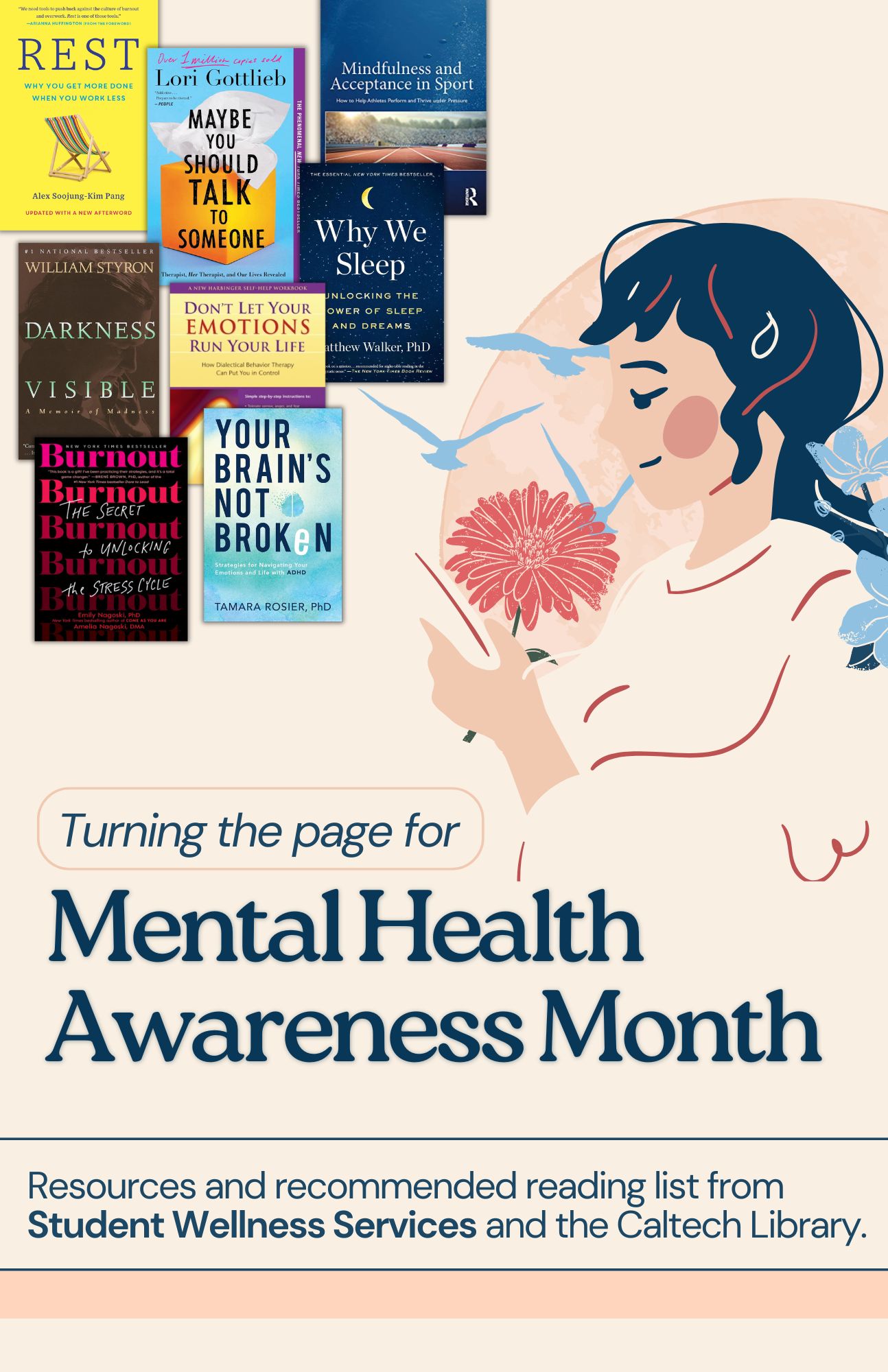
Graphic for Mental Health Awareness Month

May is Mental Health Awareness Month, established in 1949 by advocacy organization Mental Health America. This month, we reached out to our colleagues at Student Wellness Services (SWS) to share their available resources and reading recommendations to support mental and emotional health. 

Workshops, Events, and Resources from SWS

Services and events noted below are available to all eligible enrolled Caltech students and are not dependent on enrollment in any insurance plan.

14
MAY
Caltech Connect Training for Students (Joint Session)
Date: Thursday, May 14, 2026
Time: 7:00 PM PDT
Location: 269 Downs-Lauritsen
Have you been worried about a friend, student, or colleague who appears unwell or in distress, but aren't sure how to intervene? Do you feel uncomfortable engaging in a conversation about their wellbeing, or don't know how to refer to appropriate resources? Caltech Connect training is an award-winning 2-hour interactive program offered by Student Wellness Services. This training enables you to identify signs of distress, offers concrete strategies for intervention, and provides information about resources and referral options.
19
MAY
Meditation Mob
Date: Tuesday, May 19, 2026
Time: 12:00 PM PDT
Location: Hameetman Club Room 2 (Bottom Floor)
We're a drop-in mindfulness meditation group open to all Caltech students that meets every Tuesday. No previous experience is required; we offer techniques that are appropriate for everyone from newbies to more experienced meditators. There's no religious component: We offer secular practices that are, whenever possible, based in research.

Reading Recommendations 

Many of the books on the curated list below are also displayed at Sherman Fairchild Library directly shared from SWS's own clinic library. Those from the Caltech Library are available digitally through the Libby app or our LibSearch catalog. Your access.caltech credentials is your library card!

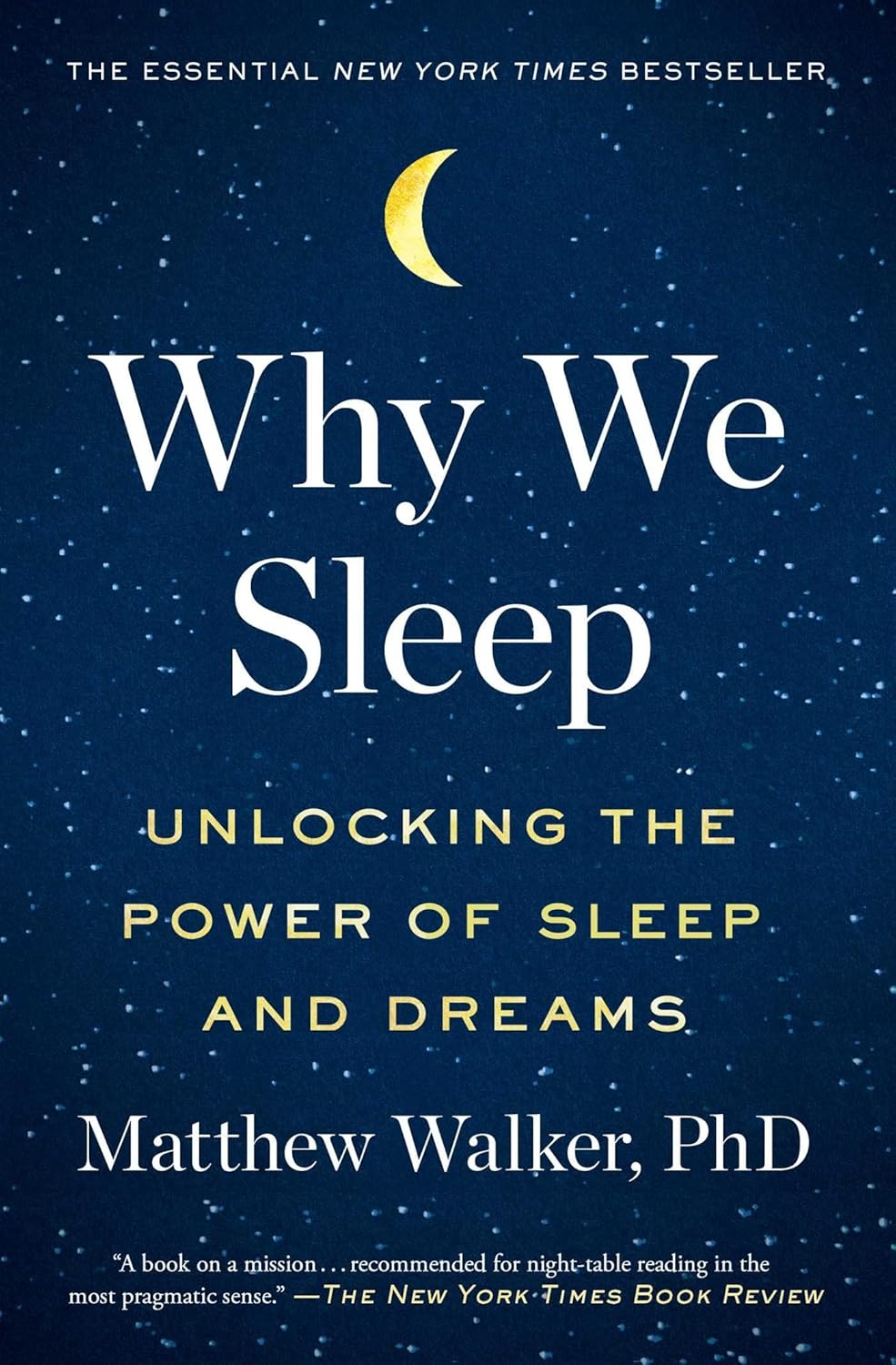
Book cover of Why We Sleep by Matthew Walker
Why We Sleep: Unlocking the Power of Sleep and Dreams
Matthew Walker
A recommendation from SWS Occupational Therapist, Grace Wong. "If I could only pick one strategy to help students with, it would be helping them get regular, quality sleep! You already know sleep is good for you - this book explains exactly why it’s so important and what to do about it."
ISBN: 9781501144325 | Call Number: QP425 .W44 2017

View Book

Book cover of Don't Let Your Emotions Run Your Life by Scott E. Spradlin
Don't Let Your Emotions Run Your Life
Scott E. Spradlin
A recommendation from Jamie Turner, LCSW from SWS. "Strong emotions serve an important purpose in our lives. They alert us to threats, trigger our competitive nature, and can be cathartic, validating and pleasant. However, strong emotions can sometimes prevent us from considering alternative perspectives, and making a decision based purely on emotion can sometimes lead to unexpected consequences. This workbook teaches DBT techniques that help us balance our emotions with other important parts of ourselves. These techniques can help maximize our ability to make the right decisions even when the stakes are high," he says.
ISBN: 9781458755957 | Call Number: Libby eBook

View Book

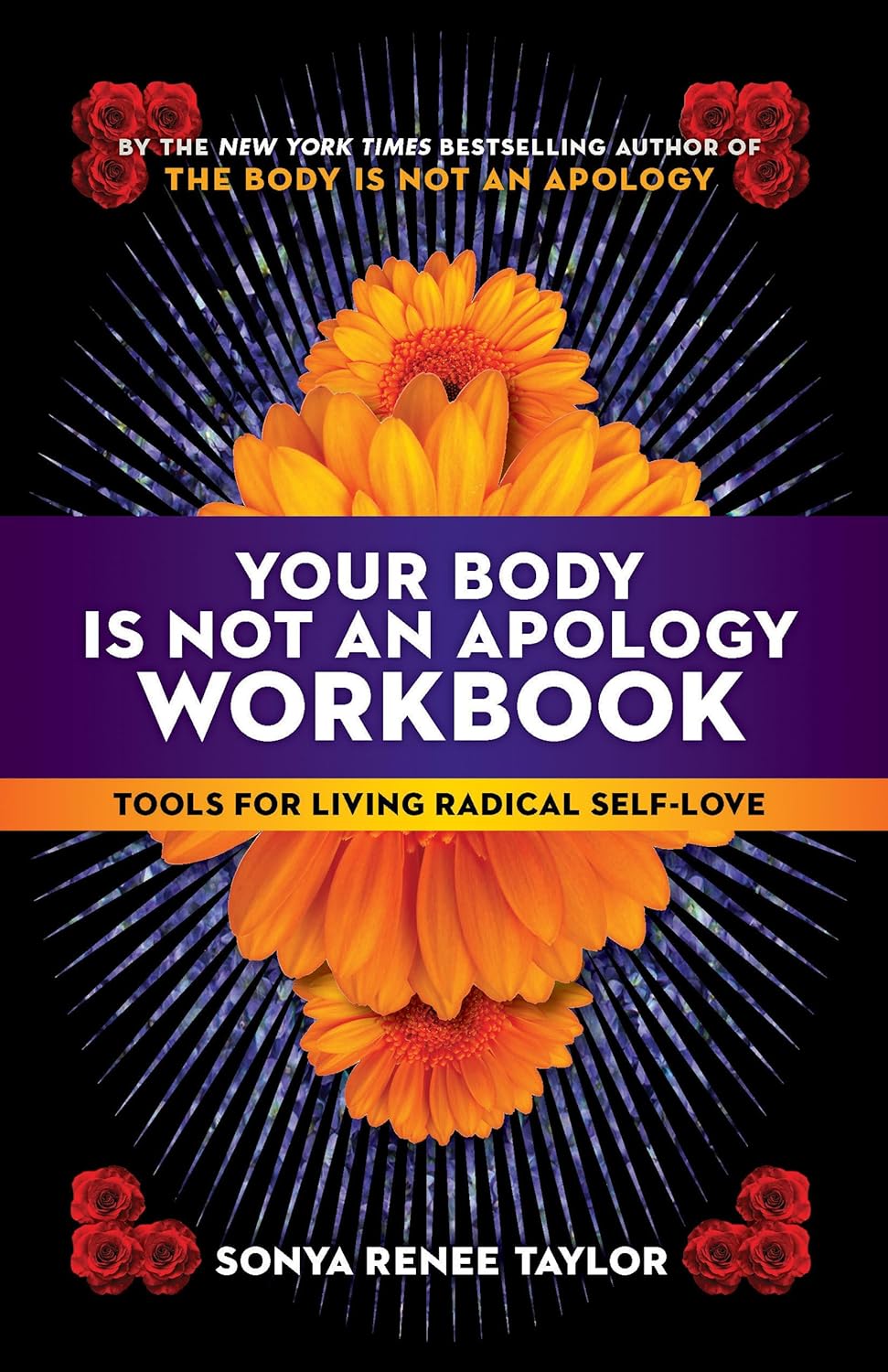
Book cover of Your Body Is Not an Apology Workbook by Sonya Renee Taylor
Your Body Is Not an Apology Workbook: Tools for Living Radical Self-Love
Sonya Renee Taylor
Recommended by Abigail Hotter, PsyD, saying, "when you’re sick of beauty standards and frustrated with feeling shame about yourself and your body. Read this to explore self-love and empowerment."
ISBN: 9781523091164

View Book

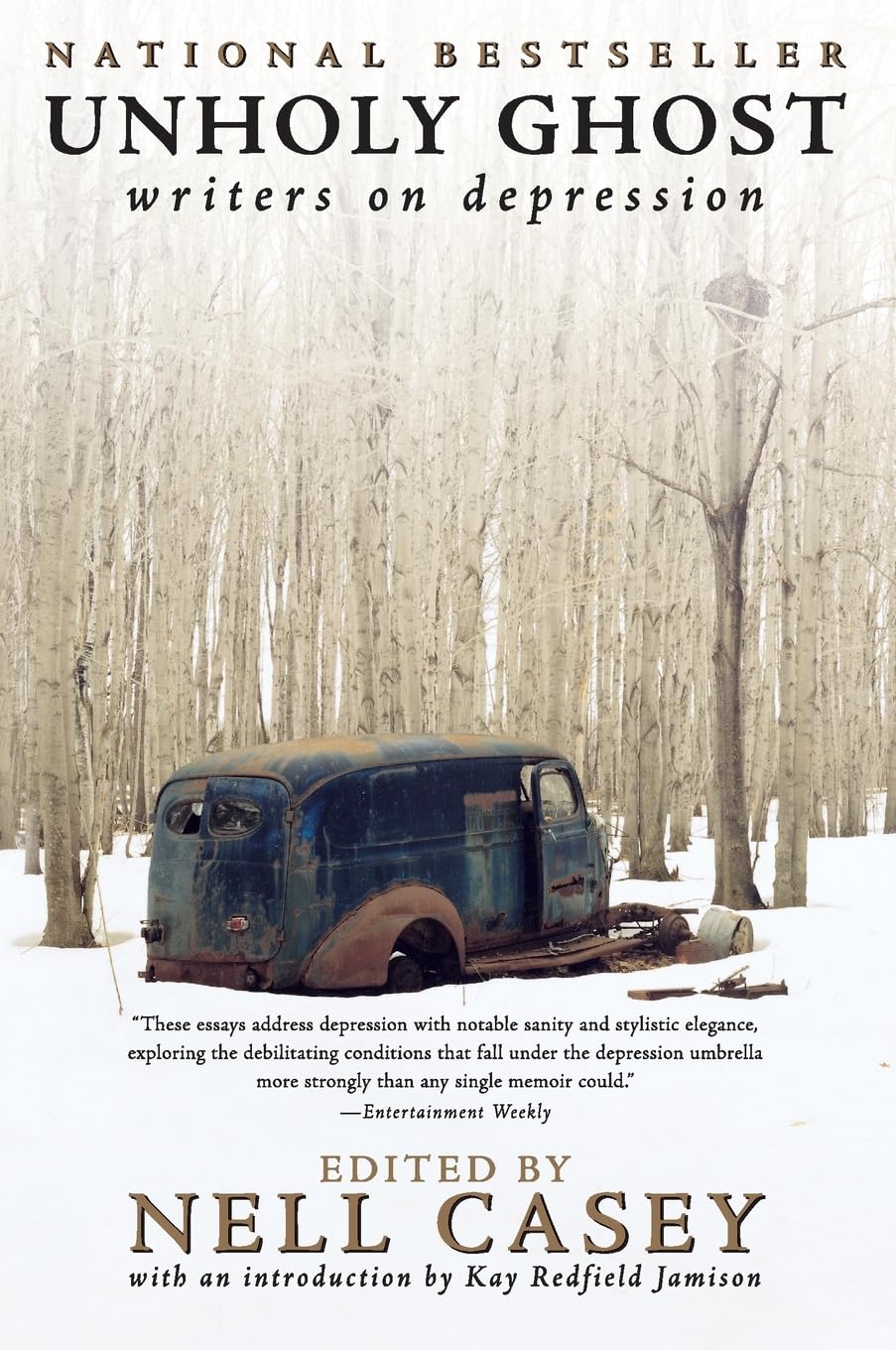
Book cover of Unholy Ghost: Writers on Depression by Nell Casey
Unholy Ghost: Writers on Depression
Nell Casey
A recommendation by SWS Senior Clinician, Lee Coleman. "The Roman poet Terence said, "I am human; nothing human is alien to me." The best literature helps us feel deeply understood, which brought me the hope that maybe my pain could be understandable too.  I chose the essays and stories in Nell Casey's Unholy Ghost because my experiences with depression were often profoundly isolating - who could ever understand this type of pain, and why would anyone want to? These stories didn't pretend to offer a quick fix for my experiences, nor did they reduce them to simple tropes.  Rather, they offered the experience of being in the company of fellow human beings who also knew this type of suffering.  I can't think of a better foundation for finding compassion for ourselves."
ISBN: 9780060007829

View Book

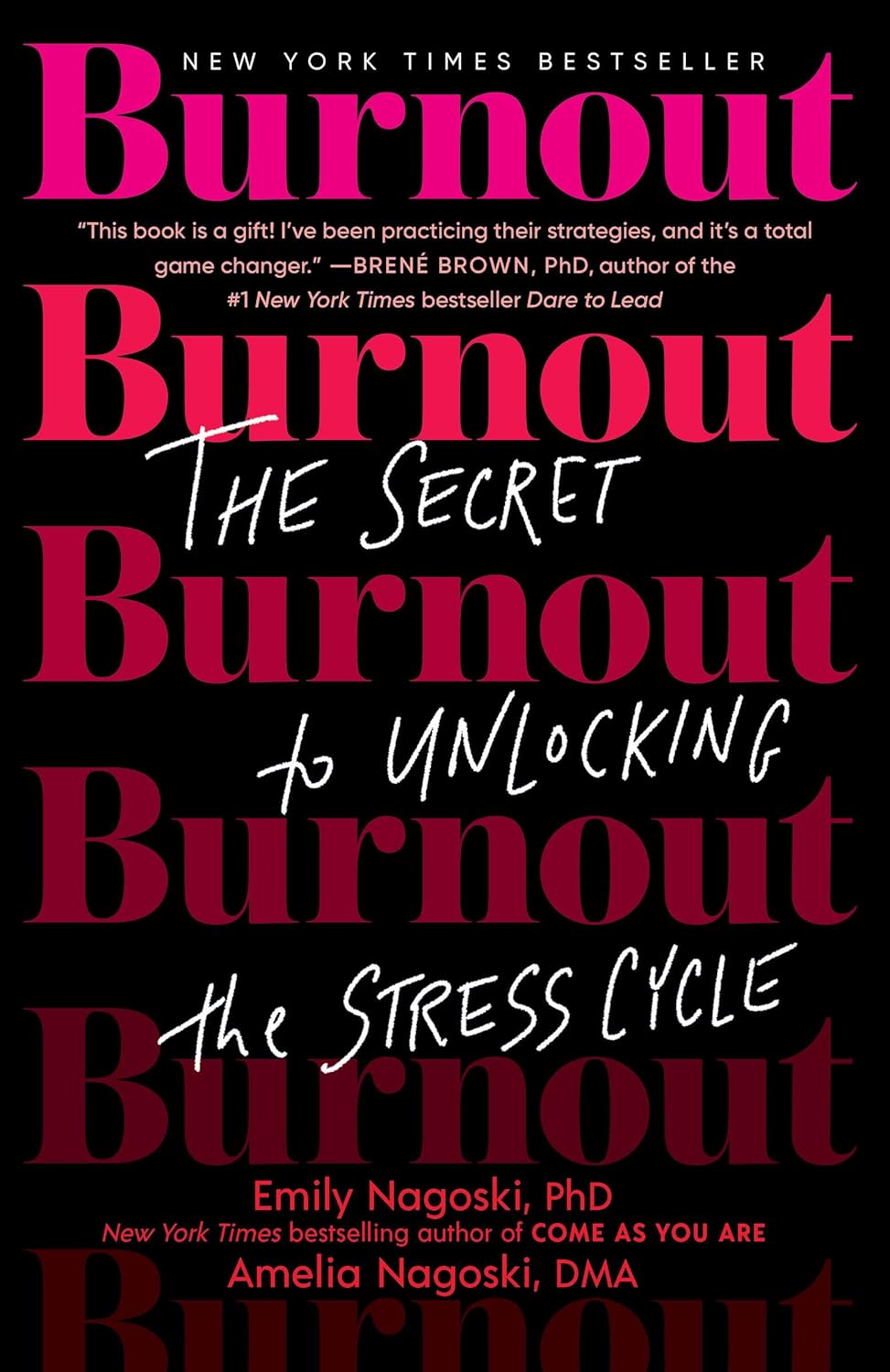
Book cover of Burnout: The Secret to Unlocking the Stress Cycle by Emily Nagoski and Amelia Nagoski
Burnout: The Secret to Unlocking the Stress Cycle
Emily Nagoski, Amelia Nagoski
With the help of eye-opening science, prescriptive advice, and helpful worksheets and exercises, all women will find something transformative in Burnout—and will be empowered to create positive change.
ISBN: 9781984817075 | Call Number: Libby eBook

View Book

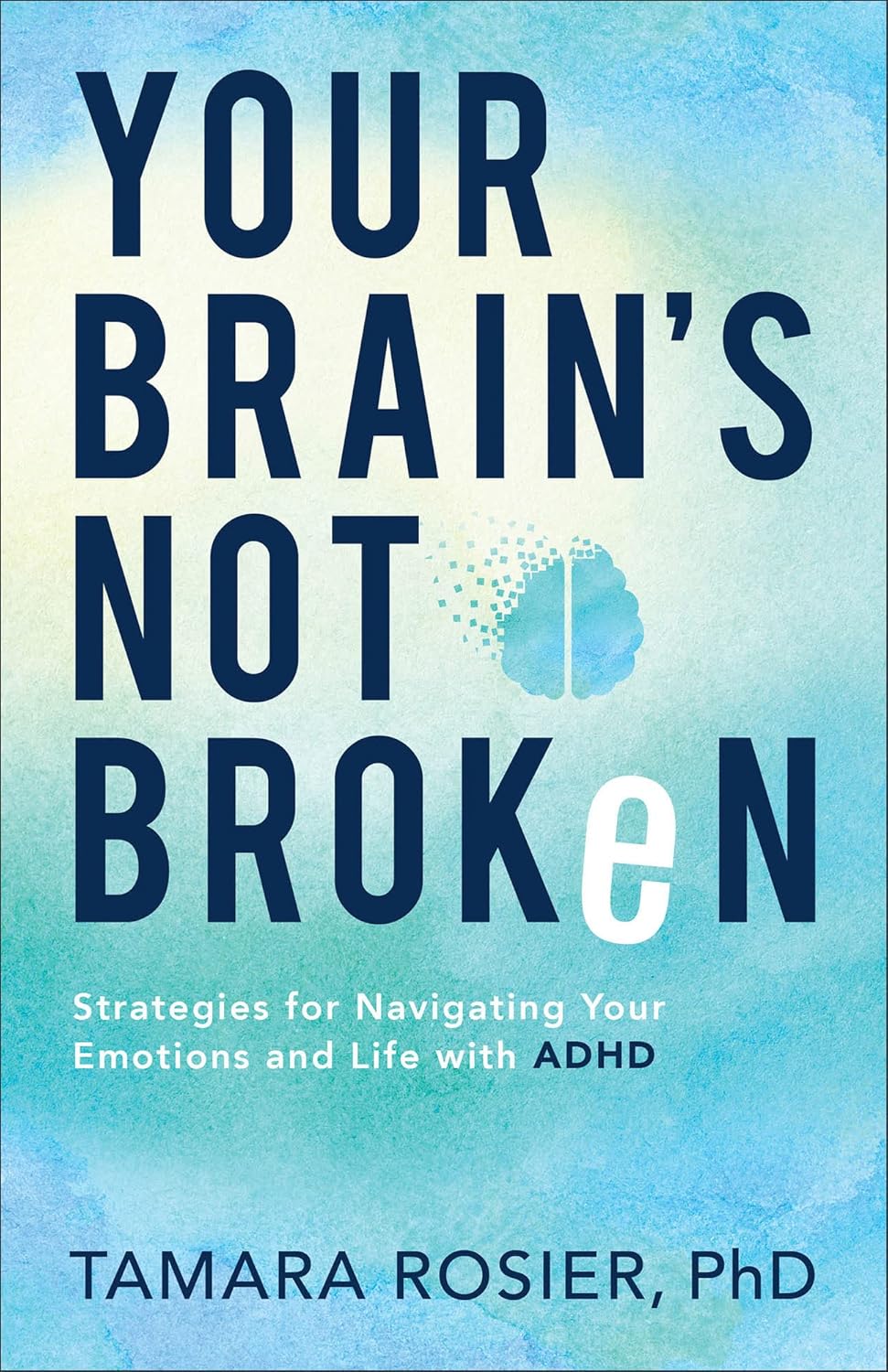
Book cover of Your Brain's Not Broken by Tamara Rosier
Your Brain's Not Broken: Strategies for Navigating Your Emotions and Life with ADHD
Tamara Rosier
Dr. Tamara Rosier explains how ADHD affects every aspect of your life. You'll finally understand why you think, feel, and act the way you do. Anyone with ADHD-as well as anyone who lives with or loves someone with ADHD-will find here a compassionate, encouraging guide to living well and with hope.
ISBN: 9780800739423 | Call Number: Libby eAudiobook

View Book

05/12/2026
Kristin Briney

The U.S. National Science Foundation (NSF) and the National Institutes of Health (NIH) are making changes to their Data Management and Sharing Plan (DMSP) templates. Both agencies are moving away from a two-page narrative DMSP toward a shorter, more structured document. The Library will support the adoption of both new DMSPs with guidance and example plans as more information becomes available from each agency. Here’s what we know thus far:

NSF DMSP Template

NSF implemented a new DMSP template, a webform on research.gov, to replace the two-page narrative data management plan submitted with a grant application. A preview of the webform and instructions have been released by NSF.

Proposals submitted since April 27, 2026 must use the new webform. The webform is directorate-specific. This update only affects the DMSP template and does not change existing data sharing requirements.

Unfortunately, NSF has not yet released clear guidance or example DMSPs for the new template. The Caltech Library will create resources supporting the new NSF DMSP template once more information becomes available.

NIH DMSP Template

NIH is also updating its data management and sharing plan (DMSP) template. The required format is changing to a structured template instead of a two-page, narrative document.

The new template must be used for grant applications submitted on or after May 25, 2026. This policy update only affects the DMSP template and does not change existing data sharing requirements from the 2023 NIH Data Management & Sharing Policy.

Caltech Library has created updated NIH DMSP resources:

Questions?

If you have any questions about either new DMSP template or questions about data management and sharing generally, please reach out to library@caltech.edu.

04/01/2026
Paula Gaetos
No Subjects
Collage environmental science and natural history books from the Library

April 22nd marks the anniversary of the first Earth Day event in 1970, consisting of rallies and marches advocating for environmental reform. The origins of Earth Day sprung from the cultural impact of Rachel Carson's book, The Silent Spring published in 1962, an environmental science book that documented the harm caused by the common use of the pesticide, DDT. The book raised critical awareness about industrial environmental impact and would become foundational to development of the modern environmental advocacy movement.

Throughout the month of April, a curated reading list of environmental science and natural history will be on display physically on the first floor of Sherman Fairchild Library or as full-text eBooks available through the Libby app or our LibSearch catalog. Your access.caltech credentials is your library card!

Book cover of When Trees Testify
When Trees Testify: Science, Wisdom, History, and America’s Black Botanical Legacy
Beronda L. Montgomery
The histories of trees in America are also the histories of Black Americans. Award-winning plant biologist Beronda L. Montgomery explores the ways seven trees—as well as the cotton shrub—are intertwined with Black history and culture. She reveals how knowledge surrounding these trees has shaped America since the very beginning. As Montgomery shows, trees are material witnesses to the lives of enslaved Africans and their descendants.
ISBN: 9781250335166 | Call Number: Libby e-audiobook

View Book

Book cover of Forest Euphoria: The Abounding Queerness of Nature
Forest Euphoria: The Abounding Queerness of Nature
Patricia Ononiwu Kaishian
Braiding her personal story with science, Kaishian shows us this making of a scientist and introduces readers to the queerness of all the life around us.
ISBN: 9781954118904 | Call Number: Libby ebook

View Book

Book cover of The story of N, a book on sustainability.
The Story of N: A Social History of the Nitrogen Cycle and the Challenge of Sustainability
Hugh S. Gorman
Gorman analyzes the notion of sustainability from a fresh perspective—the integration of human activities with the biogeochemical cycling of nitrogen—and provides a supportive alternative to studying sustainability through the lens of climate change and the cycling of carbon.
ISBN: 9780813554389 | Call Number: TD196.N55 G67 2013

View Book

Book cover of Fresh banana leaves: healing indigenous landscapes through indigenous science
Fresh Banana Leaves: Healing Indigenous Landscapes through Indigenous Science
Jessica Hernandez
An Indigenous environmental scientist breaks down why western conservationism isn't working--and offers Indigenous models informed by case studies, personal stories, and family histories that center the voices of Latin American women and land protectors.
ISBN: 9781623176051

View Book

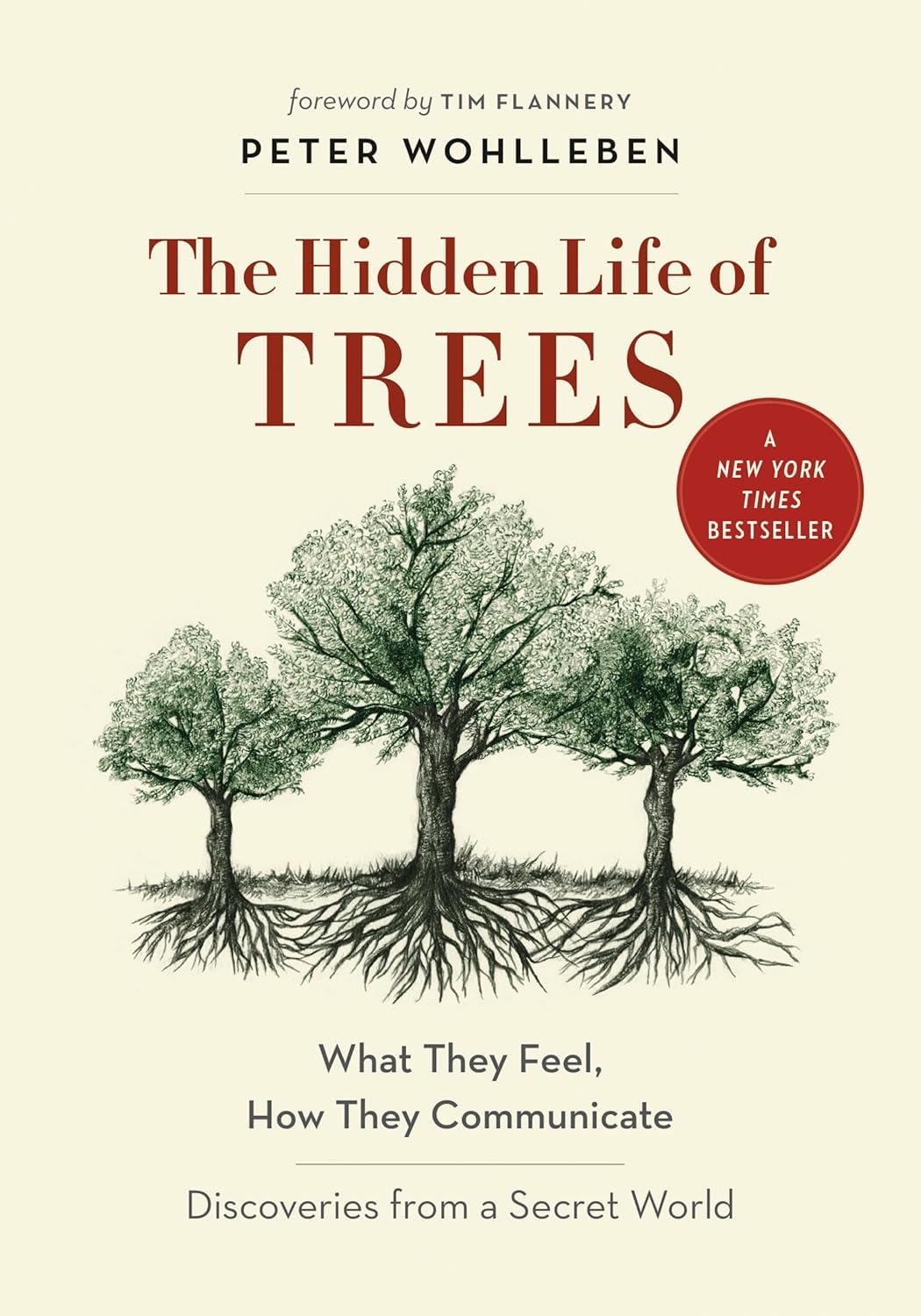
Book cover of The Hidden Life of Trees: What They Feel, How They Communicate
The Hidden Life of Trees: What They Feel, How They Communicate
Peter Wohlleben
Forester and author Peter Wohlleben makes the case that the forest is a social network. Drawing on groundbreaking scientific discoveries to describe how trees are like human families where tree parents live together with their children, communicate with them, support them as they grow, share nutrients with those who are sick or struggling, and even warn each other of impending dangers.
ISBN: 9781771642484 | Call Number: Libby ebook

View Book

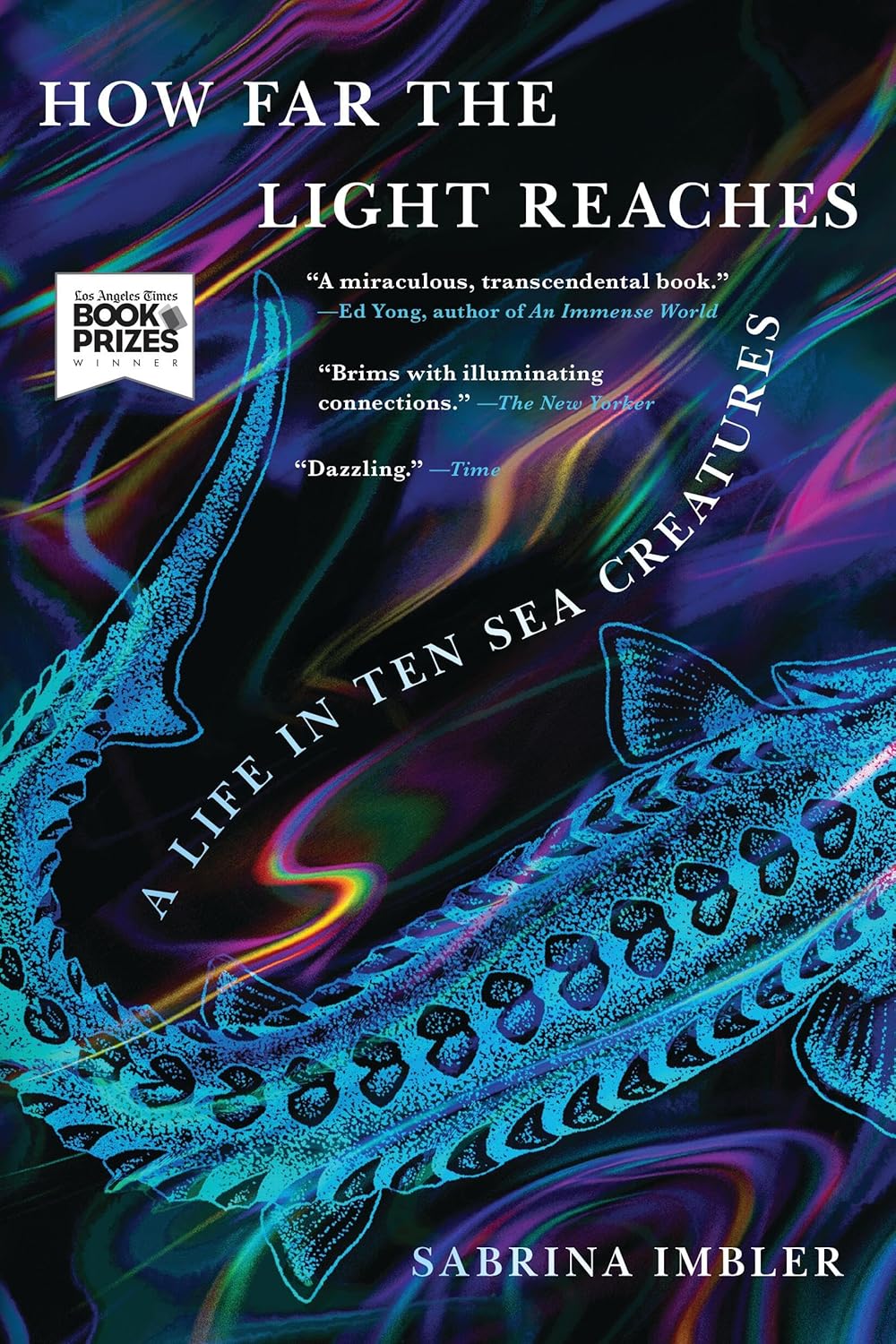
Book cover of How Far the Light Reaches: A Life in Ten Sea Creatures
How Far the Light Reaches: A Life in Ten Sea Creatures
Sabrina Imbler
Imbler discovers that some of the most radical models of family, community, and care can be found in the sea, from gelatinous chains that are both individual organisms and colonies of clones to deep-sea crabs that have no need for the sun, nourished instead by the chemicals and heat throbbing from the core of the Earth.
ISBN: 9780316540506 | Call Number: PS3609.M345 H69 2022

View Book

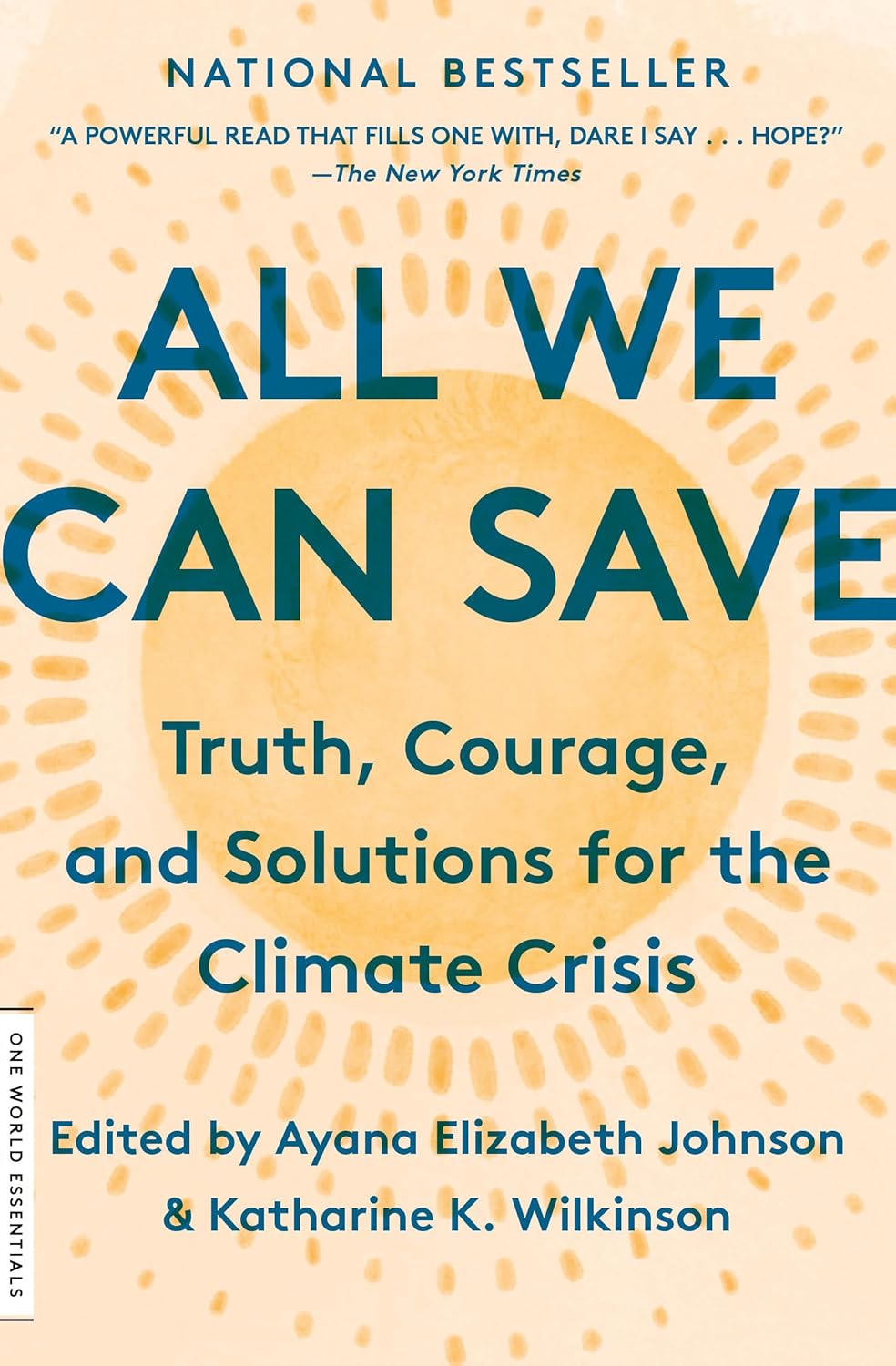
Book cover of All We Can Save: Truth, Courage, and Solutions for the Climate Crisis
All We Can Save: Truth, Courage, and Solutions for the Climate Crisis
Ayana Elizabeth Johnson and Katharine K. Wilkinson
Curated by two climate leaders, this collection is a celebration of visionaries who are leading us on a path toward all we can save. Intermixing essays with poetry and art, this book is both a balm and a guide for knowing and holding what has been done to the world, while bolstering our resolve never to give up on one another or our collective future. We must summon truth, courage, and solutions to turn away from the brink and toward life-giving possibility.
ISBN: 9780593237083 | Call Number: QC903.2.U6 A45 2021

View Book

Book cover of Nomad Century: How Climate Migration Will Reshape Our World
Nomad Century: How Climate Migration Will Reshape Our World
Gaia Vince
In this deeply-reported clarion call, Vince draws on a career of environmental reporting and over two years of travel to the front lines of climate migration across the globe, to tell us how the changes already in play will transform our food, our cities, our politics, and much more. Her findings are answers we all need, now more than ever.
ISBN: 9781250821614 | Call Number: GE149 .V566 2022

View Book

Book cover of Cannibalism by Bill Schutt
Cannibalism: A Perfectly Natural History
Bill Schutt
Eating one's own kind is a completely natural behavior in thousands of species, including humans. Throughout history we have engaged in cannibalism for reasons related to famine, burial rites, and medicine. Schutt takes us on a tour of the field, exploring exciting new avenues of research.
ISBN: 9781616204624 | Call Number: Libby e-audiobook

View Book

Book cover of Entangled Life
Entangled Life: How Fungi Make Our Worlds, Change Our Minds & Shape Our Futures
Merlin Sheldrake
By examining fungi on their own terms, Sheldrake reveals how these extraordinary organisms—and our relationships with them—are changing our understanding of how life works.
ISBN: 9780525510321 | Call Number: Libby ebook

View Book

Book cover of Wild Souls by Emma Marris
Wild Souls: What We Owe Animals in a Changing World
Emma Marris
From an acclaimed environmental writer, a groundbreaking and provocative new vision for our relationships with—and responsibilities toward—the planet's wild animals.
ISBN: 9781635579352 | Call Number: Libby ebook

View Book


Earth Week Events at the Library and Around Campus

We're also bringing back our seed and soil table from April 19th through the 25th. The table includes regional plant and culinary herb seeds and cuttings from the Library's own indoor plants ready to propagate, along with the free soil and miniature pots printed from leftover filament from the TechHub 3D printing lab. Additionally, we're upcycling for this month's Drop-In Thursdays at the TechHub. Bring your old tshirts, pillow cases, or other large fabrics and learn to sew your own tote bag.

Other events around campus include succulent planting with CCID, CALE and Caltech Y's Professional Clothing Drive, and a screening of The Spectrum of Life as part of the Movies That Matter public event series.

16
APR
Sew Your Own Tote Bag
Date: Thursday, April 16, 2026
Time: 11:00 AM PDT
Location: Caltech Hall TechHub (First Floor)
Bring your old, but clean t-shirts or spare fabric and learn how to upcycle them by sewing them into brand new tote bags, just in time to celebrate Earth Week! All tools and materials available free to attendees. Drop in any time between 11:00am and 2:00pm at the TechHub on first floor of Caltech Hall.
19
APR
Soil, Seeds, and Cuttings at the Library
Date: Sunday, April 19, 2026
Time: 12:00 PM PDT
Location: Sherman Fairchild Library (SFL) Lobby
Celebrate Earth Day all week starting Sunday, April 19th until Saturday, April 25 at the Sherman Fairchild Library. Craft a seed starter pot from newspaper clippings, use a 3D printed one from leftover filament from the TechHub, or bring your own pot to take home free soil, seeds, and cuttings. Cuttings provided by library house plants tended to by library staff. Please be courteous when handling seeds.
22
APR
Earth Day with CCID
Date: Wednesday, April 22, 2026
Time: 12:00 PM PDT
Location: Chen 100
Join the Center for Inclusion & Diversity for a workshop on potting succulents and seeds. Honor our earth by helping grow and sustain new life! Plants and pots included. Please reserve your spot (RSVP) because space is limited.
22
APR
Movies That Matter's Earth Day Screening: Spectrum of Life
Date: Wednesday, April 22, 2026
Time: 7:30 PM PDT
Location: Center for Student Services, Front Lawn
In celebration of Earth Day 2026, Caltech's Movies That Matter, in collaboration with the campus' Sustainability Project, will present a FREE screening of The Spectrum of Life, a short documentary about NASA's first biodiversity airborne campaign in South Africa, BioSCape. The film is a celebration of local biodiversity, NASA's role in conservation, and the potential of next-generation remote sensing to change how we measure and monitor ecosystems around the world. JPL scientist Phil Brodrick (who is featured in the film) and others involved in topics raised by this documentary will engage in conversation following the screening and then welcome comments and questions from the audience. The event is presented free-of-charge, but reservations are strongly encouraged.
03/31/2026
Paula Gaetos
No Subjects
Caltech Library events and activities

Every year Caltech Library’s Access and Collections Services department gathers data for reporting purposes to our University Librarian and advisory boards. These impact reports offer a snapshot of how students, faculty, staff, and researchers utilize our spaces and resources annually.

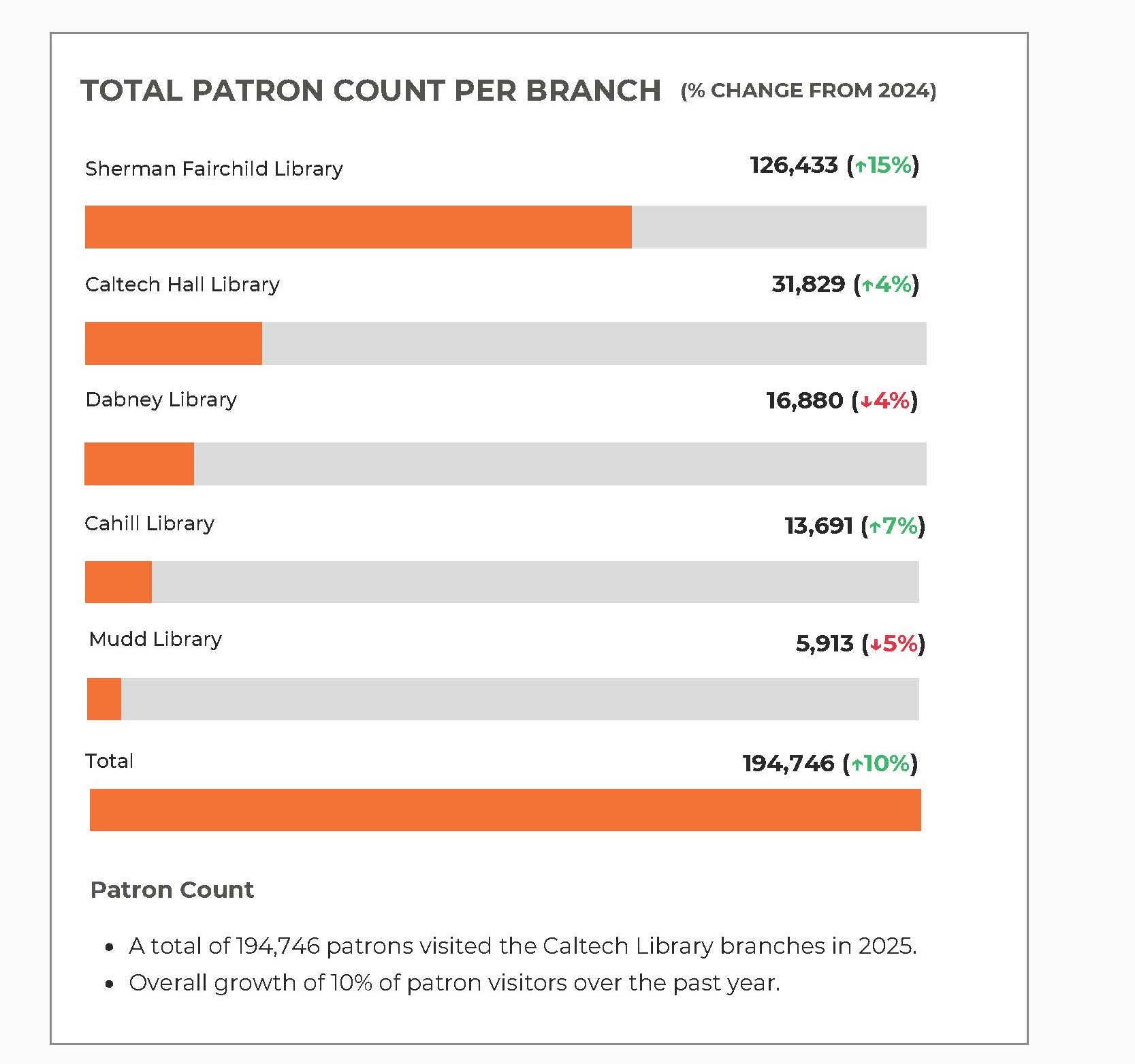
Last year, we welcomed 194,746 visitors across all our library branches, which reflects a 10 percent increase in patron visits compared to 2024. Our main location at Sherman Fairchild Library experienced much of this growth with a 15 percent increase in visitors.

A graph showing the total patron visit count at each branch of the Caltech Library
A graph of the total patron visit count per branch at the Caltech Library collected in 2025.

Working on events and outreach programming with our colleagues across campus including Student and Family Engagement, Student-Faculty Programs, and the Center for Inclusion and Diversity contributed substantially to this increase. Meeting students during resource fairs, and introducing new students and researchers to the library during orientation sessions and other community-oriented events helped expand awareness of our library services and allowed us to welcome more folks to our spaces.

Additionally, collaborations such as having an old-fashioned popcorn machine borrowed from the Title IX office on site during outdoor movie nights helped to create a welcoming, sociable atmosphere for students, which the Library continues to foster through daily operations and special events. In exchange, our Title IX colleagues reaffirmed their role in providing essential safety resources with visible resource displays and opportunities to get to know a campus advocate at the library.

Counting Accessible Information Online

Physical books still fill our shelves and displays across our library locations with the total number of physical loans being 12,240, a slightly lower number than in 2024. Mathematics and physics as subjects accounted for 22 percent and 21 percent of total loans, respectively, with most books located at Sherman Fairchild Library.  

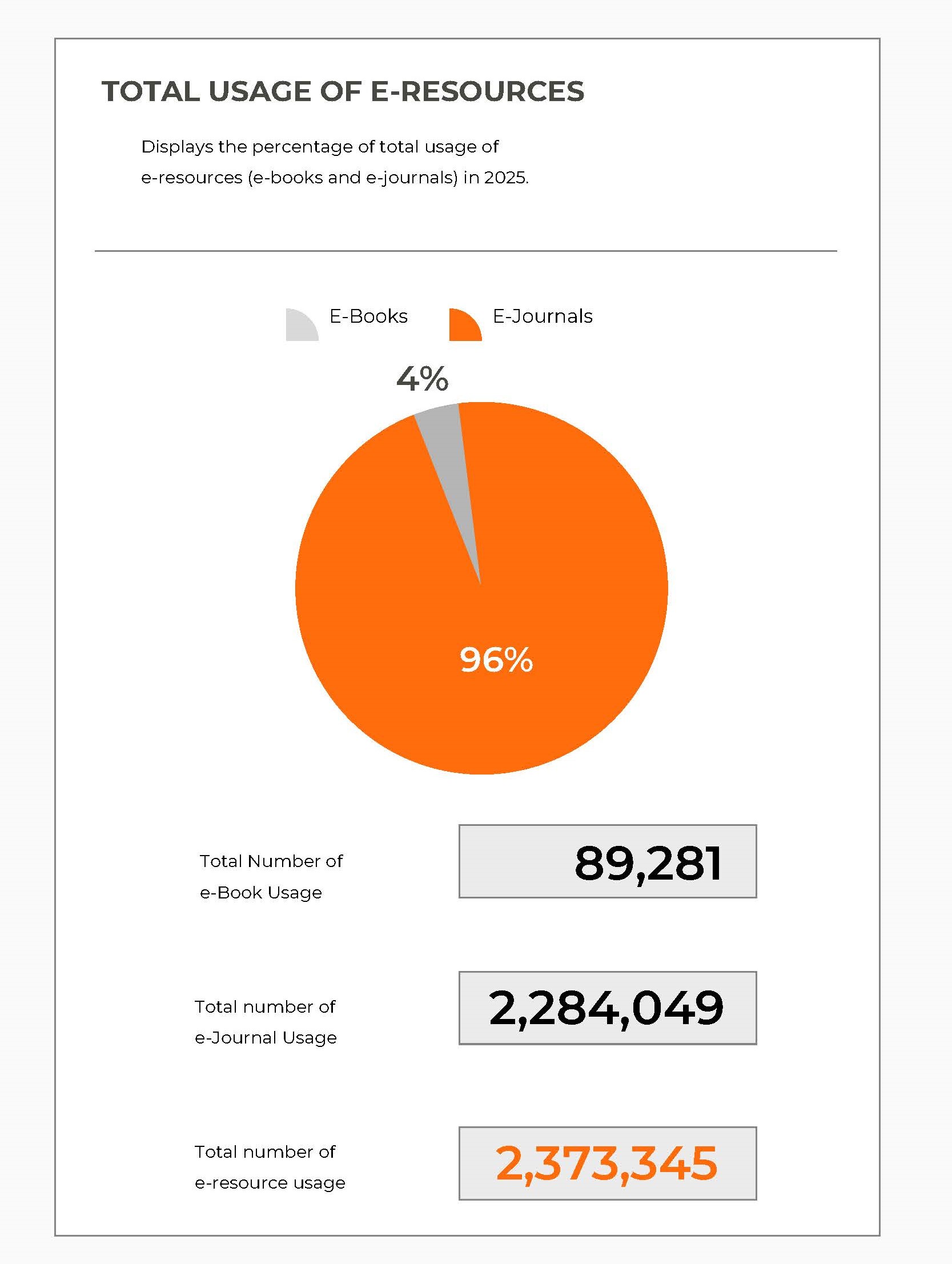
Electronic resources continue to play a major and growing role in supporting research on campus. We recorded over 2.3 million total e-resources use last year, with e-journals accounting for 96 percent of our total usage. The publisher Springer Nature received the most usage being accessed 707,018 times, followed by Elsevier/ScienceDirect at 400,565; and the American Chemical Society (ACS) at 289,308, according to Bianca Rios, our Access & E-resource Services librarian.

Calculating electronic resource use is no small task in an ever-changing digital environment. “We count “unique title requests,” which is the number of times a user downloads or looks at a book or journal during a single session,” Rios says. “If users download multiple articles from the same journal in one session, we are only counting that journal one time.”

A pie graph illustrating the total number of eresource use at the Caltech Library

These trends provide a concise overview of the impact our spaces and resources continue to have in supporting learning, research, and discovery across campus. To keep up to date with Library events and programming, bookmark the library calendar or follow the library on Instagram
 

03/30/2026
Heidi Aspaturian

Gallery exhibit in the anteroom showcasing Caltech faculty club historyVisitors to the Athenaeum basement’s newly renovated Rathskeller bar and game room—the Ath’s Rath—will have noticed that the anteroom directly off the bar has undergone its own makeover, into a mini-gallery that showcases the Caltech faculty club’s early history.  

Here’s Albert Einstein, pictured with dinner companions at the Ath’s inaugural gala in January 1931, while on the opposite wall a very young future Nobelist, William A. “Willy” Fowler, is shown sitting with fellow graduate students at one of the Ath’s signature round tables in 1934.  A reproduction of Einstein’s signed handwritten draft—in German—of remarks he gave at an early Ath dinner shares a frame with its typed English translation. These are among the photos and documents from the Caltech Archives and Special Collections now on display in the Rath annex, as the Athenaeum marks its 95th anniversary and looks ahead to its centennial.  The monumental blowup of the moon—an enlargement of a 1950s Palomar Observatory photo—that greets arrivals to the Rath is also from the Archives collection. 

Work on the gallery got under way last summer when architect Marie-Claude Fares of Caltech’s Planning, Design and Construction department and Athenaeum manager Marisu Jimenez approached the Archives about collaborating on a basement exhibit as part of the overall Rath remodel.  “Marie-Claude came to us with the idea of mounting an exhibition in the nook off the Rathskeller,” says Head of Archives and Special Collections Peter Collopy. “We proposed a display focused on the story of the Ath’s founding.”  Collection Management Archivist Bailey Westerhoff, who curated the exhibit, drew on her background in museum studies and exhibition design to research and select the display’s images, which were then reproduced and framed by the Archives and installed by campus facilities.

“Peter and I wanted to share this side of Caltech’s history with visitors to the Ath, to give them a feel for what the Ath looked like when it first opened, and to select specific objects that told that story,” Westerhoff says. “I looked for images that showed folks in the Ath and that gave a sense of its layout and architecture, and for documents directly related to the founding.”  One of those documents, a page from the Athenaeum’s first membership handbook, contains a list of the club’s newly formed House Committee members. Among them are E. C. Watson, for whom Caltech’s venerable Earnest C. Watson Lecture series would be named, and, in what sounds like an inspired recruitment move, astronomer Edwin Hubble, who was enlisted to help grow Ath membership not long after he discovered the expansion of the universe.

Westerhoff was also drawn to a 1933 award certificate presented to Caltech by the Southern California Chapter of the American Institute of Art in honor of the Athenaeum’s “exceptional merit,” which she sees as signifying public recognition of “Caltech’s place within the architectural history of the SoCal region,” and to a 1925 watercolor rendering of a prospective Athenaeum design by Bertram Goodhue. The architect responsible for much of the Caltech master plan and several early campus buildings, Goodhue died before work began on the Ath’s final design, and the job went to architect Gordon Kaufmann.

Not all of Westerhoff’s choices are in the annex gallery, a handful having been selected to decorate the Rath bar and dining room. These include a formal photo of Einstein seated between fellow Nobel laureates A. A. Michaelson and Robert A. Millikan on a pew-like bench, surrounded by local dignitaries at that first Athenaeum dinner. It hangs above two vintage benches, one of which may be the one in the photo—or possibly a bench on which Einstein sat on some other occasion.

Although he believes that this is the first time the Athenaeum has hosted a historical exhibit, Collopy points out that it’s by no means the first time art has gone on display below stairs in the Ath.  When Caltech humanities faculty launched an experimental artists-in-residence program on campus in the late 1960s, many of its shows were held in the Ath basement for want of space elsewhere. 

“There was a pretty continuous exhibition program there,” says Collopy, “until 1971, when Caltech established the Baxter Art Gallery, which then lasted until 1985. We’re excited to bring exhibition back to the Athenaeum.”


03/17/2026
Paula Gaetos
No Subjects
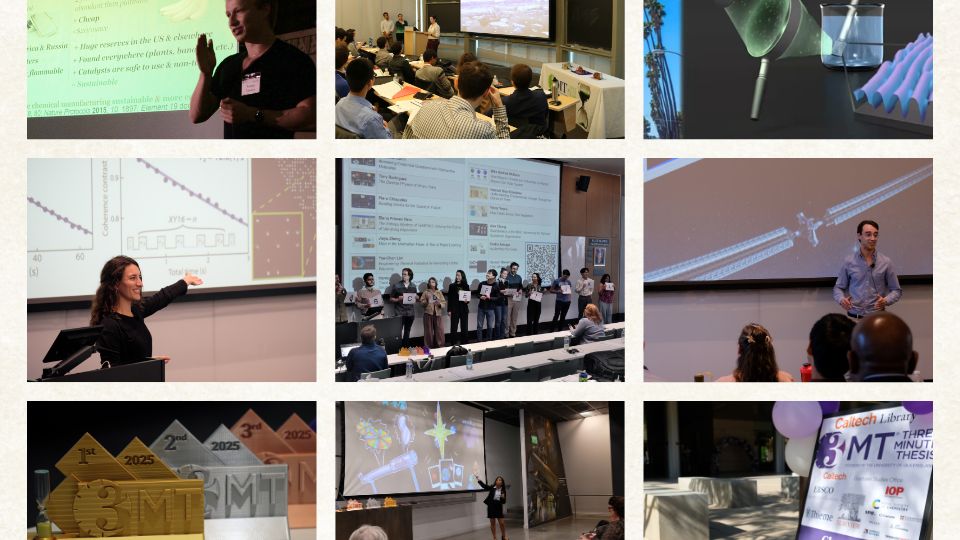
Nine photos from Caltech's 3MT competitions, 2016 through 2025

A decade ago, a cohort of Caltech graduate students took part in a new Institute event that posed a wild challenge: Explain your thesis research clearly and compellingly in front of a general audience in just three minutes

Caltech, as a renowned science and engineering institute, has no shortage of keen minds, great researchers, and effective communicators. As with all passionate students and researchers, talking at length about the work is never the problem. Conveying its significance to an interested general public is not always so easy.  But in today’s world, where scientific misinformation can circumnavigate the globe before truth and clarity catch up with it, the ability to translate the technical intricacies of scientific research into clear, jargon-free language has become more vital than ever.

3MT, or Three Minute Thesis, is a competition that originated in 2008 at The University of Queensland and is now hosted by over 900 universities internationally, including Caltech.  Participants, who are selected on the basis of video submissions in which they talk about their thesis research, make their presentations in front of a live general audience and a panel of judges, who assess how clearly and engagingly they share their research results in an illustrated talk. The first, second, and third place winners are selected by the panel, and the People’s Choice recipient is selected by an audience general vote.

Special Projects Librarian Dana Roth MS ’65, who first read about the competition in 2014, was instrumental in bringing it to campus. “Perhaps it was because I remembered my own experience in trying to explain my research, as a graduate student, to family members and old friends,” he says. “It was also likely due to reading, for a number of years, about funding agencies (NSF, NIH, etc.) expressing the need to help the public understand what the grant money was being used for.”

The inaugural event, held in Dabney Lounge in April 2016, featured nine finalists and seven judges, including a former mayor of Pasadena and Ernie Mercado, well-known across campus for his popular “Ernie’s Al Fresco” food truck. (The People’s Choice award was 3D-printed in the shape of Ernie’s food truck in the first two 3MT competitions.) “For judges, we try to make sure the panel includes someone in a graduate program, someone from faculty, from Caltech’s Hixon Writing Center, a librarian, and a special guest,” says Author Services and Digital Repository Librarian, Kathy Johnson, an integral part of 3MT as “the thesis librarian,” working closely with graduate students on the copyright and publishing of their work.

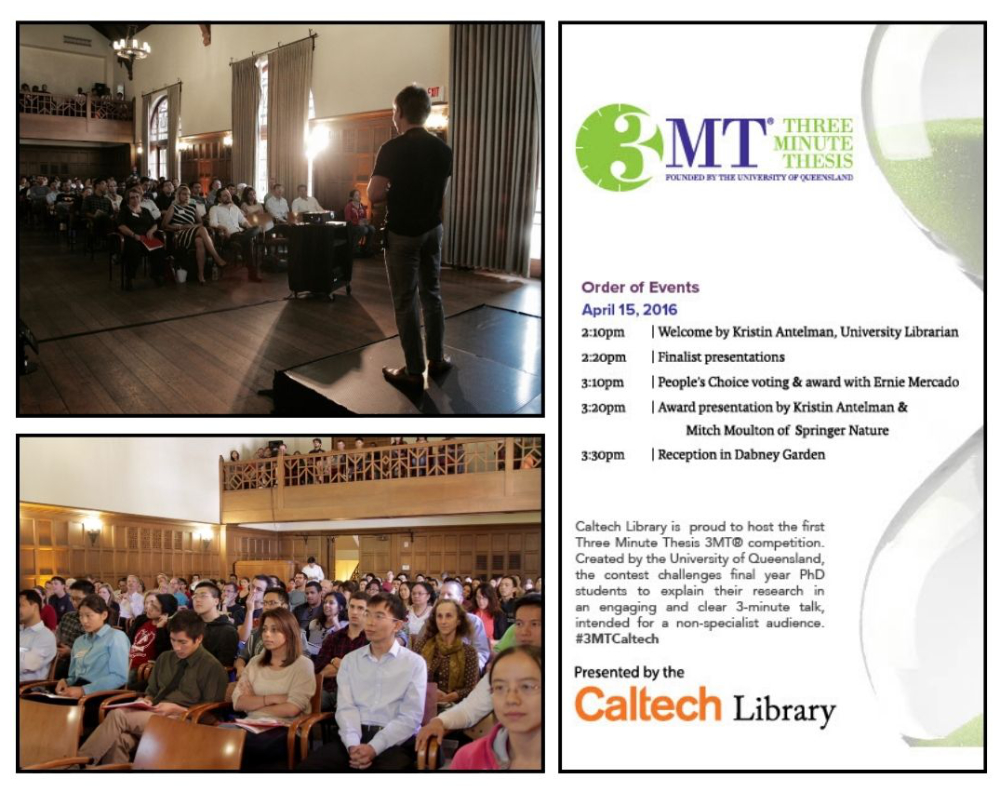
Collage of 2016 Caltech 3MT competition: audience, a finalist presenting, and the event program

“The first year was the toughest, not knowing if people would attend,” says Catherine Geard, the Library’s head of Business & Operations. “But it just happened to coincide with a large prospective student event that had just finished.”  Undergraduate Admissions encouraged attendees to head over to 3MT, and, says Catherine, “we were suddenly beyond capacity. People were up on the balcony, and it was standing room only on the ground floor.”

The top winners of that year’s competition were Anton Toutov PhD ’17, who took first place for his presentation on “Breaking Society’s Dependence on Precious Metals: Green Chemical Manufacturing Using Potassium” and Utkarsh Mital PhD ’16, who placed second for “Understanding Fundamentals of Soil Liquefaction,” which also won the People’s Choice Award.

“When we opened up the competition to more graduate students, not just to those who’ve already defended their thesis or getting ready to defend, it provided the opportunity for students to enter 3MT more than once,” says Kathy. “You get to see the growth in their presentations, their confidence, and how their research develops over time. Even if they themselves don’t participate more than once, just being able to watch past years’ competitors makes a difference.”

The Library held 3MT again in 2018.  In 2021, after a two-year hiatus, it returned as an online event, adhering to campus safety measures during the COVID-19 pandemic.  It restored the live, in-person format in 2022 and in all consecutive years since.

Much like the Caltech Library itself, 3MT has undergone some significant changes since that first competition back in 2016.  These include a move to larger venues, expanded collaborations with campus partners such as Hixon Writing Center and Academic Media Technologies (AMT), and even the inclusion of a mini-game entitled “Caltech Thesis or Science Fiction Title?” developed by Metadata Specialist Melissa Ray to engage the audience while judges deliberate. 

“Doing it fully online in 2021 was a whole challenge itself,” says Kathy. “But what came out of that was the ability to livestream 3MT with help from AMT for every event since, which not only opened it up to simply anyone interested in the research at Caltech. It also means the family and friends of our finalists can watch and support them even if they can’t attend in person, especially for our international students.”

“As the years have gone on, the entire process has continued to improve,” Catherine says. “It’s a lot of work but at the end, seeing all of the amazing presentations and slides is so exciting. It’s been great to see how the finalists support one another. Even though they are in competition, they still cheer each other on.” Kathy adds, “The audience grows every year, and we need a bigger venue each time we’ve held 3MT. People show up to support the finalists. It’s their friends and family. It’s their advisors, their cohort, their lab, their coaches. It’s really a community event.”

This April will mark the tenth year since that first late-afternoon event in Dabney, and we look forward to a new batch of competitors and fascinating research. For details on the upcoming 2026 competition, visit the official 3MT page at library.caltech.edu/3MT.

Field is required.