Buy New
-53%
$18.00$18.00
FREE delivery Friday, June 5 on orders shipped by Amazon over $35
Ships from: Amazon.com Sold by: Amazon.com
Another way to buy
-52%
$18.35$18.35
FREE delivery Friday, June 5 on orders shipped by Amazon over $35
Ships from: Amazon Sold by: MbBooks
Learn more
Used - Very Good
$8.28$8.28
FREE delivery June 8 - 10
Ships from: ThriftBooks-Phoenix Sold by: ThriftBooks-Phoenix
Sorry, there was a problem.
There was an error retrieving your Wish Lists. Please try again.Sorry, there was a problem.
List unavailable.
Download the free Kindle app and start reading Kindle books instantly on your smartphone, tablet, or computer - no Kindle device required.
Read instantly on your browser with Kindle for Web.
Using your mobile phone camera - scan the code below and download the Kindle app.
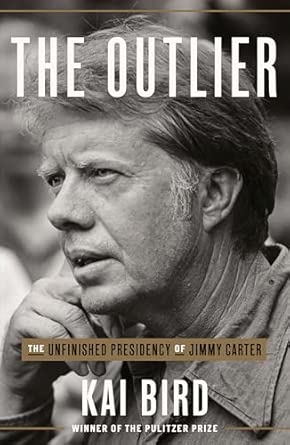
The Outlier: The Unfinished Presidency of Jimmy Carter Hardcover – June 15, 2021
Purchase options and add-ons
An essential re-evaluation of the complex triumphs and tragedies of Jimmy Carter’s presidential legacy—from the expert biographer and Pulitzer Prize–winning co-author of American Prometheus
Four decades after Ronald Reagan’s landslide win in 1980, Jimmy Carter’s one-term presidency is often labeled a failure; indeed, many Americans view Carter as the only ex-president to have used the White House as a stepping-stone to greater achievements. But in retrospect the Carter political odyssey is a rich and human story, marked by both formidable accomplishments and painful political adversity. In this deeply researched, brilliantly written account, Pulitzer Prize–winning biographer Kai Bird deftly unfolds the Carter saga as a tragic tipping point in American history.
As president, Carter was not merely an outsider; he was an outlier. He was the only president in a century to grow up in the heart of the Deep South, and his born-again Christianity made him the most openly religious president in memory. This outlier brought to the White House a rare mix of humility, candor, and unnerving self-confidence that neither Washington nor America was ready to embrace. Decades before today’s public reckoning with the vast gulf between America’s ethos and its actions, Carter looked out on a nation torn by race and demoralized by Watergate and Vietnam and prescribed a radical self-examination from which voters recoiled. The cost of his unshakable belief in doing the right thing would be losing his re-election bid—and witnessing the ascendance of Reagan.
In these remarkable pages, Bird traces the arc of Carter’s administration, from his aggressive domestic agenda to his controversial foreign policy record, taking readers inside the Oval Office and through Carter’s battles with both a political establishment and a Washington press corps that proved as adversarial as any foreign power. Bird shows how issues still hotly debated today—from national health care to growing inequality and racism to the Israeli-Palestinian conflict—burned at the heart of Carter’s America, and consumed a president who found a moral duty in solving them.
Drawing on interviews with Carter and members of his administration and recently declassified documents, Bird delivers a profound, clear-eyed evaluation of a leader whose legacy has been deeply misunderstood. The Outlier is the definitive account of an enigmatic presidency—both as it really happened and as it is remembered in the American consciousness.
- Print length784 pages
- LanguageEnglish
- PublisherCrown
- Publication dateJune 15, 2021
- Dimensions6.38 x 1.54 x 9.53 inches
- ISBN-100451495233
- ISBN-13978-0451495235
Discover the latest buzz-worthy books, from mysteries and romance to humor and nonfiction. Explore more
Explore your book, then jump right back to where you left off with Page Flip.
View high quality images that let you zoom in to take a closer look.
Enjoy features only possible in digital – start reading right away, carry your library with you, adjust the font, create shareable notes and highlights, and more.
Discover additional details about the events, people, and places in your book, with Wikipedia integration.
Frequently bought together

Customers who viewed this item also viewed
His Very Best: Jimmy Carter, a LifePaperbackFREE Shipping on orders over $35 shipped by AmazonGet it as soon as Friday, Jun 5
A Full Life: Reflections at NinetyPaperbackFREE Shipping on orders over $35 shipped by AmazonGet it as soon as Friday, Jun 5
President Carter: The White House YearsHardcover$5.45 shippingGet it Jun 8 - 11Only 1 left in stock - order soon.
Washington: A Life (Pulitzer Prize Winner)PaperbackFREE Shipping on orders over $35 shipped by AmazonGet it as soon as Friday, Jun 5
The Survivor: Bill Clinton in the White HousePaperbackFREE Shipping on orders over $35 shipped by AmazonGet it as soon as Friday, Jun 5
An Ordinary Man: The Surprising Life and Historic Presidency of Gerald R. FordPaperbackFREE Shipping on orders over $35 shipped by AmazonGet it as soon as Friday, Jun 5
Customers also bought or read
- An Ordinary Man: The Surprising Life and Historic Presidency of Gerald R. Ford
Paperback$17.67$17.67Delivery Fri, Jun 5 - Destiny and Power: The American Odyssey of George Herbert Walker Bush
Hardcover$15.08$15.08Delivery Jun 9 - 11 - The Unfinished Presidency: Jimmy Carter's Journey Beyond the White House
Hardcover$10.79$10.79FREE delivery Jun 4 - 8 - Jimmy Carter: 100 Remarkable Tales From 100 Extraordinary Years
Paperback$16.00$16.00Delivery Fri, Jun 5 - Making the Presidency: John Adams and the Precedents That Forged the Republic
Hardcover$17.00$17.00$3.99 delivery Jun 8 - 23
From the Publisher
In 1946, Naval Academy ensign Carter married Rosalynn Smith in Plains, Georgia.
President Carter, wearing a cardigan, about to give his first speech on the growing energy crisis.
Lt. Carter became a submariner, studied nuclear physics, and served under Captain Hyman G. Rickover (LEFT, with then President Carter)
President Carter, Amy (age nine), and First Lady Rosalynn Carter in the White House.
Carter nominated Justice Ruth Bader Ginsburg to the appellate court.
Former President Carter greeting a child while on an election-monitoring visit to Nepal in 2008.
Editorial Reviews
Review
“In Kai Bird’s latest masterpiece, a book that models the virtues of the biographer’s craft, Jimmy Carter receives his due. Deeply empirical and exquisitely sculpted, The Outlier . . . is a landmark. . . . Bird’s treatment gives Carter’s presidency the deep analysis it deserves.” —Foreign Policy
“Bird’s nuanced study not only sets the record straight on Carter’s misunderstood presidency, it brings him to life in a way that few other biographers have been able to thus far.”—Variety
“A bracing reminder that the 39th president was a man of probity, decency, high hopes, and high moral standards . . . Bird’s take on whom he calls ‘our most enigmatic president’ is relentlessly fair-minded. [The Outlier] redeems [Carter’s] presidency and reminds us of how callous we might have been during his years in office.” —The Boston Globe
“This is superior history, superbly researched and marvelously written.”—Douglas Brinkley, New York Times bestselling author of American Moonshot
“This beautifully written book will take its place alongside other superb one-volume biographies of American presidents. The Outlier will raise readers’ estimates of Jimmy Carter’s term in office.”—Robert Dallek, New York Times bestselling author of Franklin D. Roosevelt and An Unfinished Life
“A grand work of revisionist history, prodigiously researched and gracefully written, The Outlier tells the story of a singular man and a unique presidency at a critical point in American and world history.”—David Nasaw, New York Times bestselling author of The Last Million
“Bird tells the story with sympathy, intelligence, and a wealth of marvelously organized information. The Outlier is a pleasure to read.”—Vivian Gornick, author of Fierce Attachments
“Books about presidents are often fat and dull—not this one. Bird has talked to everybody and written a compelling account of the most underrated president in American history.”—Thomas Powers, Pulitzer Prize–winning journalist and author of The Killing of Crazy Horse
“Incisive . . . [The Outlier is] the best study to date of the Carter era and a substantial contribution to the history of the 1970s.”—Kirkus Reviews (starred review)
“. . . a lucid, penetrating portrait that should spur reconsideration of Carter’s much-maligned presidency.”—Publishers Weekly
“A readable, masterful biography of a complex leader . . .”—Booklist (starred review)
About the Author
Excerpt. © Reprinted by permission. All rights reserved.
The Past Is Never Dead
We had too much money to be ostracized. —Miss Lillian
James Earl Carter, Jr., was always an outlier—as a president and as a boy decades earlier in rural South Georgia. Born on October 1, 1924, in a small hospital in Plains, Georgia, Jimmy grew up on his father’s 360-acre farm two and a half miles down the road in the tiny hamlet of Archery. The Carter family home was a three-bedroom single-story house assembled from a Sears, Roebuck kit. The structure lacked electricity and insulation and had no running water until 1935, when Carter’s father bought a small windmill to pump water from the backyard well into a water tank. Until then, the family used an outdoor privy with four holes. The family’s shower was made by punching nail holes in the bottom of a bucket suspended from a water pipe in the wood ceiling.
The village of Plains, population 479, had electricity “most of the hours of the day,” provided by a large one-cylinder engine. Every time it hit a stroke, the engine blew a smoke ring up in the air. Everyone in town could hear the engine pounding away—until, periodically, it would break down and there would be no electricity at all. Although electricity came to Atlanta in 1884, it took more than a half century to reach Archery in 1938. Carter later recalled wryly, “The greatest day in my life was not being inaugurated president, [and] it wasn’t even marrying Rosalynn—it was when they turned the electricity on because that totally transformed our lifestyle.” Most of the streets of Plains were not paved until 1954. But if Jimmy’s boyhood home was spartan and surrounded by abject poverty, his childhood was nevertheless comfortable and relatively privileged.
Archery was a throwback to the nineteenth century. Jimmy’s father, James Earl Carter, Sr., had a tenth-grade education before dropping out to join the army. In 1903, when Earl was only ten years old, his father, William Archibald Carter, was shot dead during a violent brawl with a business rival. They had been arguing over who was the rightful owner of a desk. Earl was certainly not country “white trash”—but neither was he part of the southern plantation aristocracy. By the late 1920s, he made more than a comfortable living growing peanuts, corn, and cotton and drawing “rents” from his Black tenants. He managed to expand his farm acreage even during the boll weevil blight of the 1920s, which wiped out many cotton farmers.
“Daddy was a very aggressive, competent farmer,” Jimmy recalled. He was always trying to turn any harvest into cash. One year he planted ten acres of tomatoes, and they turned out beautifully. But so did everyone else’s tomato patches all over Georgia that year. “I remember a man named Mr. Rycroth and I loaded his truck with tomatoes,” Jimmy said, “and we rode all over Georgia, trying to sell the tomatoes. We couldn’t sell them at all. So, we came back home and told Daddy and he decided to make ketchup out of those tomatoes.” Earl was unusually entrepreneurial. “We had sheep,” Jimmy said, “and Daddy would send the wool off to some central manufacturing place, I never knew where, and get blankets back, and we would sell blankets in our local store. We grew beef cattle. We milked twelve cows at most. . . . Daddy would process the milk, either making vanilla or chocolate milk to sell in little 5-cent bottles that he would haul around and put in different grocery stores.” They grew sugarcane that Earl turned into a syrup and bottled under the label “Plains Maid,” with a picture of a pretty girl on the label. They plucked the down from a flock of geese to make down comforters and pillows. “Everything Earl Carter touched turned to money,” said his nephew Hugh Carter.
A short, stocky man, Earl dressed in store-bought suits, wore a fedora in the winter and a straw hat in the summer, and drove a Model T Ford and later a 1937 Oldsmobile. He sometimes taught Sunday school at the Baptist church—but he refused to sit for the sermons because he thought them boring. Earl had an easygoing side to him. But over his wife’s objections, he refused to give up his Friday-night poker games. He enjoyed playing tennis on a red clay court he had constructed immediately adjacent to his Sears, Roebuck home. Earl was a “very accomplished tennis player,” Carter recalled—and by the time he was thirteen years old, so too was Jimmy. Earl bought Jimmy his own riding horse, a Shetland pony named Lady, a ping-pong table, and plenty of books. Some years later, Earl built a three-bedroom guesthouse on a nearby property, complete with a swimming pond. They called this family retreat the “Pond House.” Earl tightly controlled the family’s monthly budget, and eventually he owned five thousand acres of prime farmland, a grocery in Plains, a fire insurance agency, and a peanut warehouse and brokerage business. Upon Earl’s death in 1953, his net worth was a quarter million dollars—or about $2.4 million in today’s dollars.
Growing up in Archery, Jimmy was barefoot from early April until the cold arrived in October: “There was always an argument which my parents always won about how early I could take my shoes off and how early I had to put them back on.” Every autumn Jimmy had plenty of time to go hunting with his friends for squirrels, rabbits, and quail. When it was too wet to work in the fields, he would hike down to Chucahatcha Creek with his mostly Black playmates. They’d catch catfish and eels. Occasionally, the boys played baseball. There were only three whites on the team, Jimmy and the Watson boys, and the rest of the team was Black.
Jimmy’s closest boyhood friend was A. D. Davis, whose relatives were tenants on the Carter farm. “Jimmy and them [the Carter brood] were raised up with nothin’ but colored people,” A.D. later told a reporter. “He ain’t never acted like he was more’n somebody because he was white.” They played together in the fields and worked together. And sometimes Jimmy’s mother, born Bessie Lillian Gordy—whom everyone called “Miss Lillian”—took them to the Rylander Theatre in Americus to watch movies, seating Jimmy with his Black friend in the “white-only” downstairs section. But as A.D. grew older, he’d insist on sitting in the segregated “black-only” balcony seats. That was the way things were.
Some two hundred people lived in Archery, but aside from a railroad foreman, the Carters were the only whites in the hamlet—and most of the Blacks depended on Earl for their subsistence livelihood, working as day laborers. Aside from Earl, the leading figure in the community was an African American preacher, William Decker Johnson. Born in 1869, Johnson was ordained as a bishop in the African Methodist Episcopal Church. In 1911, he moved to Archery and founded a vocational school, the Johnson Home Industrial College. He regularly preached at the St. Mark Church in Archery. Bishop Johnson was a singular influence, a rare Black man who owned property, drove his own car, and traveled across the country. Miss Lillian enjoyed talking to him and scandalized her husband by inviting the bishop into her home to chat. Jimmy occasionally heard the bishop preach at St. Mark’s Church and listened to the Black choir.
Most of young Jimmy’s childhood playmates were the sons of his father’s Black tenants, and they spent their days roaming the woods, hunting, and fishing. He had one white friend, Rembert Forrest, who sometimes rode his horse out from Plains to visit Jimmy. If his parents were away in Atlanta on business, young Jimmy would spend the night in the nearby wooden cabin occupied by Jack and Rachel Clark, sleeping on a pallet on the floor. Jack Clark was Earl’s foreman, the only Black tenant who received monthly wages. Jimmy followed Jack around the farm “like a puppy dog and bombarding him with questions.” Jack often took Jimmy into the woods to hunt raccoons and possums. Rachel sat with Jimmy, watching him fish in the creek and telling him folktales to while away the hours. Though illiterate, Rachel was a poised and dignified woman. Jimmy thought of her as an “aristocrat” and a “queen.” In the evenings they often played checkers or seven-up, a two-player, trick-taking gambling card game popular in the nineteenth century. Rachel was a small woman—and the best worker on the farm. She could pick 300 to 350 pounds of cotton a day—a hundred pounds more than anyone else, including Jimmy, even when he was seventeen or eighteen years old. “Rachel was not the kind of woman that Mother would ever have asked to do housework,” Carter said. “I don’t know what Rachel would have done if Mother asked her. She probably would have said, ‘Yes, ma’am.’ But Rachel was a little too aristocratic to do that kind of work.”
She taught Jimmy to fish, but she usually handled seven fishing poles at once and often caught three fish to every one Jimmy caught. But it wasn’t a competition. “She was nice and gentle,” Carter recalled. Rachel was just very self-assured and independent. In her later years, she’d walk around with Maccoboy snuff in her lip. She always wore a long apron with a can of beer stuffed in the pocket.
Product details
- Publisher : Crown
- Publication date : June 15, 2021
- Edition : First Edition
- Language : English
- Print length : 784 pages
- ISBN-10 : 0451495233
- ISBN-13 : 978-0451495235
- Item Weight : 2.48 pounds
- Dimensions : 6.38 x 1.54 x 9.53 inches
- Best Sellers Rank: #420,755 in Books (See Top 100 in Books)
- #300 in US Presidents
- #2,076 in Military Leader Biographies
- #2,800 in United States History (Books)
- Customer Reviews:
About the author

Kai Bird is a Pulitzer Prize-winning historian and biographer. His new book is The Good Spy: The Life and Death of Robert Ames. A biography of a CIA officer, The Good Spy was released on May 20, 2014 by Crown/Random House. Kai's last book was a memoir about the Middle East entitled Crossing Mandelbaum Gate: Coming of Age Between the Arabs and Israelis, 1956-1978 (Scribner, April 27, 2010). It was a 2011 Finalist in the National Book Critics Circle Award for Autobiography. He is the co-author with Martin J. Sherwin of the Pulitzer Prize-winning biography, American Prometheus: The Triumph and Tragedy of J. Robert Oppenheimer (2005), which also won the National Book Critics Circle Award for Biography and the Duff Cooper Prize for History in London. He wrote The Chairman: John J. McCloy, the Making of the American Establishment (1992) and The Color of Truth: McGeorge Bundy & William Bundy, Brothers in Arms (1998). He is also co-editor with Lawrence Lifschultz of Hiroshima's Shadow: Writings on the Denial of History and the Smithsonian Controversy (1998). He is the recipient of fellowships from the John Simon Guggenheim Foundation, the Alicia Patterson Foundation, the John D. and Catherine T. MacArthur Foundation's writing fellowship, the Thomas J. Watson Foundation, the German Marshall Fund, the Rockefeller Foundation's Study Center, Bellagio, Italy and the Woodrow Wilson International Center for Scholars in Washington DC. He is a member of the Society of American Historians and a contributing editor of The Nation. He lives in Miami Beach.
Customer reviews
Customer Reviews, including Product Star Ratings help customers to learn more about the product and decide whether it is the right product for them.
To calculate the overall star rating and percentage breakdown by star, we don’t use a simple average. Instead, our system considers things like how recent a review is and if the reviewer bought the item on Amazon. It also analyzed reviews to verify trustworthiness.
Learn more how customers reviews work on AmazonCustomers say
Generated from the text of customer reviewsSelect to learn more
Top reviews from the United States
- 5 out of 5 stars
This book will certainly change your perspective on his presidency
Reviewed in the United States on March 9, 2023With the recent news about Jimmy Carter on what may likely be his last days, it does seem rather timely to discuss the man and his legacy. So, I got myself this biography of the former president written by Kai Bird and it must be said that The Outlier paints an entirely different picture of Jimmy Carter. Instead of viewing the Carter presidency as a failure, Bird sees the Carter presidency as an anomaly: the president did not spend any time in the glitz and glamor of Washington DC and yet spent his entire four years in office constantly working, and it was all with a personality and a deeply religious outlook of life coming from Georgia (the deep south), Baptist Christianity, and an unorthodox education. All of this make Carter not just an outsider of Washington politics, but an outlier.
Like all biographies, it all starts with Carter’s pre-presidential life in a rather uneventful town in Plains, Georgia. He was never raised with a silver spoon like the other presidents, but as a poor [white] peanut farmer in the segregationist south. He was never rich, nor certainly poor (when compared to the other residents in Plains). The young Carter was most unorthodox compared to his contemporaries: his playmates were usually African Americans, he never harbored any racist views, and was always reading books on his free time. Life would have been different had his father not died in 1953. Carter would have had an illustrious career in the Navy and its nuclear capabilities, but his time in the Navy stood out from other presidents after him. Carter did not see combat, but he has gained knowledge of nuclear engineering. That and working as a modest peanut farmer who got rich in the 50s and early 60s. The tumultuous 1960s got Carter interested in politics and from there, Carter would win the 1976 presidential elections.
With such an outlook, belief, and relevant experience outside of politics, it is no surprise that the Carter experience was so unorthodox even by today’s standards (Trump notwithstanding). It would have been appropriate to say that Carter ran his first term as his second term, but even then Carter went against the mainstream in 1970s Democratic party politics. Compared to the Nixon days, Carter’s presidency did not have any major scandals or corrupt practices. He advanced environmental policies such as expanding nature preserves and stimulating the growth of green energy. Consumer protection, most famously in automobiles and clean air & rivers, was expanded, although automobile protection was probably more the legacy of Ralph Nader (whose supporters Carter promoted to Washington). His economic policies were against the Roosevelt New Deal policies. It was certainly neoliberal, but such policies were made sure to not harm the American people. Such policies were made to curb inflation, but Carter’s (and his Federal Reserve chair Paul Volcker’s) contribution would only pay off after he was out of office. What went wrong? Carter’s personality might have some blame. Maybe it was his National Security advisor, the hawkish cold warrior Zbigniew Brzezinski whose foreign policy outlook constantly clashed with Carter’s pacifist ideas for foreign policy. Or perhaps Carter came it at a bad time: a sluggish economy coupled with inflation, the Iranian Revolution and the Hostage Crisis put Carter in a stressful situation. It was probably all of these problems that plagued the Carter presidency and gave it a bad name.
The Outlier uses a collection of primary and secondary sources, but there is more reliance on primary sources to explain the personalities and thoughts of the figures in the Carter presidency and those around him (including the former President himself). This biography is structured in a way that anyone can read it without having any significant background knowledge of Jimmy Carter, his presidency, or the 1970s. Put it simply, you don’t need a degree to understand this book, and that is a good thing. In any other time, you could say that Kai Bird is too sympathetic to Carter. But in this peculiar time, where the past string of presidencies were considered lackluster (or in this current presidency, downright awful), people are now starting to look back to the Carter presidency as rather decent by comparison. After reading this book, I am given the impression that Carter was a president that the US needed during a time when the US had an existential crisis, but Americans were not ready for a humble man like Carter. Now, in the year 2023 the US faces such similar crises at a far worse intensity when compared to the 1970s, perhaps we should have listened to Carter and given him a chance. His “Malaise speech” was poorly received at the time, but he was telling the truth, whether we liked it or not.
The Outlier is probably one of the best biographies of Carter that truly explain the man and his presidency. It has a very convincing argument and is very well written and it can be very hard to put the book down. I would say that it is worth reading to get a new perspective about Carter and finally judge his presidency differently.
35 people found this helpfulSending feedback...Sending feedback...HelpfulThank you for your feedback.Sorry, we failed to record your vote. Please try againThanks, we'll investigate in the next few days.Sorry, We failed to report this review. Please try again - 5 out of 5 stars
Great biography of an underappreciated president
Reviewed in the United States on January 11, 2025Kai Bird's biography of Jimmy Carter is excellent. It covers Carter's early life, his political career, and his presidency. The book is very well written and very readable.
Carter's presidency (1977-1981) took place during a tumultuous period. The author puts a very positive spin on Carter's presidency. Carter was a competent, decent, and caring person. From my perspective, he was simply faced with a series of very trying challenges.
The bottom line is that The Outlier is a worthwhile read for anyone interested in modern American history.
The book has extensive notes, but they're primarily for sourcing purposes. There are relatively few notes that contain an ample amount of additional information. There's also a bibliography.
3 people found this helpfulSending feedback...Sending feedback...HelpfulThank you for your feedback.Sorry, we failed to record your vote. Please try againThanks, we'll investigate in the next few days.Sorry, We failed to report this review. Please try again - 4 out of 5 stars
A thorough but too-forgiving portrait
Reviewed in the United States on June 21, 2021Jimmy Carter is enjoying a real renaissance lately, as the subject of several new biographies and documentaries. It could be because enough time has passed that his presidency can now be analyzed as history, it could be because of his sheer longevity and status as the eldest of our elder statesman, or it could be because even a conventional “failed presidency” looks pretty good now compared to what we just lived through.
At any rate, it’s difficult not to compare Kai Bird’s biography with Jonathan Alter’s “His Very Best: Jimmy Carter, a Life”, the last major Carter biography that came out last year, and even Bird gives a hat tip to Alter’s work in his acknowledgments. And I have to say, beat-by-beat, Bird’s and Alter’s works are substantially the same book, with many of the same emphases, the same anecdotes and the same structure - both offer dialogue-heavy, fly-on-the-wall, chronological, sympathetic portrayals of Carter's public life. There are, however, a few key differences, the main one being that Bird’s book is very good - but Alter’s is much better.
The main, obvious difference is that Bird chose to focus mostly on Carter’s presidency while Alter devotes more time to his full life story. To his credit, Bird doesn’t race through Carter’s upbringing and pre-presidency in a brief prologue - he devotes a good 100+ pages to it. While it’s not as satisfying as Alter’s longer treatment of this part of Carter’s life, it does help lay the foundation for the story of Carter’s presidency. That said, Bird looks at Carter’s upbringing mostly through the lens of race relations, which is an important part of his life story and political development, but equally important is his education and experience as an engineer and businessman, which aren’t explored as thoroughly.
Bird devotes the bulk of his book to Carter’s presidency, though I find it difficult to pinpoint exactly what he did with all this extra space that Alter didn’t also thoroughly cover in 1/3rd fewer pages. Bird does sketch out fuller portraits of many of Carter’s staffers and Cabinet members, and provides more background leading up to major events like the Camp David summit and the Iran hostage crisis. And his telling of those events is excellent, particularly the dramatic, day-by-day tick-tock of the Camp David talks. Carter’s domestic struggles with the economy, the energy crisis and his tense relations with more liberal members of his party and the Democratic Congress are also well-covered (though curiously, Joe Biden only gets a couple of cursory mentions in the book, even though he was the first Senator to endorse Carter in 1976 - even slightly more space devoted to their relationship would have made the book just a little more timely).
Two drawbacks about Bird’s book really stood out to me, though. One, he never seems to question or fact-check some of the more colorful anecdotes he uses. Alter takes with a grain of salt some of the stories Carter relates in the many autobiographical books he's written. A story Carter tells in which, as a young businessman, he threatened to flush a $5 bill down the toilet instead of paying it as dues to a local white-supremacist business organization is described as “suspiciously colorful” in Alter’s book, as he notes that Carter included the story in only one of the three books in which he described the incident. But Bird relates the story as fact, with no attribution in the text and no skepticism.
Bird also relates without question Carter’s anecdote about his mother being asked after his inauguration if she’s proud of her son, to which she cheekily responds, “Which one?” This question-and-retort has been attributed to many others prior to Miss Lillian, including Dwight Eisenhower’s mother, and I can find no reporting at the time that this exchange really happened on Inauguration Day, or any other time. A 1985 Helen Thomas column claims it happened during the campaign - it’s possible she created this legend and Carter ran with it and elided some of the details (he even tells the same story in slightly different ways in two of his books), but I question whether it happened at all. Bird doesn’t. And Alter, tellingly, doesn’t mention it.
Bird also tells the story of Carter getting on stage with Dizzy Gillespie to sing “Salt Peanuts” - but he tells it twice in the book, describing it as happening at two different events at two different times. It only happened once, but Carter conflated the two events in one of his books - so Bird does, too, even though by doing so, he ends up contradicting himself in his own book.
And in one of the most memorable parts of Carter's "malaise speech" in which he quoted "a southern governor" as telling him, “Mr. President, you are not leading this nation - you’re just managing the government," Bird misattributes that quote to Bill Clinton instead of South Carolina governor Richard Riley. Not only that, but he somehow combines several different comments from several different people into one long quote and attributes all of it to Clinton!
These are all small, relatively unimportant little stories in the grand scheme of things. But they illustrate Bird’s somewhat troubling tendency of taking people’s word for what happened, or picking up some "fact" from somewhere, without considering the source or bothering to double-check whether the accounts are really true. If he didn’t fact-check the small stuff, what are we to make of the more important stuff he writes about?
The second drawback of Bird’s book is laid out right in the prologue. “No modern president worked harder at the job and few achieved more than Carter in his one term in office,” he writes gushingly. Carter’s commitment to human rights “contributed more to the disintegration of the Soviet system than did Ronald Reagan’s reckless spending on Star Wars.” Etc., etc. At least Bird shows his hand and expresses his point of view right up front, but he could have been a little less hyperbolic in his praise. Alter’s portrayal of Carter’s presidency is sympathetic but fair - he credits Carter for his tangible achievements, and points out where he deserves credit for initiating programs or reforms that didn’t fully come to fruition until after he left the White House. But he also doesn’t hesitate to point out Carter’s missteps and shortcomings.
In Bird’s telling, Carter’s efforts are always underappreciated, his critics are always wrong, the press is always unfair, and everyone who judged his presidency to be a disappointment is simply mistaken. Carter’s National Security Advisor Zbigniew Brzezinski is portrayed as a Svengali who was responsible for many of Carter’s biggest missteps, and the irresponsible press was solely to blame for “the public perception of the Carter administration as weak and ineffectual.”
But perception is no small thing. Carter’s presidency cannot be dismissed as a complete failure, and both Alter and Bird rightly try to correct that perception. But his presidency also cannot be whitewashed as a great, unheralded success that America just didn’t appreciate at the time. Carter could be a micromanaging technocrat whose actions and words were simply not persuasive or inspirational. The best leaders inspire you to do better, they don’t lecture you about what you’ve done wrong. They are strong in their convictions and don’t vacillate in their responses. And no one can be an effective leader if they can't persuade anyone to follow.
Alter acknowledges all of these faults. Bird excuses them. Alter’s book is a balanced biography that celebrates Carter’s successes but also helps you understand why his is not a celebrated presidency. Bird’s book is thorough, well-meaning and well-written but veers too close to hagiography in its conclusions, and he doesn’t really make a case in support of his subtitle describing Carter’s presidency as “unfinished”. Together with his troubling tendency to get simple facts wrong - even little things that an amateur like me was able to spot - these drawbacks keep his book from being excellent. It’s a very good read. But in the final analysis, Alter’s is simply better.
96 people found this helpfulSending feedback...Sending feedback...HelpfulThank you for your feedback.Sorry, we failed to record your vote. Please try againThanks, we'll investigate in the next few days.Sorry, We failed to report this review. Please try again - 5 out of 5 stars
Great Read
Reviewed in the United States on November 22, 2025Awesome book! Highly recommended in this silly political climate. Doubt we will ever have such a common human being in the White House again.
One person found this helpfulSending feedback...Sending feedback...HelpfulThank you for your feedback.Sorry, we failed to record your vote. Please try againThanks, we'll investigate in the next few days.Sorry, We failed to report this review. Please try again - 5 out of 5 stars
A very fair and informative biography
Reviewed in the United States on April 11, 2024Bird has written an extremely well written and researched biography of Jimmy Carter. I was attracted to it in the wake of Rosalynn's recent death and with the knowledge that we will be losing her husband, who is now in hospice, fairly soon.
Having grown up in Texas and lived my adult life there and in North Carolina and Kentucky, I related to Kai Bird's approach to Carter as a product of his Southern upbringing--that it was pivotal to his religious faith and his understanding of race. But in his case, being raised playing with mostly black children and by a mother who had little if any racial prejudice, he grew up with the better parts of being Southern, absent the racism that was all around most of us. He was smart enough not to mention that in his gubernatorial campaign, but then quickly announced that the time for racial discrimination in Georgia was over after he had been elected.
The book is mostly about his presidency, and there is so much to tell there. "Scandals" that wouldn't even pass for the hint of a scandal today. Real accomplishments that people have forgotten about, but were often unpopular at the time. Carter's flaws are covered just as thoroughly as his virtues. For example, while he took care to listen to everyone and be polite, he generally thought of himself as the smartest person in the room. And Bird writes that he often was.
I remember the night Jimmy Carter got elected. It was a squeaker. Late in the night, the returns came in. It was the only time in history that Mississippi was a SWiNG state: enough of the white vote went for Carter to carry it for him when added to the black vote. Four years later, he was first challenged by Edward Kennedy for the nomination (Ted never conceded), and then he was soundly defeated by Ronald Reagan.
But reading about how hard he worked to get an agreement at Camp David between Anwar Sadat (with whom he got along very well) and Menachem Begin (same cannot be said there) that resulted in the first peace and recognition between Israel and any of its Arab neighbors (Egypt) is inspiring. In fact, Carter worked hard at everything.
The most maddening part for me was the year-long Iran hostage crisis. Network coverage that year was a precursor to what we have now with 24 hour "news" networks that demand that everything get done NOW. Carter bowed to pressure to let the Shah enter the US in the first place, which started the crisis. Then he was patient about negotiating for their release, but finally gave into the pressure and authorized an ill-fated and ill-conceived rescue attempt. Servicemen died in that effort, but it is even more ridiculous when you read that those who insisted on doing it acknowledged that servicemen, hostages, and Iranians would all lose lives if it succeeded. Carter's national security advisor Brzezinski was pushing all these moves.
But none of that negates the accomplishments people have forgotten: the Panama Canal treaty, normalization of relations with China, putting human rights into the forefront of our international relations, among others.
Rosalynn plays a big part, and she herself is surprisingly influential--not just with her mental health campaign, but also weighing in on policy decisions.
The last chapter is on the post-presidency, and Carter continued to be a work-horse there. Starting as a writer and fostering the Carter Center to be more than just a presidential library, then moving on to working with Habitat for Humanity, eradicating diseases in Africa, and other causes. He also remained involved in foreign affairs, especially in the Middle East, sometimes to the displeasure of whoever was president at the time.
It is a long book, but it is broken down into chapters, and each chapter has sections. For those of you who, like me, read for only a given time each day, this works out really well. I highly recommend the book. It will remind you of things you lived through (if you lived back then), but also tell you about things you never knew. I, for instance, never knew how cold the Washington crowd was toward the Georgians. But I am not surprised.
6 people found this helpfulSending feedback...Sending feedback...HelpfulThank you for your feedback.Sorry, we failed to record your vote. Please try againThanks, we'll investigate in the next few days.Sorry, We failed to report this review. Please try again - 5 out of 5 stars
A great biography! Must read!
Reviewed in the United States on June 2, 2025Excellent book. Well written! 700 page book and that’s fine!
Sending feedback...Sending feedback...HelpfulThank you for your feedback.Sorry, we failed to record your vote. Please try againThanks, we'll investigate in the next few days.Sorry, We failed to report this review. Please try again - 5 out of 5 stars
Finally, a biography worthy of the man
Reviewed in the United States on November 15, 2021I have long considered Carter a much underrated statesman and president. Camp David accords, the appointment of Paul Volker as Fed chairman, his efforts to end dependence on fossil fuels and his promotion of alternatives clearly make Carter a visionary, particularly seen in the light of the breakdown of Republicanism, the economic collapses of the 21st century and his promotion of peace and the willingness to engage in high-pressure diplomacy to achieve his goals. Kai Bird finally offers a warts-and-all portrait of a president who will receive much fairer evaluations by historians in comparison to most of his successors, including GOP's St. Reagan. Telling people what they don't want to hear but need to hear is the mark of true leadership, and ``The Outlier'' demonstrates the truth of this statement. It will also begin the process of historical revisionism desperately needed to counter the opportunistic cynicism of post- Reagan America.
8 people found this helpfulSending feedback...Sending feedback...HelpfulThank you for your feedback.Sorry, we failed to record your vote. Please try againThanks, we'll investigate in the next few days.Sorry, We failed to report this review. Please try again - 5 out of 5 stars
definitive
Reviewed in the United States on September 19, 2021I believe this will be the definitive book, if there is such a thing, on the Carter presidency. All biographers use the diaries and letters of their subjects when doing their work. Kai Bird had the biographer's luxury of having so many of the characters in the Carter story still living and able to be interviewed. And, even more wonderfully, he had access to their diaries too. Bird left no stone unturned. It was outstandingly done.
I admit to being furious at Carter for not going to war with Iran who had committed an act of war against us, but, of course, he was right, and I was wrong - which I realized years ago. Over the years I had forgotten the very many good things he managed to do in his four short years in office.
I thought this hugely long book could have used some cutting in the first 200 pages, but, by the end I was understanding why it was all needed. The book belongs on every American History reading list.
14 people found this helpfulSending feedback...Sending feedback...HelpfulThank you for your feedback.Sorry, we failed to record your vote. Please try againThanks, we'll investigate in the next few days.Sorry, We failed to report this review. Please try again
Top reviews from other countries
Peter Smith5 out of 5 starsRivetting, in depth analysis of a complex, fascinating man
Reviewed in the United Kingdom on September 27, 2022A fascinating insight into the wall to wall decision-making and endless challenges of a very proactive, principled President.He makes UK politicians look like lightweight, posturing incompetents
Sending feedback...Thanks, we'll investigate in the next few days.Sorry, We failed to report this review. Please try again
James4 out of 5 starsThe struggles of a good man who refused to become a politician.
Reviewed in Australia on February 4, 2025Wonderful - almost as good as his more famous biography of Oppenheimer.
Will be studying this book with my presidential bios class - will be most interested as to what the group thinks.
A clear picture of the struggles of a good man leading America at a challenging time.
Sending feedback...Thanks, we'll investigate in the next few days.Sorry, We failed to report this review. Please try again
John L. Davies4 out of 5 starsThe innovative works he accomplished
Reviewed in Canada on July 23, 2021Personal knowledge
Sending feedback...Thanks, we'll investigate in the next few days.Sorry, We failed to report this review. Please try again