

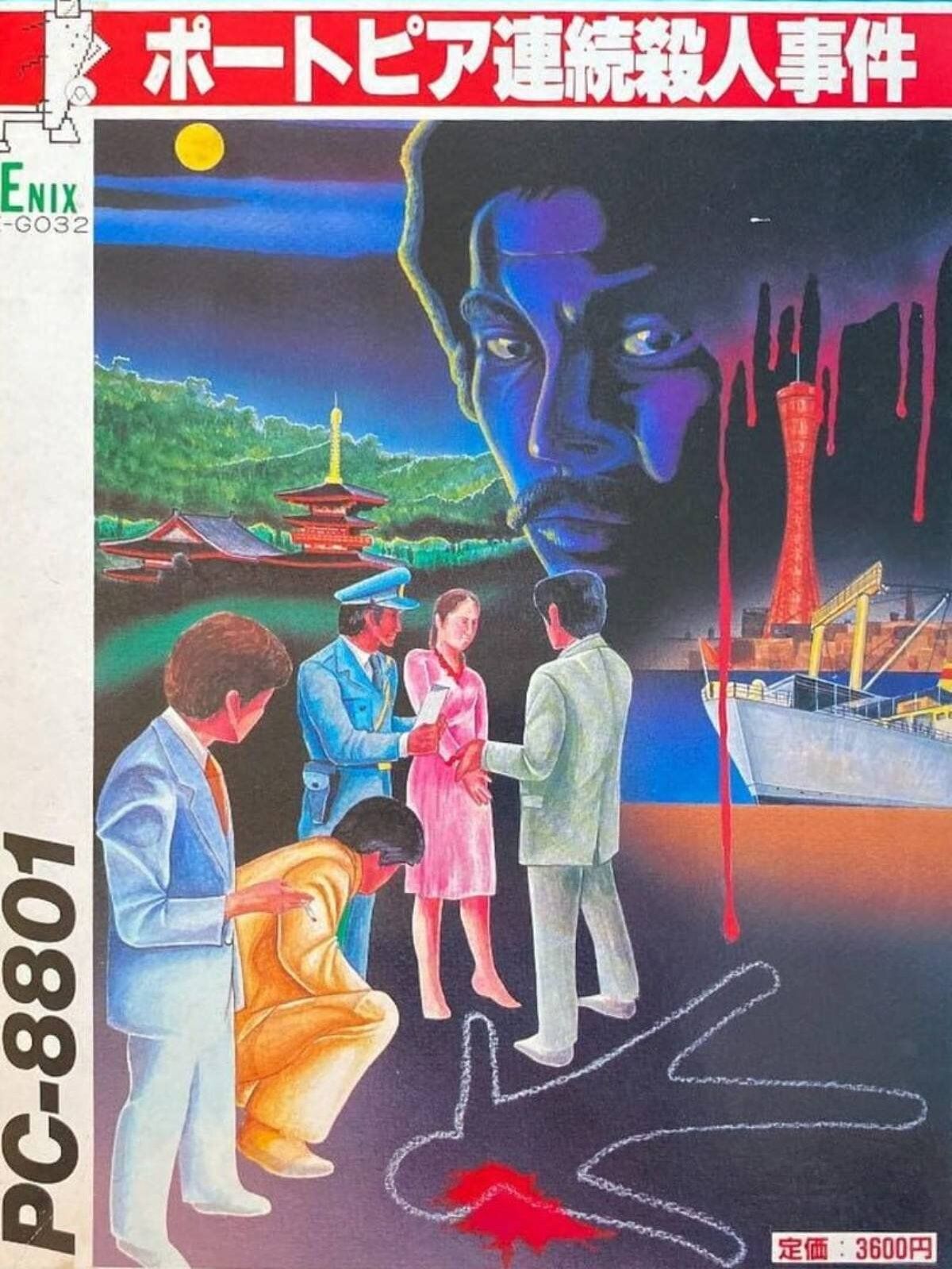
The Portopia Serial Murder Case (ポートピア連続殺人事件) is an Adventure Game developed by Enix, originally released for the NEC PC-6001 and various other computers in June 1983. The game would later be ported to the MSX and the Famicom console in 1985, the latter courtesy of Chun Soft, who swapped out the computer version's text parser with a menu-based interface that many Japanese adventure games would go on to adopt.
A wealthy banker named Kouzou Yamakawa is found dead in his mansion by his secretary, and while all immediate signs seem to indicate that it was a suicide, the police are still suspicious and send in a private detective to investigate further. You are that (unnamed) detective, and alongside your assistant Yasuhiko "Yasu" Mano (who simply calls you "Boss"), you must travel around Kobe to learn the truth of the matter. And you better have your walking shoes on, because it quickly becomes clear that Kouzou wasn't a nice guy by any stretch, and there's a long list of people who could've wielded that bloody knife.
While largely unknown in the West, Portopia is considered one of the most influential games of all time in Japan, acting as the Trope Maker for Japanese adventure games and the Visual Novel genre by being the Ur-Example of numerous tropes in the context of video games, including the Choice-and-Consequence System, Dialogue Tree, Immersive Sim, Multiple Endings, Point-and-Click Game, Story Branching, Unreliable Narrator, and even the Wide-Open Sandbox. Its success put Enix on the map, allowing creator Yuji Horii to go on and create the even more successful Dragon Quest franchise (which would itself become a trope maker for the Eastern RPG genre). Portopia has regularly been cited as a key inspiration and influence for several Japanese developers, including Hideo Kojima (Snatcher, Metal Gear), Yoshio Sakamoto (Famicom Detective Club, Metroid), and Eiji Aonuma (Marvelous: Another Treasure Island, The Legend of Zelda). The game would be succeeded by two more mystery adventures that would come to be collectively known as the Yuji Horii Mysteries along with Portopia: these being The Hokkaido Serial Murder Case: The Okhotsk Disappearance (1984)note , which was actually the first of the series to use the menu interface before Portopia's Famicom port; and Karuizawa Kidnapping Guide (1985).
An English Fan Translation of the Famicom version was released in 2006 by DvD Translations; this translation later saw additional updates in 2010 and 2011, and can be downloaded here . The game would see multiple mobile phone ports over the years, but its official international debut would be through a freeware Video Game Remake on April 20, 2023; titled Square Enix AI Tech Preview: The Portopia Serial Murder Case, this version of the game doubles as a tech demo for the improvements in natural language processing achieved in the years since the original PC-6001 release. It can be downloaded on Steam here.
Tropes found in this game include:
- 555: The original game has a regular phone number for Pal Bar (first three digits 117), while the remake changes it to a 555 number.
- Asshole Victim: Kouzou and Kawahara were conmen who had destroyed numerous lives, including causing Yasu and Fumie's parents to commit suicide. Subverted for Kouzou, however, as he had become The Atoner.
- The Atoner: Near the end of the game, the player finds a diary from Kouzou which reveals he was aware that Fumie, Yasu's sister, was the daughter of one of the families he destroyed, and in fact had been trying to care for her as a surrogate daughter. Yasu is devastated to learn this fact, and it's implied is what drives him to confess to the murders once he's outed as Fumi's older brother.
- Book Safe: There's a key found in a book in the mansion.
- Chalk Outline: As shown on the box artwork, and in-game. It's simply used to show where the body was located.
- Conclusive Confession: After the Boss pushes Yasu to take off his clothes and thus prove himself as Fumie's older brother through his birthmark, both he and Fumie confess to the crime, confirm the suspected reason they did it (vengeance for their parents), and explain how they committed the murders.
- Deadpan Snarker: Yasu can get like this when your commands are nonsensical."He's the one who was killed. Probably doesn't need to have an alibi."
- Detective Mole: Sort of. As in, your assistant is the killer.
- Diegetic Interface: Almost all of your commands are orders given to Yasu; almost all the game's text is his response or description of what happened as a result.
- Distinguishing Mark: A local states that Fumie's older brother separated from her when they were taken in by different relatives had a butterfly-shaped birthmark on his right shoulder. This is how the player is able to identify Yasu as Fumie's older brother and thus the culprit of Kouzou and Kawahara's murders.
- The Dog Was the Mastermind: Without question, the reason why the game is so remembered. Yasu is literally the foundation on which the game is built, being the Second-Person Narration as well as the one who carries out all actions. Him being the culprit has since became a shorthand for the identity of the culprit in Japanese mystery fiction.
- Driven to Suicide: Hirata, implied to be as a result of his accumulated debts. Surprisingly a case almost completely unrelated to the main mystery.
- Easter Egg: There is some optional bonus content within the game, most prominently the optional dialogue that can be gotten from dialing certain numbers on the phone:
- Dialing '000 000 0000' will result in a person on the phone speculating on who the killer is, depending on the part of the story the player is at. Initially, it's Toshi. After Toshi is arrested for dealing drugs, it's Mr. Hirata. After Mr. Hirata is found dead, it's Mr. Kawamura.
- Dialing the police number in Japan, 110. If done near the start of the game, the emergency operator will yell at you. If done after finding Mr. Kawamura's dead body, the emergency operator leaves you hanging.
- First-Person Perspective: The game's events are almost entirely conveyed through Yasu's narration, however the perspective is undeniably that of the Boss. He is never shown in-game from an external perspective, whilst Yasu is.
- Foreshadowing: Talking to the bar owner about Kouzou leads to him mentioning that he'd witnessed a fight between him and Kawahara. Interviewing Ooki adds to this since she mentions Kawahara was blackmailing Kouzou about their history together. The fight was because of Kouzou wanting to split away from Kawahara, hinting at the revelation near the end that he'd become The Atoner.
- Guide Dang It!: Lots of it, but a few instances especially stand out:
- The ring. The player has to go to the outside of the Yamakawa Mansion and examine the bottom the door, a completely random and inconspicuous area, and then present it to Toshi. Not only does nothing even hint that such an item would even exist, but by this point the player is likely to have had Toshi arrested, and would thus have no reason to think there's anything else for him to even say.
- Proving to the barkeep who Kouzou is and that he has a connection with Kawahara. It requires heading back to Kouzou's mansion and examining two spots which are completely unmarked. Not just objects, either, but specific spots, and the latter of the items, the lighter, doesn't even have any clear relation to the conversation anyway.
- By far the worst however is finding Kouzou's diary. After being told of something hidden in the maze, the player has to go down there, follow the steps provided to them...and find themselves in a random hallway. The solution? You have run into one of the walls multiple times, revealing it conceals a hidden room, the only hint to this being that wall plays a different sound if you run into it. Oh, and forgot the directions given to you? You're out of luck, since it's only told to you once.
- Additionally, finding your way back out of the maze after completing the above isn't exactly easy, either. You get no indication of how to get back out, and even if you try to reverse engineer the original directions, it's mandatory that a part of the maze closes after you when you're following the initial directions. Either you crack open a walkthrough for the directions back, or you spend goodness knows how long wandering randomly through the maze until you stumble upon the exit.
- Hooker with a Heart of Gold: Implied with Ooki, a stripper who is by far the most cooperative and useful of any of the witnesses as she directly tells the detectives that Kouzou and Kawahara were conmen, Kawahara threatened to blackmail Kouzou over this, tips off Kawahara's location, and connects Fumie as the child of one of the duo's victims.
- Immersive Sim: It was the first game to have most of the key immersive sim elements, making it the Ur-Example. It was a first-person adventure game with an open world, character AI, choices and consequences, non-linear game design, open-ended narrative told through notes and diaries, interactive environments, emergent gameplay, allowed multiple ways to achieve objectives, and lacked fail states.
- Informed Attribute: Inevitable given the game's very slim characterisation, but Yukiko is mentioned to have been a delinquent who had recently reformed. No evidence of this is ever shown in the game, other than possibly explaining her rather hostile and unpleasant behaviour towards the detectives.
- Locked Room Mystery: The victim was found in a room locked from the inside. In reality, the room had never been locked. Fumie just made it look that way after the body was discovered.
- Long Lost Sibling: Yasu is Fumie's older brother who was separated from her after their parents committed suicide following them being conned into bankruptcy by Kouzou and Kawahara.
- The Maze: In the NES version, the basement is a maze with a few one-way doors.
- Multiple Endings: An Ur-Example of this trope. Whilst there's only one main storyline, closing the case pre-emptively as a suicide when Yasu prompts you to will quickly result in an ending where the police chief berates you for letting the case go so easily.
- My God, What Have I Done?: Implied to be Yasu's reaction after he learns that Kouzou had in fact become The Atoner hiring Yasu's sister Fumie knowing she was the daughter of one of his victims.
- No Ending: Downplayed. The game ends right after Yasu and Fumie are revealed as the culprits and have explained their murder methods, the final lines being them calling out each other's names. No information is given about what happens afterwards. Though this aligns with the general lack of focus on characterisation in the game as it primarily prioritises following the mystery, it can still feel abrupt to modern players.
- Notice This: The remake has items that may be investigates marked with a star-shaped light.
- Pixel Hunt: There are four items you need to find to progress with the game. Of these, at least two aren't linked with an obvious visual cue.
- Point-and-Click Game: This game contains an Ur-Example of point-and-click mechanics. In the original versions, whilst the default controls only let the player flick between the options on the menu at the side, investigating the area with the Magnifying Glass allows the player to directly control a cursor on-screen, and click on things they want to investigate. This is required to pick up multiple key items for progression.
- Police Are Useless: Downplayed. Yasu is enthusiastic, but tends to assume the simplest solution to the case without much follow-up. Thanks to Multiple Endings, you can do the same. Granted, Yasu's trying to get the case solved as quickly as possible so he doesn't get caught.
- Police Brutality:
 Values Dissonance for many modern players; the interface has an actual 'hit' button, which (among other things) you must use on suspects during interrogations in order to proceed.
 - Police Procedural: While not remotely accurate (you freely use brutality in interrogations, for instance), the game focuses a lot more on this aspect of play than many later entries in the genre; the core gameplay loop consists of collecting evidence and witness statements, then bringing in a suspect and interrogating them.
- Red Herring: Two examples are required to be pursued to progress the story:
- Toshi is the only four of the initial suspects who has a clear motive (inheritance money), and his alibi is easily proven false through basic investigation. Turns out he's just a drug dealer, however, and otherwise has no connection to the case.
- Hirata has a clear motive for killing Kouzou, no alibi and disappeared the night of the murder, all pointing towards his guilt. Turns out he'd committed suicide before Kouzou even died.
- Say My Name: The game closes on Yasu and Fumie calling out each other's names.
- Shout-Out: The maze you explore at the end is a shout-out to Wizardry; in particular, at one point there's an inscription on the wall saying that a monster leaps out at you (it doesn't.)
- Sympathetic Murderer: Yasu killed Kouzou and Kawahara as revenge for them driving his parents to commit suicide. He's clearly remorseful for murdering Kouzou once he discovers that Kouzou had knowingly hired Fumie and planned to leave money for her trying to atone for above, which is implied to be why he ultimately confesses.
- Unbuilt Trope: Compared to most of the genre of visual novels it inspired, The Portopia Serial Murder Case is far more of an open-world game and much less of a "novel"; it also plays around with the concept of a videogame interface, which was still relatively new at the time, through its Diegetic Interface.
- Unexpected Genre Change: At one point, the game unexpectedly shifts from a pixel-hunting detective mystery to a 3D-ish Wizardry-style maze explorer (though with no RPG mechanics.) This is because Yuji Horii actually created the game after being impressed by Wizardry itself at a demonstration in the US; his ultimate goal was just to make enough money to fund what would eventually be Dragon Quest.
- Unreliable Narrator: The story is told through Second-Person Narration. In the game's twist ending, it is revealed that the narrator was the culprit all along.
- Visual Novel: It is the Trope Maker of the visual novel genre.
- Wide-Open Sandbox: Portopia was the first adventure game to feature an open world.
- Wouldn't Hit a Girl: If you try to use the hammer on a girl after she's been brought into the police station for questioning, one of Yasu's potential dialogues is him outright refusing to do it for this reason. His description in the manual says that he is a gentleman who is particularly lenient towards young women.
- You Can't Get Ye Flask: The remake sometimes requires specific wording. For example, finding the button in The Lounge accepts "Examine picture", but not "Take picture", when it requires "take frame".