

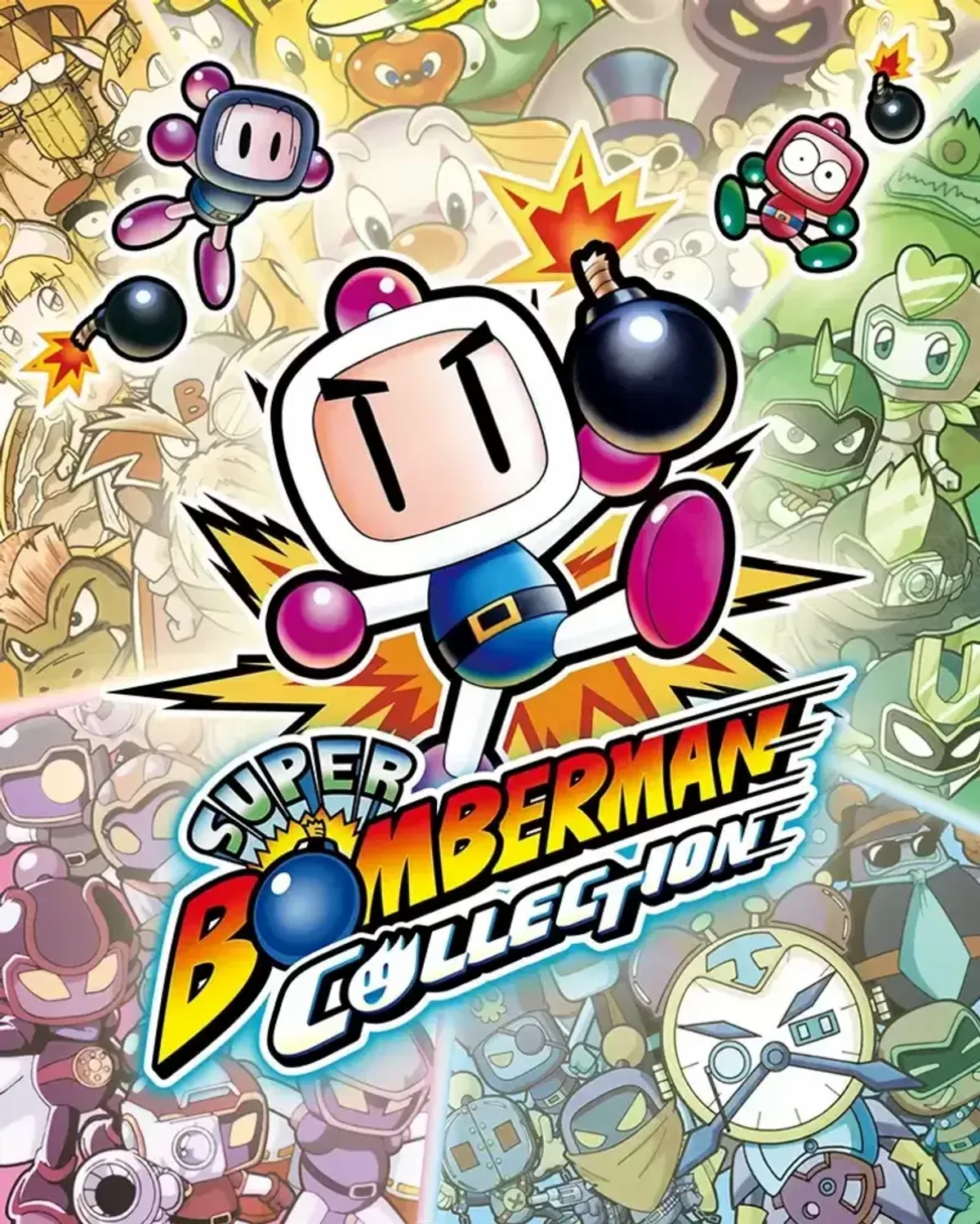
Super Bomberman is a series of Bomberman games released in the early-to-mid 90s for the Super Famicom/NES. The first two games were released internationally, the third was released in Japan and Europe, and the fourth and fifth games were Japan-exclusive.
The games make use of the classic gameplay formula: the stages are laid out in a grid pattern with enemies and destructible blocks. When all of the enemies have been defeated, the exit will open and the player can progress to the next stage. Some games instead require you to activate/destroy switches to open the exit. Super Bomberman 5 also gives several branching paths, and it is possible to reach the (good) ending without seeing 3/4s of the game.
The first Super Bomberman was one of the first SNES games to allow four-player multiplayer, which required the use of a Multitap device. It was largely through these games that Bomberman became synonymous with frenetic multiplayer. The third through fifth games upped this to five players.
In 2017, the series finally saw its first new entry in two decades, Super Bomberman R for the Nintendo Switch. The following year, the game was ported to Steam, PlayStation 4 and Xbox One. Super Bomberman R Online, a free-to-play rerelease with a revamped Battle Royale Game-esque online mode and new characters and outfits, was released on September 2020 as a timed exclusive for Google Stadia and shut down on December 2022.
In June 27, 2022, a sequel to Super Bomberman R was announced. Super Bomberman R2 expands the classic Bomberman-style gameplay with new additions like "Castle" mode, where one player defends their castle from 16 other players, and a new exploration mode and the return of the Battle Royale mode from Super Bomberman R Online. It was officially released on September 13, 2023.
On February 5, 2026, the Super Bomberman Collection was announced for the Switch, Nintendo Switch 2, PlayStation 5, Xbox Series X|S, and Steam, bringing 3 through 5 to the US (as well as 4 and 5 to Europe) for the first time ever. As a bonus, the collection also includes the Famicom versions of both the original Bomberman and Bomberman II, with Super Bomberman: Panic Bomber W, the Super Famicom iteration of the Panic Bomber Puzzle Game spin-off series, set to be added on August 20, 2026.
Games in this series are:
- Super Bomberman (1993)
- Super Bomberman 2 (1994)
- Super Bomberman 3 (1995) - No US release
- Super Bomberman 4 (1996) - Japan only
- Super Bomberman 5 (1997) - Japan only
- Super Bomberman R (2017)
- Super Bomberman R Online (2020)
- Super Bomberman R 2 (2023)
- Super Bomberman Collection (2026)
These games provide examples of:
- 100% Completion: Super Bomberman 5 features 100 levels, and each unique level cleared contributes 1% to the completion rate. The player will only be able to visit a small fraction of them on each playthrough due to this game's story mode's non-linearity. Getting 100% allows the player to start a New Game Plus where power-ups get shuffled around and they can go for 200%.
- Action Bomb: In many of the games, there are enemies that are essentially hovering bombs with eyes. Occasionally, they would plop themselves onto the ground and shoot out fire in four directions to emulate an explosion without destroying themselves. Other enemies (including other bomb monsters) aren't immune to their flames, so they might end up accidentally killing enemies for you, though you aren't awarded any points for the kill(s). They can also destroy power-ups or release monsters from the exit, so you have to make sure to deal with them swiftly.
- All in a Row: 4 allows the player to have up to two extra eggs, which will follow the player. The player can move against a wall to have the eggs compress into the same spot that the player is in, to prevent the eggs from accidentally getting destroyed by fire.
- Americans Are Cowboys: The Bomberman representing the USA is even called Bomber the Kid.
- Anti-Frustration Features: In Collection, the player is allowed to use a rewind feature if they get damaged during Normal Mode.
- Arc Number: 5656. Entering it as a password in the various 16-bit Bomberman games almost always had an effect, though what it did varied depending on the game.
- Artificial Brilliance: Anytime you face a Bomber enemy controlled by the computer, the Bomber bosses tend to be the most challenging enemies of the game, and for good reason. The CPU can be ruthless, even the meekest CPU has a tendency to artfully find holes in your bomb placements, and if they have the ability to kick, punch, or throw bombs, you can bet they'll put it to good use with devastating results against you — or to get out of hairy situations like any player would. Without remote bombs or something to break their AI, you're not getting past these guys simply by randomly laying bombs.
- Art-Shifted Sequel: The first two games had a realistic art style with washed out colors. The games from 3 onwards trade this with a more colorful, expressive, and anime-like art style.
- As Himself: An update for Super Bomberman R introduced Xavier Woods Bomber, voiced by the man himself.
- Bad Future: Akuukan (Japanese: 亜空間, literally 'hyperspace'), the final area of Super Bomberman 4 — the penultimate area is Choumirai (Japanese: 超未来, literally 'super future'), which is a Good Future.
- Boring, but Practical: White Bomber in Online. He is essentially the "vanilla" character, with no special abilities and all abilities starting at Lv. 1. However, he is the only character who is capable of reaching the full maximum level of Lv. 8 for Flame, Bomb and Skates, and access to every power-up lets him be flexible. This essentially means he has Magikarp Power, as he starts out fairly mediocre but if he survives long enough to hoard a bunch of power-ups, he becomes one of the most powerful characters in the endgame.
- Boss Rush: In 4, the final area, Hyperspace, has Bomberman facing all of the previously fought Bomber Kings before engaging Bomber Great. The final fight against Buggler starts with him re-summoning all of the main bosses before facing Bomberman.
- Brain in a Jar: Buggler at the end of Super Bomberman 3. He continues like this in Super Bomberman 4. He's shown getting a new body in Bomberman Hero.
- Bubblegloop Swamp: Mori Mori Star / Swamp Attack in Super Bomberman 3.
- Call-Back: Great Gattaida, the first phase of the Final Boss in Super Bomberman R, is an upscaled version of Gattaida, the final boss of Super Bomberman 3.
- Collision Damage:
- Enemies kill you on contact.
- In the first game only, hitting enemies with kicked bombs will do the same amount of damage as an explosion.
- This is Pyramid Head Bomber's special ability in R and Online. Using it causes Pyramid Head Bomber's walk speed to slow to a crawl, but if anyone touches it while its ability is active they instantly keel over and die. In Online, this is balanced by Pyramid Head Bomber's stats and power-up access being the worst in the game, but in a hectic online match where players are passing by each other constantly it is surprisingly easy to net kills by just flipping the switch when unaware opponents get too close.
- Combining Mecha: In Super Bomberman 3, the Five Dastardly Bombers become a large mecha for Buggler to ride after joining together.
- Competitive Balance: Grand Prix Mode in Super Bomberman R, as well as Grand Prix, Battle 64, and Castle Mode in Super Bomberman R 2, tends to give characters with stronger abilities weaker stats. It also gives weaker maximum stats to characters with stronger starting stats.
- Compilation Re-release: Super Bomberman Collection contain all five main games, including new features such as Boss Rush mode, a rewind function, a Concept Art Gallery, and two extra games from the NES, Bomberman and Bomberman II. A later update added Super Bomberman: Panic Bomber W, a Super Famicom version of the Panic Bomber puzzle game spin-off that takes place in the Super games' timeline, specifically between the events of Super Bomberman 2 and Super Bomberman 3.
- Concept Art Gallery: In Collection, the bonus section contains an art gallery for all five main games depicting concept art and character designs, including from the anime OVA, Thanks for the Courage
 .
. - Cursed with Awesome: The 2nd phase of the final boss in Super Bomberman has the two villains in a hovering vehicle tossing out Skull items all over the stage. Their intent is for you to accidentally collect them and kill yourself because the Skulls' effects caused you to mess up while fighting the boss. However, getting a Skull does give you a hefty amount of points, so if you can deal with their effects, you can collect them to gain enough points for some extra lives.
- Cyberspace: Planet Brainwave in Super Bomberman R.
- Death Seeker: In Super Bomberman R 2, Fusell's ultimate goal is to kill himself and all the Ellons and Lugions in a massive explosion. The problem is not just the genocidal part of the plan, but the fact that the explosion would wipe out the whole universe.
- Delayed Explosion: The "dud" bombs in Super Bomberman. Rarely, bombs would fizzle out partway through their fuses and not explode when they were supposed to. If they weren't set off by something else, the bombs would eventually reset themselves with a longer fuse before finally exploding.
- Demoted to Dragon: Plasma Bomber debuted as the villain of 2. In 3, his creator, Buggler, becomes the Big Bad while Plasma Bomber is the penultimate boss fight.
- Demoted to Extra: Due to the campaign in 2 only allowing for one player, Black Bomberman is only playable in the battle mode in that game.
- Destroyable Items: In all of the games, any power-up that appears on a level can end up getting destroyed by a bomb.
- Double Knockout: Mass-mutual KOs are common in multiplayer, due to the hectic pace of battle.
- Dynamic Difficulty: A slight example; in the arena world of 1, there will be two Mecha-Bomberman opponents per stage in two-player play instead of just a single opponent per stage in one-player play.
- Early-Installment Weirdness:
- The series isn't internally consistent with its primary setting. In particular, Super Bomberman 3 is the first named appearance of Bomber Nebula, yet it still depicts Earth (despite the game it was based on debuting Planet Bomber). By Super Bomberman 5, Planet Bomber was given a new appearance and suddenly replaced Earth as Bomberman's home.
- 2 is a bit of an oddball in ways too, perhaps due to the fact that it was a completely different team than the first game, and not even sharing the same composer as all the other games. One major difference from the other games is that it has scrolling levelsnote , and thus does not allow multiplayer at all in its story mode.
- Easy Levels, Hard Bosses: While the later stages in the game can throw you a few curveballs, regular maps are mostly meant as an opportunity to gather power-ups. The bosses, by contrast, do not mess around: even ignoring the cases of Fake Difficulty (of which there are a few, the Final Boss of 1 and 2 are especially guilty), they take multiple hits compared to your measly one and can flood the arena with hazards on a whim. Bosses that follow PvP rules can be even worse if you're not good at the multiplayer.
- End-Game Results Screen: In 5, depending on how many levels were completed, a screen after finishing the game shows the overall percentage done and provides a given rank.
- Eternal Engine: Many. Brain Bomber's spaceship (also to a lesser extent Plasma Bomber's) in Super Bomberman 2. The Clockwork Terrain in Zone 5 of Super Bomberman 5. Also, Planet Technopolis in R.
- Every 10,000 Points: Most games give extra lives at various point plateaus.
- Eviler than Thou: Of sorts. Moments before his Heel–Face Turn in Super Bomberman, Black Bomberman gets beaten by a Mecha Bomber from the game's main villains (Carat Diamond and Dr. Mook).
- Expy:
- Four of the World Bombers from Super Bomberman 3 could be this to the World Bombers from Super Bomberman: Panic Bomber W:
- Raster-Bomber: Mexican Bomber
- Metal-Bomber: Metal Bomber (?)
- Bom-Gunman: Bomber Kid
- Animal-Bomber: Bomber Uhho
- The appearance of the Green Bomber in R resembles the design used for the White Bomber in Bomberman Jetters.
- Four of the World Bombers from Super Bomberman 3 could be this to the World Bombers from Super Bomberman: Panic Bomber W:
- Fake Difficulty: World 5 in the first game. A chain of fights against Mecha Bombers, with each fight counting as one stage, it will probably kill you at least once. Not by anything the bombers do, necessarily, but by virtue of running out of time without any time pickups to be had, since the time does not reset between fights. Kiss your Remote Bombs goodbye, and it's not even your fault.
- Fast-Forward Gag: In 5, the credits for the bad ending pass by at quick speed, giving Bomberman Wingding Eyes.
- Giant Space Flea from Nowhere: In Super Bomberman 2, after Plasma Bomber is defeated, he decides to concede and shake hands with Bomberman, moments before a energy beam emerges from his machine and destroys him, with the G-Ganzu suddenly revealing itself out of nowhere to act as the final boss.
- Guest Fighter:
- Super R invites Vic Viper, Simon Belmont, and Pyramid Head as DLC. A later patch introduced Jehuty and Anubis, a Bubblehead Nurse, Reiko, Goemon, Dracula, an Option, Shiori Fujisaki, and Princess Tomato.
- Another later patch introduced Solid Snake, Naked Snake, and Raiden, Ebisumaru, Bill Rizer and Lance Bean, Vic Viper Zero, Ayako Katagari, and Xavier Woods.
- The PS4, Xbox One, and PC releases of Super R adds Ratchet & Clank, Master Chief, and P-body, respectively.
- Ver 2.2 adds bombers based on Alucard, Mimi and Nyami, and Upa to every version. Version-exclusive characters include Caesar for the Switch release, Pipo Monkey and Toro from Doko Demo Issyo for the PS4 release, an Arbiter and a Grunt for the Xbox One release, and Atlas for the PC release.
- Super Bomberman R Online adds Richter Belmont Bomber and Robbie the Rabbit Bomber. Once R Online went multiplatform, the game added Bombers based on Old Snake and a Bean.
- R Online Season 2 adds Soma Cruz Bomber, and Season 3 adds Suikoden 2 Hero Bomber.
- R 2 version 1.3.0 adds Luca Blight Bomber.
- Guide Dang It!: Getting 100% Completion, or even just the Good Ending in Super Bomberman 5 can be tough without a guide that tells which exits lead to which stages. Though the game is at least nice enough to color-code the exits: Ones that go to new levels are colored yellow, and ones that go to previously-visited levels are a dark purple.
- Heel–Face Turn:
- Black Bomberman had spent three games before as the antagonist, but by Super Bomberman he's gone through this.
- Plasma Bomber almost did in Super Bomberman 2.
- All 5 Dastardly Bombers have one in Super Bomberman R.
- In Super Bomberman R 2, Fusell ends up giving up his plan to destroy the universe when White proposes the idea of him using his ridiculously long lifespan to find a way to restore the Lugions from their Empty Shell status.
- Inconsistent Spelling: The recurring Big Bad was originally romanized as Buglear in Bomberman '94. In the Super Bomberman 3 PAL manual, he's now referred to as Professor Bugler, and then Professor Buglar in the very next sentence (which happens twice).
- Inconveniently-Placed Conveyor Belt: They will move either players or bombs that stand on them, though the player can generally move fast enough to outrun them.
- Joke Character: Green Bomber in Online, who is the worst character in the game by a fair margin. He starts with Punch, Kick, and Power Glove, but he has miserable stats, with maximum Lv. 1 Flame, Lv. 1 Bomb, and no Skates and cannot pick up Piercing or Rubber Bombs, and unlike characters with similar stats like Pyramid Head Bomber, Green doesn't have a special ability to balance it out. Green's game plan essentially revolves around trying to kill opponents with their own bombs, as he is so terribly weak otherwise that it'd be a miracle to actually net a kill on his own.
- Kingmaker Scenario: 3 and onward have the "Gutter Bomb" option in their Battle Modes to allow defeated players to influence the match by throwing bombs in from the edge of the arena.
- Konami Code: In Super Bomberman Collection, quickly inputting the code (minus the "Start" input) while the Konami logo appears during bootup unlocks the hidden battle stages in SB2-SB5 — originally they could only be accessed by mashing X using the turbo function on Hudson's own special controller, which obviously isn't as replicable on modern hardware. You'll know you've succeeded if the background for the wraparound menu is red instead of the usual yellow.
- Landfill Beyond the Stars: Planet Scrapheap in SB R.
- Law of Chromatic Superiority: The opponents in the arena stage of 1 all look identical other than their color, though they get progressively tougher. The first four take just one hit to defeat. The next three take two hits and have better AI. The golden-colored boss comes with many more power-ups, including maximum range and bomb kick, and takes five hits.
- Lethal Lava Land: Achi Achi Star / Firestorm in Super Bomberman 3.
- Living Dinosaurs: Different dinosaurs show up early on in Super Bomberman 4 as generic enemies... until you blow them up and they turn back into eggs. The first one you walk over hatches back into the same dinosaur and gives you a ride, while any extra ones follow you around like Yoshi eggs.
- Long Song, Short Scene: For Super Bomberman 2, some themes, like the intro theme, are cut short before they can finish playing.
- Marathon Level:
- The final world of Super Bomberman 3 consists of just one stage, but it is eight screens long, with the final screen naturally being the Final Boss fight.
- The arena world in the first game may also count, as the fights go one after another with no break (though technically each fight is one stage — this can be seen by using passwords). Running out of time can be a very real problem if one does not get a clock item, which unfortunately pseudo-Randomly Drops.
- Massive Multiplayer Crossover: Super Bomberman R, Super Bomberman R Online, and Super Bomberman R 2 feature a lot playable cameos, ranging from well-known characters from Konami's repertoire like Simon Belmont and Pyramid Head, to other recognizable third-parties like Master Chief and Ratchet & Clank, to more out-there choices like Princess Tomato and Reiko Hinomoto.
- Megamix Game: Super Bomberman 5, with the first four worlds being based on the four preceding games.
- Mercy Invincibility: A very generous amount is given to you at the beginning of every stage in the first Super Bomberman game, so much that a trick could be used to take advantage of it. Lay a bomb, and wait for it to explode, then keep tapping the A button to lay more bombs, which will immediately explode because they are within an explosion. Walk around the stage while doing this and you can get a very nice head start. Just make sure you stop before your invincibility wears off, or, well…
- Super Bomberman 5 also starts you with invincibility, although a much smaller amount. The other three games don't start you with invincibility.
- Mini-Mecha: In 2 and 3, the Five Dastardly Bombers pilot their own unique machines when fighting Bomberman in their boss fights.
- Mirror Boss: The Mecha Bombers in Super Bomberman, along with other on-foot bomber bosses in the sequels.
- Multiple Endings: 5 has two endings depending on whether the player found the correct path to face Terrorin.
- Bad Ending: Terrorin and the Fiendish Bombers teleport away, leaving Bomberman confused.
- Good Ending: Terrorin is destroyed and Bomberman has the Fiendish Bombers imprisoned back in their jail cells.
- Mutually Exclusive Power-Ups:
- The piercing bombs and the manually thrown bombs.
- Super Bomberman 5 also has Land Mines and Pursuing Bombs. Even though Pro Action Replay codes could let you combine Piercing and Remote, those other two still won't stack with Remote.
- Also, if a game has both Bomb Kick and Bomb Walk abilities (again, SB5), they may not be able to overlap either.
- The first Super Bomberman averts this by letting you have both piercing (colored red instead of having spikes like in later games) and remote bombs at the same time without cheats. They'll just be red remote bombs, and have both powers at once.
- My Rules Are Not Your Rules: The final bosses of 1 and 2 are hated for this. Like some enemies in the game, they float to avoid bomb explosions; unlike other enemies in the game, they never come back down. The only way to damage them is to use the Bomb Punch/Glove power-up to hit or throw them over the head... which is implying that you, you know, have it and didn't LOSE it from dying. It becomes less of a battle against the boss and more of a battle against the RNG to try and dig up a Bomb Punch/Glove from under a destroyable block; the game becomes Unwinnable otherwise. Thankfully, all the later Bomberman games didn't use bosses like this.
- Mythology Gag: Super Bomberman R's unlockable cross-over characters have specific quirks to them that reference their own series, but Vic Viper Bomber's rocket helmet makes him out to be a Good Counterpart to Sirius, who had armor that let him turn into a jet.
- Natives of Planet Castlevania have a specific vocal filter that emulates the "empty hall" echoing effect of spoken dialogue in Symphony of the Night
- National Stereotypes: The battle mode in 3 is full of them, except for Japan having the standard Bomber.
- Neon City: Gendai in Super Bomberman 4.
- New Work, Recycled Graphics:
- Super Bomberman 3 and (to a lesser extent) Super Bomberman 4 reuse assets from the TurboGrafx-16 games. Super Bomberman 5 also reuses a lot of graphics from all four previous Super Bomberman games.
- In a bizarre instance of this and Company Cross-References, Super Bomberman 3 reuses a lot of enemies from the Neutopia games wholesale.
- No Fair Cheating: In Collection, playing in Battle Mode has the rewind function disabled to prevent players from using it to gain an advantage.
- Non-Fatal Explosions: At the end of 2, Bomberman is left on the spaceship before it completely explodes, but is merely blown away and makes it back to Planet Bomber unscathed.
- Non-Indicative Name:
- Emperor Terrorin, the villain of Super Bomberman 5, who is the leader for no empire to speak of, save for the Criminal Bombers that he breaks out. One can only assume that he seeks to establish an empire, or his empire is time itself (at least in his own mind).
- Super Bomberman R Online is not an Updated Re-release of Super Bomberman R despite having "Super Bomberman R" in the name. It's a standalone free-to-play online game that uses the gameplay and (most of the) characters from Super Bomberman R.
- No Plot? No Problem!: The first five SNES and Super Famicom titles had a "
 gameplay first, story last" mindset to them as in most cases, the story is either locked away in a physical instruction manual or is only seen as cutscenes, one at the start, and the other at the end of the game. It took until Super Bomberman R, a game that released a whole 21 years after Super Bomberman 5, for the series to finally subvert this in-game and start treating worldbuilding and characterization as a major part of the game.
 - Oh, Crap!: In 5, Bomberman and the main bosses panic when they get trapped in front of a bomb with no way to escape before they get blown up.
- One-Hit-Point Wonder:
- Getting caught in explosions or colliding with enemies means instant explodey death. Grabbing the Heart power-up granted you one hit of Mercy Invincibility. This is played very straight in R, where there is no Heart power-up.
- Averted in Online's Battle 64 mode, where players start with two lives and can pick up Hearts from defeated opponents.
- 1-Up: Shaped like the player character. The first game also features a fire extinguisher powerup that maxes out the player's lives at 9.
- Planet of Hats: One of the series' favorite settings for their story modes is a world where every planet consists of a single biome and/or culture.
- Planet Spaceship: The main setting of Super Bomberman 2, and Bagurā Ship / Battleship in Super Bomberman 3.
- Point of No Return: As soon as Plasma Bomber is defeated in 3, the player is unable to return to previous stages due to Bagura's Battleship threatening to destroy the main 5 planets otherwise.
- Poison Mushroom: The geta (wooden sandals) in later games reduces speed by one level, cancelling out one roller-skate power-up. May be good if if Bomberman has gotten too fast to control well, though.
- Power-Up Mount: The Rooi kangaroos in 3 and 5; half of the enemies in 4.
- Prehistoria: Genshijidai (Japanese: 原始時代, literally 'Primal Age') in Super Bomberman 4.
- The Present Day: World 3 of Super Bomberman 4, called 現代 gendai, which translates to the trope's name.
- Puzzle Boss: The 2nd phase of the final boss of Super Bomberman has the two villains in a hovering vehicle well above any bomb explosions you try to send their way. To defeat them, you need to use the Punch Glove to lob bombs directly at the vehicle. If you don't have the Punch Glove, the game will give you one if you wait long enough.
- Quirky Miniboss Squad: The Five Dastardly Bombers introduced in Super Bomberman 2, the Bomber Shitennou in Super Bomberman 4, and the 8 Kyouaku Bombers in Super Bomberman 5.
- Recycled Soundtrack:
- Super Bomberman 4 reuses a few songs from Super Bomberman 3 (like the multiplayer battle, regular boss, and final boss themes).
- Super Bomberman 1 re-uses the title theme, battle theme, and all three stage themes from the 1990 PC Turbo Grafx 16 Bomberman game. Same goes for Super Bomberman 3.
- 3 (alongside 4) also borrows many tunes from Bomberman '93 and Bomberman '94. They basically are the same songs but with the SNES sound font. For instance, 3 lifts its title theme, intro theme, and map screen themes, among others, from '93.
- Red Oni, Blue Oni: In Super Bomberman R, Pink and Pretty are the Red to Aqua's Blue.
- Rewarding Vandalism: While blowing up the exit in the first game will make an enemy (or sometimes multiple) spawn, on a few stages it can also uncover some very nice items, like a heart, or the fire extinguisher which maxes out a player's lives.
- Rouge Angles of Satin: The nationalities in the battle mode of 3, "French" and "Kenia" were corrected to "France" and "Kenya" in the European release.
- Shifting Sand Land: Sara Sara Star / Pyramid in Super Bomberman 3.
- Shown Their Work: In an aversion of the franchise's usual fare of Hollywood Science, Super Bomberman R actually shows signs that the developers have done their research: The black hole created by Bagular during the climax may not be the popular idea of a black hole, but it actually resembles one of the many possible looks of real-world black holes◊.
- Sinister Silhouettes: In the Japanese manual for 3, Buggler's machine, the Gattaida, is displayed as a silhouette with a question mark on it, with the full design revealed during the final boss fight.
- Slippy-Slidey Ice World: Yuki Yuki Star / Winterland in Super Bomberman 3. Also Planet Lalaland in R.
- The Smurfette Principle:
- The only female humanoid characters in the Super Bomberman series consist of Pretty Bomber, Lady Bomber, and Honey. Pretty Bomber would go on in the Bomberman Land series as the only main female.
- The Dastardly Bomber and the Four Bomber Kings (plus Great Bomber) are the main villain groups in the series. Each consists of four males and one female (Pretty Bomber and Lady Bomber, respectively).
- Averted in 5 with the Criminal Bombers, who were all male.
- Socialization Bonus: The story mode of 4 features Bonus Rounds that are only accessible with two players playing, since the entrances to them are behind solid walls. To get to these entrances, one player must have the Power Glove power-up and use it to throw the other player over these walls.
- Spinventory: In Collection, you can view and spin around each game's box package, cartridge, and manual.
- Stealthy Cephalopod: The Deep Sea world in 3 has enemies called Sea Balloons. They are red octopi that can hide under the sand to avoid explosions and spit ink that makes the screen darker, thus making it harder for the player to see.
- Story Branching: Super Bomberman 5's story mode is highly non-linear, with levels having up to five different exits. Each world also has multiple different boss levels, which will drop the player off at different points in the next world, or in the final world, determine which ending the player gets.
- Super Title 64 Advance: The series got its title from the Super NES. Averted with the R games, which keep the Artifact Title despite being on 8th- and 9th-generation consoles.
- Suspiciously Similar Substitute:
- The Bomber Shitennou (plus Great Bomber) to the Five Dastardly Bombers in Super Bomberman 4.
- In Super Bomberman 2, Plasma Bomber's doomsday device fulfills this role quite surprisingly by killing Plasma Bomber just before he could complete a Heel–Face Turn, then it attacks Bomberman. It has to be defeated in the same way you defeat the final boss in Super Bomberman.
- Technicolor Fire: In 2, the Bombs deployed by bombers in Battle mode and their ensuing explosions are colored to match the Bomber's color.
- The End... Or Is It?: In 3, The Stinger after the credits shows that Buggler has managed to survive the destruction of his ship by ejecting his own brain before the explosion, drifting through space while plotting his revenge.
- Throw Down the Bomblet: Each of the five Dastardly Bombers has his/her own signature bomb(s).
- Timed Mission: Generally, every non-boss level in the story modes. Battle mode can be timed too, with the option to gradually shrink the arena when time gets low.
- Title Drop: Gendai in Super Bomberman 4 has "BomberMan 4" (no "Super") in neon lights in the back of most of its stages.
- Tomboy and Girly Girl: Pink (Tomboy) and Aqua (Girly Girl) respectively.
- 20 Minutes into the Future: The setting of Super Bomberman, and Gendai in Super Bomberman 4.
- Underwater Level: Buku Buku Star / Deep Sea in Super Bomberman 3 takes place underwater.
- Unusual Chapter Numbers: The story mode of 5 numbers the stages in each world, but due to the branching paths, the player will not go through them in a predictable, incrementing order. For instance, after zone 1-01, the player can go to 1-02, 1-05, or 1-07. The stage numbers will generally go in ascending order, but not always; for instance, on zone 1-02, the player can actually go back to zone 1-01 (or to 1-03). The player might not even necessarily start in zone X-01 of a world depending on which boss stage they went through in the previous world (some of the boss stages appearing identical, other than which zones their exit(s) will lead to). For instance, the player can start at zone 2-12 out of 15.
- Version-Exclusive Content: Each version of Super Bomberman R has an exclusive character depending on the platform you play it on. All but one of them are guest characters. The Steam version gets Atlas and P-Body, the Xbox One version gets Master Chief, the Playstation 4 version gets Ratchet & Clank, and the Nintendo Switch version gets MAX.
- Villain Opening Scene: 3 begins with Buggler reviving the Five Dastardly Bombers and sending them across the Bomber Nebula to take over each planet.
- Wake-Up Call Boss: Bomber Woof from Super Bomberman 5 will take many beginner players by surprise with how tricky navigating around its mines can be.
- Who Wants to Live Forever?: In R 2, Fusell's core motivation boils down to this trope; he's so sick of being alive that he doesn't care if he destroys the entire universe as long as he dies too.
- The Wonderland: Zone 5 in Super Bomberman 5, especially the Train Set and Toy Box terrains.
- Wutai: Edojidai in Super Bomberman 4. Planet Timbertree in R also has very Japanese (or at least "Eastern")-esque music and architecture.
