


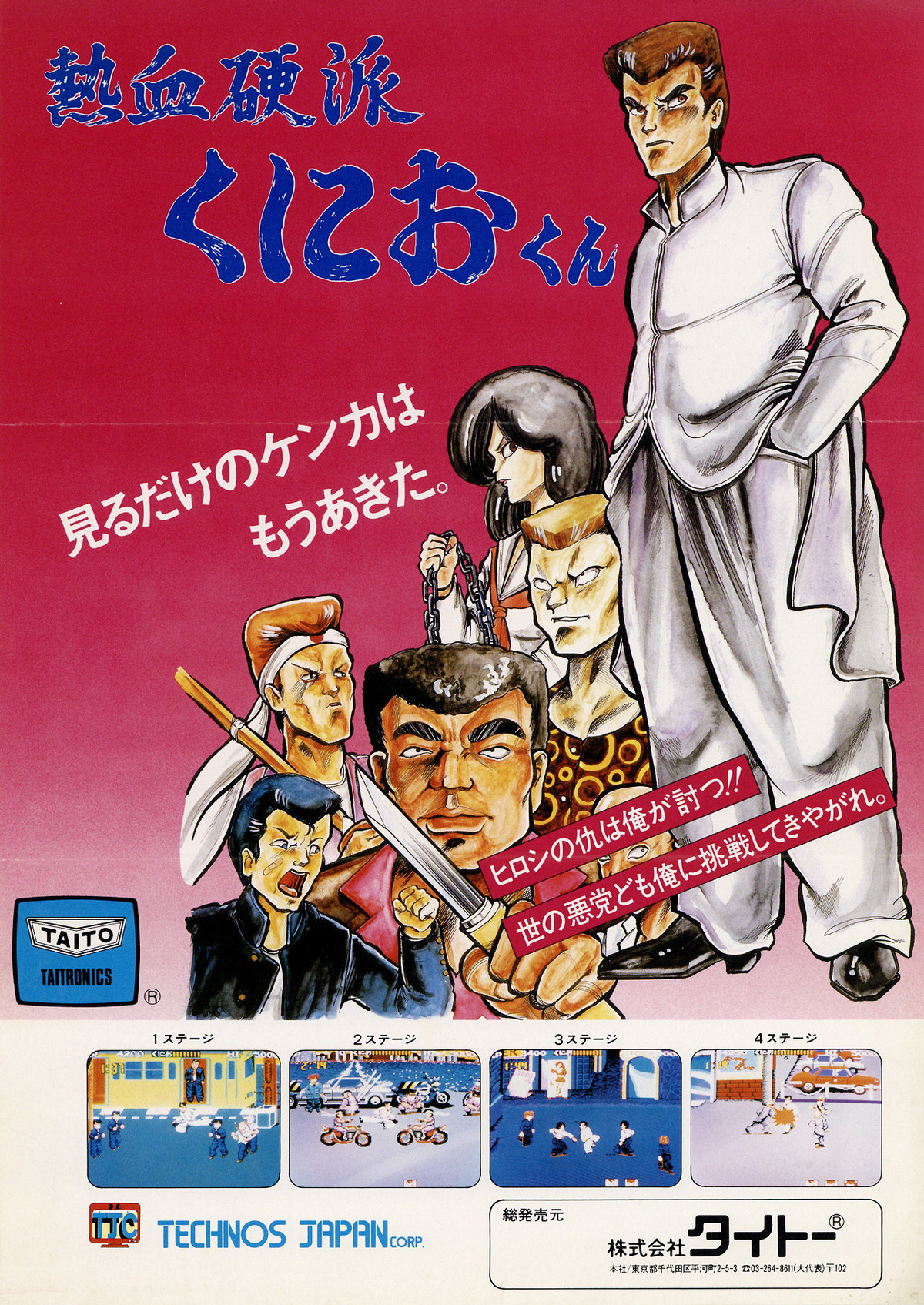
Renegade is a 1986 arcade beat 'em up developed by Technōs Japan. In Japan, it's known as Nekketsu Kōha Kunio-kun and is the first game in the Kunio-kun series. In the west, it was published by Taito, which gave it vastly different graphics that hide its Japanese origin, although the game plays the same.
The story differs between the Japanese version and the Western version. In Nekketsu Kōha Kunio-kun, an ordinary high school student named Hiroshi is assaulted by various enemies in intro of each stage; his best friend and renowned fighter, Kunio, challenges them with his bare fists so that he can make them pay. In Renegade, the "avenge your friend" plot is dropped and it's about Mr. K defeating a bunch of gangsters to win a nameless woman.
The developer would create more famous beat 'em up series, Double Dragon, basing its systems on this game. A port to the Nintendo Entertainment System was released in 1987 and is the only version developed by Technōs Japan in-house. In the west, there were a lot more ports, including Sega Master System and many computer platforms.
The western version of Renegade was followed by two Divorced Installments unrelated to Kunio games, Target Renegade and Renegade III: The Final Chapter. A proper English localization of the original Japanese version happened in 2020, when the compilation Double Dragon & Kunio-kun Retro Brawler Bundle translated the NES version as Nekketsu Renegade Kunio-kun. This compilation also includes the original English NES version of Renegade, allowing the Japanese players to see what the game was like in the overseas.
This work contains examples of:
- Adaptation Expansion: The NES version divides each stage into multiple segments. The final stage is the longest, which became The Maze.
- Adapted Out: The western arcade version removes stage intros where Hiroshi gets assaulted each time and does not add cutscenes in their replacement. This extends to the NES version; the Kunio-kun version added a new ending where Hiroshi shakes hands with Kunio after he gets rescued, but Renegade removes all this, jumping to the credits immediately.
- All Bikers Are Hells Angels: The second level features Shinji's biker gang, whose members ride motorcycles, wear tokkō-fuku, and try to ram over Kunio. They're modeled after the real-life Japanese biker culture Bosozoku
 .
. - Artificial Brilliance: In many beat-em-ups, enemies are more than willing to walk right up in front of you in range of your fists. You can even often just mash punch and have them walk into it. Not this one. At least in the arcade, they will stop short every time and swing their sticks/bats/whips/chains at you as soon as they are close enough to actually hit you. This is the main source of the challenge.
- Artificial Stupidity: Since neither the Sanwa Yakuza nor Sabu will dash towards you, they also won't dash to reorient themselves out of inconvenient positioning the way the other gangs will. Therefore its possible to pin Sabu helpless against either wall given you can fend off the rest of his yakuza goons.
- Author Avatar: Kunio was loosely based on the game's creator Yoshihisa Kishimoto himself, who got into fights daily for a time after a rough break-up.
- Contractual Boss Immunity: Bosses will bypass your attempts to defeat them via Ring Out by falling towards you rather than falling backwards when you score a knockdown. They also will resist being thrown and sat on for the sit-on punch until their health is lowered to the same as the mooks these tricks normally work on.
- Cultural Translation: Nekketsu Kōha Kunio-kun is very thick with Japanese Delinquents culture, which would get lost for anyone outside of Japan. Renegade translated the graphics into Gangbangers, more recognizable to western players. The original Japanese version did get an unchanged English localization in the compilation Double Dragon & Kunio-kun Retro Brawler Bundle although only the NES version.
- Decapitated Army: If you defeat a stage boss with any gang members still in play, the survivors will retreat and make their exit out the bottom of the screen.
- Dub Name Change: Kunio became Mr. K in Renegade. The other bosses are called Jack (Riki), Joel (Shinji), and Kim (Misuzu), with only Sabu remaining unchanged. It should be noted their names don't appear in the arcade version, which only display "1P" or "Boss" next to their health (the Japanese version displays all their names, by comparison). Only the NES version displays the names when you win or lose a fight.
- Early-Installment Weirdness:
- The tone and canon in Renegade is generally consistent with the later series, but the characters in this game are rarely acknowledged later. Riki was a boss character and Kunio's enemy in this game while his later appearance depicts him as his best friend, with an in-universe explanation being Defeat Means Friendship. The others — Shinji, Misuzu, and Sabu — had it much worse, who never appeared in the entire rest of the NES games and only made a brief return in River City Girls Zero and the Neo Geo Super Dodge Ball before Technōs Japan closed down. The new management under Arc System Works brought back the cast to the series, but at this point the NES-era characters were so established that the Renegade characters have had a disconnected feel to the canon.
- The character designs have a proportionally small head, even in the NES version, and lack Big Anime Eyes in most ports produced in the west. The arcade version of Super Dodge Ball tried the Super-Deformed style and then River City Ransom nailed the graphics, which would become its signature style from then on. There have been some games that came up with different graphics, like Shodai Nekketsu Koha Kunio-kun and River City Girls, but they're treated as exceptions or spin-offs in contrast to the main series, which always uses the River City Ransom graphics.
- Controls are strange for the players from future; one button only attacks left and the other only attacks right. River City Ransom separated them for kick and punch.
- No stage progression exists and you just pick out enemies in a limited arena until the boss joins the battle. The NES version has some kind of a progression, but it has a frequent use of Fade Out transition instead of seamless scrolling. It was the Double Dragon series that first used "walk up until the screen halts, beat all enemies to move it again" gameplay, which was applied back to Kunio games with Bangai Rantō Hen.
- Endless Game: The arcade versions loop indefinitely with the main game lasting about 15 minutes. Its not unheard of for an especially skilled player to last around 5 or 6 loops. The gangs also stop harassing poor Hiroshi after the first loop as the game afterwards skips straight to the action.
- Have a Nice Death:
- The gang bosses will verbally taunt you upon defeating you. "Namen'nayou, kono-yarou!"
- Rather disturbingly, being defeated by the Yakuza/ Mobsters in the arcade version is followed not by a taunt, but by Kunio's death cry.
- The Lethal Connotation of Guns and Others: The final level introduces yakuza mobsters with knives and Sabu with a pistol, and they're both amazingly lethal, taking down Kunio in a One-Hit Kill. Quite fitting for the last challenge of the game.
- One-Hit Kill:
- The first level, on a subway platform, could have enemies or you knocked or thrown over the edge. It's an insta-kill for whomever goes over, even if it's the Boss or you, though good luck actually doing it to the boss before it's nearly defeated anyway.
- The second level, on a dockside locale with one end facing the river, is the same way. Whoever's thrown into the drink isn't coming out. Again it works better on the Mooks than the boss.
- The motorcycle riders can be jump-kicked off their cycles, and they are instantly taken out.
- In the final level, knifers kill in a single hit, and the same goes for the boss when he uses the gun. His kicks, however, only drain some energy.
- One-Hit-Point Wonder: The whip wielding sukeban in Stage 3 have glass jaws and are out instantly as long as you score a knockdown on them. Even dashing at them and shoulder checking them registers a knockout for them.
- Race Lift: Kunio-kun only has Japanese. Renegade changes the characters to be more like American, with a few characters getting their skin darkened as a result.
- Revenge: Hiroshi is beat up by local gangsters and Kunio goes after them for revenge. In the Arcade western version, it's not clear why he's fighting them until the ending reveals he was rescuing his girlfriend from the gangs. The NES version only provides a vague premise of "You vs. Gangs" in the manual.
- Ring Out: Kunio as well as the gangs he faces can fall off the Shinjuku subway platform in Stage 1 or Yokohama port in stage 2, knocking them out of play instantly.
- Targeted to Hurt the Hero: Implied that the gangs intentionally target Hiroshi since its the fastest way to goad Kunio into a fight.
- Throw the Mook at Them: Kunio can grab an enemy by the upper clothing and then throw them into oncoming enemies.
- Unbuilt Trope: It's considered the first true sidescrolling beat 'em up with eight direction movement, but plays very unlike the games that followed. The hero always fights in an arena and it uses three buttons with the two only attacking left or right. It wasn't until Double Dragon that a proper stage progression was introduced and it wasn't until Final Fight that it was simplified to two buttons. Thematically, Renegade is relatively based on realism faithful to Japanese Delinquents culture. This is why Kunio immediately dies when he's stabbed with a knife. It is unlike most following beat 'em ups that allow absurdity like Final Fight, which features a ninja and a mayor who wrestles people to death.
- Whole-Costume Reference: Mr. K's Native American uniform was inspired by The Warriors.
- A Winner Is You: All versions have a short ending, but the NES Renegade version really falls victim to this, which removes an original ending added in the Kunio-kun version, cuts to black as soon as the final boss is defeated, and plays the credits.
- Would Hit a Girl: The third level is in a downtown area, with the female mooks armed with chains and spiked clubs. Kim/Misuzu is also bigger and stronger than you. They all have Sabu's orders to take you down, especially since you beat the bosses on the previous two levels. So you, the player, have to defend yourself.