

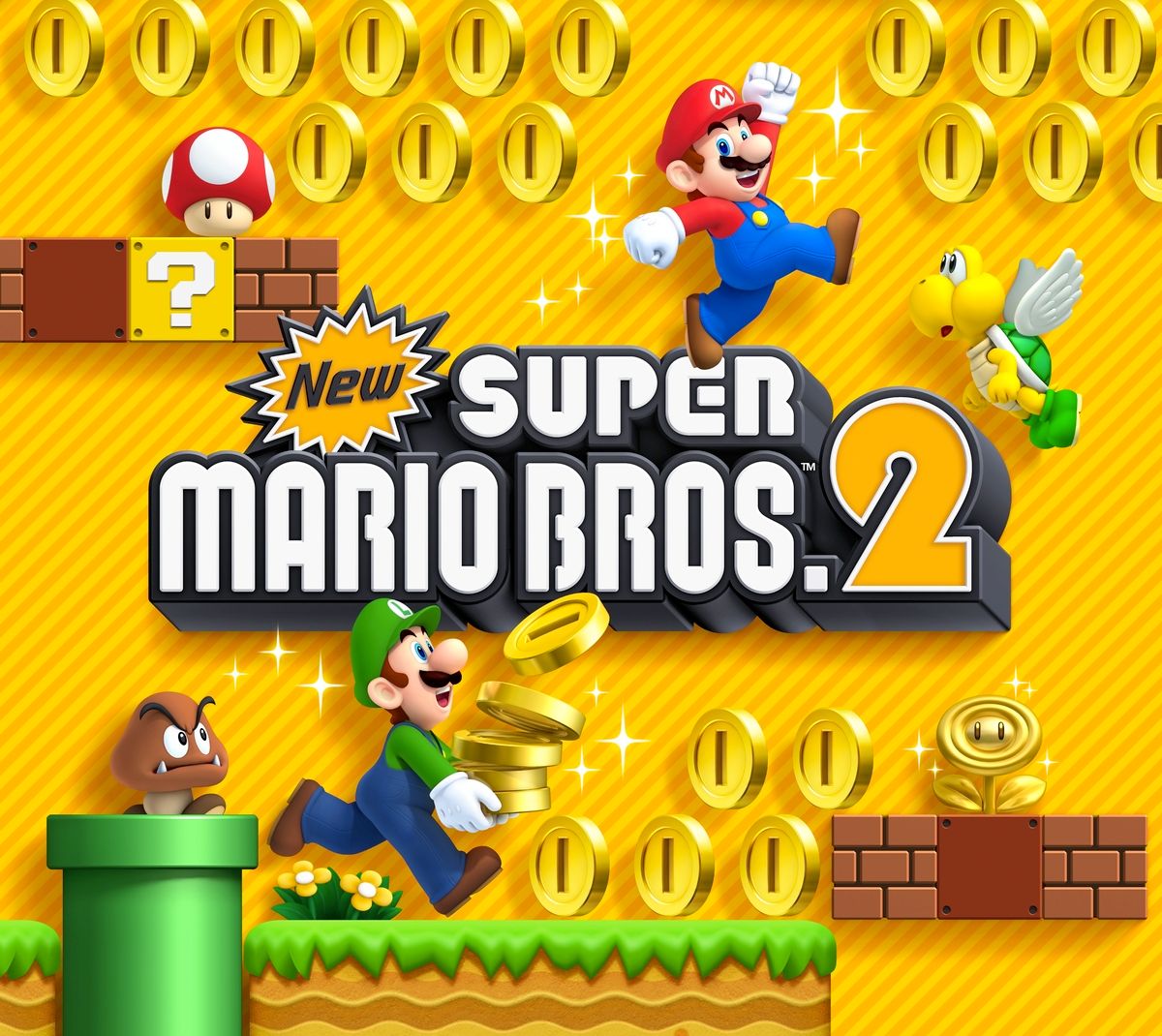
New Super Mario Bros 2 is the direct sequel to New Super Mario Bros. 1, following New Super Mario Bros. Wii in that regard, and the third overall game in the New Super Mario Bros. series. The first New Super Mario Bros. game was the side-scrolling Mario title for the Nintendo DS, just as New Super Mario Bros. Wii was for the Wii, and now New Super Mario Bros. 2 fills the same role for the Nintendo 3DS. It is the fifteenth Super Mario game in general.
The game features further throwbacks to Super Mario Bros. 3 (akin to Super Mario 3D Land and Mario Kart 7) — namely, Raccoon Mario's first polygonal appearancenote (just as Super Mario 3D Land did the same for Tanooki Mario) as well as the classic P-Charge Bar featured in Super Mario Bros. 3. Reznor from Super Mario World also appears as a boss in the tower stages. The game also notably reuses the same soundtrack, all Video Game Settings, and most of its assets and obstacles from New Super Mario Bros. Wii, fundamentally being a Mission-Pack Sequel to it.
Its defining characteristic is its focus on coin collection. Mario is tasked with the optional, non-essential goal of collecting a million coins during his adventure, and new ways to earn money are everywhere, from golden enemies to Gold Fire Flowers that turn whatever the fireballs hit into coins.
The title was released on July 28th, 2012 in Japan (along with the 3DS XL) and was released during August of that year in Western territories. It is notably the first full retail game to become available as a digital download on the Nintendo eShop.
In 2014, a version of the game with all DLC packs already included was released, titled New Super Mario Bros. 2: Gold Edition in North America and Japan, and New Super Mario Bros. 2: Special Edition in Europe. This version never saw a physical or eShop release; instead, it came pre-installed in special edition 3DS XL units in North America and 2DS units in Europe, while in Japan, 3DS LLnote owners could download it for free throughout July and August of 2014.
This game has examples of:
- 2½D: Just like its predecessors, this game is a 2D platformer that uses 3D models for the characters.
- Advancing Boss of Doom: Bowser's giant form chases you up the tower, all while you're dodging his attacks and jumping on bone platforms.
- And Your Reward Is Clothes: The prize for collecting one million coins is just an alternate title screen with a Gold Mario statue. And maxing the coin counter to 9,999,999 coins just gets you a gold Raccoon Mario statue.
- Anti-Frustration Features: Like Super Mario 3D Land, if you die too many times in one level, the game will offer you a box with the White Raccoon suit, which makes you invincible. However, some players find this insulting.

- Appropriated Title: The game was called New Super Mario Bros. Gold during development, but was later renamed New Super Mario Bros. 2, since a number of levels step away from the coin-collecting theme of the game.
- Artistic License – Botany: This game introduces Bone Piranha Plants, which, as the name indicates, are skeletal Piranha Plants, despite the fact plants don't have bones.
- Ascended Extra: In the previous game, the Koopalings were simply Bowser Jr.'s henchmen and had no impact on the plot, while in this one they are directly responsible for Peach's kidnapping and continue antagonizing Mario up until the final level, where they band together to try and petrify Mario with a modified Koopa Clown Car. They also take up Kamek's role of making Bowser grow for the final battle.
- Audience Participation: The first batch of DLC Coin Rush levels (Gold Rush Pack, Coin Challenge Pack A, and Nerve-Wrack Pack) were designed after recommendations from Club Nintendo survey responses.
- Back from the Dead: Bowser's Dry Bowser form is fought as the True Final Boss.
- Background Boss: Bowser's giant form stays in the background, trying to swipe you on whatever column of platforms you're standing on.
- Big Boo's Haunt: The Ghost Houses return in this game, with the first one appearing in World 2.
- Bonus Dungeon: World Mushroom and World Flower can only be accessed through the Cannon levels, which in turn are only unlocked by reaching the secret exit in other stages.
- Bridal Carry: A Ship Tease example: during the end credits mini-game, Mario carries Princess Peach from Bowser's castle all the way back to hers.
- Broke the Rating Scale: Coin Rush packs receive a star rating from 1 to 5 based on their difficulty. However, the Impossible Pack is designed to be so difficult that it has to deviate from the rating system. For comparison, the second hardest pack, the Nerve-Wrack Pack, has 5 stars and is classified as "Very Hard"; however, the Impossible Pack reads DANGER! and replaces the stars with icons of Bowser's face.
- Brutal Bonus Level: The final DLC pack in Coin Rush is the Impossible Pack. As the name implies, it's designed to be far more difficult than anything else in the game, requiring great skill and precision to survive. It even has a non-standard difficulty rating. It's to the point that the scoring aspect of Coin Rush is de-emphasized, instead focusing almost entirely on survival: there are no coins anywhere in the levels, so coins can only be earned based on your remaining time when completing each level, with the goal being a mere 100 coins as a result; there are also no power-ups, and the starting inventory Gold Flower you unlock after clearing the main game is unavailable.
- The Bus Came Back: The Reznors from Super Mario World return as the Tower bosses.
- Cap:
- The maximum coin amount you can get in Coin Rush is 30000, and yes, it is possible to reach that score.
- Due to the sheer abundance of coins, the lives system from Super Mario 3D Land was brought over to this game, resulting in a maximum of 1,110 lives, where a crown replaces each digit in the lives counter at 1,000, 1,100 and 1,110. In fact, one of the completion stars for your save file is obtained by maxing out your lives.
- The maximum coin amount you can get in Coin Rush is 30000, and yes, it is possible to reach that score
- Cherubic Choir:
- The ground theme is literally the same as the Wii version, only with the addition of this.
- The Athletic theme heard is also full of this.
- Continuity Nod:
- Luigi's Super Leaf form still has Kitsune ears and a tail.
- The game's intro is a reference to Super Mario Advance 2, with Mario and Luigi flying around. The only difference is that instead of them coming back to find Peach missing, the Koopalings show up with Peach in captivity.
- Co-Op Multiplayer: It can be played with two players through Download Play or Local Wireless connection.
- Creative Closing Credits: The credits scene has Mario/Luigi carry Peach home through an autoscrolling level, with patterns of flying coins you can pick up to add to your total. You can also watch Bowser and the Koopalings try to harass you, and fail.
- Damn You, Muscle Memory!: New Super Mario Bros. Wii introduces the feature of shaking the Wii Remote to spin jump. Even without the Propeller Block or Propeller Mushroom, it's still handy for covering small yet valuable bits of extra distance during tough jumps. For players who become dependant on it, it's not hard to find oneself instinctively doing the same thing here, only to have nothing happen and remember that it doesn't work on a 3DS. Not helping is that the feature was brought back for New Super Mario Bros. U.
- Dem Bones: Now we have Bone Goombas (although this type is more like a Gloomba with skull masks), Bone Piranha Plants, Dry Bowser.... (Though since when did plants have bones?)
- Developer's Foresight: The Gold Flower power-up gives you coins for every enemy you jump on, and grants a multiplier for combos. So if you were thinking you could totally cash on utilizing the classic 1-Up trick while Gold Flowered, tough luck—the shell will disappear after the 24th bounce. You can't even abort the trick hoping to reset it and do it again, because the shell actually memorizes how many times you hit it. But at least you get 1050 coins from it and the shell explodes into confetti. You can circumvent this limit if Mario is hanging onto a beanstalk or if you leave and return to the area via warp pipes.
- Downloadable Content: Starting October 2nd (for Japan), paid DLC in the form of Coin Rush stages was released every four weeks. Each pack costs ¥200 ($2 in America and £2 in Europe), and there were full bundles released at the same time too. Notably, this is the first 3DS game to use DLC.
- Evolving Title Screen: As the coin counter increases, more and more piles of coins start appearing on the title screen. Reaching a million coins results in a golden statue of Mario being added to the title screen; maxing out the coin counter at 9,999,999 changes it to a statue of Raccoon Mario.
- Fake Longevity: The million-coin objective provides this. A normal 100% Completion playthrough will net you in the neighborhood of 60,000 coins if you're not deliberately playing levels with high coin counts over and over, and that's nothing to say of the insane amount of time you'll have to put if you're going for the Gold Raccoon Mario statue, that requires maxing the coin counter to 9,999,999 coins.
- Final Boss: Bowser, like all games in the NSMB series.
- Funny Background Event: Of a sort. If you look at the background during the end credits, you will notice the Koopalings scattered about, topped off with Bowser stuck in the ground upside down!
- Gameplay and Story Segregation: At the end of the intro, Mario and Luigi chase the Koopalings in their Super forms. However, they start World 1 small.
- Gold and White Are Divine: White Raccoon Mario follows this colour pattern and is appropriately invincible to anything that doesn't cause instant death.
- Golden Super Mode: Gold Mario is a rare power-up that lets Mario fire explosive fireballs that turn enemies and blocks into coins.
- Gold Fever: In some places, you'll have to risk dangerous enemies in order to get coins, or your pursuit of coins might screw you out of getting a special item or something. When trying to get a whole million coins, Mario may not get Gold Fever, but the player might.
- Gold Makes Everything Shiny:
- Sparkly golden variations of regular enemies◊, which reward you with coins upon defeating them.
- Golden Fire Flowers that turn Mario gold and allow him to shoot fireballs that turn blocks and enemies into coins◊.
- Luigi becomes clad in silver instead. And what placing is the silver medal given to?
- Sparkly golden variations of regular enemies
- Green Hill Zone: Much like in the prequels, World 1 takes place in a meadow.
- Guide Dang It!: You can play as Luigi in single player like in the first New Super Mario Bros. 1, though the game never clues you in to this at all. The code to do so is identical to the one from the original NSMB, holding L and R when selecting your file, so you'll only know it if you played that game. However, in this game the code only works on files that have defeated Bowser, unlike in the first game where it could be done at any point, so even if you're already familiar with the code you may think it doesn't work if you tried it before beating the game.
- Hailfire Peaks: World 3 starts off with a beach theme, but transitions into a jungle theme around halfway through.
- Hammerspace: Lampshaded by the game upon collecting 700,000 coins.700,000 coins! Where do you keep them all?
- Hoist by His Own Petard: The Koopalings end up taking themselves out after they use their magic wands on their father, and he accidentally (and completely unawarely) headbutts them out of the sky upon his growth spurt, identically to Kamek in New Super Mario Bros. Wii.
- Idiosyncratic Difficulty Levels: The Coin Rush DLC packs all have their difficulty rated by stars (as in, one star is the easiest, five stars is the hardest), all except the Impossible Pack which is rated "DANGER!"
- Infinity +1 Sword: The Gold Flower, which at first is available only on certain levels as the powerup wears off when you complete a level so it can't be carried from one level to the next. However once you complete all the levels in the game, you gain unlimited use of the Toad Houses. This lets you use the Gold Flower on any level as many times as you want. The Gold Flower is particularly awesome for its splash damage, its ability to give you coins for enemies you defeat, and best of all it lets you have your revenge on all those Invincible Minor Minions who've tormented you over the years in past Mario games.
- Invincibility Power-Up: The Super Star returns from previous games. The White Raccoon suit also counts, but only shows up if the player fails to clear a level 5 times in a row.
- It's All Upstairs From Here: The Tower levels have Mario climbing his way up to that level's boss fight. Also the Final Boss, which is an Advancing Boss of Doom.
- Jungle Japes: World 3 takes place in a dense jungle.
- Lethal Lava Land: World 6. Much like in the prequels, the final main world is fire-themed.
- Level in the Clouds: World 5. It is located on a single large cloud, with several tall pieces of land jutting out from below.
- Made O' Gold: Being that the game is based off coins and gold, there's quite a few examples.
- The gold flower, a golden version of the fire flower, which turns Mario to gold when he grabs it, and allows him to throw molten gold fireballs. Strangely, when Luigi grabs it, it turns him to silver, despite the flower being gold.
- Gold Mushrooms, mushrooms made of gold, replace 1-Up Mushrooms in Coin Rush mode. They give their collector 50 coins upon collection.
- The Gold Lakitu enemy is a normal version of Lakitu, but he wears a golden shell and rides a golden cloud.
- Make My Monster Grow: Once again, Bowser becomes giant thanks to the Koopalings' magic for the Final Boss. This time, he does this twice with the return to Dry Bowser.
- Meaningless Lives: Played staight and subverted. The game hands out lives like they do coins, which also give you lives after collecting one hundred of them, but getting 1,110 lives (denoted by three crowns) is necessary for 100% Completion.
- Mini-Game Credits: A bunch of coins appear while Mario is carrying Peach back to the castle.
- Mission-Pack Sequel: By far the biggest example in the NSMB series and 2D Mario games as a whole alongside Super Mario Bros.: The Lost Levels, it reuses almost all of its graphical and musical assets from New Super Mario Bros. Wii and lacks any significant changes or improvements to the gameplay.
- Mythology Gag:
- The forms the Gold Flower gives the Mario Bros. are Gold Mario and Silver Luigi. In Animal Crossing (2001), there are Gold Mario statues and Silver Luigi statues.
- Luigi becomes Silver Luigi instead of gold. Silver medals tend to be given to second place, and it also references Luigi constantly being in Mario's shadow.
- As 90 Star Coins are required to enter World Star and the remaining 9 required to enter the Toad House there, the world has no need for Star Coins, having Moon Coins instead. While the coins themselves are new to the series, their design bears a striking resemblance to the 3-up Moons in Super Mario World.
- As you collect more than 999 lives, the 9s start rolling over to crowns, this is a reference to Super Mario Bros, where the lives counter would show random symbols (crown included) in the 10s digit if lives got too high.
- No Fair Cheating: The Impossible Pack has two cases: Playing as Mario removes the ability to use the Gold Flower, while using Gold Raccoon Mario doesn't give you access to the time boosters at the start of each level.
- Non-Indicative Name: The game's title is "New Super Mario Bros. 2", yet it's the third game in the New Super Mario Bros. series, and is much more similar to New Super Mario Bros. Wii than to New Super Mario Bros. 1 (being a Mission-Pack Sequel to Wii, with its only real similarities to the original being the Dual Screen setup and the return of the Mega Mushroom —which is barely used, only appearing in three levels—) and is completely unrelated to Super Mario Bros. 2 and Super Mario Bros.: The Lost Levels (other than ironically also being a Mission-Pack Sequel). It is, however, the second handheld NSMB game.
- No Plot? No Problem!: Unlike the main campaign, which has the typical Excuse Plot of rescuing the princess, Coin Rush has no story at all.
- Nostalgia Level: The DLC level pack 'Golden Classics' revives memorable levels from Mario Bros., Super Mario Bros. 1, Super Mario Bros. 3 and even New Super Mario Bros. 2 itself. They are not straight ports however, 2 to 3 levels are all remixed into each of the three courses (for example, going underground during what was originally 1-1 from the first game leads to 1-2 rather than a small bonus room), with many new secret areas and ways of getting coins.
- Ominous Latin Chanting: The final boss battle, just like New Super Mario Bros. Wii. It's even the same theme.
- One-Hit Kill: A somewhat bizarre case. The Gold Flower allows you to shoot golden fireballs that destroys any enemy that gets caught in the explosion. The Koopalings are somewhat resistant to these, as getting hit will count as a stomp and force them into Retaliation Mode, but very oddly, Bowser doesn't have this luxury due to lacking a Retaliation Mode and goes down in one hit.
- Palmtree Panic: The first half of World 3 takes place on a beach.
- Patchwork Map: Instead of the traditional eight distinct world themes, this game condenses the beach and jungle themes into Worlds 3 and the sky and mountain themes into world 5.
- Punctuated! For! Emphasis!: "800,000 coins! SO. MANY. COINS."
- Reality Warper: The Gold Flower turns you into a Coin-based version of this, as it inexplicably allows Mario to turn regular blocks and enemies into coins.
- Recycled Premise: Collecting as many coins as possible was the main goal of Wario Land, though this game gives you a concrete goal to work towards, as opposed to "enough to buy a new castle".
- Recycled Soundtrack: With the exception of the themes for Worlds Mushroom, Flower, and Star, and the Super Mario World boss theme remix used for the battles with Reznors, the whole soundtrack is recycled from New Super Mario Bros. Wii.
- Save the Princess: The intro has the Koopalings kidnap Peach so that Mario and Luigi can once again save her.
- Scoring Points: Kind of. The game features the traditional score counter, but coins can be thought of as a secondary form of scoring. Each level saves your maximum coin score, and Coin Rush Mode saves your total coin score that you got through the mode. This shifts the focus of beating the levels with the most amount of time on your clock, to beating the levels with the most amount of coins gotten from the level.
- Sequel Number Snarl: The game is titled New Super Mario Bros. 2, despite being the third game in the New Super Mario Bros. series. The actual second game in the series is its predecessor, New Super Mario Bros. Wii, which was released on the Nintendo Wii platform rather than a handheld Nintendo console.
- Sequential Boss: Like NSMBW, Bowser has two forms. His normal form (the fight of which is reminiscent of the original SMB), and his giant form.
- Shifting Sand Land: World 2 takes place in a desert.
- Shout-Out:
- The Reznors make a roar that sounds very similar to Godzilla's.
- Dry Bones will do a dance similar to Michael Jackson's Thriller on occasion.
- Slippy-Slidey Ice World: World 4 is ice-themed. World Flower also has elements of this.
- Taken for Granite: During the final castle, as well as the true final castle, the Koopalings in their Koopa Clown Car will periodically flash a bright light, turning Mario into stone if he is not behind any walls.
- Third Is 3D: While it's not titled "New Super Mario Bros. 3", it is the third game to use the NSMB name, and it has 3D functionality.
- Title Scream: The HOME Menu sound. NEW SUPER MARIO BROTHERS TWO!!!
- True Final Boss: Dry Bowser, who's fought at the end of World Star, and works the same as normal Bowser except he's invulnerable to regular fire; fire from a gold flower can take him out in one hit.
- Underwater Level: World 3 combines this with Jungle Japes, but a few underwater levels are found in other worlds.
- Variable Mix: Getting a Raccoon leaf adds a wood block soundtrack to the mix. Also, World 4 (and much of World Flower) add sleigh bells to the mix of every level to indicate they're snow levels.
- The Very Definitely Final Dungeon: World Star, unlocked by clearing World 6. You also need to pay 90 star coins to actually play through it.
- Updated Re-release: New Super Mario Bros. 2: Gold Edition, which is only available in Nintendo 3DS and Nintendo 2DS bundles that have the game pre-installed on the system. It's mostly the same as the normal release, but "Gold Edition" is shown on the title screen and all of the Coin Rush levels are already included instead of being DLC. Coin Rush itself also gets one significant change: if you die in either of the first two courses of a pack, instead of the run ending immediately, you're simply taken to the next course.
- With Lyrics: Justified. This time around, the choir "bah"s almost every freaking note in the ground and athletic themes.

