

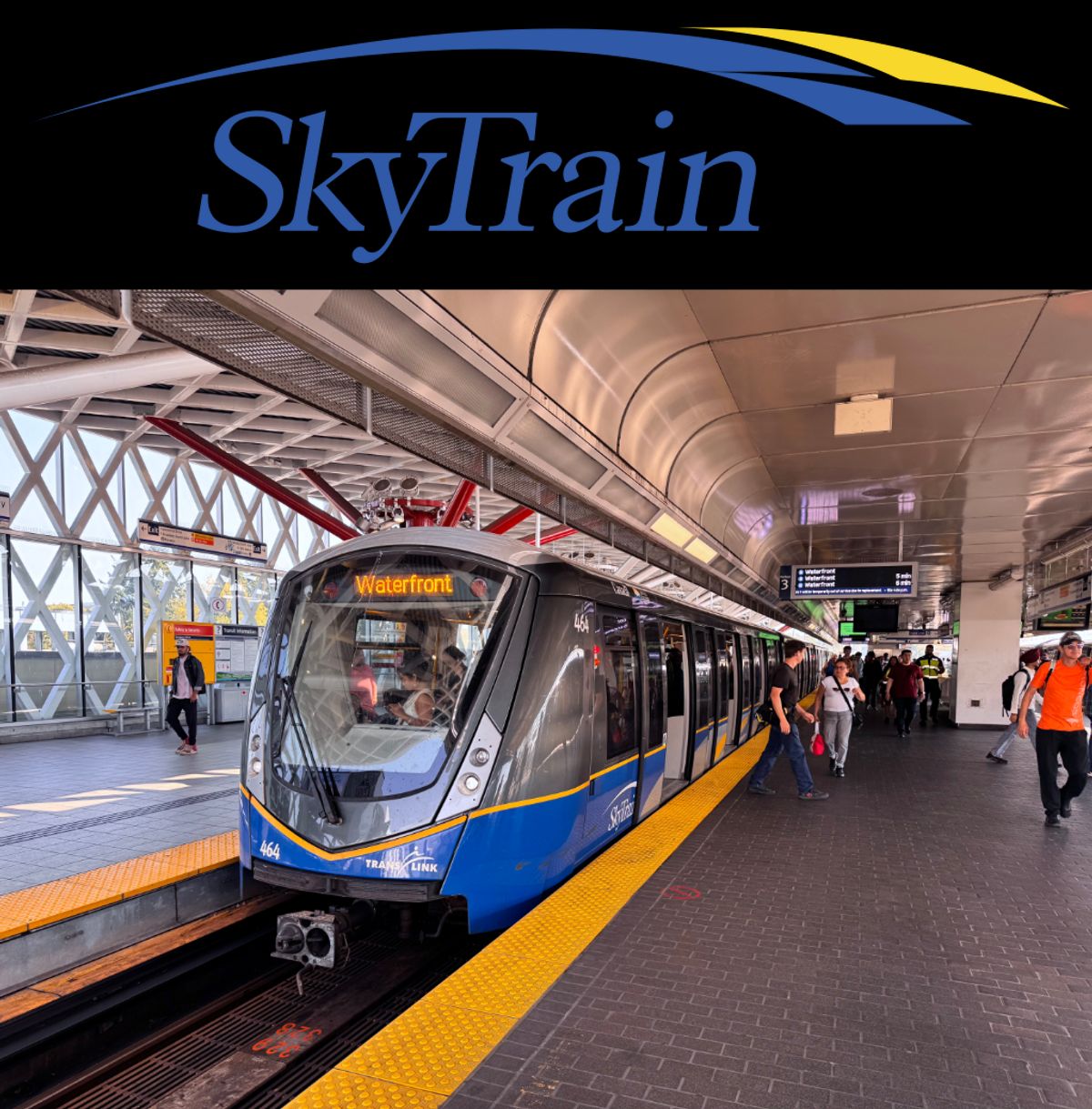
The oldest driverless metro train system in the Americas (opened in 1985), as well as the longest (79.6 km or 49.5 mi across all three lines as of 2025), the Vancouver SkyTrain is named for how most of its track is elevated, while it moonlights as a subway in the downtown core and other densely-populated areas. And yes, you read that right—the SkyTrain is driverless, with individual trains under normal operation not having drivers at the front: Instead, a control centre remotely monitors the position and status of each train as their computers automatically maintain a safe distance from one another.
What this means is the first thing you'll notice as a first-time rider is the schedule for the trains: Not only are they almost always on time, but even their off-peak frequency is so high that it's comparable to the peak frequency of some of the busiest metro networks in the worldnote . The second thing you'll notice is that the lack of a driver's cabin means you can just walk right up to the front of the train and look right out of it—this, combined with the mostly-aboveground nature of the SkyTrain, provides the frontmost seats with uniquely scenic views of Metro Vancouver.
The SkyTrain was originally operated by BC Transit (a Crown corporation which now manages public transit across the rest of the province) until 1999, when its Metro Vancouver operations were spun off into a separate entity known as TransLinknote , which also manages the city's bus network, the West Coast Express commuter line, and the SeaBus ferry.
Due to Vancouver's penchant for California Doubling, this metro system tends to appear more often than you'd expect in movies and other such media—examples of this are at the bottom.
Lines of the SkyTrain:
The oldest, busiest, and longest line, which initially opened in 1985 and ran from southeast from Waterfront to New Westminster station. Since then, it's been extended with a fork: After Columbia station, two thirds of trains cross the SkyBridge—the world's longest cable-stayed, transit-only bridge when it was first built—and enter Surrey, with their terminus at King George station; the remaining third continue along the west bank of the Fraser River through New Westminster, before doubling back into Burnaby and meeting the Millennium Line at Lougheed Town Centre and Production Way-University.
An extension is currently being built that will extend it all the way to the centre of Langley, in the southeasternmost reaches of Metro Vancouver.
The middle child line, which first opened in 2002 and originally ran from Waterfront to Commercial Drive station in a big loop around Vancouver, Burnaby, and New Westminster (using the track that the Expo Line's Production Way branch uses now). As of 2016, the line instead runs west to east from VCC-Clark station in Vancouver to Lafarge Lake-Douglas station in Coquitlam (the section from Burquitlam to Lafarge Lake is known as the "Evergreen Extension").
Currently the least busy line, but a new extension is in progress that will see the Millennium Line go further west and run underneath Broadway to Arbutus Street, linking it to the Canada Line and bringing it about halfway to UBC; another extension is planned that will take it the rest of the way.
The youngest and shortest line, the Canada Line was the first SkyTrain line to be built with a fork: Heading south from Waterfront, half of all trains fork after Bridgeport and go west to YVR Airport, while the other half go further into Richmond and terminate at Richmond-Brighouse station. Owned in a public-private partnership with InTransit BCnote , and operated by SNC-Lavalin, the Canada Line features different tracks, trains, station designs, signage, and PA announcements from the Expo and Millennium Lines. It also spends the most time underground compared to the other lines, somewhat betraying its SkyTrain namenote .
No extensions have been built or planned for the Canada Line since its opening, but a new infill station, Capstan, was opened in December of 2024.
SkyTrain rolling stock:
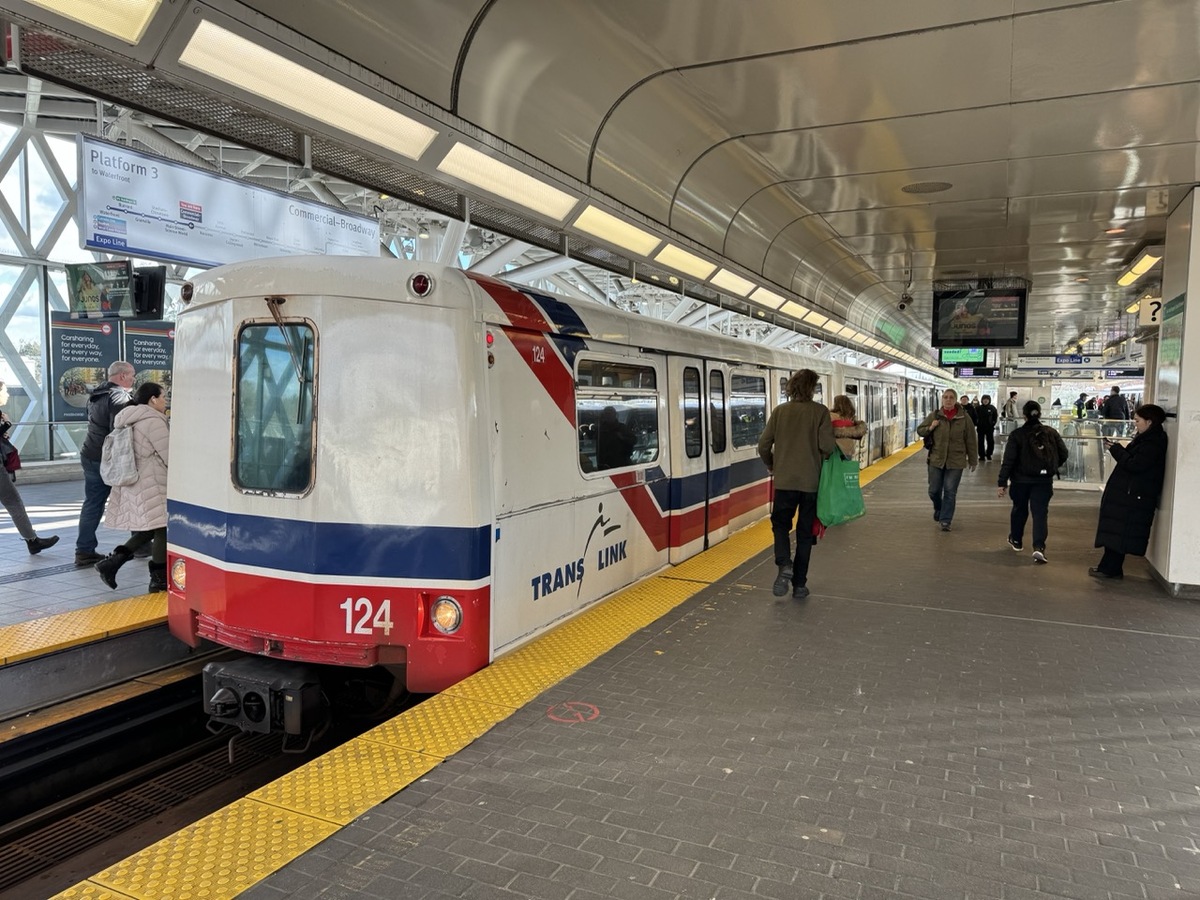
Designed and manufactured by the now-defunct Urban Transportation Development Corporation (and later Bombardier Transportation when they bought out UTDC), the Mark I's are venerable at over 40 years of age, but suffer from a lack of amenities, being the smallest, loudest trains with no walk-through cars or real-time information displays. They do have HVAC, but it's very weak, and during the summer it's common for passengers to open the windows, which tends to make the noise problem worse. They used to have some unusual features in order to give them a more "premium" feel for Expo 86, such as carpeted flooring and push-button operation for the doors, but these were removed and/or disabled within a few years as they didn't hold up well to being used by thousands of people. Mark I's produced from 1991-1995 lack doors on the end of each car and instead have larger windows, but this makes little difference to riders as the end doors are to be used in emergencies only.
Notably, the individual Mark I cars were initially named after various cities and municipalities in British Columbia—this naming convention was abandoned in the final 1995 production run, however.
UTDC ICTS Mark I cars have also been seen running on the Detroit People Mover and the (now-defunct) Line 3 Scarborough in Toronto. This, combined with them being in the process of being retired, and their more nondescript appearance, has made the Mark I the model of SkyTrain you're most likely to see in media.
As the Mark V has begun to enter service, the Mark I's have slowly been getting retired—for each Mark V added to the Expo Line, a Mark I is removed. It's not clear exactly when the last Mark I will be taken out of service, but with how long their run has been, it will mark the end of an era.
1st-generation Mark II
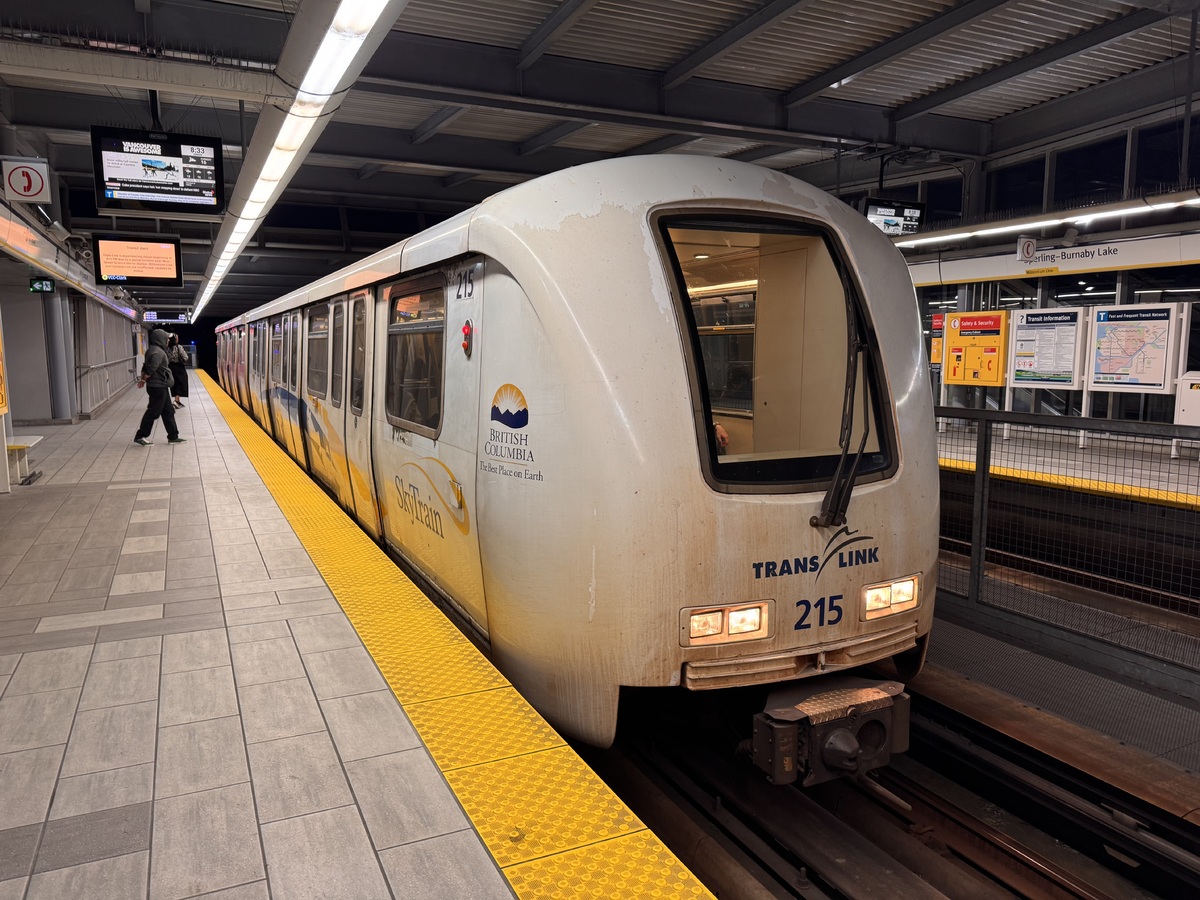
2nd-generation Mark IInote
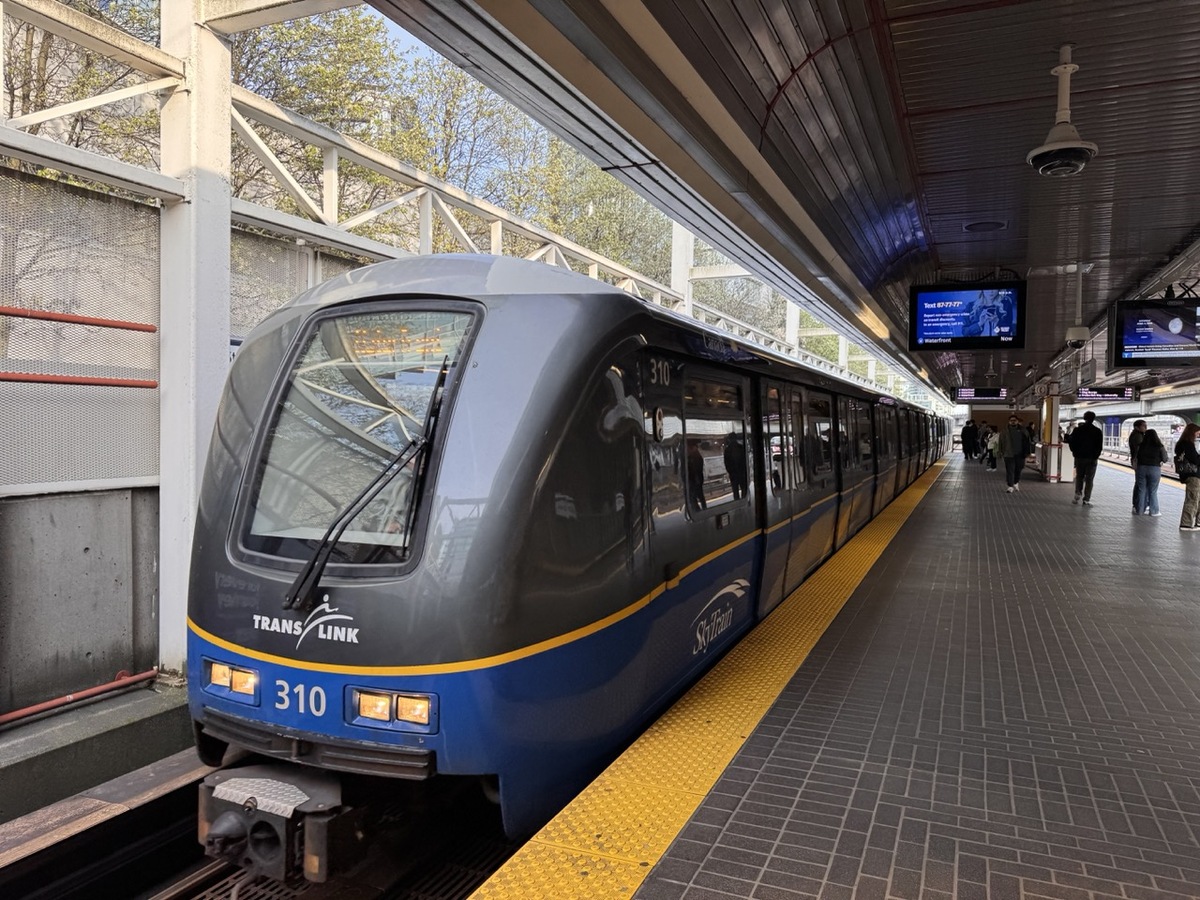
Designed and produced by Bombardier Transportation, and debuting with the Millennium Line, Mark II SkyTrains are produced in mated pairs of two, allowing passengers to walk between the cars (but not all the way in 4-car setups). They're larger than the Mark I with larger and more comfortable seats and better HVAC, but they still lack real-time information displays and are sometimes even louder than the Mark I.
The 2nd-generation Mark II is an improved variant: While the outer design remains the same (albeit with a new livery), the trains feature a variety of new features, including significantly quieter motors, redesigned seats, a layout more optimized for standing room, real-time LED station displays, destination signs on the outside of the trains, and further-improved HVAC.
Despite having more in common with the Mark III's than the Mark I's, the Mark II's are also slated to be retired, but only after the Mark V's have replaced every Mark I currently in service.
A major facelift and small improvement over the second-generation Mark II, the Mark III features even quieter motors, LED destination signs inside the cars (as well as outside), larger windows, end-to-end walkthrough cars, and further improved HVAC. However, they axe the driver's seat that the Mark I and Mark II have.
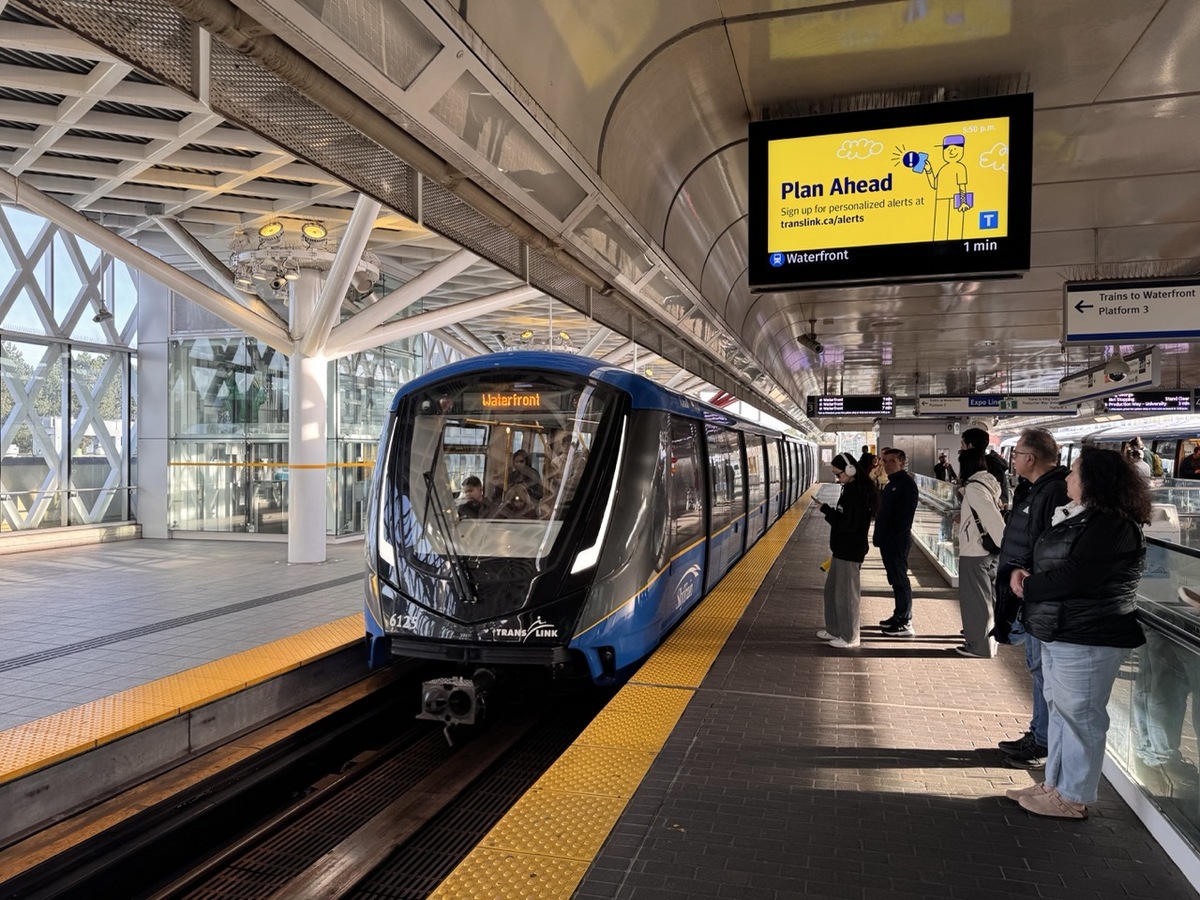
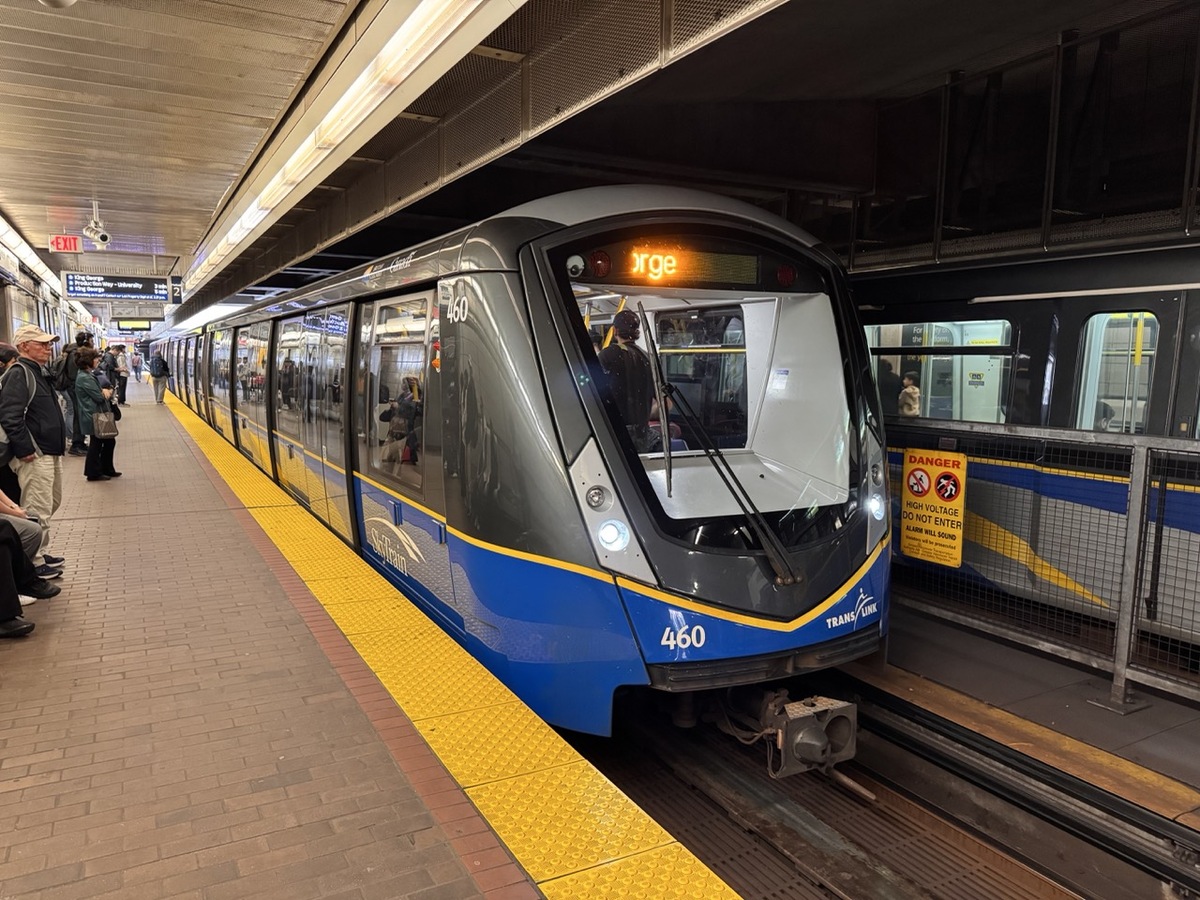
A facelift of the Mark III produced by Alstom (who in the time since the Mark III had bought out Bombardier Transportation), featuring longer trains; a layout optimized for standing as well as wheelchairs, strollers, and bicycles; real-time LCD information displays; yet further improved HVAC; even quieter motors; and the return of the driver's seat.
Another noteworthy aspect of the Mark V is its additional aesthetic flair: The glass dividers between the doors and seats feature art made by local Musqueam, Squamish, and Tsleil-Waututh artists; and each car features its own design (though the same five designs are seen in each Mark V). On top of this, a large decal has been placed in front of each driver's seat, depicting a bunch of buttons and switches—a move made to appeal to kids playing pretend-driver.
TransLink claims that the name Mark IV was skipped in case they want to upgrade Mark III trains in the future.
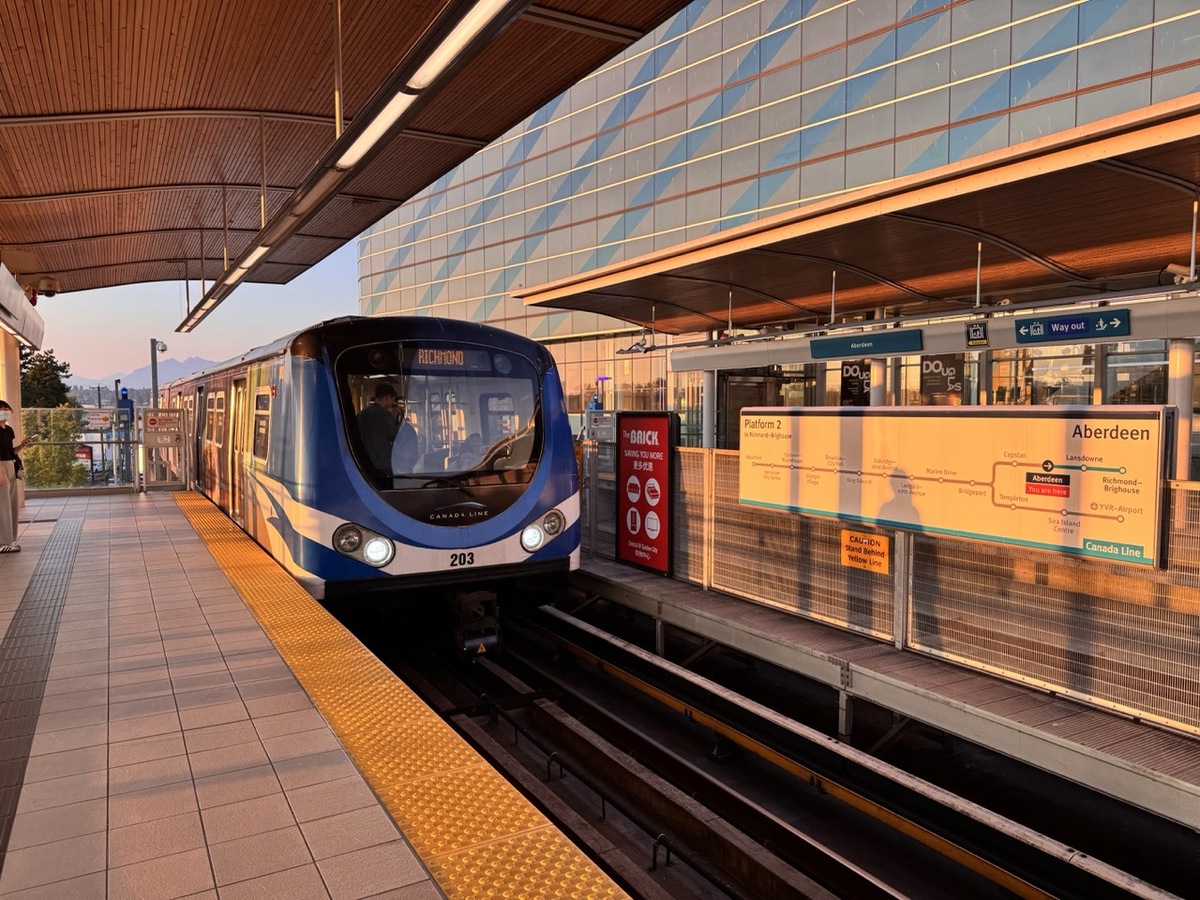
Exclusively found on the Canada Line due to using a different train width and propulsion system, the Canada Line trains are designed to make it easier to fit luggage, bicycles, wheelchairs, and strollers. They have LED destination signs inside and outside of the car, but no map-based real-time information displays.
Because of the short length of Canada Line stations, the trains run in sets of two cars, and the only possible expansion is a half-length car that would go in the middle.
Other notes about the SkyTrain:
- The core philosophy behind the SkyTrain's driverless operation and "is-it-light-rail-or-is-it-metro" design was conceived by the Urban Transportation Development Corporation, the Ontarian Crown corporation which supplied the specifications, computer systems, and trains used by the Expo Line. The idea was that by running elevated, driverless trains, a mid-sized city could have a metro system comparable to much larger cities, all without having to deal with the associated construction and labour costs, hence their name for it: The Intermediate Capacity Transit System. While UTDC have since been bought out by Bombardier Transportation—who in turn have since been bought out by Alstom—this model of "elevated, driverless trains for mid-sized cities" has since been proven by the SkyTrain, and its blueprint has since been followed by other cities, such as Montreal with the REM, and Honolulu with the Skyline.
- SkyTrain lines are much longer than other metro lines, resulting in them acting like a hybrid between metro and commuter rail—for example, once the Expo Line's Langley extension is built out, the line in total will span a whopping 52.4 km (22.6 mi). This is due to Vancouver's general lack of existing rail infrastructure to build upon—the rationale is that it's easier to keep extending the SkyTrain lines than to add new heavy rail track.
- The Expo and Millennium Lines run on an unusual combination of linear induction motors and third-rail electrification, meaning their tracks have four rails in total. The Canada Line still uses a third rail, but is propelled with more traditional AC motors. The use of LIM motors results in some of the older
 models of SkyTrain having very unique acceleration and deceleration sounds.
- The Canada Line was and continues to be a victim of Executive Meddling:
- The Vancouver and Richmond City Councils at the time strongly doubted the need for a SkyTrain line to South Vancouver, Richmond, and the airport; at one point, a surface-level LRT line was proposed and seriously considered instead. As a result of this doubt, funding for the Canada Line was stripped to the bare minimum, forcing TransLink to scrimp wherever they could: Each Canada Line station looks almost identicalnote , has extremely short platforms, usually has only a single entrance, only up escalators at each station, and only one elevator per platform level (which are prone to breaking down). Most egregious is that the outbound terminuses of the Canada Line—YVR-Airport and Richmond-Brighouse—are single-tracked, which caps the maximum frequency of trains in a way that is completely alien to the Expo and Millennium Lines. These cuts have overall resulted in the Canada Line frequently getting overcrowded as ridership has blown past even the most optimistic estimates, and the line having only a little over half the theoretical maximum ridership capacity of the Expo and Millennium Lines; as well the elevator troubles causing headaches for anyone with bikes, wheelchairs, strollers, or even just a lot of luggage as an airport traveller.
- Building the Canada Line as a public-private partnership with SNC-Lavalin required a contract which effectively nickels and dimes TransLink for every improvement they want to make to the line, even down to things as small as recording new PA announcements for the trains. This has made TransLink very reluctant to actually upgrade the line in any significant capacity until the contract ends and full control of the line is handed over to them in 2044.
- The SkyTrain was one of the metro networks in North America least severely impacted by the COVID-19 Pandemic, seeing a much faster rebound. This is attributed to their driverless design, as the extremely high frequency of the trains, combined with there being no driver crunch during the pandemic, meant that cautious riders were able to simply wait until an empty-enough train arrived for them to get on.
- The SkyTrain is part of TransLink's unified 3-zone Compass fare system, which treats Vancouver propernote as Zone 1. After tapping out, you get unlimited transfers for 90 minutes, and—if you're using a credit card or Compass card—if you cross another zone, the difference is automatically charged. Kids 12 and under ride for free, and all travel is treated as 1-zone after 7pm and all-day on weekends.
- The West Coast Express has its own fares, but it still refers to its tiered fares as "zones" picking up from Coquitlam and the others in Zone 3, while adding in a Zone 4note and Zone 5note .
- This zoned fare system applies to all transit systems in Vancouver, except for the West Coast Express and buses—the latter of which is due to technical issues in implementing zoned fares. This means that while some of these municipalities are in higher-fare zones, the lack of anything but buses running within their borders makes it impossible to pay more than a 1-zone fare to go in or out of themnote .
- There are plans to replace this zoned system with a new one based on distance travelled, along with upgrades to the Compass fare network that would also add mobile wallet support, but they have yet to materialize.
Other public transit in Vancouver:
- The West Coast Express is Vancouver's only commuter rail line, having first opened in 1995. It runs west to east from Waterfront station to Mission City, a fair distance beyond the limits of Metro Vancouver. It only runs on weekdays, with five westbound trips in the morning and five eastbound trips in the evening. The Evergreen Extension of the Millennium Line has since supplemented its route; the two lines meet at Moody Centre and Coquitlam Central stations. Marked on maps in purple.
- The SeaBus is a passenger ferry that first opened in 1977. It crosses the Burrard Inlet, running south to north between Waterfront station downtown and Lonsdale Quay in North Vancouver. It has a peak frequency of every 10 minutes, and is notable for its specialized catamaran ferry design that can travel in either direction without having to turn around. Newer ferries even have free Wi-Fi and power outlets onboard. Marked on maps in greyish brown.
- For anything less than a SkyTrain, TransLink operates a veritable legion of buses of various shapes and sizes, generally separated into four tiers of service:
- BRT is currently in development (no official name yet), with the first BRT lines planned out as the King George Boulevard BRT, Surrey-Haney Place BRT, and the North Shore-Metrotown BRT.
- The RapidBus (formerly B-Line, except for the 99 B-Line) features frequent, at-maximum 10-minute service intervals with articulated buses, infrequent stops, dedicated bus lanes (most of the time), and bus stops with real-time info displays. The 99 B-Line, which runs along Broadway from Commercial-Broadway station to UBC, is particularly noteworthy for being the busiest bus route in all of Canada and the USnote . B-Lines and RapidBuses also have a tendency to get made into SkyTrains or other faster transit down the line: The 98 B-Line was replaced by the Canada Line, the 97 B-Line was replaced by the Evergreen Extension of the Millennium Line, the 99 B-Line will eventually be replaced by the Millennium Line's Broadway and UBC extensions, and the R2 is slated to be replaced by the North Shore-Metrotown BRT in the future. RapidBus lines are marked on maps and bus stops in green, while the 99 B-Line is marked in orange.
- Buses that are part of TransLink's Frequent Transit Network guarantee no worse than 15-minute service intervals during the day and into the evening.
- Any other bus routes can provide service as frequently as every 20 minutes or as infrequently as every 2 hours.
- Some bus routes are not operated by TransLink directly, but instead by partners or subsidiaries: Most bus routes in West Vancouver are run by West Vancouver Municipal Transit—a.k.a. the "Blue Bus"—while Bowen Island's three bus routes are run by First Transit. There's no real perceivable difference to riders however, as the buses are largely the samenote , and they use the same fare system as the rest of the network anyway.
- HandyDART is a provincial paratransit service available to disabled and elderly riders, offering door-to-door service. Most routes are contracted out to Transdev, but a few outside of Metro Vancouver are run by BC Transit directly.
- The Burnaby Mountain Gondola is a 3S gondolanote set to connect Production Way-University station with Simon Fraser University on Burnaby Mountain. It's been in the planning stages for a while, but has been delayed due to a lack of funding.
- Regional rail is run from Pacific Central stationnote , just a block away from Main Street-Science World station on the Expo Line. The main passenger services operated from the station are VIA Rail's The Canadian—the longest passenger train route in the Americasnote , going east to Toronto—and Amtrak's Cascades, which offers southbound service to Seattle and Portland.
- Two private ferry companies—Aquabus and False Creek Ferries—operate small boats that run between various docks in False Creek. They're a practical way to cross the creek without having to find a bus or SkyTrain that goes around it. Taking one of their ferries to or from Granville Island is popular with tourists.
- BC Ferries is a former Crown corporation that offers passenger and vehicle ferries across the province—in Metro Vancouver however, they operate ferries from Horseshoe Bay in West Vancouver and Tsawwassen First Nation in Delta. Horseshoe Bay offers ferries to Nanaimo, Bowen Island, and the Sunshine Coast; while Tsawwassen offers ferries to North Saanich (adjacent to BC's capital Victoria), the Gulf Islands, and Nanaimo (a different terminal without public transit access).
- Hullo is a private ferry company that offers passenger ferry service from downtown Vancouver (right from the Convention Centre) to Nanaimo. By running from downtown directly, they are cheaper and easier to reach compared to BC Ferries's offerings, and while they are passenger-only, it is possible to bus from Nanaimo to Victoria... Albeit not quickly.
SkyTrain appearances in media (both as other metros and as itself):
- Friday the 13th Part VIII: Jason Takes Manhattan: All interior shots in the New York Subway scene are of a graffiti-covered Mark I running between Waterfront and Granville station.
- KPop Demon Hunters: An unusual example—the chime played in the subway scene when the doors close is the SkyTrain door chime.
- The Last of Us (2023): Four Mark I's appear in Season 2 Episode 4, having been painted with a Seattle Sound Transit livery and modified with an escape hatch, as well as being made to look derelict by having their chassis and wheelsets removed.
- TWICE: The music video for "LIKEY" features a scene aboard a Mark I, as well as a shot of the tracks east of Columbia station.