

Shang | Zhou | Qin | Han | 3K | Jin | S&N | Sui | Tang | 5D&10K | S+L+JJ+WX | Yuan | Ming | Qing
(Bestowed with the Mandate of Heaven,
may the Empire thrive and prosper)
The Qin family rule was short but sweeter
Tang, Ming, Song and the rest may have ruled for longer
But look at me, they don't come much stronger
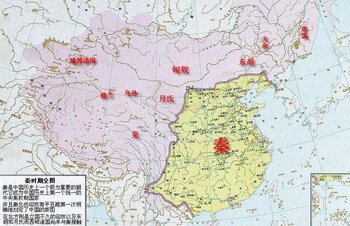
The Qin Dynasty (秦朝, Qín Cháo, 221 BC – 206 BC) is the fourth Chinese dynasty, following the Zhou Dynasty and the first one to be ruled by an emperor.
It had only two emperors, but the first one was Qin Shi Huangdi, and that one was really enough for at least two dynasties in many other states. Among other things, he unified the country (perhaps a quarter to a third the size of modern China) in a swift 9-year campaign; and then standardized the laws, coinage, and writing system. In short, he codified Imperial China.
The Qin Dynasty began as a state from the Spring & Autumn period to the subsequent Warring States period located in Western China. Due to its preoccupation with the nomadic tribes in the region and its geographic location, the Qin remained remote from the central affairs of the Zhou and other states in China. The genesis of the state of Qin arrived under very harsh conditions: its lands were underdeveloped, and its location gave the Qin few partners in trade. It does not help that the people of Qin were initially viewed as semi-barbaric by the rest of China due to their constant entanglement with local nomadic peoples, and was not expected to last long as a state.
Against all odds, the state of Qin vastly improved its economy and infrastructure overtime. In addition, the Qin unified writing, measurements, codified legislation, and established an overall consensus of nationhood. The entire society was reformed under Legalismnote , which became the law of the land, and, at least in the state of Qin, accompanied harsh but fair punishment against crimes regardless of social-class. Initially, many Qin nobles thought the Legalist reform would not affect them, and they would continue to enjoy a status above-the-law as they previously had. This soon proved to be not the case, as many nobles found themselves at the receiving end to extremely harsh punishments for committing crimes (petty or otherwise). This was to demonstrate to the populace that social-class was meaningless under Qin law, and the reforms meant business.
Furthermore, the state of Qin significantly militarized, with military institutions dominating the society, and gradually becoming synonymous with Qin itself. Aspects of military training peppered throughout all corners of the state, and embodied by the populace, of whom only two trades were encouraged by the state: either join the army and kill loads of enemies, or stay home and grow crops to feed the soldiers while they kill loads of enemies. In short, the state of Qin ran The Spartan Way on steroids. As such, the Qin was able to efficiently mobilize its population for war, in greater numbers and in overall better readiness compared to all of its competitors. Over time, successive Qin leaders whittled away their competition, and when Ying Zheng, the future Qin Shi Huangdi took the throne, he accelerated the process and finished the job in less than a decade.
Once Qin Shi Huangdi unified all China, legalism became the dominant philosophy. Moreover, Qin Shi Huangdi became rather authoritarian, especially in his later years. This became an obvious problem to conquered peoples under the Qin, as they had very little tolerance of an extremely militarized society, and how legalism was exercised overall. Many of his more bloody actions (especially those against the Confucians, who later came to power and wrote all the history books) sealed his legacy as THE tyrant of China. Predictably, upon the death of Qing Shi Huangdi, rebellions across the empire erupted. Qin Shi Huang's successor was not nearly as capable and the dynasty soon ended when the third ruler (who styled himself as "king") was killed by Xiang Yu.
Physical legacies of the Qin include The Great Wall of China (rebuilt by the Ming, now a tourist attraction), the Terracotta Army (as part of his burial complex, now a museum), and the Dujiangyan irrigation system (which, even to this day, is still doing what it was supposed to do).note

The Qin dynasty created a model that the later dynasties followed. Their influence was such that the name the West still uses for the country — China — is derived from the word Qin, which was originally rendered into western languages as Chin.note
Of the "24 Histories", Shǐjì covers this dynasty, which is also the last dynasty that Shǐjì covers in its entirety.
Not to be confused with the much-later Qing dynasty.
Notable monarchs
- Qin Shi Huangdi (秦始皇帝) (259 BC – 210 BC): "The First Emperor of Qin", famous for reasons stated above. He coined the Chinese word of "Emperor" and intended to live on by that name. His dynasty ended shortly, however, thus the "of Qin" part.
- Qin Ershi (秦二世) (230 BC - 207 BC): Qin Shihuang's successor who is widely considered to be an incompetent ruler, being used as a puppet by Chancellor Zhao Gao, who himself ordered Qin Shihuang's eldest son and heir apparent to commit suicide to prevent his misdeeds from being exposed. Zhao Gao later repeated the feat with Qin Ershi himself and forced him to commit suicide. Also known as Huhai (胡亥).
Depictions in fiction
- Emperor: Rise of the Middle Kingdom has a separate campaign for Qin, having as many missions as campaigns for centuries-long dynasties.
- The Emperor and the Assassin
- Fate/Grand Order: The third Lostbelt takes place in an alternate version of China at Qin Dynasty where civilization advancement is halted on purpose by Qin Shi Huangdi himself. It surprisingly results a peaceful and happy China (even though Qin Shi Huangdi still forbids anything he deems Confucius and heavily punishes those who steps out of line), but it results the humanity in this alternate universe to stagnate culture-wise so much the universe is about to be pruned.
- Hero (2002)
- Honor of Kings: The Qin Dynasty is represented as one of the factions of the game, where it's once again led by Qin Shi Huang, but he's using his name during his youth, Ying Zheng. Several figures from his era, like generals Meng Tian and Bai Qi, along with Empress Dowager Xuan (Mi Yue), are also playable heroes put under his banner. It also features two of his would-be assassins: Gao Jianli and Jing Ke (although the latter is gender-flipped into a woman named Ah Ke/Arke so the developer can avoid being complained about 'misleading the youths').
- King's War: Here, Qin Shi Huang is portrayed by Yu Hewei; he doesn't speak often and dies early in the series, kicking off the Chu-Han contention.
- The King's Woman
- The Myth and its television adaptation
- Prince of Qin: An Alternate History game based on the notion what if Qin Shihuang's eldest son Fu Su didn't not commit suicide as ordered.
- The Qin Empire: Only the last season (season four); the previous three seasons were set in the late Warring States era.