

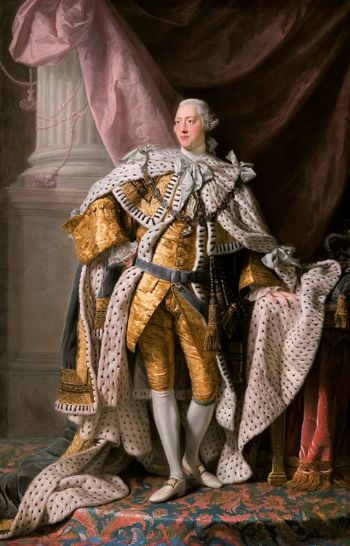
The third British monarch of The House of Hanover, grandson of King George II (his father, Frederick, Prince of Wales, having died young), George III (4 June 1738 – 29 January 1820) came to the thrones of Great Britain, Ireland, and Hanover on 25 October 1760, aged just 22. He went on to become both the longest-lived and longest-reigning sovereign in British history by that point, and remains the longest-reigning king (the successors who surpassed him both being queens regnant).
Four major events happened during his reign: the American and French Revolutions, the Act of Union between Great Britain and Ireland (1800), and The Napoleonic Wars, after which the electorate of Hanover was upgraded to a kingdom. Since George was content to let Parliament run things most of the time (particularly when the Tories were in charge), it's best to just read those articles for further information.
Alas, he is also remembered for going quite insane (probably due to porphyria or bipolar disorder).
The first Hanoverian to have been born in England and raised speaking English, he in fact never visited Hanover in his long life. Unlike his two predecessors, who were mostly interested in their German territories, George's attentions were firmly fixed on Britain; at his coronation speech, he famously proclaimed, "I glory in the name of Briton".note He nevertheless also accepted the principle of constitutional monarchy; his occasional fights with Parliament were rarely all that contentious, and although he experimented with trying to control the government from outside the Cabinet he was never fully invested in that and gave it up as a fool's errand after the end of the American War of Independence. He took a personal interest in agriculture (fitting, given that Britain's Agricultural Revolution reached its height during his reign), and wrote pamphlets on agriculture under the pseudonym Ralph Robinson. These interests earned him the popular appellation "Farmer George".
A perhaps atypically-successful family man for a British monarch, George and his queen Charlotte had a happy marriage (despite first meeting only on their wedding day, when he was already King) and 15 children, of whom eleven lived to the age of at least 60. He was also a remarkably relaxed king, preferring to live in the countryside and much more informally than many of his more traditional courtiers would like; Queen Charlotte agreed with him, going on walks through country towns with him without any servants. A man of great personal piety (spending hours in prayer daily) and morality (never taking a mistress and never drinking to excess, and abhorring the womanizing, boozing, card-playing habits of his father—whom he tried to avoid, per Hanoverian tradition—as well as his brothers and, later, his sons), he is generally remembered as a good king in Britain. He opposed Catholic Emancipation because he believed it would violate the coronation oath he took to 'defend the [Protestant] faith'.
Americans have a more complex opinion on him, but even then most historians believe him to be Mis-blamed—he only had a significant role in the American crisis after the Boston Tea Party (which was beginning of the revolt's turn toward anti-monarchical sentiment), at which point his support for a military response was just one of several trump cards the hawks in Parliament had over the doves. At the time, contemporary Americans were able to distinguish between His Majesty and his Majesty's Parliament, which passed a number of laws which were unpopular in America but which George himself had only so much control of. Until very shortly before war broke out, many Americans liked him. (They liked his wife, Charlotte of Mecklenburg-Strelitz, even more: both Charlotte, North Carolina and Mecklenburg County in which it sits are named for her. Ironically, the city became known as a "hornet's nest of rebellion" during the war). Meanwhile, after the Thirteen Colonies achieved independence, George commented that "I was the last person to consent to the separation [of America and Britain], but I will be the first to accept the friendship of the United States as an independent power."
In 1811, it was thought best that His Majesty, having gone completely cuckoo (this was not the first time, mind, since the first time it happened was when two of his sons died in infancy, causing him to go through Sanity Slippage from grief), should be quietly removed from power. His beloved daughter Amelia, the last of his fifteen children and his favourite among them, had died of illness, and it destroyed him: an attendant of the princess wrote that she could often hear King George cry loudly and in a hearbreakingly way and scream for his daughter. His eldest son George, Prince of Wales (Prinny), took over and was the nominal monarch for the next nine years — this is why Regency England is called such. (It should be noted that from the Civil War onwards, Parliament had been growing in power - over the last century or so it had blossomed. Prinny, thankfully, did not have all that much power).
George would die in 1820 of pneumonia, at Windsor Castle. He was succeeded by his son and regent, who would go by the regnal name of George IV and was the uncle of Queen Victoria.
Portrayals of George III in fiction:
- In the 1924 silent film America, he's played by Arthur Donaldson in a couple scenes. The intertitles characterize him by saying that he "believed in personal rule" and "looked upon America as a rebel colony of Englishmen who wanted more liberty than he thought was good for them."
- Played by Henry Mowbray in The Pursuit of Happiness (1934)
- Played by Raymond Lovell in The Young Mr Pitt (1942)
- Played by Frederick Valk in Mrs Fitzherbert (1947), based on the novel by Winifred Carter
- Played by Robert Morley in Beau Brummell (1954), based on a play by Clyde Fitch
- Played by Eric Pohlmann in John Paul Jones (1959)
- Played by Roger Booth in Barry Lyndon (1975), based on the novel by William Makepeace Thackeray
- Appears in Jonathan Strange & Mr. Norrell, where the character of Jonathan Strange attempts to cure him.
- In Rip Van Winkle (1819), the title character sleeps through the entire American Revolution. When he returns to town, one of the peculiar changes he notices is that a prominent portrait of King George has been altered and is now labeled "General Washington." Moreover, Rip nearly gets himself lynched when he declares himself to be "a loyal subject of the king, God bless him," but cooler heads prevail.
- Shades of Magic: A Darker Shade of Magic (2015) and its sequel A Gathering of Shadows (2016) has the Antari Kell visits him (and George IV of the United Kingdom) while in Gray London.
- Horatio Hornblower meets George III.
- The Prince And The Quakeress (1968) and The Third George (1969) by Jean Plaidy tells the story of George III as a young Prince of Wales and his supposed relationship with Hannah Lightfoot, and then in the latter novel is of his life married to Charlotte and his role as king.
- Briefly appears in Victory of Eagles, where his mental health is well and truly on the decline (it's implied that this is at least partly because Napoleon has invaded England and he's had to take refuge in Scotland). In fact, as a result, the Regency begins five years earlier than it did in our timeline.
- Appears in the last episode of Blackadder the Third where he was depicted as a complete madman with a German accent, played by Gertan Klauber.
- Appears occasionally in Bridgerton, a Netflix adaptation of The Bridgerton Series of Regency England romances, played by James Fleet. Appears much more frequently in the show's prequel Queen Charlotte: A Bridgerton Story, where he is played by Corey Mylchreest.
- Graham Chapman plays George in the Monty Python's Flying Circus episode "The Golden Age of Ballooning" (1974)
- Played by Albert Lieven in the British drama Rakes Progress (1939)
- Played by John Tillinger in the American drama series The Adams Chronicles (1976)
- Played by Nigel Davenport in the BBC drama series Prince Regent (1979)
- Played by Rhys McConnochie in the ABC miniseries Captain James Cook (1987)
- Played by David Warner in the drama documentary The American Revolution (1994)
- Played by Nicholas Rowe in the miniseries Longitude (2000)
- Appears in Jack of All Trades, in the episode "It's a Mad, Mad, Mad, Mad Opera" (2000), where's he played by Mark Hadlow.
- Played by Tom Hollander in the HBO miniseries John Adams. Hollander's performance in his only scene—John Adams's presentation of his credentials as the first Minister of the United States to the Court of St James's—is largely regarded as a One-Scene Wonder effort, playing very well with Paul Giamatti's John Adams. (The dialogue, incidentally, is taken almost word-for-word from historical records of the event.)
- Is a recurring character in Horrible Histories, being played by Simon Farnaby and Lawry Lewin, where he has his own episode where's he played by Simon Farnaby.
- One sketch has George be naive about how hated is he by many people with his servant trying to protect him from potential assassins, such as getting hit by rocks, being stabbed, and even from a gunshot.
- A sketch parodies Come Dine With Me, where George uses a tree branch as food.
- Appears in the Horrible Histories song "George IV: Couldn't Stand My Wife" where George appears mad while his son explains how he has to be regent.
- Appears in TURN: Washington's Spies, being played by Paul Rhys.
- Was played by Paul Whitehouse in Christmas special of The Windsors where he, like many of Britain's past monarchs, appears as a ghost to give guidance to Prince William. His surgeon appears in episode 4 of Season 3 to guide Harry into performing a surgery.
- In Hamilton, he is the only character the book explicitly calls to be played by a white actor, and his songs are traditional Broadway showtunes, contrasting with the hip-hop of the rest of the production. In the original Broadway production, Jonathan Groff portrays him as a goofy psycho who lightheartedly comments on the start of The American Revolution, its aftermath, and finally John Adams' succession as President of the United States. (He also appears briefly during The Reynolds Pamphlet, seen silently throwing around copies of the title document and dancing with the others somehow.) Though not the kindest of people, he also sees the future clearly, asking an Armor-Piercing Question in his second song that resonates to this day:
What comes next? You've been freed:
Do you know how hard it is to lead?
You're on your own: (sarcastic Valley-girl accent) Awesome, wow.
Do you have a clue what happens now? - The 1969 music theatre piece Eight Songs for a Mad King by Sir Peter Maxwell Davies depicts the increasing madness and eventual death of the king as he talks to birds.
- George's insanity is the subject of the 1986 radio play In the Ruins by Nick Dear, which would be made for the stage in 1990 with Patrick Malahide as George
- Is in 1991 play The Madness of George III by Alan Bennett with Nigel Hawthorne as George looking back on his life in 1817. It would eventually get a film adaptation in 1994.
- George appears as Prince of Wales and later king in the play Mr Foote's Other Leg by Ian Kelly.
- He is Great Britain's starting faction leader in the Late Start Campaign of Empire: Total War, which starts off in 1783, and the campaigns of Napoleon: Total War. He is also the faction leader of Hannover in the former.
- OverSimplified's take on the American Revolution portrays George III as an egotistical buffoon.
- He appears in the animated series Liberty's Kids where he was voiced by Charles Shaughnessy.
- Schoolhouse Rock! features a song entitled "No More Kings" which paints George III as a tyrant reluctant to allow the colonies out from under his boot. His portrayal borders on Card-Carrying Villain at times, complete with George rubbing his hands as points.