

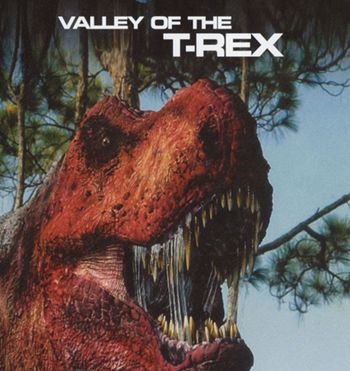
The program has received major criticism due to Horner's negligence to take note of any evidence that might confirm the opposite of his theories, the one-sided approach in the presentation, and the arguments he uses for why Tyrannosaurus was a pure scavenger don't hold up to scrutiny.
The work provides examples of:
- Anachronistic Animal: Saurornitholestes, the dromaeosaurs shown in the program, probably went extinct a few million years before T. rex and Triceratops appeared. Teeth from the Hell Creek Formation previously attributed to Sauronitholestes (tentatively) are now thought to belong to Acheroraptor (named in 2013).
- Animals Not to Scale: The dromaeosaurs in the program are identified as Saurornitholestes, which was around the size of Velociraptor (i.e. the size of a turkey). However, these dromaeosaurs are about as tall as a man, much like the raptors from Jurassic Park (since then, Dakotaraptor, a man-sized dromaeosaur that lived alongside T. rex has been claimed, although it is disputed whether this is an accurate reconstruction).
- Artistic License – Biology: The program was well constructed and explained its methodology in detail, but still makes several demonstrably wrong claims and pretty much ignores basic common sense to make a point.
- Could an animal that size support itself by being lucky enough to constantly bump into still-edible dinosaur carcasses whenever it was hungry? If it is a slow animal, is it possible that maybe it didn't need to be fast because its prey would have been just as slow if not slower? Couldn't it have also just used the element of surprise to catch its food? If it couldn't get up from the ground because of its small arms then how is it supposed to sleep?
- Horner seems to be under the impression that certain scavengers such as vultures look “ugly” because that helps them repel their opposition when stealing their kill. As if wild animals have the same beauty standards as humans or care much about them, to begin with. The iconic bald heads of vultures and condors have instead been theorized to be an adaption for digging into carcasses (reducing the chances of blood sticking to their plumage), or alternatively for thermoregulation (since most species live in hot and arid environments), while their scruffy feather collars help them keep their tucked head and neck warm at night. Those that have wrinkles, wattles, and/or brightly colored skin evolved them as display features, as a sign of fitness and virility (some taking it to the extreme
 ), and plenty of other birds (many of them not being scavengers or even carnivores) have similar features.
 - Horner compares T. rex to spotted hyenas for his argument, drawing on the common image of them as disgusting, cowardly scavengers. But they actively hunt their food more than they scavenge. In fact, as predators who rely on the sheer crushing power of their jaws to kill their prey, hyenas actually do make a good comparison to tyrannosaurs.
- Another huge strike against the scavenger theory is the environment T. rex lived in and its contemporaries. Comparing T. rex to the giant short-faced bear (Arctodus simus), although the latter also wasn't a specialized scavenger (despite what many 2000s documentaries would claim), the short-faced bear (much like today's brown bear) likely did scavenge far more often than it hunted live game. However, with Arctodus, it could get away with that because it was an omnivorous generalist, while T. rex was a hypercarnivore, and the short-faced bear lived in a very predator-rich environment, where dire wolves and numerous species of big cats (Smilodon, Homotherium, American lion, giant jaguars) were the main predators of the large herbivores that inhabited Pleistocene North America, while T. rex was the only large land carnivore in late Maastrichtian North America, with the only other coeval land carnivores being wolf-sized dromaeosaurids like Acheroraptor and Dineobellatornote , mostly mid-sized azhdarchids like Infernodrakon, Quetzalcoatlus lawsoni, and Wellnhopterus and the giant but still very gracile Quetzalcoatlus northropi that could only hunt game small enough for it to swallow whole, and the very gracile, long-legged, mid-sized tyrannosaur Nanotyrannus (the last one filling the mid-sized predator niche), so there was literally nothing but T. rex to hunt the sympatric multi-ton mega-herbivores like Edmontosaurus and Triceratops, and thus keep their numbers in check, and more importantly, nobody else to provide T. rex with a semi-regular supply of carrion.
- Small arms make hunting difficult? Eagles, monitor lizards, crocodiles, sharks, orcas, literally almost every other large carnivore BUT cats would like a word with you, Mr. Horner. It gets even more egregious when he cites wolves as a modern counterpart to dromaeosaurids, despite wolves not using their forelimbs at all for hunting.
- Artistic License – Paleontology: Quite a bit, especially considering that a lot of Horner's points in favor of tyrannosaurs being scavengers were countered as far back as 1988's Predatory Dinosaurs of the World!
- Horner claims that Tyrannosaurus didn't have a very good sense of sight when T. rex is known for having some of the best eyesight of any animal, theorized to be superior even to modern birds-of-prey, never mind dinosaur.
- Horner suggested dromaeosaurs would be the true top predators instead of T. rex, and the documentary proceeds to show them bringing down prey many times their size in numbers. This is, of course, analogous to jackals bringing down an elephant. Admittedly, this was before the discovery of Dakotaraptor, a larger dromaeosaur from the same time as T. rex, but still one way too small (grizzly bear-sized) to bring down animals larger than elephants even in a group. However... The entire idea of pack hunting dromaeosaurs has been brought into question for most varieties as well.
- The documentary claims that T. rex grew to 15 feet tall which is 2 feet taller than the largest specimens that have been discovered. It also claims that the Wynkel specimen was the most complete T. rex skeleton ever found, which is wrong because that title belongs to Sue.
- Both the T. rex and dromaeosaurs have pronated hands, even though it's believed neither were able to hold their hands in such a position.
- The fingers on Horner's Rex are the same length when one should should be shorter than the other.
- T. rex roars like a bear; indeed, the documentary actually uses a stock bear roar sound effect. Whatever vocalizations dinosaurs made probably didn't sound at all mammalian.
- Feathered Fiend: Saurornitholestes and a bunch of other small dromaeosaurs which the rex chases away from their kill.
- Raptor Attack: The Saurornitholestes are not only oversized, inaccurately feathered, and living in the wrong time period, they were also shown bringing down an Edmontosaurus many times their size and have also managed to kill a Triceratops, against all logic, all while Jack Horner basically fanboys over them as being legit killers unlike T. rex.
- Red and Black and Evil All Over: The "scavenger-fied" T. rex that appears at the end of the documentary is predominantly dark grey with a crimson head, and fully enforces the Scavengers Are Scum trope.
- Scavengers Are Scum: The scavenging T. rex as imagined by Horner is depicted in an extremely negative light, in contrast to the nobler image of the classic predatory version.
- Stock Footage: From Discovery's former dinosaur show, When Dinosaurs Roamed America.
- Stock Sound Effects: The roars uttered by the T. rex when it scares away a few smaller theropods from their kill are very obviously modified grizzly bear roars.
- Terrifying Tyrannosaur: Despite making T. rex a pure scavenger in the documentary, it ends with T. rex finding a Triceratops carcass being feasted by Sauronitholestes... and easily scaring them off because of its intimidating size and jaws, a fact that's objectively true in T. rex fossils no matter the debate of predator or scavenger.