

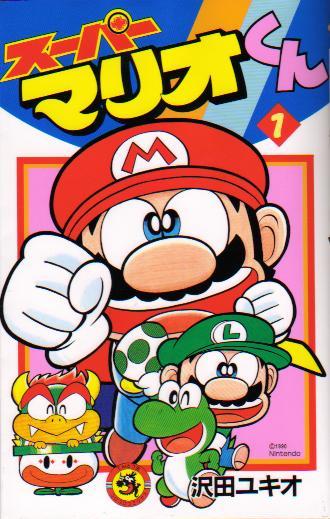
Super Mario Bros. Manga Mania (Super Mario-kun) is a long-running manga based off of Super Mario Bros.. It is written by Yukio Sawada, published by Shogakukan, and ran in CoroCoro Comic. In Japan, the manga is also available digitally on a Nintendo 3DS app.
The manga loosely adapts Super Mario Bros. games. It's a Gag Series manga with a focus on Slapstick and Vulgar Humor. Some chapters also feature puzzles to solve. Its first chapter was published in November 1990.
In 2014 it began localization in France as Super Mario: Manga Adventures and in 2016 it received a Spanish translation as Super Mario Aventuras. For its 25th anniversary, the manga's incarnation of Mario was made available as a downloadable costume in Super Mario Maker. It was the first time the character appeared in most countries.
In March 2020, it was announced that VIZ Media would localize a collection of select stories from the manga into in English, based on the Japanese Greatest Hits volume Super Mario-kun Selection. The collection was released in December 2020.
Super Mario Bros. Manga Mania provides examples of:
- Actually Pretty Funny: Mario and Luigi both legitimately enjoy a pun Bowser makes on TV at the start of the Super Mario Land 2 arc, with Mario saying Bowser's developed a knack for comedy and Luigi suggesting Bowser has found his true calling.
- Adaptational Jerkass: In early chapters Mario was much more of a jerk than his normal Nice Guy version. This is because the manga didn't have much to base him off at the time. This is also reflected in how he uses the more proud オレ/ore as a personal pronoun rather than the humble ボク/boku he uses in the few later titles he speaks in like Fortune Street and The Super Mario Bros. Movie.
- Adaptational Wimp: Usually, most characters are made less competent than in the games (up to and including spin-off protagonists like Donkey Kong and Wario) at the expense of having Mario save the day. That being said, even he tends to get beat up a lot before something or someone arrives to help him.
- Adaptation Deviation: The series is fast and loose in regards to adapting specific games (having Mario show up in Yoshi's Story and in Wario Land: Super Mario Land 3 outside the ending, for instance).
- Calling Your Attacks: Everyone does this frequently.
- Decomposite Character: Pauline's two designs are treated as separate characters.
- Denser and Wackier: It's much goofier than the games.
- Divergent Character Evolution: Since the baby Yoshis look alike, they each get their own distinct personality here: green is the brave leader, red is spirited, blue is calm and aloof, sky blue is the most intelligent, pink is the overly feminine girl, and yellow is the dumbest one.
- Early Adaptation Weirdness: Early volumes of Super Mario-kun features a rougher and Adaptational Jerkass version of Mario. This contrasts with his standardized Nice Guy portrayal. The early chapters differentiate heavily from Mario canon due to being created when the series was still relatively young and low on characterization.
- Exploiting the Fourth Wall: In the Super Mario 64 adaptation, just when Mario's on the cusp of victory, Bowser uses an N64 controller to delete the save file, completely undoing Mario's progress and erasing all the stars and power-ups he collected over the course of his adventure.
- Jail Bake: Of a sort. Mario gets eaten by a Sumo Bro in chapter 13, so Luigi offers the Sumo Bro a cake, allegedly as a truce, but it actually contains a power-up block for Mario to use to get out.
- Long Runner: It's been running since 1991.
- Mondegreen Gag: One of the most used gags in the comic. Usually coming with the misinterpreting character pulling out a Visual Pun and the other one correcting it.
- Mundane Made Awesome: In the Super Mario World arc, Invincible Mario getting shot out of a Pipe Cannon is referred to as Dangan (Bullet) Mario.
- Paper-Thin Disguise: Parodied during the Super Paper Mario arc wherein Luigi is brainwashed into being "Mr. L" just like in the game...only for Mario and Bowser to tell who he is straight away and Bowser even mocks Luigi for the poor disguise.
- Pragmatic Adaptation:
- The Paper Mario and Paper Mario: The Thousand-Year Door adaptations cut Mario's traveling companions down to Goombario and Kooper, and Goombella and Koops respectively; the other partners only appear for their respective chapters.
- The Super Paper Mario adaptation is even more pragmatic: the only Pixls who appear are Tippi, Thoreau and Barry, most of the side characters are removed and the plot skips straight from Outer Space to The Overthere, with two of the Pure Hearts (the Floro Sapiens and the Sammer Guys) being found offscreen by Peach. Justified by the author himself during the Overthere chapter, where he pops out in a panel to admit that he's rushing the plot to have more space for the Super Mario Galaxy adaptation.
- Ruder and Cruder: The series has a lot more Toilet Humor than the mainline Mario games.
- Screw This, I'm Outta Here: The standard tactic used when being faced against a formidable foe. It never works for long.
- Spared by the Adaptation:
- In the The Thousand-Year Door, Bobbery's wife Scarlette is actually still alive, with the whole story about her dying just being something he made up to get out of work.
- Bobby, Olivia and King Olly don't die during the events of Paper Mario: The Origami King. Rather than blowing up to destroy the boulder, Bobby yells so loud that he destroys it, and then goes to the hospital to make sure he didn't injure his throat.
- Surveillance as the Plot Demands: The main villains tend to watch Mario's current actions via a monitor.
- Very Special Episode: Super Mari-Old, a non-canon entry in the long running manga was only posted in issue 4 of the Coro Coro Aniki magazine and was not placed in any volumes until the Super Mario-kun Selection release (which the English release was based on). There's a reason why; It deals with the author's retrospective on how he had to continue the comic after his father's death, using Mario as a personification of himself to express his thoughts. Dr. Mario also appears as a representation of the author's decision to keep going.