

This is a musical strategy used in media (most commonly video games, due to their larger freedom in exploration and side content), where the mood for an area's soundtrack is changed drastically to fit along with the area's new visuals and features, since the old, cheery song no longer fits the new vibes.
Can combine with Dark Reprise if the new song retains the original's Leitmotif or melody. Often paired with Familiar Ruins or Bleak Level. Almost always played in the Doomed Hometown or Hub Under Attack. Compare Sudden Soundtrack Stop, if the change made is the removal of music altogether, and Leitmotif, if one is involved. Contrast Triumphant Reprise.
Not to be confused with Requiem for a Dream, which is a 2000 movie directed by Darren Aronofsky. Although, there are similar vibes going around there, too, though.
Due to the nature of this trope, all spoilers have been left unmarked. You Have Been Warned.
Video Game Examples:
- The Legend of Zelda:
- Majora's Mask: In the last 12 hours before impact, all overworld music is replaced by Final Hours.

- The Minish Cap: After Vaati takes over Hyrule Castle and transforms it with his magic, the music changes to a Dark Reprise of the Hyrule Castle theme from A Link to the Past.
- Twilight Princess: When Link is turned into a wolf and Ordon Village is attacked by the Twili, the once calm and peaceful song becomes sad and panicked.
- Tears of the Kingdom: The songs for the four towns suffering from regional phenomena in this game are twisted versions of their counterparts from Breath of the Wild, most notably Zora's Domain.
- Majora's Mask: In the last 12 hours before impact, all overworld music is replaced by Final Hours.
- Kingdom Hearts:
- Kingdom Hearts I: Inverted. The world of Hollow Bastion is but a large fortress occupied by Maleficent in an endless ocean of water. Kingdom Hearts II and Kingdom Hearts: Birth by Sleep reveal that the world was known as Radiant Garden, a lush and beautiful town with a large castle (which is the bastion of the name of the world). The Kingdom Hearts II version of Hollow Bastion/Radiant Garden's field theme, "Rebuilding Hollow Bastion", is an optimistic reprise of "Hollow Bastion", the Kingdom Hearts version's field theme, and the battle theme, "Scherzo di Notte", follows suit as an upbeat reprise of its Kingdom Hearts counterpart. The Birth by Sleep version's field and battle themes, "Radiant Garden" and "Black Garden", are outright more bombastic and triumphant reprises of their Kingdom Hearts II counterparts.
- Kingdom Hearts 0.2: Birth by Sleep -A fragmentary passage- has two examples, each using the remains of worlds from Birth by Sleep in the Realm of Darkness. Both remains' field themes are Dark Reprises of the original worlds' field themes, mashed up with the Realm of Darkness's field theme, "Night in the Dark Dream".
- The World Within is the remains of Dwarf Woodlands, and its field theme is a Dark Reprise of the Dwarf Woodlands' field theme, "The Secret Whispers", combined with "Night in the Dark Dream".
- The Forest of Thorns is the remains of Enchanted Dominion, and its field theme is a Dark Reprise of Enchanted Dominion's field theme, "The Silent Forest", combined with "Night in the Dark Dream".
- In Xenoblade Chronicles 1, the High Entia capital of Alcamoth is destroyed when all its denizens are mutated into Telethia by Zanza. When it's revisited in the Future Connected epilogue, the background music has turned from the majestic theme that was playing before to the bizarre, warbling "Memory's End", which previously only played in The Very Definitely Final Dungeon Memory Space.
- Hollow Knight: Downplayed. The Forgotten Crossroads music is already somewhat melancholy, as the location has already been reduced to ruin, but once it turns into the Infected Crossroads, the music loses any sense of adventure or mystery it once had and is replaced by a distorted Dark Reprise of its original rendition, taking an already somewhat depressed song and turning it into something slightly more harrowing.
- Hollow Knight: Silksong:
- Inverted, then played straight with Bellhart. Upon first discovering Bellhart, it will simply play tense strings, as everyone is suspended in the air by threads of string. However, after beating Widow, everybody is freed, and the town music becomes a lot happier. However, in Act 3, the music becomes a lot more ambient and tragic.
- Downplayed with Songclave. In Act 2, the music wouldn't exactly be called happy, but its more subdued, ambient version in Act 3 is definitely even less happy.
- Once again downplayed with Bonebottom, with it possibly having the least happy town theme of the three, but quite possibly has the most drastic change in Act 3 - the town itself is completely gone, and as such, it doesn't even receive a Dark Reprise like Bellhart and Songclave do - it just gets a harrowing ambience comprised of wind noises and strings.
- Inverted, then played straight with Bellhart. Upon first discovering Bellhart, it will simply play tense strings, as everyone is suspended in the air by threads of string. However, after beating Widow, everybody is freed, and the town music becomes a lot happier.
- Banjo-Tooie:
- After destroying Spiral Mountain (especially Banjo's house) and killing Bottles, both Spiral Mountain and the ruins of Banjo's house play minor renditions of their original themes.
- After Gruntilda sucks out all of King Jingaling's life force and turns him into a zombie, the music for his throne room stays largely identical, except for it playing in minor key now.
- After destroying Spiral Mountain (especially Banjo's house) and killing Bottles, both Spiral Mountain
- Sonic 3 & Knuckles: The music for Act 1 of Angel Island Zone is one of the most upbeat in the game. However, in Act 2, since Angel Island Zone is on fire, the music gives an unusual fast-paced example of this trope, but nonetheless fits, as it's in a minor key.
- Chrono Trigger has several overworld themes for the different time eras, but the saddest one is Ruined World, which plays in 2300 AD, 3 centuries after Lavos destroys the world.
- Final Fantasy:
- Final Fantasy VI:
- Though all three overworld themes in the game are in minor key, Terra's Theme and Searching for Friends have more triumphant sounds to them. However, this is not the case for Dark World. This song plays in the World of Ruin overworld up until the point you get the airship (at which point it's replaced by Searching For Friends), and in Narshe in World of Ruin, since it has been largely abandoned.
- Most towns in the game will switch their soundtrack to From That Day On... in the World of Ruin.
- In the first half of the game, Jidoor plays Kids Run Through the City, which also plays in most of the towns in the game. However, in the world of ruin, it gets a unique song: The Magic House, which, despite its mystical name, matches the downbeat feel of the World of Ruin while being perfectly fitting for the snobby feel of Jidoor.
- Strangely averted in the town Nikeah, which is the only town in the World of Ruin to still play Kids Run Through the City.
- Though all three overworld themes in the game are in minor key, Terra's Theme
- Final Fantasy VII:
- The overworld music, Pre-Meteor, is slow but triumphant. However, the same cannot be said for its Post-Meteor counterpart.
- The music for Upper Junon, regardless of what point in the game you're in, takes on the form of a march. However, it's happy Pre-Meteor, but sounds like an army defense Post-Meteor.
- The overworld music, Pre-Meteor,
- Final Fantasy VI:
- Mario & Luigi: Superstar Saga: Beanbean Castle Town normally has the quirky and upbeat "Beanish People" theme. After it is attacked by Bowletta, the music permanently changes to the depressing and ominous "Touch of Evil" theme.
- Persona:
- Persona 3: In general, most of the overworld music switches from a fairly upbeat collection to a more sorrowful set after the New Year, as SEES come to terms with Nyx's impending doom on the world. Some examples include:
- "Iwatodai Dorm" plays at the aforementioned location, depicting life at the dorm. It's then replaced with "Living with Determination" after 12.31, signifying SEES' stoic resolve in the face of great calamity.
- "Want To Be Close" and "Changing Seasons" play at Gekkoukan High during the first and second school terms respectively, then are supplanted by "Memories of the School" after the new year.
- "Iwatodai Dorm
- Persona 4:
- The day theme switches between the upbeat Your Affection on sunny days or the more pensive Heartbeat, Heartbreak on cloudy or rainy days. These, however, are supplanted by the eerie, minimalistic Omen after the fog engulfs the town of Inaba following Kunino-Sagiri's defeat.
- The home theme for most of the game is the cheery Signs of Love, signifying the protagonist's generally happy home life with the Dojimas. It, however, switches to the melancholic Alone after both are hospitalized in the wake of the Wham Episode in November.
- The day theme switches between the upbeat Your Affection
- Persona 3: In general, most of the overworld music switches from a fairly upbeat collection to a more sorrowful set after the New Year, as SEES come to terms with Nyx's impending doom on the world. Some examples include:
- Heroes of Might and Magic V: The Necropolis Theme is a dark and sinister remix of the Haven Theme. The 1st chapter of the single player campaign has the player controlling Haven, and ends with Queen Isabel's husband King Nicolai being slain by a demon. Later, during the Necropolis chapter, a Necromancer named Markal convinces Isabel he can bring Nicolai back from the dead and seizes control of the Griffin Empire.
- Terraria:
- If you die in Terraria, you spawn a tombstone. Let too many tombstones gather in the same area, and the area will become foggy, spawn ghosts, and play creepy, melancholy music.
- The Corruption and Crimson, the game's evil biomes, could be considered this, as they spread over time (especially in Hardmode), have a more negative aura, are more difficult to traverse, and, most importantly, play downbeat and evil-sounding music. So, technically, this trope can apply if a biome with an otherwise happy song gets overwhelmed by an evil biome. Especially apparent if either of these overtakes a town, rendering it uninhabitable.
- If you die in Terraria, you spawn a tombstone. Let too many tombstones gather in the same area, and the area will become foggy, spawn ghosts, and play creepy, melancholy music.
Non-Video Game Examples:
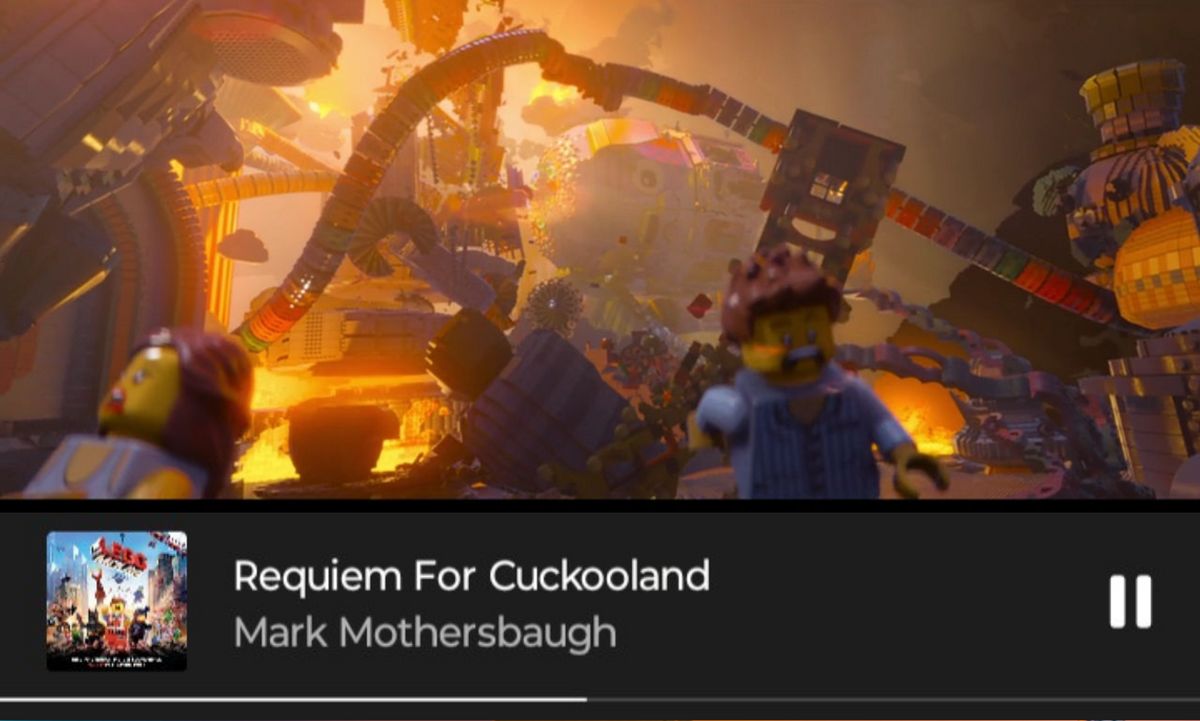
- The LEGO Movie has "Requiem for Cuckooland", which plays over a sequence where the main cast are escaping via submarine and watch the wreckage of Cloud Cuckoo Land sink into the ocean, as opposed to the much more happy music that plays when Cloud Cuckoo Land is introduced.
- Mulan (1998): Implied. Even though the town that Shan-Yu destroys isn't shown prior to its destruction and therefore doesn't have any music backing it, the reveal of its destruction cuts the song "A Girl Worth Fighting For" short, and songs with lyrics are avoided for the remainder of the movie.
- Big City Greens: In Chipocalypse Now, the normal intro sequence is swapped out for a montage of Chip replacing Big Coffee and the apartment complex next door to the Greens with a Wholesome Foods on both sides of their house, complete with a Dark Reprise of the show's theme song.