

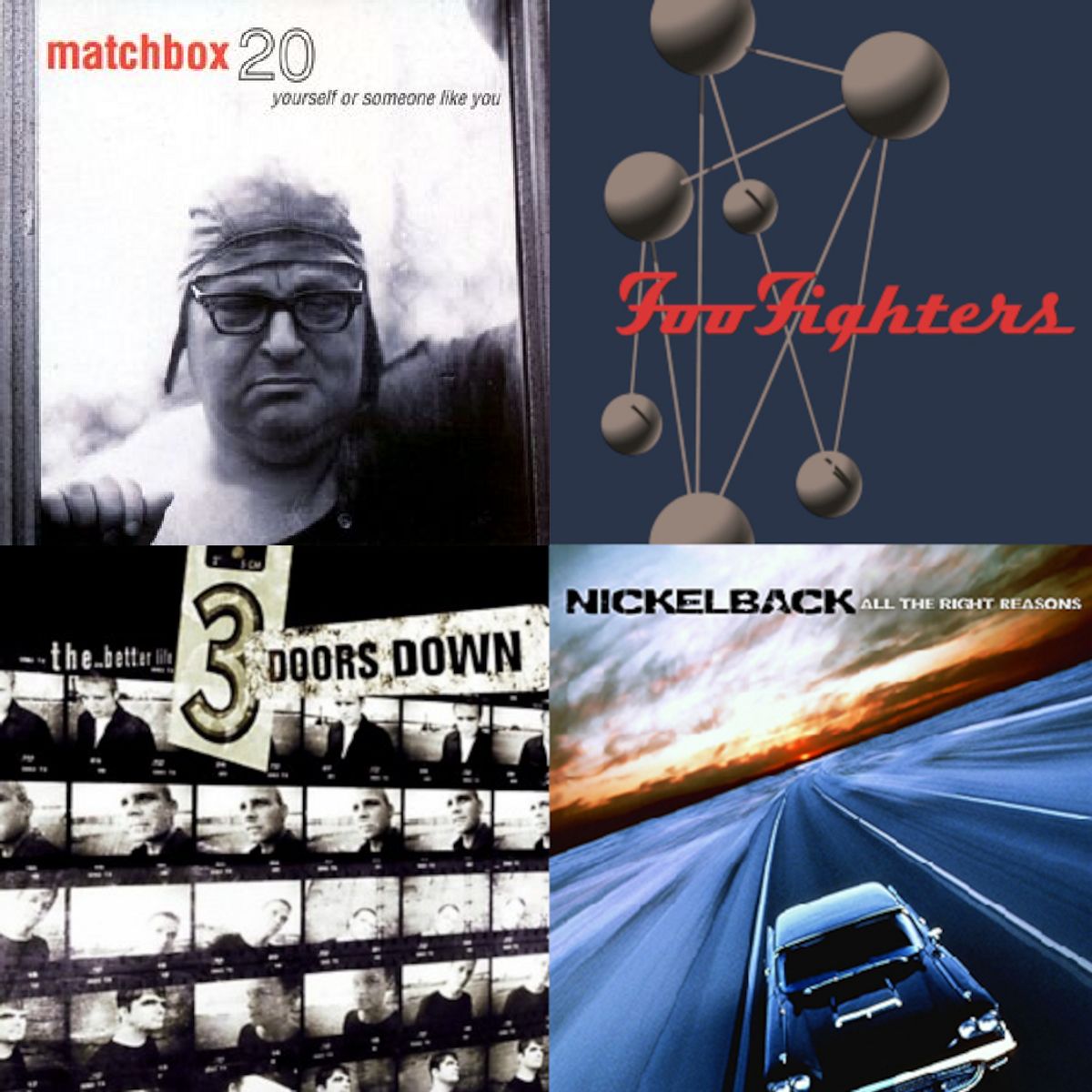
Post-grunge is a "derivative" of Grunge music that became popular in the late '90s. The genre is primarily marked by its use of yarling vocals, downtuned guitars and Hard Rock/Punk aesthetics commonly associated with Grunge, but removing the more unusual songwriting choices and less commercially-friendly influences from Hardcore Punk and Noise Rock that many original grunge artists were known for, in addition to much more mid-tempo songs. In other words, taking the more commercially viable qualities of Grunge while cutting out its oddity and offending harshness, and building more traditional songs out of it than Grunge. Yeah, this genre doesn't go over well with the underground music scene. Its popularity has occasionally caused it to receive blame for Alternative Rock losing its experimental qualities, as the genre's existence contributed to the numerous bands previously snatched up by major labels after Nirvana's breakthrough being unceremoniously dumped.note
The genre has been known to use the more traditional rock structures often rejected by their predecessors in Grunge, modernized with more up-front, brooding lyrics. In this sense, the movement could be considered (ironically) the Spiritual Successor to Hair Metal, whose pop beats and polished production brought heavy rock to a widespread audience (Post-grunge is also well known for its "soul-searching" ballads). Indeed, many post-grunge bands take more influence from Poison, Cinderella and Whitesnake than Nirvana; post-grunge players generally think of the old grunge-greats as idols/heroes rather than true influences, with more of an interest in writing their own material in that particular style (stylistic emulation) over combining many influences (the subtle difference between a direct or indirect influence from grunge can affect how well-received a post-grunge band is, both critically and to their audience). Post-Grunge tends to focus more on conventional lyrical structure than the music itself, and though the genre is rooted primarily in Alternative Rock, make no mistake, post-grunge was tailor-made for the mainstream (with even some underground songs of the genre being used in big media franchises of the time), and is what helped Alternative become rooted as 'Mainstream' music. note In essence, it took no influence from the ethos of Grunge, but took every influence from its sound without the same ideology.

The rise of Post-grunge has gone to dominate and even embed itself in the standardly recognized sound of Hard Rock as most people can hear, creating the assumption that post-grunge is, along with Pop Punk and mainstream Emo, one of the only forms of modern rock. This has had the flip-side effect of some of the more straight-forward, contemporary rock groups note being lumped in with post-grunge, despite largely having no alternative qualities in their musicnote . There is a bit of cross-over involved as well: Saliva, Shinedown, 3 Doors Down and Daughtry like to dabble in/pay tribute to "regular" hard rock when they can, adding to this confusion. It seems the only way to escape this is to play very old-fashioned retro-rock, such as Garage Rock revival, new Blues Rock, neo-psychedelia, traditional-metal revival, or modernized Power Pop.
After dominating mainstream rock music in the late '90s and '00s, post-grunge eventually wore out its welcome in The New '10s. Few new bands are playing post-grunge anymore, largely moving onto straightforward Alternative Rock or Pop Rock. While a few bands are still doing well on Mainstream Rock radio (usually because they added elements of other genres into their music) and a minor revival has taken place among remixers of Dragon Ball franchise songs (due to action anime fans generally liking many kinds of rock and metal with few of the hierarchies followed by other rock fans, and the Texan dub's original soundtrack being inspired by it at points with actual underground post-grunge songs that were a rarity at the time used in the films' dub soundtrack), everyone else retains small to large cult followings at most or are completely unknown now.
Sub-Trope of Post-Somethingism (a movement/genre that arises from the evolution of the previous one's conventions).
Bands typified as Post-grunge:
First-wave Post-grunge:
- 60 Ft. Dolls
- Bush (occasionally considered genuine grunge, although this is controversial)
- Candlebox
- Collective Soul (for what it's worth, Ed Roland has confirmed that Collective Soul's influences are distinct from Grunge and that they weren't even trying to make Grunge-like music)
- Creed (one of the more infamous examples)
- Days of the New (a mostly acoustic band, sounding a bit close to Alice in Chains in acoustic mode)
- Dog's Eye View (with more folk and roots rock influences than typical for this genre, arguably crossing over to "adult alternative")
- Foo Fighters (ironic, considering the band's origins; Easily one of the most well known on this list)
- 1995 - Foo Fighters (Album)
- 1997 - The Colour and the Shape
- 1999 - There Is Nothing Left to Lose
- 2002 - One by One
- 2005 - In Your Honor
- 2007 - Echoes, Silence, Patience & Grace
- 2011 - Wasting Light
- 2023 - But Here We Are
- Grey Daze (known as the band Chester Bennington was in before he joined Linkin Park)
- K's Choice
- Live (Got lumped in due to supposed Grunge influences on Throwing Copper, despite being around during Grunge and making Art Rock at that time)
- Marcy Playground
- Matchbox Twenty
- Our Lady Peace (shifted to New Millennium-style in 2002)
- The Presidents of the United States of America
- Seven Mary Three
- Silverchair (first two albums could be considered straight-up grunge, later work is more experimental)
- Tonic (first album; they later became "adult alternative")
New Millennium style post-grunge:
- 3 Doors Down
- 12 Stones
- 32 Leaves
- Adema
- Aranda (on their second album, "Stop the World")
- Art of Dying
- Black Stone Cherry (overlaps with Southern Rock)
- The Calling
- Cavo (their song "Champagne" was a number one hit on rock radio in 2009).
- Dark New Day
- Daughtry (widely recognized as one of the heaviest things to come out of American Idol)
- Default
- Evans Blue
- Feeder (probably the only known band who also overlaps with post-Britpop)
- Finger Eleven (best known for the hits "One Thing" and "Paralyzer.")
- Fuel
- Hinder (a band from the Sex, Drugs, and Rock & Roll wave influenced by Glam Metal)
- Hoobastank (was more Nu Metal in on their debut album, but this seems to better apply to their second album)
- Jet Black Stare
- Lifehouse
- My Darkest Days (short-lived Sex, Drugs, and Rock & Roll act, known as the original band of Three Days Grace’s second frontman Matt Walst.)
- Nickelback (easily the most successful, yet hated example)
- 2001 - "How You Remind Me"
- 2005 - "Savin' Me"
- Poets of the Fall
- Pop Evil (earlier work, though they've since embraced a more metal-influenced sound)
- The Pretty Reckless (fronted by popular actress Taylor Momsen)
- Puddle of Mudd (started out as more nu-metal influenced but later work was in the Sex, Drugs, and Rock & Roll style)
- Rev Theory
- Saving Abel (Another Sex, Drugs, and Rock & Roll act, fairly similar to Hinder although more influenced by Southern rock)
- Sixx:A.M. (a rock trio featuring Nikki Sixx; their sound is far removed from that of Sixx's more well-known band)
- Stereomud (a nu-metal group whose bassist is now the guitarist for Seether)
- Switchfoot (overlaps with Christian Rock)
- 2003 - The Beautiful Letdown
- Tantric (a spiritual successor to Days of the New, with a heavier emphasis on acoustic guitars than most bands)
- Theory of a Deadman (also a Sex, Drugs, and Rock & Roll group who are closely tied to Nickelback. They were for the most part the lone survivor of that wave of bands after they went out of style)
- The Veer Union (one of few examples with a black lead singer)
Post-Grunge / Alt-Metal crossover:
Some post-grunge bands take more after tool and Alice in Chains than Pearl Jam or Nirvana, while some like to add a heavier edge to their sound as not to be lumped with their softer post-grunge contemporaries while maintaining their alternative status. Thus, the overlap with Alternative Metal was inevitable. Note that all or most post-grunge bands fall under the Hard Rock umbrella (a genre related to alt-metal and Heavy Metal}), but post-grunge bands with similarities to metal aren't necessarily an example of alt-metal. Given their similar pop-leanings, normally when a post-grunge band makes their sound heavier they become nu-metal rather than pure alt-metal; achieving the sound of alt-metal requires a distinctly guitar-driven, alternative rock approach with less of the aggression, rap elements and simplicity associated with nu-metalnote . In other words, bands like Papa Roach, who practiced more standard-fare nu-metal early in their career only to switch to post-grunge later, wouldn't be an example of post-grunge/alt-metal crossover. Post-grunge/alt-metal crossover bands melodically tend to follow more in line with classic grunge, Alternative Rock and NWOBHM. They are generally much more acclaimed and respected than regular post-grunge. These include:
- 10 Years (an Ensemble Dark Horse that is one of the most Tool influenced of the lot, also considered Progressive Metal)
- Adelitas Way
- Alter Bridge (made of Creed minus Scott Stapp, and much more respected than their parent group. Possibly the only post-grunge band in existence who overlaps with progressive rock and speed metal).
- Audioslave (Which is Chris Cornell with Rage Against the Machine backing him.)
- Breaking Benjamin (one of the more well received bands belonging to the genre, still enjoying success well into The New '10s)
- Burn Halo (once again from the Sex, Drugs, and Rock & Roll wave, though less successful)
- Chevelle (most obvious example of the Tool influence within Alt-metal/post-grunge)
- CKY (generally regarded as somewhere between here and straight alt-metal or something else altogether, they also have very strong stoner influences that are very uncommon in this genre)
- Cold
- Crossfade (known for a song called "Cold", unrelated to Cold the band)
- Dark New Day (best known for their hit song "Brother;" featured members of Sevendust and Stereomud, and was significantly more grunge-influenced than their parent projects).
- Cryoshell (Mixed with Symphonic Metal , and they have a definite Evanescence influence )
- Decyfer Down (a Christian Rock group known for minor radio hits "Fading" and "Crash")
- Drowning Pool (originally a Nu Metal act; third album onward)
- The Exies
- Filter (crosses over with Industrial Metal, given they’re an offshoot of Nine Inch Nails)
- Flyleaf (a rare female-fronted example of such).
- Godsmack (most obvious example of the Alice in Chains influence within Alt-metal/post-grunge. Primarily was Nu Metal at the beginning of the era)
- Halestorm (like Flyleaf, they have a female lead singer).
- Hurt (once again, a big Ensemble Dark Horse of the genre, being very experimental and Tool-esque)
- Kilgore
- Presence ( their first album was straight Nu Metal. They switched to this still for their second and final album)
- Onesidezero (another Tool influenced band)
- Pop Evil
- Red ( Mixed with Christian Rock and Symphonic Metal)
- Seether (a successful South African import)
- Sevendust (not always, but a lot of their more radio-friendly material leans towards this)
- Shinedown (Probably the Post-Grunge band with the most Soundgarden influence)
- Sick Puppies (an Australian act, known for having a female bassist who occasionally sings)
- Skillet (Which is also one of the most famous examples of Christian Rock)
- Smile Empty Soul (arguably the most respected example)
- SOiL (not coincidentally, their original singer Ryan McCombs went on to join Drowning Pool and play on their third and fourth albums)
- Staind (nu-metal/post-grunge)
- Stone Sour (Corey Taylor occasionally lapses into this genre when with Slipknot when singing melodically)
- Taproot (have had run-ins with the nu-metal label)
- Thousand Foot Krutch (Another Christian Rock example; as of War of Change, earlier work is Nu Metal)
- Three Days Grace (later work showcases their post-grunge/alternative side more)
- Trapt (one of the only bands who fall under this and Nu Metal simultaneously)
- Tremonti (Side project of Creed and Alter Bridge’s guitarist; less Post-Grunge / Alternative Metal, more Post-Grunge Thrash Metal, and one of the consistently heaviest of Post-Grunge bands)
Here's a way to pass the time: count how many of these bands:
- Come from Canada (specifically, British Columbia and Southern Ontario), California, the Pacific Northwest, and the Upper Midwest. The southern US is also optional.
- There's a good reason for the first one: Nickelback is from Hanna, Alberta (curently based in Vancouver), and Chad Kroeger loves seeking out bands that sound similar to his own so he can sign them (in the hopes of "bringing back rock n' roll").
- Insist on being called straight-rock, Alternative Rock, or "real" grunge.
- Either have a vocal hatedom that decries them as "buttrock", or are (slightly more charitably) viewed as middle-of-the-road, rock.
- Have been called Christian Rock at some point. Bonus points if they actually did start out as a Christian rock band (Skillet and Switchfoot are two examples). Or they write vaguely spiritual lyrics.
- Regularly played large summer package tours, usually Cruefest or Uproar Festival.
- Have a sizable amount of single-word-title songs.
- Have a member with a Kurt Cobain-like shaggy hair cut and goatee combo. Some like Jon Foreman from Switchfoot evolved into it due to pressure from record executives to look edgier. When the band started, Foreman had short, spiked hair with very little gruff.
- Took a more Hair Metal-oriented turn in the mid-to-late 2000s (due primarily to acts like Hinder, Saving Abel, and Rev Theory, who mixed the two genres and became quite successful as a result).
- Sing like Eddie Vedder or (with some bands) Kurt Cobain or Layne Staley. Or in light of this, claim their vocalizations were influenced by Jim Morrison. This has been known to reach Flanderization levels: sounding like Kurt Cobain means Suddenly Shouting during the chorus in between Perishing Alt-Rock Voice passages, sounding like Eddie Vedder means groaning and mumbling, and sounding like Layne Staley means an nasal characteristic and vibrato on almost every note.
- Cobain-style vocalists include Wes Scantlin, Jason Wade, and Tyler Connolly. Vedder-style examples include Scott Stapp, Alex Band, Aaron Lewis, and Shaun Morgan. Staley-style includes Adam Gontier, James Michael, and John Cooper.
- Had a hit single on Top 40 or adult contemporary radio.
- Had a Top 10 hit single on mainstream rock radio in the mid 2010s or later.
- Currently plays to a few hundred people at their concert gigs.
- Are blamed for having "killed rock music".
- You've heard a softer Signature Song from any of them on rock radio lately? (possibly an acoustic ballad)