

Cinderpelt: Why should they be? There are no borders in StarClan. Cats roam where they please. Bluestar lives with Oakheart now. They can be the family they never were in life.
When a character dies, with rare exceptions, they end up in an afterlife populated by other deceased. Some of these people will have been friends or loved ones in the living world, reunited at last. Some of these people...well, let's just say not everyone in Heaven was on good terms before they died. Some of them were even bitter enemies!
But in the afterlife, there's little reason to care about former rivalries and disagreements. It stops mattering what happened when you were alive, and so the people you used to hate, suddenly, aren't so bad at all.
This may happen because the afterlife brings a sensation of peace and understanding. A character once consumed by rage or jealousy or power can gain some perspective after death, and become a much calmer, friendlier person. At the same time, there's nothing left to pick a fight over, anyway. You don't need money, land, or authority when you're a ghost— so why continue to hate the people that challenged you? With the entire reason for the animosity being nullified, rivalries can be put aside. However, it doesn't have to happen instantaneously. The afterlife is supposed to be eternal, after all. There's more than enough time to mend bridges with the people you used to fight with, so some works portray this process as being about a gradual bonding and forgiveness process while there's nothing left to do but talk to each other, rather than an immediate shift.
Having this occur between individuals is most common, but it could also happen on a larger scale. Entire warring nations could become friends in the afterlife, and though their descendants will still fight, at least the afterlife brings them a truce.
Compare Fire-Forged Friends. See also All Are Equal in Death. Contrast Afterlife Avenger, for cases where the conflict does continue beyond the grave.
As this is a Death Trope, unmarked spoilers abound. Beware.
Examples:
- Code Geass: In the manga version of Resurrection, in C’s world not only does Euphemia help CC resurrect Lelouch showing she’s completely forgiven her brother for killing her, Shirley and Rolo happily help out as well with no hostility despite the latter having murdered the former.
- Jujutsu Kaisen: While it's vague if what Gojo was experiencing was just a Dying Dream or an actual Afterlife Antechamber, his death sees him reuniting with all the people he had significant interactions with that had already died. While this includes the obvious ones like Geto, Nanami, Haibara, Yaga, Riko, and Kuroi, it's shown that Toji is there too. While Toji was singlehandedly responsible for the death of Riko and inadvertantly set off Geto's Protagonist Journey to Villain with Gojo having every reason to hate him, the two display no animosity, Gojo choosing to instead just cherish the fact he's with the people he loves again and hoping the students he left behind can carry on without him.
- Space Runaway Ideon: At the end of the movie Be Invoked, the souls of the main characters are shown to interact peacefully with the Human Alien Buff Clan, with whom the main characters have been at war for the entirety of the series. This is likely due to the understanding brought about from the Ide.
- The Chronicles of Wormwood: Heaven is populated by people of every faith and belief, since the main requirement is basically "do no harm" (by contrast, Hell is where pedophiles, Hitler and Judas end up, and the real torture is being unable to hide from the fact that they deserve to be there). A priest and a Buddhist monk are seen amiably chatting together (all the more remarkable since God is a nutcase who constantly masturbates), and there's even a suicide bomber who doesn't attack anyone but does thinks he's in the wrong place, despite the 72 virgins in his care... that is, 72 constantly screaming, constantly hungry babies.
- In ElfQuest, Strongbow was beating himself up when he was forced to fatally shoot down Kureel, a Glider elf at the end of Siege of Blue Mountain in defense of his son and a sympathetic young human. In Kings of the Broken Wheel, the tribe suggests that Strongbow get this off his chest by going to the Palace where most of the spirits of late Elves dwell after death to ask forgiveness. He makes the journey and contacts the spirit of Kureel, and it turns out that he is completely at peace and barely remembered the circumstances of his death. As such, Kureel was willing to forgive Strongbow immediately, if only to make a fellow Elf feel better.
- The Jujutsu Kaisen fan video "All Toji's Go To Heaven
 " acts as a Deconstructive Parody of the trope. Riko Amanai and Misato Kuroi, both recently killed during the "Hidden Inventory" arc and reunited in the afterlife, are baffled to find Toji Fushiguro, their killer, joining them due to Satoru Gojo having just killed him. Neither of them can understand why he's in Heaven and are understandably angry since he killed them, but Toji's overall blasé attitude while trying to invoke the trope, not even remembering he killed Riko and thinking he left Kuroi alive but didn't realize she bled out, just frustrates them to the point they eventually spend the next decade barely tolerating him and playing Uno together. When Suguru Geto then shows up after Gojo killed him at the end of Jujutsu Kaisen Zero, while he's happy to reunite with Riko and Kuroi and tries avoiding mentioning he was Madden Into Misanthropy after they died, he's livid to see Toji there and accidentally calls him a "monkey", disturbing Riko and making clear there's gonna be even more awkwardness going forward.
- In the Empath: The Luckiest Smurf story "Smurfed Behind: Smurfing In Heaven", Empath (who thinks he's dead) goes to Elysium and sees all not only are all his fellow Smurfs there, but also nobody has a problem with anybody up there — especially with the likes of Grouchy, Brainy, Jokey, and Clumsy. Of course, this all gets undercut by the fact that this version of Elysium that Empath visits isn't real.
- EON: Pelagial features an Inversion with Kairos. Having died at the hands of somebody they trusted (and subsequently underestimated), they'd filled with nothing but hatred and desire for revenge.
- Here Comes the New Boss: The first Butcher's power causes anyone who kills the current holder of the power to inherit both the powers and minds of all previous Butchers. While the minds maintain distinct personalities, there is an intermingling of personalities and memories that allows them to better understand one another. This has caused many Butchers who hated one another in life to develop friendlier if still caustic relationships in death. Even Flinch who has spent years submerged in memories to ignore the horror of his existence has gradually developed an Odd Friendship with the other Butchers thanks to Taylor's presence.
- Move Aside, Make Way for Ultra Despair: After they arrive in the afterlife, Ben is shown to fully forgive Svetlana for murdering him, while Charlie and Bronwyn forgive each other for the quarrel that claimed both their lives.
- Of Apologies and Food Fights: A Glimpse Into the Afterlife: Nayeon is no longer hated and despised by the others, and appears to have changed her ways for good.
- Oh Shit, There's Fanfiction of Us!?:
- The various victims of the Killing School Life are shown to be quite civil and happy with each other in the afterlife, even the ones who murdered each other. This may be due to the fact that all of them were friends before the killing game and wouldn't have killed each other if the Big Bad hadn't wiped their memories.
- A more serious version of the above scenario, A Collection of Afterlife Reunions feature this trope eventually happening, with even the Big Bad being welcomed back into the group's True Companions, but it takes a lot of forgiving to get there.
- one day at a time (Nyame): This is heavily Implied during Jason's Near-Death Experience. None of the people he meets are angry with him over the choices he'd made in life, completely understanding all of his reasons and enabling them to reconcile. One of the last things he sees before reviving is Bruce and Selina holding hands, implying that despite how stormy their relationship was, they're Together in Death.
- The Ballad of Buster Scruggs: Scruggs reflects on the nature of the afterlife:
Scrugges: There's just gotta be a place up ahead, where men ain't low down and poker's played fair. If there weren't, what are all the songs about? I'll see you all there, and we can sing together and shake our heads over all the meanness in the used-to-be.
- Beetlejuice: In the waiting room for the Afterlife one of the souls is a big game hunter with his head shrunk. He's sitting next to the Witch Doctor that apparently did that to him. Neither man seems troubled by the other man's presence.
- Played for heartwarming laughs in Happy Gilmore — after winning the golf championship and his grandma's house back, Happy looks up at the sky to see his dead mentor Chubbs Peterson smiling down at him from Heaven, along with Abraham Lincoln... and the alligator that bit Chubbs' hand off.
- Star Wars: Return of the Jedi: After Darth Vader sacrifices himself to save his son Luke and destroy the Emperor, his redeemed self appears as a Force Ghost in the movie's final scene alongside Obi-Wan and Yoda. Neither of them seems to bear him any enmity, despite him having previously aided the Empire in slaughtering their entire order and sort of killed Obi-Wan.
By Author:
- In the books by C. S. Lewis:
- In The Great Divorce, nearly everyone makes enemies with each other in Hell and there is no enmity between anyone in Heaven. In particular, two of the Saved, Len and Jack, are on perfectly friendly terms, even though the former had murdered the latter. Len is also ready to make peace with his previously hated boss (one of the damned who ultimately refuses Heaven).
- In The Last Battle, some people who have opposed Aslan turn towards him in the end. Some of the dwarves manage to give up their cynicism, and there is that famous heartwarming story about the young Calormene soldier, formerly a devoted worshipper of Tash, who accepts Aslan and makes peace with the Narnians.
- In Mere Christianity, Lewis imagines that if he'd died fighting in World War I, him and his opposite number would meet in paradise, have a good laugh about killing each other, and then go for tea.
- In Space Wolf the Fenrisians consider recruitment by the Space Wolves after falling in battle to be something like Valhalla, but Ragnar gets picked up alongside Stybjorn, a warrior from a rival tribe who may have killed his father, and they spend most of the first book as bitter foes. By the end of the novel, they've fought together against a Chaos Space Marine incursion and put aside their dispute from their old life.
By Title:
- In "Bobok", this trope has a rare Played for Horror spin. The characters are The Undead, corpses who have just two or three months of half-life before they completely rot away. Instead of getting closure for their lives, let alone feeling any remorse, they decide to forget everything and let their hair down one last time. The camaraderie between victims and assailants isn't forgiveness for the former and repentance for the latter — it's total indifference to anything except some company for the last few weeks of debauchery. In particular, Klinevich reminds Avdotya Ignatyevna that she raped him when he was fourteen in a mildly teasing tone, and Catiche, a fifteen-year-old girl who is treated as a Lust Object by twenty-nine-year-old Klinevich and seventy-year-old Tarasovich, reacts to them drooling over her with nothing but eerie giggles.
- This concept is discussed by Ivan and Alyosha in The Brothers Karamazov. Ivan says that he couldn't accept a world where a mother embraces a torturer and murderer of her son, and they exclaim aloud with tears, "Thou art just, O Lord!" Alyosha has to agree with him.
- In The Letters to a Sleeping Brother by Andrey Desnitsky, the narrator, a resident of Heaven, writes to her brother (in Hell but with a chance of survival) and tells him how former enemies turn to friends in Heaven. In particular, she says that Peter, a Latvian soldier whose arrest her brother had (unwillingly) caused, is in Heaven now and sends him his love. She also mentions a pagan priest who reconciled with the victims of child sacrifices he used to perform.
- The Posthumous Memoirs of Brás Cubas: In life, judgment and power disputes influence people into faking who they are and shrouding their true conscience. But in death, there are no friends or enemies, nor public, and thus the gaze of opinion loses its virtue. There is still judgment and examination, but the dead have no reason to take it into account, which is why Brás Cubas feels so free to highlight his own mediocrity to the living in his Memoirs.
"The gaze of opinion, that sharp and judgmental gaze, loses its power as soon as we step into the territory of death; I don't say that it doesn't extend here, and doesn't examine and judge us; but it's that we don't care about the examination or the judgment. Gentleman of the living, there is nothing as immeasurable as the disdain of the deceased."
- The Roald Dahl short story They Shall Not Grow Old, a British WWII pilot has a near-death experience where he almost ends up landing at a heavenly airstrip; he sees airplanes of both sides landing, with both Allied and Axis airmen on the field cheering the new arrivals side-by-side.
- In Warrior Cats, the Clans all have an intense territorial rivalry with one another. However, all borders break down when they die and join StarClan. Cats live in peace together in StarClan.
- In the French-Canadian youth fantasy novels Amos Daragon, the titular Amos ventures through all levels of hell in book 7 and meets an old Arc Villain who died in book 2 and is now in the warmonger hell alongside other warlike tyrants. He has considerably mellowed since then and helps Amos through this particular circle of hell.
- An episode of Criminal Minds plays with this, as Aaron Hotchner collapses and is taken for emergency surgery, where he has a vision of his late wife, as well as the man who murdered her and whom Aaron had beaten to death, both chatting with him and each other casually. Whether they were legitimately in the afterlife, or just a dream by Hotch as he was under anesthesia is open for debate.
- Implied to be the case in Desperate Housewives with the final episode ending with most of the dead characters standing watching Susan leave the street. The dead not seeming to care that they were enemies when they were alive.
- The Good Place:
- One of the new arrivals in Season 4 is John, a gossip columnist who often mocked Tahani on his blog. Turns out that he was specifically chosen by the Bad Place to torment Tahani, and it almost works, but Tahani, determined to not let the Bad Place win, extends an olive branch out to him. After an initially bumpy start, they find that they have a lot in common and become friends.
- After a truly ridiculous Love Triangle between Chidi, Simone, and Eleanor (involving both women being Chidi's girlfriend repeatedly at different times across multiple timelines and all involved parties having their memories of each other wiped and un-wiped several times over), the series finale shows all three happily getting along in the Good Place without any sign of awkwardness. When you consider that awkwardness had been Chidi's defining character trait on Earth, this is a remarkable testament to the afterlife's ability to make people better.
- In the Grand Finale, after numerous Jeremy Bearimies, the family members of the Soul Squad (some of whom were abusive or criminal) are in good terms with their children. Special mention goes to Tahani's parents: while they blatantly played favorites among their daughters, once they meet Tahani and Kamilah again, they are nothing but apologetic. It helps that all of them passed their tests to become better humans in the Bad Place.
- Legends of Tomorrow: When Ray Palmer's soul is temporarily in hell after his body is stolen by the demon Neron, he runs into his team's former archnemesis Vandal Savage, who was sent to torture him. However, it turns out Vandal has mellowed out a lot since his death, and the two of them end up becoming friends and playing multiple games of Giant Jenga together.
- The M*A*S*H episode "Follies of the Living - Concerns of the Dead" had an American soldier's ghost hanging around the camp because he was in denial that he had been killed (only a delirious Klinger could see or hear him). At the end, another GI's spirit says it's time to go and he joins a procession of soldiers from both sides as well as Korean civilians as they head into the afterlife.
- Early in the Tales from the Crypt episode "Showdown", Billy, an outlaw on the run, and Tom, the ranger who goes after him, have a fast-draw duel that ends with Billy killing Tom. Late in the episode, after Billy dies in the gunfight against Tom's posse and his and Tom's dead bodies are buried, the presumed ghosts of Billy and Tom (and some others) stop by their graves, where Billy and Tom have a cordial exchange about their fast-draw skills before they go Riding into the Sunset, at which point the episode ends.
- The Twilight Zone (1959): In "The Passers-by", the soldiers killed on both sides of The American Civil War walk together towards the afterlife, people from the Union and the Confederacy helping each other. In the end of the episode, Abraham Lincoln comforts and encourages Confederate widow Lavinia, giving her strength to move on and join her husband.
- Yellowjackets: In "Storytelling", Javi shows up in the adult Natalie's dying dream and tells her that "there's nothing to be afraid of, you know?" Javi had died in place of teen Natalie when she "won" a Lottery of Doom that would have ended up with her fellow survivors eating her body.
- It is one of the characteristics of the Heavenly Kingdom in Christianity. The Book of Isaiah, in particular, has a detailed passage on the post-Last Judgment world (although some may say this is talking about the Millennial Kingdom in the Book of Revelation):
The wolf also shall dwell with the lamb, The leopard shall lie down with the young goat, The calf and the young lion and the fatling together; And a little child shall lead them.
- In a Christian tale incorporating elements of Irish Mythology, The Fianna, a band of elite, superhuman warriors led by Fionn Mac Cumhaill, are trapped in Hell. Goll, a member of The Fianna who was once Fionn's friend and second in command, but eventually went rogue and warred with him until both parties were destroyed, appears battling demons that are tormenting The Fianna. Goll and Fionn reconcile and, as a united brotherhood again, face down the Legions of Hell as one and fight their way out of Hell to freedom.
- Warhammer Fantasy: Subverted with the Nehekharans, whose Liche-Priests promised them a golden paradise of eternal bliss, but were only able to preserve their bodies as mummies and bind their souls to them, so that when Tomb Kings wake up, it's to go to war against armies attacking their city, fellow Nehekarans they see as usurpers, or to keep on conquering new lands that they'd conquered in life.
- The Legend of the Invisible City of Kitezh and the Maiden Fevroniya: In the earthly life, the residents of Greater Kitezh cried "Woe to the damned Judas!" after learning their city's location was betrayed. In the afterlife, they are happy to help Grishka — the traitor in question — find a way to a Heel–Face Turn.
- Depending on the staging, some performances of Les Misérables have Javert and Valjean meet during the finale, shake hands, and make peace with each other.
- The Haunted Mansion ride features a ghost decapitated knight singing happily next to his ghost executioner in the ghosts' graveyard jamboree at the end.
- The finale of the main quest line in The Elder Scrolls V: Skyrim brings you to Sovngarde, the Nord afterlife. Any major characters you killed before that point will show up there:
- One such character is Galmar Stone-Fist, the second-in-command of the Stormcloaks. Initially, he bitterly accuses you of trying to continue tormenting him in the afterlife. But once you defeat Alduin, who had been eating the souls of the dead in Sovngarde, he warms up considerably, both out of thanks for defeating the World Eater and also figuring that "eternity is too long to hold a grudge."
- One quest has you assisting the ghost of the bard Svaknir, who was punished for writing a satirical work attacking king Olaf One-Eye. During your visit to Sovngarde, you can meet king Olaf and he tells you that he considers Svaknir a Worthy Opponent and is looking forward to his soul arriving in Sovngarde so they can greet as equals.
- In Hades, The Dual Boss that Zagreus faces in Elysium is Theseus... and Asterius (more commonly known as the Minotaur), who is now the eternal comrade of the one who slew him in life. In this case, it's because Theseus helped Asterius redeem himself in the afterlife, granting the Bull of Minos access to the realm of the greatest heroes.
- Metal Gear Solid 3: Snake Eater:
- There is a moment where Snake has a near-death experience and is forced by The Sorrow to face all he has killed in the game. Every single soldier and boss will attempt to attack Snake as he walks past them down a river, except for one: The End is at peace, having gotten his final duel before passing on, and thus holds no animosity toward Snake and lifelessly floats past instead of attacking.
- The Sorrow himself seems to hold absolutely no ill-will toward anyone in life. He let The Boss kill him so she, his lover, could live, and in death treats her as an ally. Even toward Snake, who is killing his own comrades: he does judge him for the men he has killed, but The Sorrow himself seems more interested in helping Snake such as by giving him his camo if Snake passes his judgment, and feeding Snake intel like the access code to escape the cell and warning him of time remaining before an explosion.
- Zig-Zagged in Saints Row: Gat Out of Hell, where Johnny and Kinzie travel to Hell and run into a bunch of the Saints' long-dead enemies, some of whom still hold a grudge against them, while others are quite amicable. Most notable of the latter is Dane Vogel, the Big Bad of Saints Row 2, who was murdered by the Saints at the height of his power and achievement but used his time in Hell to reflect and realized that he would rather be friends with them when they also inevitably end up down there. Similarly, Kiki DeWynter, one of the enemy gang leaders in Saints Row: The Third, is quite happy to work with the Saints in Hell — although her enmity was never personal, and her twin sister (now also in Hell) ran over to the Saints while she was alive.
- The Sniper's parents in Team Fortress 2 disapprove of his job as an assassin, until the three briefly reunite in Heaven. The Sniper's father, who disapproves more, tells him to return to the world of the living to shoot more people who deserve it.
- In Homestuck Vriska and Tavros are weirdly chill with each other in the afterlife, especially considering she was the one who killed him in the first place. Most alpha trolls in general are also pretty chummy with Meenah, despite the fact that she laid the bomb that killed them all.
- Played for Laughs in The Last Days of FOXHOUND when The Sorrow takes Liquid Snake to face the spirits of all the people he's killed so he can "learn their sorrow". Liquid doesn't mind one bit, as his case of amnesia means he won't remember them anyways, which bothers The Sorrow. One of Liquid's victims, an enemy soldier, seems perfectly fine with meeting Liquid and even instructs him on the move he used to kill him, which infuriates The Sorrow.
The Sorrow (To himself): Calm down... you're The Sorrow, not The Fury... you can get through this...
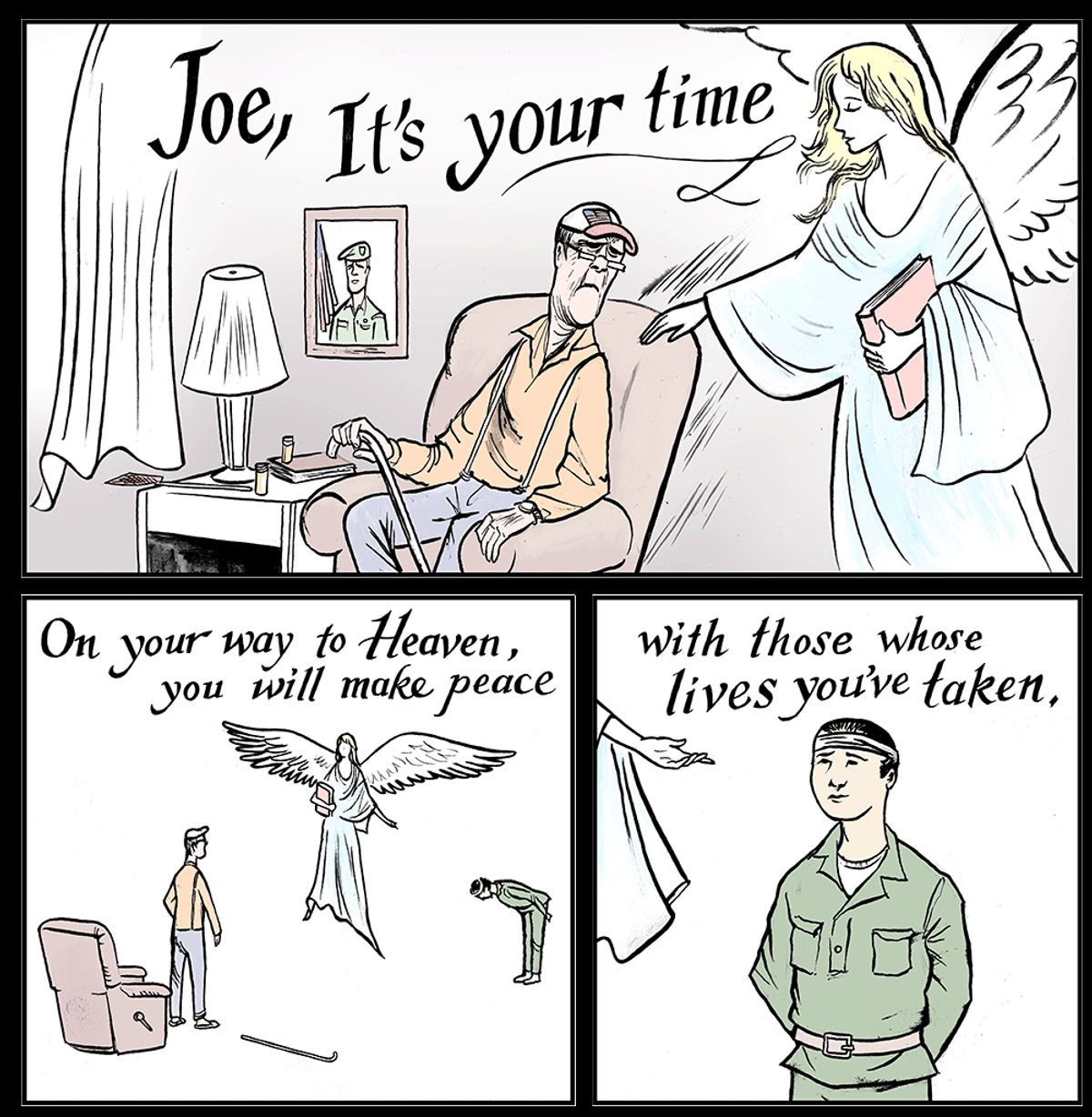
- One The Perry Bible Fellowship comic had an old man dying and being told that before moving on to the afterlife he must first make peace with all the souls whose lives he ended. He first meets and hugs a soldier he killed in a war, but then sees that he also has to make peace with every single animal he ever ate and every single bug he ever squashed.
- A parody of the Perry Bible Fellowship comic has circulated, where someone is told they must make peace with everyone they've killed - and when they respond that they've never killed anyone, they're told, "Video games count."
- The Call of Warr ended with multiple characters dead, several of whom had spent their last few days fighting or killing each other. Despite this, they all teamed up to help Ashes and save the day, and then proceeded to have a picnic with Ghost Lady, sharing food and enjoying each other's company without concern for what happened in life.
- Downplayed at the end of Everyman HYBRID. Evan and Vinnie were quite literally at each other's throats, having a fight to the death after it was revealed that Vinnie had betrayed everyone and had deliberately lured Alex to death-by-Slender-Man. They then both arrived in the "Candleverse" — the realm where they all get sent to after death before they get reincarnated back on Earth and get haunted by monsters all over again — where they were not only met by Jeff and Corenthal but were back to acting peacefully. All four of them, despite what they'd been through and how bad things had gotten, calmly walked off together, waiting their new cycle.
- Filmation's Ghostbusters: The ghosts of Captain Ahab and Moby-Dick are Fire-Forged Friends, serving out a sentence on the Phantom Prison Planet.
- Futurama: In the movie The Beast with a Billion Backs, the titular beast, Yivo, brings everybody in the universe to his universe so they can live on his planet-sized body, which is essentially a Physical Heaven where everyone gets along. Even Wernstrom and Farnsworth, who are bitter rivals on Earth, can be seen working together on science projects.
- Comically subverted in Robot Chicken when Tupac Shakur meets The Notorious B.I.G. in Heaven. They cheerfully greet each other, then immediately gun each other down.
- The Sealab 2021 episode "The Policy" ends with Sparks attempting to kill Captain Murphy for the insurance money, but Murphy manages to cause Sparks to die as well. In The Stinger, both are in hell, casually conversing about their respective punishments.