

Who needs names? Plenty of stories, jokes, and even myths eschew them entirely in a Nameless Narrative. If a character is "named", it's more than likely to be as their role in the story or the job they have. Sometimes, the "name" might be a unique and prominent feature to them that serves as a reminder of their basic description, such as "the one-eyed man", or "the silver-haired maiden".
Stylistically, it's very economical in terms of prose and narrator memory (many Nameless Narratives come from the Oral Tradition) and at times elegant, distilling a character's essence down to their archetype.
The Nameless Narrative also works hand in hand with The Law of Conservation of Detail and Nominal Importance, allowing for a small named central cast and many nameless extras. This is usually because it's simply easier to remember the background characters this way than to give them all sprawling motivations and backstories.
May overlap with "Burly Detective" Syndrome (if descriptive epithets are used in place of names), Everyone Calls Him "Barkeep", No Name Given, The Nameless, The All-Concealing "I" and You Are Number Six. Often employs Spell My Name with a "The".
Examples:
- As the animated Vive Sin Drogas ads have no reason for it, they don't specify what the name of the flower, butterfly, or boy are.
- Akudama Drive only refers to characters by descriptors that reference their jobs or crimes, such as Brawler, Cutthroat, Pupil, and Boss. Even the protagonist is only known as "Ordinary Person" or "Swindler".
- Bikini Warriors has none of the human characters give their proper name, with all the heroines referring to each other by their combat class. Fair enough for a series of sexual comedic shorts meant to lampoon the conventions of old-school role-playing games.
- Bloom Into You has the School Play, in which none of the characters are referred to by name, merely described by their relationship to the protagonist (her nurse, her schoolmate, her younger brother and her girlfriend).
- Futari Escape is about a pair of friends and roommates - a manga artist and a NEET. The former addresses the latter as "Senpai," but their names are unknown.
- This is actually a plot point in Ill Boy, Ill Girl, where the main characters suffer from a disease that obscures everything related to a person's identity, including their names. Even the protagonists' names aren't revealed, and they are simply referred to as "the boy" and "the girl".
- The One Piece special episode One Piece Fan Letter doesn't name any of its characters, due to being a Lower-Deck Episode about ordinary people. The closest thing we get to an identifier is "the Benevolent King of the Waves", a nickname given to a Marine lieutenant commander by his men.
- In Yuri Couple, a manga by Waflove, the couple's names are never revealed. Their only distinguishing characteristics are that one girl has long hair and yellow speech bubbles, while the other has short hair and pink speech bubbles.
- In I Killed Adolf Hitler the only character other than Fuhrer who has a name is David, the unnamed heroine's date.
- Even though we already know their names (or perhaps because of it), Batman and the Joker are never referred to as such in The Killing Joke. Even the newspaper clippings only call them "Disfigured Homicidal Maniac" and "Bat-garbed Vigilante." This works well with one of the themes of the book, which is that the two of them have gotten so intimate with each other that there's no need for names.
- Red Ears: This gag comic has no recurring characters and thus many remain nameless.
- Through the Woods: Several of the short stories, including the most famous, (His Face All Red) are full of unnamed characters. For example, in His Face All Red, there's only three characters that even get a title; the main character/narrator, the narrator's brother, and the brother's "starry eyed" wife. None of them ever gets called by name.
Creators:
- In the tales of Asbjørnsen and Moe:
- "East of the Sun, West of the Moon": The heroine is "the girl"; the hero is "the White Bear", and later, "the Prince".
- "The Three Aunts"
- In "The Old Dame and her Hen", neither the old widow, nor her daughters, nor the troll are given names in the story.
- In the tales of Alexander Afanasyev:
- "Morozko" has the titular Father Frost... and the old man, the old woman, her stepdaughter -the heroine- and her daughter.
- In "The Wise Little Girl", no character is given a name.
- In "The Feather of Finist the Falcon", Finist is the only character with an actual name.
- "The Fire-Bird, the Horse of Power, and the Princess Vasilissa": Neither the hero nor the main antagonist are given names. They are only "the archer" and "the Tsar".
- In "The White Duck", the characters are the king, the queen and the witch.
- In several stories by Hans Christian Andersen, such as The Little Mermaid or The Little Match Girl, the characters are not named and only referred by their titles, e.g. 'the mermaid' and 'the prince' in The Little Mermaid.
- In the tales of The Brothers Grimm:
- "Bearskin" — unless you regard "The Devil" as a proper name.
- "Cat And Mouse In Partnership": No one is mentioned to have a name. The cat tells the mouse that she is the godmother of three babies named "Top-off", "Half-gone", and "All-gone", but those are only lies so she can steal the fat they were meant to share.
- "The Girl Without Hands"
- "The Goose Girl"
- "The Twelve Dancing Princesses"
- "The Two Brothers", which gets a bit awkward when the two brothers are together. The main way it's got around is by distinguishing one as "the younger brother", even though it's also a plot point that they're identical twins.
- In "The Three Snake Leaves", the main character is the young man (later prince). The remainder characters are the main character's father, the king, the princess, the old servant and the skipper.
- "The Nix in the Mill-Pond": The cast is composed of the miller, the miller's wife, the miller's son -later the huntsman-, the huntsman's wife, the old woman and the nixie.
- "The Singing, Springing Lark" (though at least one translation names the main character Lily).
- Technically, the name "Snow White" is just a description of the fairy tale's heroine.
- Similarly, "Red Riding Hood", although many evolutions of the story have that become her nickname.
- "The Gold Mountain": Nobody, at any point in the story, gives their name.
- "The Devil with the Three Golden Hairs": No character is referred to by name, unless you count "The Devil".
- Joseph Jacobs' "The Old Witch
 "
"
- In the tales of Andrew Lang:
- "The Blue Mountains"
- "The Golden Blackbird"
- "Diamonds and Toads"
- "The Nine Peahens and the Golden Apples": The characters are the king, the young prince, his brothers, the empress, the old witch, the old servant... There is not one single named character.
- "The Elf Maiden": No character is referred to by name.
- "Little Otik": The titular monster is the only character who goes by a name instead of a descriptor.
- In Charles Perrault's version of the tale, the princess is just "Sleeping Beauty".
- In the tales of Franz Xaver von Schönwerth:
- In "King Goldenlocks", the protagonist is the only named character, and even so he is often referred to as "the prince" or "the gardener".
- In "The Turnip Princess", the characters are the prince, the queen, the bear and the old woman.
- "The Enchanted Quill": The characters are referred to by a descriptor (the man, the crow, the youngest daughter...) or their job (the caretaker, the huntsman...)
Individual tales:
- Despite being a culture that put great emphasis and value on names, Ancient Egypt has a few tales with no named characters, such as the Tale of the Shipwrecked Sailor (Old Kingdom), the Wax Crocodile (Middle Kingdom), and the Tale of the Doomed Prince (New Kingdom).
- "Prince Lindworm": All character are nameless.
- "The Small-Toothed Dog": The heroine tells the dog its name is "Sweet as a Honeycomb" when she's trying to coax it, but there are no other names.
- In "The Story of King Odd", Odd is the only character referred to with an actual name.
- Among You: Employees of MIRA aren't allowed to go by their birth names, only their colours, as it makes it easier to report back to HQ. Even the viewpoint characters are only called by their colours. However, in and they say murder can't be a bonding activity we learn that White Reliant's real name was Rachel Zaera.
- In A Boy, a Girl and a Dog: The Leithian Script, only canon characters have names. All original characters are known by either their occupation or their rank (the Captain, the Youngest Ranger, the Seneschal...)
- While the tags for Better Off Not Knowing give her name as "Hakini," the viewpoint character is not named in the story proper. Similarly, while canon characters appear indirectly in the newspaper article (which mentions that Korra is recuperating after the events of Book 3's finale and is accompanied by Zaheer's "craggy, defiant" mug shot) that Hakini is reading, they're described in terms of role rather than being named.
- Daring Do's Bipedal Adventure overlaps this with Unreliable Voiceover near the end as the narration refers to Cara's guards as Changeling #1, Changeling #2, etc. and insists that they "probably don't even have names" despite the fact that two of them are named in the dialog.
- Seductio by Fialleril retells the story of Anakin Skywalker on Tatooine without ever naming a single character. For a writer whose Tatooine worldbuilding emphasises the meaning and power in names, this drives home the theme of Loss of Identity.
The word the boy could not remember is keekta-du. It's a word that doesn't translate exactly. The closest approximation in Basic might be one who has forgotten where he comes from.
- In Superman and Man, the narrator always refers to Christopher Reeve as "the actor".
- Heroic Times was meant to be an entirely visual-musical movie with no voice acting, until the execs added a Character Narrator. Regardless, nobody, not even the main character is named, since he speaks in first person and refers to others from his own perspective — "my brother", "the king", "the princess", "the Czech knight", and so on. Even the title conceals his identity. The film is actually an adaptation of the Toldi book trilogy, life story of Miklós Toldi, so being familiar with the stories helps identify most characters.
- Life in a Tin is centered around the repetitiveness of an ordinary life, and as such, the main character and any character he interacts with remain nameless in order for its message to have a more general reach.
- The Little Prince (2015) is an Adaptation Expansion with several Canon Foreigners, but as in the book, they remain nameless—the Little Girl, the Mother, etc. Played With in the third act, where we meet "Mr. Prince." Given the circumstances, this probably shouldn't be considered his "real" name.
- In The Polar Express, only two characters are named: the protagonist's sister, Sarah, who barely appears, and Billy, the sad boy who is last to board the train. (Well, also Santa Claus.) The main character is credited as Hero Boy, with the other main kids called Hero Girl and Know-It-All Kid.
- Waking Life takes this a step further: aside from the protagonist ("the Dreamer"), it barely has any recurring characters, so you can't even qualify people in relationship to each other. As such, the credits just show pictures of everyone alongside the actors' names. The one exception is Steven Soderbergh, who plays himself.
- The Air I Breathe: The four main characters are known only by their Theme Naming, respectively Happiness, Pleasure, Sorrow, and Love, and these are All There in the Script. Their real names are never spoken either, though Sorrow is referred to several times by her stage name "Trista".
- All Is Lost: The main character played by Robert Redford is unnamed.
- The Baby of Mâcon: The top level of reality of the film is a Renaissance morality play, so the characters have names like the Daughter, the Baby, the Bishop, and the Bishop's Son. Only Grand Duke Cosimo de'Medici, an audience member with the authority to interact with the play, is given a name.
- The film Blindness (2008), like the book it's based on, does not name any characters, main or otherwise.
- The only two characters in Closet Land are credited as Interrogator and Victim. It's not a comedy.
- Only three characters get names in Curse of the Zodiac, and one of those names is only revealed in text just before the credits, which only list the actors, no character names or titles.
- The Debussy Film: None of the cast or crew of the Show Within a Show are referred to by name. They're credited either as the character they play, or by their job title, like Director or Secretary.
- None of the characters in The Driver has a name, not even the three main characters. Ryan O'Neal is "The Driver", Bruce Dern is "The Detective", and Isabelle Adjani is "The Player".
- Embers: By nature of the movie's premise (apocalyptic amnesia virus) almost no one knows their own names; in the credits the nameless characters are listed as "Guy," "Girl," "Teacher," "Chaos," and "Boy."
- Only two characters in Eraserhead are named: main character Henry and his fiancee Mary. Everyone else is named either by their relation to those two or where they live, such as Mary's Mother, The Beautiful Girl Across the Hall, The Man in the Planet and the Baby. This, coupled by the general lack of dialogue and oppressive music gives the film an extremely disturbing and alien feel.
- In Exam, the main characters insist that they only go by pseudonyms based on their physical appearances (save for one character): White, Black, Blonde, Brown, Brunette, Dark, Deaf, and Chinese Woman. The other two characters are the Guard and the Invigilator.
- In Christopher Nolan's Following, only one character is referred by a name ("Cobb"), and that might be just a pseudonym. The main character alternately gives his name as Bill or Daniel; there's no indication which (if either) of these is his real name, and the credits just call him "the young man".
- Notable Chinese film The Goddess, about the life of a Shanghai prostitute, does not give any names.
- Hiroshima Mon Amour combines this with Minimalist Cast. The two lovers who are the protagonists, and have about 98% of the dialogue, aren't named, nor is anyone else.
- Intolerance where this trope is used to powerful effect, causing the characters to become allegorical and thus universal (although some of them are historical figures). The Mountain Girl, the Rhapsode, the Dear One, the Boy, Brown Eyes.
- The Lobster uses this. The protagonist is named David, and his dog is Bob, but the main cast otherwise consists of the Limping Man, the Lisping Man, the Shortsighted Girl, the Heartless Woman, the Hotel Manager, and many others. Only the Limping Man and the Lisping Man get their actual names revealed.
- 1909's short film The Lonely Villa features nameless characters.
- In mother!, no character is named. The main characters are credited as "mother" and "Him". Everyone else gets a generic title in the credits relating to their role in the story; "man", "woman", "oldest son", "youngest brother", etc.
- Japanese silent film A Page of Madness doesn't even use any title cards, so it's a Nameless Narrative pretty much by default.
- Just like in the book, no characters are named in The Road. The main characters are referred as the man and the boy. Double subverted with an old tramp they meet at one point, who claims his name is Ely, before revealing it isn't, and that he doesn't want to tell them his real name.
- Slacker, as a result of the film switching characters every five minutes. Names used in the end titles include "Should Have Stayed at the Bus Station", "Grocery Grabber of Death's Bounty" and "Tura Satana Look-Alike".
- The characters in Spring, Summer, Fall, Winter… and Spring are never named. Even a newspaper headline involving two of them does not use their names.
- In Strike the only named character is the worker whose suicide precipitates the strike.
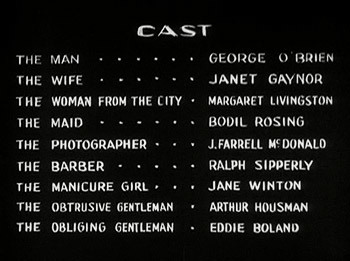
- In F.W. Murnau's classic silent film Sunrise, the main characters are called the Man, the Wife, and the Woman From The City.
- The ten strangers who make up the main cast of the movie Ten never properly introduce themselves to each other, so no names are ever spoken, and the credits refer to them by either their occupation or role in the story (e.g. The Medium or The Religious Fanatic). Unusually, a few minor characters who are solely The Voice do have full names that are All There in the Script. The novelization has an interesting way to deal with having largely nameless characters - each main character narrates one of the ten chapters of the book, so they all have slightly different, in-character ways of referring to the other nine.
- Tetsuo: The Iron Man: The first film in the trilogy has a totally nameless cast, giving us the Woman, the Salaryman and of course, the Metal Fetishist.
- No names are given in the 1971 film Two-Lane Blacktop. The credits refer to the characters by their profession or some other identifying attribute, e.g. "The Driver" (James Taylor), "The Mechanic" (Dennis Wilson), "The Girl" (Laurie Bird), and "GTO" (Warren Oates).
- Tyranno's Claw, a film set in prehistoric times, where none of the characters are named onscreen. Even the movie's IMDb page doesn't have their names!
- Under the Skin: The end credits list the actors in order of appearance, but give no character names. The only time that people are named during the film is in a "missing persons" report that we hear on the radio.
- In Versus (2000), none of the characters have names. The closest thing the main character has to a name is his prisoner number (KSC2-303).
- None of the characters are named in Wind Chill. This was done to make the story feel like an urban legend.
- In Your Friends & Neighbors, none of the characters are referred to by name. In the credits, they're given placeholder rhyming names such as Cheri, Jerry and Barry.
- Throughout Zombieland, the only person referred to by name is Bill Murray - everyone else is referred to by their home or destination. The girls' names are revealed at the end (though one is hard to catch), but the men never really have names.
- Characters from Aesop's Fables never have any names. Mostly only identified by what species they are.
- Beachwalker doesn't have a single named character. Instead, the characters are named after their roles, or after figures from the protagonist's favorite childhood story.
- The characters in Blindness (1995) are referred to by their roles or, ironically, physical descriptions (given the fact all of them are stricken by blindness). José Saramago does this frequently, in whole or in part, for example in Seeing, Death With Interruptions, and (ironically) All The Names.
- In The Canterbury Tales, almost all the pilgrims are unnamed and are identified solely by their occupation. The only pilgrims explicitly named in the work are the Prioress (Madame Eglantine), the Cook (Roger), the Reeve (Oswald), the Friar (Hubert), and the Wife of Bath (Alisoun).
- A Chance of Sunshine: The main leads are simply referred to as "he" and "she" — or, collectively, "they" — throughout the book.
- There was a trend for a while for Doctor Who Expanded Universe stories to be told first-person or singular-viewpoint by minor characters who never really got a full explanation of what was going on. Frequently, they wouldn't even learn the names of the other characters, although they would note that one of them claimed to be a doctor.
- The Four Gospels: Many of Jesus's parables are like this: the "sower" (of seed); the "man which sowed good seed in his field", also known as "the householder"; the "man" who sowed a grain of mustard seed; the "woman" who leavened her meal; the "man" who found a treasure in his field; the "merchant" who sold everything for a pearl of great price; the "good Samaritan", and so on.
- In Girl: "Who are you?" Alien: "Er, I'm an alien.", none of the characters are given specific names.
- In Goblin Slayer, no one has a proper name used for them. Everyone is known by either their occupation (such as the titular Goblin Slayer, Cow Girl, etc.), their class (like the Priestess, Spearman, Witch, etc.), or their species plus an attribute (like the High-Elf Archer, Dwarf Shaman, Lizard Priest, etc.). This gets Played for Laughs in volume 9 when Harefolk Hunter tells her mother to "look after Brother and Sister and Brother and Brother and Sister and Brother and Sister!".
- Appears everywhere in The Heptameron. Most stories Hand Wave it as "I won't name this guy because I used to know him once" or "I forgot her name, but anyway." Titles of characters abound, and proper names are few.
- Skirted by The Incredible Journey — the two dogs and cat do have names, but they're only used when their owners are around. Considering most of the book is about them trying to find their owners, this amounts to the introductory and concluding chapters, with the rest of the book using species, breed, and age to distinguish them.
- In the Black Whale of Ascalon is about a man who drinks all day in a bar and gets kicked out for being unable to pay the bill. None of the appearing characters have any mentioned names.
- In "The Lady, or the Tiger?", the characters are identified by their roles instead of their names. This helps the story work, because the readers are supposed to read the story as if facing the terrible choice of the title question themselves. The sequel, "The Discourager of Hesitancy," is titled after one of the king's servants, but as before, no one has a name.
- The Light of the Fireflies: None of the characters are referred to by name, although it's stated that the protagonist at least has one. The protagonist narrates in the first person, and everyone else is referred to by their relationship to him or by a description.
- The Little Prince: No one is named, though the narrator is apparently supposed to be the author, Antoine de Saint-Exupery, himself. (The story was based on a real incident when he crashed his plane in the desert and, according to legend, hallucinated a young boy who inspired the Little Prince.)
- In Maoyu, the characters are referred to by their titles and positions even by each other, such as Hero, Lady Knight, Demon King, and Lone Winter King. "Ruby Eyes" is the closest anyone has to a proper name, and that's more of a title or epithet.
- Night Shift (1978): The narrator of "The Man Who Loved Flowers" is nameless (although he believes his name is Love), and he meets a woman whom he claims is named Norma, but this is not her name at all, and he kills her due to going mad from the death of his old love Norma.
- No character in "Nothing Like the Sun" has a name revealed. Fortunately, the story is narrated in first person and has a Minimalist Cast.
- Phantastes has very few names revealed.
- Ragtime starts out only mentioning the names of real people who figure into the plot while the fictional protagonists remain nameless, so "Mother" meets Harry Houdini. About a third of the way through, the pattern is subverted when the fictional Coalhouse Walker Jr. shows up.
- The Wedding-Guest and the Ancient Mariner in The Rime of the Ancient Mariner.
- The Road, and its film adaptation have a Double Subversion. None of the characters are named (the two main characters are known simply as "the Man" and "the Boy"), but at one point, they meet an old man named Ely. However, it's shortly after revealed that Ely is just a pseudonym, and he doesn't give his real name.
- "Robot Visions": The narrator doesn't give his name and doesn't differentiate between the multiple scientists working on their Time Travel project, saying that these things aren't necessary for his account. The robot sent to the future, however, is named.
- "Segregationist": The surgeon, the nurse, the med-eng, and the Senator. None of the characters are given names, although the only one who is clearly human is the Senator; the rest of the characters might not even have names.
- Lampshaded in "The Sleeper and the Spindle", a fairy tale pastiche, which states that "Names are in short supply in this telling." None of the characters in the story are referred to by name, instead being referred to by occupation or physical appearance, although it's pretty clear who the queen and the princess are.
- In Lucy Sweeney's Slummy Mummy column (and novel), the title character is called "Lucy" by others, but everyone else is named by description: Youngest Son and Husband on a Short Fuse, Alpha Mum and Alpha Mum's daughter, Smouldering Teacher, Celebrity Dad, and so on.
- In the first book of The Southern Reach Trilogy, the main characters are forbidden to tell each other their names. Throughout the narrative, they are referred to only by their job titles: the psychologist, the biologist, the anthropologist, and the surveyor. The later books in the series reveal the characters' names, except for the biologist, who insists on being called by a nickname instead.
- Starting Over: Not a single character is ever referred to by name in the original short story. (In the novelization, however, everyone but the main character and his family members is Named by the Adaptation.)
- Sun and Moon, Ice and Snow (based on "East of the Sun, West of the Moon") has the main character known only as 'Pika' (girl) or 'Lass' because her mother refused to name another girl, and only a mother can name the daughters. She's given a name by the white reindeer to protect her from trolls, but it isn't until late in the story that she reveals it. The prince in the story also remains nameless for the majority of the story, but mostly because he never did get a chance to tell the Lass his name.
- Surfacing by Margaret Atwood has a nameless narrator.
- Everybody in The Tale of Genji is referred to by their titles.
- A Tale with No Names refers to the use of this trope throughout the book. All the names are titles or aspects of the personalities of the characters.
- Edgar Allan Poe's The Tell-Tale Heart, which makes the old man's murderer's identity and relation to him ambiguous. Other examples from Poe are The Pit and the Pendulum and The Black Cat.
- In The Time Machine, the Time Traveller and most of the people to whom he's relating his story are just identified by their role, such as the Doctor* and the Journalist. Only one character in each time period has a name: Filby in the frame story and Weena in the future. The official sequel The Time Ships mentions the narrator of the original's Framing Story a few times as the Writer — although he's clearly H. G. Wells himself. It also has the Time Traveller's younger self using the name "Moses" (a Development Gag on an early draft of the original), although that seems to be a nickname.
- The War of the Worlds (1898): More characters get names, but the narrator/protagonist and his family don't. In general, public figures like a famous astronomer are identified by name while everyday people mostly aren't unless it's necessary to keep the narrative clear.
- In "The Willows" by Algernon Blackwood, the narrator never gives his own name and only refers to his traveling companion as "the Swede". Other minor characters they encounter are similarly referred to by a description such as "the Prussian officer" and "the shopkeeper".
- In The Wonderful Adventures of Nils, the narrator only ever refers to Nils as "the boy" and Mårten as "the goosey-gander"; we only learn their names from conversation with other characters - and, in the case of Nils, the book's title.
- Fleabag employs this trope widely but not universally. The Protagonist goes nameless (the title of the show is understood to refer to her and it is how the character is listed in the credits, a nickname borrowed from Phoebe Waller-Bridge's own family nickname - but no one in the series actually calls her that). Many if not most of the other characters lack names too: they are just credited as Godmother, Dad, Bank Manager, Arsehole Guy, Bus Rodent, Priest (or Hot Priest), Counsellor and Hot Misogynist. In fact, all the characters with whom Fleabag has any kind of significant relationship are nameless with just a few exceptions: her sister, who is named Claire, her brother-in-law Martin, her late best friend Boo, and her on-agan-off-again boyfriend Harry. There certainly seems to be some significance around naming and not-naming in Fleabag; perhaps most obviously that this is a story being told from Fleabag's point of view. People are referred to by the labels that are most significant to how she relates by them - including herself.
- The Twilight Zone (1959)
- “Two”: The last two survivors of an unnamed war (played by Charles Bronson and Elizabeth Montgomery) never say their names, nor does the narrator name them.
- In the episode "The Passersby", the Confederate sergeant (James Gregory) has no given name; everyone just calls him "Sergeant".
- In the episode "Five Characters in Search of an Exit", an army major wakes up to find himself trapped in a circular room with a clown, a ballerina, a hobo, and a bag piper. None of the characters have names that they can remember. The Protagonist is known simply as The Major.
- Almost none of the characters in Ayreon albums are named; the exceptions are Ayreon himself, Merlin and a few characters with names based on the names of singers playing them.
- Conversely, the protagonist of The Downward Spiral, another concept album, is never referred to by any name of any sort.
- Invoked in The Last Will and Testament. The names on the document are redacted.
- Ludo's song Girls On Trampolines tells a story of friends going to a party, but the friends are exclusively referred to by monikers such as "Nice Guy", "Weed Guy", "Ride Guy", and "Party Guy".
- For a longer-running example, their rock opera Broken Bride has only one named character— King Simias, an anti-christ figure— while the protagonist is The Traveler, his Lost Lenore is The Bride, and other characters include The Mayor and The Boy.
- The Spin Room: We don't know the name of the singing man, the woman of his dreams, or other mentioned characters.
- The Ookla the Mok song Suprema Lex is a Villain Song sung from the perspective of Superman's archenemy Lex Luthor and has the villain sing about his hatred of Supes and how he schemes to destroy him. Nowhere in the lyrics does Lex refer to himself by name, nor does he ever refer to his adversary as Superman.
- In the concept album The Wall, none of the characters except for Pink, the main character, have names.
- The titular characters of 12 Angry Men are only known by their juror numbers. No names are used for any of the jurors, the witnesses, the victim, or the defendant. The film added an epilogue that gives last names for Juror #8 (Davis) and Juror #9 (McCardle), but the original play didn't name anyone.
- The Spanish playwright Federico Garcia Lorca's tragedy Blood Wedding leaves all but one character without an 'official' forename — they are denoted in the script by their archetype or role, for example "The Mother" or "The Bride".
- Edmond by David Mamet features just two named characters in its sizable cast: the titular lead, and a waitress named Glenna.
- Two Richard Strauss operas have only one named character: Die Frau ohne Schatten (Barak) and Friedenstag (Maria).
- About half of the characters in the fairy-tale-based Into the Woods are nameless (e.g. the two princes). Most of the rest are named because they are familiar fairy tale characters (Cinderella, Jack, Rapunzel, etc.); only Cinderella's stepsisters get somewhat gratuitous names (Florinda and Lucinda).
- In Cirque du Soleil's KÀ, the characters are called the Twin Brother, Twin Sister, Counselor, Nursemaid, etc. This makes sense as the show has no real-language dialogue anyway.
- Machinal has a Dramatis Personae and plot synopsis which identify the characters only as generic archetypes, and many of the characters are in the habit of referring to others only by their initials. However, the three most significant characters are given full names in dialogue: the protagonist (billed only as "Young Woman") is Helen Jones by marriage (her maiden name is not revealed beyond "Miss A."), her husband is George H. Jones, and her lover is Richard Roe.
- Carl Orff's one-act opera Der Mond includes only one named character, who doesn't appear until the second half. In the Spiritual Successor, Die Kluge, none of the characters have names.
- In the Spanish children's play El Principe Que Todo Lo Aprendio De Los Libros (The Prince Who Learned Everything in Books) all of the characters are called only by their role ("The King", "The Ogre" etc.) The only seeming exception is the protagonist, Principe Azul, which literally means "Prince Blue" — however, Principe Azul is the Spanish equivalent of saying "Prince Charming" so it doesn't really count as a name either.
- Much like the book it was based on, very few of the non-historical characters in Ragtime have no names. The exceptions are Coalhouse and Sarah, which is in keeping with the book, and the Little Boy, who is given the name Edgar for the musical. In the latter case, Word of God says that the scriptwriters gave him a name because they found it too difficult to have other characters address him without one (the character's role in the musical was significantly expanded from the book).
- The Soldiers Tale has no named characters in its Dramatis Personae. The Soldier's name is revealed to be Joseph in one scene where he returns home and addresses his fellow villagers by name... but none of them recognizes him.
- Ace Combat 04: Shattered Skies is completely nameless, save for a few secondary pilots towards the end.
- Castle Crashers gives names to none of its characters, only referring them by what they are (The "X" Knight, The Cyclops, The King, etc.)
- Nobody in Castle of Heart has a name. The hero is the Stone Knight battling an Evil Sorceror, and the bosses are The Mayor, The Serpent, The Bear Shaman, and so on.
- Chants of Sennaar: While there are a few glyphs that denote individual characters like the preacher or the bellman, the only character in the game that has what could be considered a proper name is Exile.
- Every single character in Citizens of Earth is named by their profession, such as Vice-President, Photojournalist, or Bodybuilder. Subverted in that once you recruit them, you can name them whatever you want.
- Cloud: Due to having the only character be No Name Given.
- Darkest Dungeon: Downplayed. Individual Heroes have customizable names that you can give them as well as individual Canon Names for each type of hero, but otherwise characters in the game are only referred to by elaborate descriptors and epithets befitting a Gothic Horror story (e.g. the narrator is referred to as "The Ancestor").
- Death Palette: The previous owners of the cursed painting as well as the mansion's maid are only referred to by job titles, and with everyone else (including the artist, the girl, the model, the original painter, and the old man) going completely unnamed.
- Doom, specifically Ultimate Doom and Doom II. Proper nouns are never given for any character, as the only human of any consequence is Doomguy and there are no unique demon characters. The sole exception to this is when Ultimate Doom Episode 4 names Doomguy's pet rabbit "Daisy". Averted by later games in the series.
- None of the characters in DREDGE are given names and are instead called by their occupation. It's possible to ask the Fishmonger for his name but he thinks it's not worth sharing since he is just a passerby.
- Due to the use of pictures instead of dialogue, the only named character in Dropsy is the eponymous clown.
- Epic Battle Fantasy: Early-Installment Weirdness for the first game, Epic Battle Fantasy 1, where the player party is of "Player 1" and "Player 2", but are named in later games, as Matt and Natalie.
- Escape Lala has very few characters, and none of them have names. The achievements for 2 use descriptors for some of them, though. ("the snake," "the pearl," etc.)
- Fallen London is almost devoted to this trope. Characters with names other than "The Adjective Job Title" are limited to the Masters of the Bazaar (Mr Thing, where Thing is what they trade in), the dueling opponents in the Black Ribbon, and a few others (F.F. Gebrandt, Huffam, Esq., Madame Shoshana, Mrs Plenty) who have their own Twitter feeds and were thus grandfathered into the universe.
- This is true in-universe as well; the Traitor Empress has forbidden the use of her name, and it seems likely that, 30 years after the Fall, society has imitated this, with all remotely-fashionable individuals being referred to by role. All of those who have names are either on the margins of society or businesspeople (possibly aping the Masters rather than the Empress). Assuming you count semi-suicidal as being the margins of society.
- Notably subverted in the prequel game Mask of the Rose, which is set immediately after the fall and before this rule was implemented. Indeed, it actually provides names for a few characters from the first game if you can figure out who's what.
- In Fishing Vacation, none of the characters are named and are only referred to by their relationships to each other, with the exception of Sedna, the Inuit ocean goddess.
- Friday Night Funkin': All of the original characters are only referred to by their role in the narrative: the player character is Boyfriend, his girlfriend is Girlfriend, and her parents are Daddy Dearest and Mommy Mearest, at best terms of endearment. Even original characters not attached to the main cast apply: Monster, Senpai (a character in a video game), and Spirit (a ghost trapped in the same game).
- None of the bosses in Furi are ever given a proper name, only a title revealed during the credits. This convention is also shared with the main character The Stranger/The Rider, who may not even have a name, and his guide The Voice, aka The Architect, which is how he addresses himself. The only exception is the DLC Superboss named Bernard.
- Not one single character in The Girl and the Robot is ever identified by name.
- Neither the proagonist of Gorogoa nor the dragon he seeks are given names, fitting into the game's complete lack of dialogue.
- In Half-Life (1998), aside from protagonist Gordon Freeman and a few names on the lockers in the locker room, there are no named characters whatsoever. Other named characters are introduced in the expansion packs and the sequel, though.
- A Hat in Time: Most of the characters are referred to with titles or descriptors, with the exceptions being Queen Vanessa, the "murdered" Owl Express member (who is revealed to be named Robin), Steve from accounting and possibly DJ Grooves. The "possibly" comes from that it could be his stage name.
- Not one character is given a name in Haunt the House. The tutorial is told in the second person, which is why the player character is never named.
- Hello Neighbor gives neither of its characters (the protagonist and their neighbor) names.
- None of the characters in Hotline Miami are given names of any sorts. While there are Fan Nicknames such as "Jacket" or "Richard" for the protagonist, officially he is never addressed by anything (although the developers have taken a liken to "Jacket" and other fan nicknames and have started referring to them as such). Averted with most of the new characters in the sequel, though characters that were nameless in the original, like Jacket, remain unknown.
- Nearly all characters in How Fish Is Made are nameless. The exceptions include "Friend-O", who's only called that by the parasite that ate its tongue, and the giant Bandage Mummy in The Last One and Then Another, although his name (Curly) is only given in the next game he appears in.
- Hyper Light Drifter: All information is non-verbal, so nobody is called by name. However, some characters have official names drawn from Tarot Motifs.
- Just Shapes & Beats: The closest things we get to names for any characters are the titles of certain boss levels, which many fans have indeed adapted into their respective characters' names.
- Most of Kero Blaster is this. The company president is simply known as "The President", while the protagonist and his co-workers don't even seem to have a title they are referred to by. However, there is a secret cast roll (found after finishing the final glitched area in Omake Mode) that lists names for the characters, and the bosses have names listed in the code (the names can be found on this page).
- None of the characters in Knock-Knock are given a proper name, instead referred to by epithets. The protagonist is the Lodger, the Stringy-Haired Ghost Girl is the Girl, the giant Eldritch Abomination that looms over the Lodger's house after the halfway point is the Bogeyman, and the ghosts you have to run and hide from in the dream world are the Guests.
- The NPCs in Monster Hunter games never seem to have real names, instead using job titles or simple descriptions to designate characters. As for you, despite whatever name you choose for yourself, you're never referred to as anything other as Hunter. Averted with the Pub Manager in Monster Hunter Generations Ultimate, who so far is the only character in the entire series to actually call the player Hunter by their name. This trend was dropped by Monster Hunter: Rise, which is the first mainline game in the series to give every member of the cast actual names, and following games in the series also followed suit.
- No, I'm not a Human: None of the characters in the game are referred to by a name. Most of the residents you allow into your house go completely unidentified, while others will only be identified by their general role. While some of the characters do have names given to them in the game files and Steam's Achievement API, they aren't used in the game proper.
- Paper Chase: Bluto is the only character with a name. Everyone else is referred to by their job/position.
- The first Propagation doesn't have any named characters. Averted in the sequel.
- While the characters in Portal do have names, they never actually refer to each other or themselves by name except Cave Johnson and Caroline, and Wheatley referring to himself by name once. Their names are only mentioned in subtitles and end credits.
- Prince of Persia (2008) almost does it, if it were not for Elika and Ahriman. Every other character goes unnamed.
- Only two characters in RC Helicopter are named: Mark, a random boy, and Beakly, a woman who owns an shop.
- Super Ninja Meow Cat: Downplayed. The only named character is King Cobra, the boss of level 5. All the other bosses, as well as the protagonist, remain unnamed.
- All the player characters and the Announcer in Team Fortress 2 are referred to solely by profession/class in-game (which admittedly doesn't have a plot) and in the machinima videos. The webcomics do eventually give the majority of them names (and Miss Pauling), but they're still mostly referred to by class.
- Toca Life: Basically none of the characters have names, save for the stars of Toca Life: Stories, whose names are implied.
- Yume Nikki: Aside from Madotsuki, Monoe and Monoko (their names come from the files for their full-screen events), every character in the game has no name. Fans have gotten around this by using Fan Nicknames for everyone.
- Nobody has names in Dra+Koi. There's the dragon, the dragonslayer, the protagonist's mother and the protagonist, who later becomes the hero by attacking the dragonslayer, which was just a suit of armor that now recognizes him as a worthy hero. It's metafiction, so names would just get in the way.
- In Juniper's Knot, neither character is given a name. They are identified as "boy" and "demon" or "fiend".
- a letter of challenge: No character in the story has a name. The game's antagonist is usually referred to as "the mysterious girl."
- Nobody in Milk inside a bag of milk inside a bag of milk has a name. The sequel Milk outside a bag of milk outside a bag of milk does have one character with a name.
- Up until this point, there has nary been a proper noun in the entirety of the comic The Artist is Dead! In fact, it's safe to say that there won't be a proper noun in the comic, mostly because it has already been finished.
- Being a dialogueless webcomic, none of characters in Childhood Friend Yuri is given a name.
- Clueless Hero: None of Clueless Hero's player characters or even the villains are actually given names, not even the protagonist.
- Averted in Erstwhile, in which several characters who were nameless in the original Brothers Grimm tales are given names.
- Fifteen Minds: Due to the lack of text in the comics, none of the characters in any of the stories are ever named. The most we ever get from the artist on the subject is out-of-universe descriptors for the characters, such as "bunny and dino", hence the monikers used throughout the works page.
- Hardly any of the characters in Gone with the Blastwave are named, and the two protagonists aren't among them. Furthermore, all the characters are Gas Mask Mooks wearing uniforms, so the emblems on their helmets are the only way they can be told apart.
- Hero is a partial example — while there are a few named characters, some central and some not so much, there are also many major and minor characters known only by roles or titles.
- Lady of the Shard: No names are given for anybody. The acolytes have a tradition of not using them; the Phoenix is a title, and we never learn what her name was before she inherited it; at the end of the comic, the Goddess addresses the Old God by name, but it's written as a small cluster of stars, implying that it can't be pronounced or understood by humans anyway.
- Whenever someone would be referred to by name in Little Nuns, they are instead identified by a small drawing of their face. Both this wiki's character page and Danbooru's character tags use nicknames to identify the cast due to this quality.
- minus.: Aside from a small number of bit characters and minus herself, no one in the comic is given a name.
- ''Piled High And Deeper" includes many named characters but the central semi-autobiographical grad student has no name.
- Problem Sleuth: Many characters (for example, Problem Sleuth, Mobster Kingpin, Nervous Broad, the Weasel King) have titles instead of names. Madame Murel, the Midnight Crew and possibly Death are exceptions.
- What, Were You Raised By Wolves?: None of the characters have names, owing to the lack of dialogue.
- Pretty much all the recurring characters in xkcd are nameless: Black Hat Guy, Black Hat Guy's Female Counterpart/Girlfriend, That Weird Guy In The Beret, etc. Pretty much the only exception is Megan. (And that's assuming it's always the same Megan.) The featureless main character (if it's always the same character) with the Fan Nickname Cueball is sometimes called Rob.
- The only names given in Elfslayer Chronicles are Bali and Baldin, Those Two Guys. The main protagonist is 'OP' (short for Original Poster), his accomplice is 'the Half-Orc', the DM is simply 'The DM', the player who opposed OP is 'the Weeaboo' (an insulting term for a Japan fangirl/boy), the victim is The Prince, and the prince's lover (who OP framed) is just 'the Royal Guard' (his position).
- Most of the anecdotes on Not Always Right, as the poster won't know the names of those involved, and it wouldn't add anything anyhow, so the names are usually a description - "Husband", "Wife", "Kid", "Mother", "Father", "Stoned Guy" - or just "Me", "Customer", "Cashier", "Manager".
- The Principal Saga: The series never explicitly gives any of the characters names. Instead, they are referred to based on their role at the school, like "The Principal," "The Vice Principal," "The Blonde Cheerleader," or "The Jock/Bully."
- Screen Rant Pitch Meetings
- The series stars a Screenwriter and a Producer, neither of whom are referred to by name, as they discuss the former's movie pitches.note
- In the Jurassic World pitch meeting, the Screenwriter initially plans on forgoing names because the characters are so flat they don't need them, but the Producer convinces him they need names, so he thinks of names for "Money Lady" (Claire) and "Animal-Loving Navy Guy" (Owen).
- The two friends from Two Best Friends Play. Since they are in the same room talking to each after already staring up a game, it makes sense that they would have already said their names to each other. This is dropped in the second season when their names are revealed as Matt and Pat.
- WHAT COLOR ARE YOU?: While you enter a name for yourself at the start of the quiz, it's never used and the player is only addressed as 'you'. Likewise, the creator/narrator never gives their name, and all the characters encountered during the game segment are simply called things like 'the snake' or 'the noble' by them.
- The short video To The Death has a total of five characters, only two of which get actual lines. None of them get a name, or even a descriptive title in the credits. The video's trope page settles for calling the characters by roughly descriptive titles: the teacher, the student, the janitor, the man in the black suit, and the bearded man/the master.
- For the most part, very few characters in Samurai Jack actually have names or even address each other. Most characters are Only Known by Their Nickname instead of their real name, if they're even given a name at all.
- Many Tex Avery cartoons feature one-time characters whom Avery never bothered to give a name. This includes many anonymous cats, dogs and mice and even the infamous wolf character who, despite being a recurring character, always has No Name Given.