

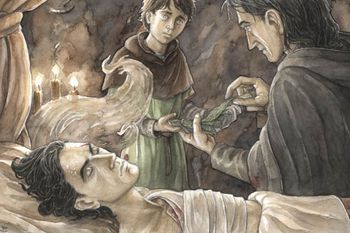
A plant or natural product has a power to cure all sorts of wounds, heal illnesses and act as the Magic Antidote. It may be leaves or flowers made into a tea or tincture, or seeds or bark ground into a powder, or the leaves might be used as a compress, made into a salve or ointment, or smoked in a pipe. It may even be something other than a plant, such as mud from a sacred pool or ground-up seashells. Regardless of how it is prepared or administered, the plant has a remarkable effect on the patient.
One of the favorite forms of an external healing source, close to Healing Potion, of which it may be one ingredient. The healing herb may be easily available and growing beside every path (as long as you know how to look for it), or, it may be rare and hard to find (maybe it only grows on the top of the magic mountain on the last day of May...). The healing herb might be usable to help the patient immediately after you pick it. Alternatively, maybe the herb doesn't truly help until you follow a complex recipe (boiling in a Magic Cauldron, soaking in blood, etc) to extract the healing properties.
Besides curing the hero, its other advantages are that searching for the healing herb can make a good Plot Coupon or MacGuffin that the heroes have to find. It can also show a person is close to nature, such as a Mountain Man, and even symbolize the idea that nature can make characters well.
A certain amount of Truth in Television: many plants are the root source of modern medicines. A surprising number of medicines were discovered by either investigating folk cures (some of which actually worked, and some of which did not) or by taking extracts from random plants.note However, in Real Life, herbs are not Magic Antidotes. Like drugs derived from them, herbs can have side-effects, sometimes quite serious, even fatal; they can interact with other drugs; and unlike the drugs, natural variation in growth means the dosage is unpredictable, and there will certainly be impurities. For safety reasons, therefore, do not include Real Life examples. Someone serious about learning about herbal medicine can find much better sources than this wiki.
In fiction, they are more likely to be a Panacea. See also Fantastic Fruits and Vegetables. The realistic version is That Old-Time Prescription. The Spice Rack Panacea is another take on it, where a herbal remedy cures something in fiction (or is proclaimed to cure something in real life) that it technically should not be able to cure. The Flower from the Mountaintop is sometimes a Healing Herb.
This is a subtrope of Heal It with Nature.
Examples:
- Belladonna of Sadness: Jeanne makes a deal with Satan to become a witch. Afterwards she can heal people and make magical potions with the belladonna plant.
- Black Clover: Mimosa Vermillion mostly uses Plant Recovery Magic, forming flowers, leaves, and vines from her magic that heal others. She can even cover herself in a dress of vines and flowers that increases the power of her healing.
- Delicious in Dungeon: The Thorden party brings a variety of medicinal herbs on their next jaunt into the dungeon, from standard healing and burn-alleviating herbs, to antitoxins, to one that restores mana when eaten. Senshi uses them all up at once to stuff and season the basilisk he's about to roast.
- Dragon Ball:
- The Senzu Beans which are grown by Korin, the wise old talking cat. They can heal all of the eater's wounds, and as a bonus sate their hunger for ten days. Unfortunately, they take a very long time to grow, and there are some things they can't fix (like the Saiyans' tails being removed, or the heart virus Goku contracts).
- In an episode of Dragon Ball Z, Gohan remembers his dad showing him how to make a medicine out of a leaf, which he uses on himself when Piccolo leaves him alone in the wilderness. He later uses an even bigger one to heal a wounded dinosaur.
- Full Dive: Played for Laughs when Hiro makes a big deal out of getting healing herbs in the video game world, only to find that they are pretty much useless in a hyperrealistic world. First, they cannot revive the dead. Second, he tries to tap on an herb to absorb it and heal his wound, only to learn that doesn't work and he actually has to cut up and grind the herb. Third, when he finally applies the herb to his wound, it does not instantly heal, just like in the real world.
- Tintin: In The Castafiore Emerald storyline, Captain Haddock is stung in the nose by a bee in a Garden, swelling it up. The somewhat flighty Bianca Castafiore puts some flower petals on his swollen nose to help it heal, which only makes Haddock look more ridiculous.
- "Godfather Death": Death takes his godson out to the forest and shows him a herb that can cure all patients except those which Death intends to claim for himself. By use of this herb, the godson becomes a famous physician.
- Avengers: Infinite Wars: The Guardians of the Galaxy accept a contract to defend a colony on a farming planet in exchange for nyslim seeds, as the seeds will grow into herbs with great healing properties and the Guardians can accelerate their growth with the aid of Groot's ability to manipulate plants.
- Blind Courage: Ganondorf heals Zelda of her deadly fever with a poultice made of leaves and mushrooms.
- Familiar Evil: Arklay herbs, which grow around Raccoon City, are incredibly good at healing wounds, with even a sprained ankle getting healed in seconds. Louise notes that Terre has similar plants, but those are nowhere near as effective, and suspects that Arklay herbs are magic-based, a result of the worlds crossing over at some point in the distant past.
- Father Finster: Claydoious is home to a plant called a medicinal marigold, which if brewed properly, can cure any disease extremely quickly. The chapter "Pongie Visitors" focuses on a small group of Pongie aliensspoiler visiting Claydoious searching for these flowers as they need them to cure their sick population.
- The Flight of the Alicorn: The badge of courage orchid is a flower found only in remote swamps of the Impenetrable Lands. It can heal almost any injury when eaten, with the caveat that it will only cure ones that were gained nobly.
- It's A Dangerous Business, Going Out Your Door: The beneviolet, a rare mountain flower that grows in high-magic areas. The natural magic of the areas it grows in mixes with the plant’s own biological defenses, resulting in the grown flower being a powerful remedy against many kinds of illnesses, including the deadly Horn Rot.
- Pokémon Untamed: Mazian Vanillite's medical talents focus on gathering, storing, and using specialized berries to cure various ills, such as Persim berries against headaches and Aspear berries for frostbite.
- To the New World: Erdtree sap is such a powerful restorative that only a few drops will preserve one from death. Because of its sanctity, Morgott only rarely gives it out.
- Vow of Nudity:
- In The Sinking Temple, Haara uses an illusion to disguise herself as a goblin with a missing tongue to conceal the fact that she cannot speak the goblin langauge. Another goblin hands her an herb and tells her to chew it. When she does, she finds her energy restored and all the cuts and bruises she got during the story heal up instantly. It presumably would have restored her tongue if it was really missing.
- In The Savage Savannah, Fiora's shortfang clan scavenges healing herbs from the savannah for medicinal purposes. Even after she's exiled, her proficiency with herbalism kits lets her craft healing poultices if she can find the ingredients in the wild.
- Tangled opens with a magic flower, which is put into a soup for the queen in order to heal her of a fatal illness that befalls her. The powers are actually passed on to the queen's daughter, Rapunzel, in the form of long, golden hair, and because of this, the newborn baby is stolen by Mother Gothel so she can use the child's powers to retain permanent youth and beauty. The powers are even used at the end of the movie when Rapunzel is able to heal Flynn Rider using her tears despite her hair being chopped off and losing its magic.
- Lone Wolf's world features several, most notably:
- Laumspur, a wild herb with bright red flowers, which you can find over most of Magnamund. Most common ingredient for Healing Potions.
- Oede herb, which has golden leaves, is considerably rarer, but powerful enough to qualify as Panacea.
- In the Fighting Fantasy gamebooks, if a character is bitten by a werewolf they can cure themselves of it by chewing belladonna. You take some Stamina damage, but it certainly beats getting turned into a werewolf. There's also a number of Fighting Fantasy books where your character can find or buy some healing herbs.
- Andre Norton:
- Catseye (1961): Medical plants are one treasure of the Wild.
- Dread Companion: Kilda uses the notus on Kosgro's wound. Inflammation dies down while she does it.
- The Belgariad: "Adara's rose" will cure any poison with its fragrance alone. Its creation is one of Garion's Achievements in Ignorance: he was only trying to conjure up a flower as a gift for his cousin Adara and doesn't learn that it's "the sovereign specific" until years later.
- Beware of Chicken:
- In addition to serving as potent cultivation enhancers, the Lowly Spiritual Herbs that Jin grows have general restorative properties. Poultices and elixirs derived from the Lowly Spiritual Herbs quickly come to form a significant part of Meiling's medical repertoire.
- There are also a wide variety of plants and mushrooms with more specific applications, both commonplace ones used even by mortals and more mystical ones that are usually only used by cultivators.
- The Calf of the November Cloud: When the Dorobo hunter finds Konyek lying injured and unconscious on the ground, he takes the Masai youth to a safer place and starts looking for medicinal roots and the bark of the cassia tree. Then, the hunter boils the roots and bark in a gourd, bathes Konyek's wound and covers it with healing leaves.
- The Chronicles of Thomas Covenant: The Land has aliantha, berries which are surprisingly nutritious and refreshing, to the extent that just a few a day (less than a handful) with no other food or water can keep a person alive indefinitely. They also cure a variety of ailments including leprosy, at least while the person remains in the Land. They are, however, stated to be an expression of Earthpower, which is basically magic.
- The Cold Moons: It's shown that badgers understand basic medicine. Tendril heals Bamber's torn and sore paws using a mixture of water, chewed grass, and chewed herbs. The badgers of the Cilgwyn forest have a badger specifically dubbed "the Healer" who helps heal sick badgers.
- Discworld:
- A Hat Full of Sky: Played for laughs. Tiffany learns the Doctrine of Signatures from Miss Level, based on a real-life medieval idea that God placed a signature on every plant that indicated its medical use, to those who could read it properly. This being Discworld, the signatures are literal, and with a special magnifying glass, you can read them on the stems. Sadly, plants are terrible spellers, but Miss Level has worked out a great many cures this way, such as goldenrod being good for jaundice, which turns skin yellow.
- While most of Granny Weatherwax's potions work on the placebo effect (she tells one patient that it contains rare herbs like "sukrose and akwa" or more prosaicly, sucrose (sugar) and aqua (water)), she does have a herb garden full of unusual plants for when that isn't enough. "The Sea and Little Fishes" says that medicinal plants are sometimes called simples, but Granny's herbs are complicateds.
- Dragonriders of Pern: After two thousand years without high technology, herbal medicine is about all that Pern's Healers have to work with. They're aided by the fact that Pern has a few herbs that Earth didn't, such as numbweed (a powerful, safe topical anesthetic) and fellis juice (a safe general painkiller and sleeping drug).
- Masques: Aralorn finds a ridiculously effective pain-numbing herb when she's badly injured. It has side-effects, though; you can't eat anything under the influence because it will make you throw up, and you will be noticeably drugged and not quite there. In the state she's in, it doesn't matter to her.
- Saga of the Volsungs: Sigmund completely cures Sinfjotli of a mortal wound by touching it with a magic herb brought to him by a raven.
- Temeraire: In Throne of Jade, Temeraire catches the flu and is made to suffer through a series of increasingly bizarre medicines, culminating in a preparation of an enormous and incredibly noxious mystery mushroom that cures him completely but leaves him punch-drunk as a side effect. Two books later, it turns out Temeraire's "flu" was actually a lethal pneumonia that is now epidemic among Britain's dragons, which means finding out where that mushroom came from is now an issue of paramount importance.
- Tolkien's Legendarium:
- Beren and Lúthien: When Beren is struck in the chest by Curufin's arrow, Huan gathers medicinal herbs so that Lúthien can heal his wound.
- The Lord of the Rings: Herbal medicine is commonly used in Gondor and among the Dunedain. One of the few that is specifically mentioned is athelas (or kingsfoil). By the time of the story it's thought of as an old-fashioned folk remedy used mainly by the elderly, which really annoys Aragorn because it makes the herb hard to find when he needs it. However, it's a strong general restorative and seems to be the only effective remedy for the Ringwraiths' evil influence (what Aragorn calls "the Black Breath"). Aragorn uses it several times throughout the story: to treat Frodo's knife-wound at Weathertop, again to soothe Frodo's injuries after the fight in Moria, and then to counter the effects of the Black Breath on Faramir, Eowyn, and Merry after the Batle of the Pelennor Fields.
- Tolkien described the properties of athelas in a non-LotR source. It technically doesn't cure anything, but is used by healers because of its strong smell when burnt, which relaxes and inspires patients. In that way it is analogous to several real-world herbs like lavender, sage and witch hazel.
- Tooth and Claw: Maiden dragons have golden scales. The first touch of an unrelated male dragon causes them to 'blush' pink, permanently and obviously signalling that they are no longer 'maidens', but 'brides'. This is expected to happen upon getting engaged but it's not always the case. A non-affianced pink dragon is regarded as Defiled Forever. Early in the book, a sleazy parson presses against Selendra trying to force her to have to marry him and she blushes, to her horror. As her brothers discuss her grim prospects, her Old Maid makes an herbal tea for her which causes her gold color to return. One brother starts to question the maid, knowing that certain herbs that can reverse the blush are illegal, then decides to drop it.
- The Two Princesses of Bamarre: The moily herb is an elven flower that can ease pain and heal wounds.
- Wagons West: Janessa was taught by her mother Mary White Owl the herbal medicine of the Cherokee. In Illinois!, Toby and Janessa begin their bonding by finding a permanent place for her to store her herbs.
- Warrior Cats: Because the characters are cats and obviously wouldn't have access to or knowledge of human medicine, their healers, known as medicine cats, use herbs instead. Recurring materials include burdock, whose root, when chewed to a pulp, is used to numb pain and combat infection; catmint, used to cure the deadly greencough; willow bark, used as a painkiller; and yarrow, to induce vomiting. Other recurring medical aids include moss, used as a sponge to carry liquids; cobwebs, used as bandages and to bind poultices; and mouse bile, used to detach fleas and ticks.
- The Way of Kings (2010) (first book of The Stormlight Archive): A much more realistic example is knobweed, the sap of which is a powerful antiseptic. The heroes make a small fortune by taking advantage of the fact that Sylphrena is very good at finding patches of these weeds, far better than the workers employed by the local doctors.
- In American Horror Story: Coven, Misty raves about the healing properties of swamp mud and proceeds to rub it all over a boy's wounds. It works but her magic may have had something to do with it.
- In Arrow, Yao Fei and Oliver make use of healing herbs found on Lian Yu to greatly speed up healing and counter poisons. In Season 4, the Golden Lotus is a magical herb that's used to cure Thea of her Lazarus Pit-induced bloodlust.
- Earth Abides: Heather brings back extracts of Pacific yew, which has medicinal qualities. This saves many people at San Lupo from the new strain of the virus, though not all.
- The Lord of the Rings: The Rings of Power: The alfirin seeds are known to have magical healing properties. Healers like Bronwyn crush the petals to create a salve out of them and use it as medicine.
- In Merlin, Gaius' second-most common explanation as to where Merlin is is that he is out collecting herbs for him. There are other times when Merlin actually does go out to collect the rare herb needed to heal an important patient.
- The Book of Mormon: During a peaceful season, the book of Alma mentions that rather than dying from wars, some people died from seasonal fevers, but less than it could have been due to "the excellent qualities of the many plants and roots which God had prepared to remove the cause of diseases". As a result, Mormons have a long history of using plants in medicine.
- Iron Crown Enterprises' games (such as Rolemaster and Middle-Earth Role Playing) and settings (such as Shadow World) had many types of healing herbs, including ones to restore lost hits, cure diseases and poisons, and heal specific types of damage.
- Dungeons & Dragons:
- Dragon magazine #82 article "Wounds and Weeds" listed in-game healing benefits from 12 different Real Life plants, including comfrey, garlic, and woundwort.
- Dragon magazine #269 article "Herbcraft: Expanding the Herbalism Proficiency" had new uses for the Herbalism NWP as well as 21 fictional herbs and descriptions of their properties.
- 2nd Edition introduced the Herbalism non-weapon proficiency, which allowed characters to heal using herbs.
- Pathfinder 2nd Edition has the Herbalist archetype, who can craft alchemical items that have healing properties using gathered herbs and the Nature skill instead of the normal Crafting.
- RuneQuest: The jang flower is a potent healing plant; its petals, if bound to a wound, greatly accellerate its healing. Its potency depends on when it's plucked, as the flowers wax and wane in size and magical strength over the year — jang harvested during the Sea season is the most potent, while jang harvested during the Darkness season is useless.
- Warhammer 40,000:
- Dark Heresy: Yanth is home to a number of endemic plants with powerful healing properties, such as the roots of the absolla tree, which when ground into a paste induce regeneration of lost tissues; windreth vines, whose juices can be made into an elixir that mends and regrows damaged flesh; and the seeds of the hypoletta bush, which can be used to create potent anesthetics. The local Adeptus Mechanicus, several Rogue Trader groups, and a couple of smuggling rings are in active competition for the ability to harvest and sell these substances, but their efforts are complicated by these plants only growing in remote and inaccessible environments, alongside Yanth's extremely aggressive, oversized and dangerous insect fauna, which often nests and hunts right where the plants grow best. The absolla tree is also actively carnivorous in its own right.
- Necromunda: Stinger mould is extracted for use by the Imperium in making medicine. If used in unprocessed form, it will still give your ganger back some health.
- In John Milton's Comus, the attendant spirit tells of a shepherd lad who knows these.
a certain shepherd lad,
Of small regard to see to, yet well skilled
In every virtuous plant and healing herb
That spreads her verdant leaf to the morning ray. - In William Shakespeare's All's Well That Ends Well, Helena's knowledge of a herb is enough to cure the king.
- In Alundra, herbs are the weakest available recovery item, but also the one of which it's possible to hold the largest amount at a time.
- Azure Dreams contains a plethora of herbs and fruits which convey various effects on one's stats. The most basic are the medicinal herb, which recovers HP, and the pita fruit, which recovers a monster's MP. There's also one named the Healing Herb which can only be found on a particular floor and functions as a MacGuffin to heal the game's ill girl.
- Each of the Breath of Fire games except for Dragon Quarter contains a healing item called Herb or Healing Herb.
- Darkest Dungeon has bowls of mashed medicinal herbs as provision items. They have two uses: cleansing most debuffs on the hero using it, and sanitizing certain curios (dungeon objects you can interact with in missions).
- The first Deception game has medical herbs for recovering minimal HP, with "Nectar" (represented by a leaf with a dew drop) recovering a greater amount. Later games in the series did away with items entirely.
- Healing herbs are a staple part of the players' diet in Demon's Souls.
- Elfroot in the Dragon Age series. A fairly weak healing item on its own, but it can be brewed into stronger healing potions and poultices. Spindleweed and embrium in Dragon Age II also fall into this category.
- Dragon Quest I contains the "medicinal herb", which is likely the reason that having such items in Eastern role-playing games is more the rule than the exception. It continues to appear in each installment of the Dragon Quest series. Later games have stronger versions in the form of Strong Medicine and Special Medicine, themselves collections of herbs, as well as the poison-curing Antidotal Herb.
- EBOLA, a Resident Evil-inspired Indie game, naturally has herbs as the default healing item, even looking like those from RE (small potted plants you pick up and add in your inventory).
- Eternity: The Last Unicorn has various Elven herbs as healing items you can collect in the forest and lakes. It works as effectively on the elven heroine as it does on the human Viking sidekick. Yggdrasil leave sin particular can cure poison.
- In a likely hat-tip to Resident Evil, herbs are found all around the town of Union in The Evil Within 2. They can't be consumed by themselves, but are instead used to craft healing syringes.
- Final Sword: Birth of a Hero: The first MacGuffin is a medicinal herb the player finds to cure his sick mother. A Subverted Trope since the herb doesn’t even work, and he ends up working with a magic fairy to cure the disease instead.
- For the King has many herbs, including Godsbeard (the game's basic Healing Potion), Panax (removes poison, disease, and elemental effects), Hag's Bane (removes Curses), Golden Root (restores Focus), and Firesilk (restores perfect health). The magnitude of the effect depends on the pipe used to consume it.
- In Golden Sun, herbs are the weakest healing item, and nuts are a stronger one.
- Every game in the Grandia series contains several examples. The first game alone contains herbs, health weed, rainbow weed, ginseng, and the white and red sulfa weeds, the latter of which is a MacGuffin which is needed to treat a sick NPC.
- Herbs are the only portable healing item in Half-Minute Hero.
- In Illusion of Gaia, Herbs, which restore 8 HP, are the game's only healing item. You'll be seeing a lot of these, but considering that the total number in the game is strictly limited, never quite enough.
- Indiana Jones and His Desktop Adventures has the Yerba Buena
 as a potent healing item, which the village healer can give you in unlimited amounts for free.
- In the first Jade Cocoon game, Calabas Herb is a MacGuffin needed to cure some villagers of a sleeping curse; the sequel downgrades it to a more common healing item.
- In Kid Kool, the Plot Coupons gained at the ends of levels are the seven herbs needed to cure King Voldam of a fatal disease.
- Both Simba and Tarzan use a renamed Cure spell called Healing Herb in the Kingdom Hearts series.
- One of the healing items in Knights of Valour are raw ginseng roots, which boosts your life bar by half.
- The Legend of Heroes: Trails in the Sky plays this trope more realistically, as there are potent medicinal herbs you're occasionally tasked to collect, but only so they can be studied and processed for the production of more reliable medicines. They can also be cooked into Health Food, but the herbs are never useful on their own.
- The Long Dark has rosehip, reishi mushroom, and old man's beard lichen, which are substitutes to painkillers, antibiotics, and antiseptics, respectively. From the former two, you have to brew tea, which makes them heavier to carry than the tablet form of their conventional counterparts. Conversely, old man's beard lichen, however, needs to be woven into bandage and has negligible mass, compared to antiseptics which came in liquid form.
- Both Lunar: The Silver Star and Lunar: Eternal Blue contain herbs and healing nuts as HP recovery items.
- Present in The Matrix: Path of Neo during one level to rescue a Chinese herbalist. The herbalist gives Neo an unnamed herbable powder to permanently raise his strength and focus.
- Present in Monster Hunter. While it's one of the weakest healing items, carrying some around later on may be useful to craft stronger Potions in case you run out during a hunt.
- In Myth: The Fallen Lords, the Journeyman (and also the Heron Guard in the sequel) can heal up to 85% of a unit's life with the mandrake root. But never use it on anyone who's above 85% health as it will drop them to that percentage instead. Mandrake root also kills undead units as well.
- Angels in Nexus Clash have a home plane full of healing herbs that function the same as modern medical equipment and can heal anything from scratches to multiple gunshot wounds to the face. Demons have an Evil Counterpart, the Bone Leech, that runs on Harmful Healing but will still raise one's hit points.
- Nocturne: Rebirth has herb items that apply a Gradual Regeneration effect on a target and heal more than potions in total, despite having a slower effect. Story-wise, Khaos grows herbs that can be used to dispel curses.
- Pico's School has a medicinal herb that you can find in a locker to fully restore your health, as a nod to Resident Evil... specifically to the fandom joke that the "green herbs" in that series are actually cannabis, as the herb in question is rolled into a spliff and the animation when you use it shows Pico smoking it and getting blazed.
- Pokémon has several varieties of healing herb, including two kinds of powders, a healing root, and a bundle of leaves that can restore a fainted 'mon. They're very powerful but come with a price — they're very bitter and lower the Pokemon's friendship. Not a problem in some cases, but if you're trying to get something like Golbat, Pichu, or Togepi to evolve, or if you want to max someone's friendship for use of the move Returnnote or for a move tutor visitnote you have to watch it.
- Potion Permit: Various plants that are used as potion ingredients can be found in the overworld and are marked on the map when you first encounter them. They're harvested using a scythe.
- Radiation Island: There's one type of flower and one type of leaf you can harvest. Depending on how you craft things with them, you can cure infection, radiation sickness, and zombie bites.
- Resident Evil: A staple of the series and they can be mixed together for stronger effects. Green recovers health, blue cures poison, and red cannot be used by itself, but it can be mixed with a green herb to make it stronger. Resident Evil 4 also uses yellow herbs, which extends your life meter. It's never explicitly stated how the herbs are used, though Resident Evil 5 makes the herbs be applied to the body like a spray can and Resident Evil 6 compresses herbs into easy-to-swallow tablets.
- Herbs appear to be eaten in the earlier titles. A note in the police station on Resident Evil 2 (Remake) complains about having to constantly replace the station's plants due to staff eating them for every little ailment. (Or just to feel a mild high.)
- RimWorld has the prosaically-named Healroot, which can be used to do everything from salve bruises to stop a gunshot wound from bleeding, though it's not recommended to use it for surgery unless you've got a very good doctor. It's implied to have been genetically engineered specifically to act as a pharmacological Multi Purpose Monocultured Crop some time in the distant past.
- Roots of Pacha: Various medicinal herbs are scattered across the overworld. They're used to craft medicine for sick animals, and they can also be bought from Ada, the resident herbalist.
- Shadow Hearts: Leaves are the first tier of restorative items. They come in three flavors, so to speak: Thera Leaves (HP), Mana Leaves (MP), and Pure Leaves (Sanity Points).
- Star Ocean: The series uses berries and herbs as healing devices. All it takes to restore 20% of your life in the heat of battle with the ultimate evil bent on destroying all existence are a couple of blueberries.
- Summit: The main character searches for a cure for his father, known as the Rose of T'maion.
- Suikoden: The basic recovery item is "medicine," but in the third game, it's possible to collect "medicine" of all the various grades simply by picking leaves off certain plants. Considering that all the Suikoden games are set in a single highly consistent setting and timeline, it's probable that the "medicine" is simply medicinal herbs in every case.
- Vagrant Story: The low tier recovery items are healing roots and healing bulbs for HP, and mana roots and mana bulbs for MP.
- The Wandering Village: Otherwise nondescript Herbs serve as the main medical resource against the fungal plague. They are used directly by doctors to cure poisoned villagers and are turned into antitoxin by the pharmacy to cure Onbu of the same issue. Healshrooms are instead turned into another kind of medicine used to directly restore Onbu's health.
- Wild ARMs: The series traditionally uses berries for HP recovery items (heal berry, potion berry, and mega berry, from weakest to strongest,) and magic carrots for MP recovery. The KO-recovery item is the revive fruit, and all the stat increasing items are apples.
- ZanZarah: The Hidden Portal: Healing herbs are consumable items that can revive defeated fairies after the battle is over and restore part of their health.
- A Hero and a Garden: Buttonberries are known for their healing properties and human doctors like to make tinctures from them.
- Catechism: Lyssa flowers are used in an ambiguously magical way to treat diseases, particularly sleeping sickness.
- The Dragon Prince: After the Dragon Queen, Zubeia falls out of the sky due to a bite from a beast corrupted by dark magic, a helpful Earthblood Elf, calling himself the "mushroom mage" begins to heal her infected wound using magic fungi.
- In the My Little Pony: Friendship Is Magic episode "Three's a Crowd", Discord reveals that his "blue flu" can be cured by an infusion made from the petals of a rare flower growing at the other side of Equestria. When Twilight and Cadance finds the flower, though, they discover it's the size of a tree and it's protected by a giant Tatzlwurm. Not that Discord truly needs it anyway.
- Star Wars: The Clone Wars, "Bounty Hunters": The villagers are growing the healing herb nysillin, which Obi-Wan points out as one of the most valuable crops in the galaxy explaining the pirate's interest.