

Nick Vera: ...the suspects...
A detective applies their crime-solving skills to an old historical mystery. Either the mystery has remained unsolved in the interim, or the detective has found reason to suspect that the original solution was flawed. The Dead Guy Did It and Suspect Existence Failure are not as much twists as certainties, though some writers can get creative even with this part.
Differs from the usual Revisiting the Cold Case plot because everybody involved in the original incidents is dead, excluding The Constant and immortals that are Really 700 Years Old, that is. This means the detective has no opportunity to re-interview witnesses or suspects and is forced to rely on what physical and documentary evidence remains. It also affects the framing of a successful outcome, since it's too late to make things right for the original victims, but they may have a living relative whose situation will be affected. In supernatural stories, the resolution may help put old spirits at rest by fulfilling their Ghostly Goals.
This plot often appears as the premise of a Formula-Breaking Episode for an established detective series. Some of these cases may be already famous enough to be Stock Unsolved Mysteries before the character (and author) decides to take on them, and their resolution will consign the disproven theories to Dated History in-universe.
Examples:
- The Changeling (1980): After moving into a Haunted House, the main character uncovers a 1906 murder that had gone completely unnoticed because the victim, a six-year-old boy, was replaced with an orphan who never learned about the crime.
- Raise the Titanic!: The MacGuffin is a load of Unobtainium ("Byzanium") aboard the RMS Titanic. Investigating its whereabouts almost 70 years later, the main character interviews surviving crewman John Bigalow, who claims that the passenger who loaded the cargo forced him to take him back to it at gunpoint. They raise the Titanic to get hold of the Byzanium, only to discover that it had been buried in England and never made it into the ship.
- Scary Stories to Tell in the Dark (2019): The main characters investigate the writer of the cursed book they found in a haunted house, that an urban legend has for a serial-killing witch who hanged herself in the 19th century. They eventually discover that she wasn't responsible for the murders attributed to her, and that she was, in fact, a victim of continuous abuse and slander by her own family. Though the movie is set in 1968, everyone involved in the crimes is dead. They are allowed to live when they promise her vengeful ghost that they will tell the truth about her.
- Titanic (1997) begins with Brock Lovett trying to find the "Heart of the Ocean" diamond 84 years after it was lost in the sinking. As part of this quest, he interviews main character Rose Dewitt Bukater, the only remaining survivor of the 1912 scenes who is one month shy of 101 years old.
- In Uncovered (based on Arturo Pérez-Reverte's The Flemish Panel), an art restorer finds the hidden message "Who killed the Knight?" in a 1471 painting, and decides to investigate the 500-year old murder with her friends.
- The non-fiction book The Cases That Haunt Us (2000) by John Douglas and Mark Olshaker reexamine the cases of Jack the Ripper, Lizzie Borden, and the Lindbergh Baby through the lens of modern profiling among others.
- In The Daughter of Time, Inspector Alan Grant is laid up in hospital with a broken leg and passes the time re-investigating a murder from the 15th century. Famous because, rather than have him investigate a fictional case, Tey used the real incident of Richard III and the Princes in the Tower. The investigation includes examining the primary historical sources on the case and realizing the political biases of either their writers or the sources which these writers used.
- In "The Fall of the House of Voticky" by Karel Čapek, a historian turns to a police investigator to try making sense of a 15th century noble family drama. Here, the reason isn't that it was unsolved or solved incorrectly - the case was plain, but no one bothered to write the details down.
- In the fourth Felse Investigates novel, A Nice Derangement of Epitaphs, George Felse goes on holiday and is invited to attend the opening of a historic tomb in the town where he is staying. It is discovered that the tomb's occupant was apparently Buried Alive, and figuring out the truth about her death becomes the B-plot to the more recent violent death that is the main mystery.
- Inspector Morse: In the eighth novel in the series, The Wench is Dead, Morse is laid up in hospital and passes the time by re-investigating a murder case from Oxford in 1859, which he suspects resulted in three wrongful convictions. (The murder case is fictional, but it was inspired by a real 1839 case.)
- It: Mike Hanlon discovers that the titular "It" attacks Derry in a 27-year cycle, each time culminating in an instance of mass murder. These include the disappearance of Old Derry in 1740-1743, the Markson familicide in 1851, a group of lumberjacks murdered in 1876-1879, and the Kitchener Ironworks explosion in 1906.
- In "The Musgrave Ritual", a young Sherlock Holmes not only resolves the disappearance of a butler but also locates a historical artifact, the crown of King Charles I. The butler had also discovered this, and got as far as the chest containing the crown, but was left to die by his accomplice/ex-lover.
- In On the Street Where You Live, set in 2001, Emily Graham and to a lesser extent the local police start investigating the disappearances of three young women who vanished in Spring Lake in 1891, 1893, and 1896, as they are believed to be related to two disappearances in 1996 and 1998, due to one of the newer bodies being found next to an old one. Emily believes the new killer found out who killed the older women and that solving their crimes will help solve the modern ones. She relies on old town records, newspaper articles, letters and diaries from the 1890s and early 1900s, plus her grandmother's recollections of things her own grandmother had told her about one of the victims (Emily's great-great-great aunt), to piece together the case.
- A variation is the main plot of the Tommy and Tuppence novel Postern of Fate. Tommy and Tuppence attempt to investigate a poisoning death from the World War I era, decades following the death of most witnesses and suspects. But the killers in the case were the founders of a spy ring, and the detectives have current members of the spy ring trying to "silence" them.
- Bones:
- In "The Archaeologist in the Cocoon", the Victim of the Week had recently discovered a collection of early Homo sapiens and Neanderthal bones, which are brought in as evidence. Brennan, assigned to modern murders but eager to participate on prestigious specimens, quickly notes that one of the injuries seems not to be accidental and petitions Cam to classify it as a murder so that she can make it her priority. Clark Edison, the anthropologist assigned to ancient remains, points out that the modern case is much more pressing, while the older murder has only academic interest. They wind up solving it anyway.
- "The Shallow in the Deep" has the team investigate a skeleton found in a slave shipwreck.
- Cold Case: A few cases go back to the 1930s or earlier. In these episodes, the show's strict formula of interviews with living witnesses is largely replaced with the detectives interviewing the witnesses' descendants, reading diaries and letters, and listening to records. The investigation is almost always triggered by the recent death of an elderly relative of the victim and that relative's descendant coming forward with new information.
- In the series premiere, "Look Again", Lilly asks what the coldest case ever is, and her old partner claims that it is Lucy the Australopithecus because someone bashed her head in with a rock.note
- The oldest case of the first season, "The Letter", is from 1939, 65 years before the present section and 19 before the next oldest case in the season. The main characters only look into the case because Lilly wants to. However, three witnesses are still alive, and the detectives are surprised to find that one of the killers is as well (he confesses when they tell him they'll look for DNA in the body). This episode is the first old enough to not feature the usual evidence white box in the prologue, and the one to introduce the storage area for pre-1950 crimes going at least as far back as 1903.
- Downplayed in "Best Friends". Despite the case being from 1932 (the oldest yet when first aired, and third-oldest overall), the two most critical players (apart from the victim herself), though elderly, are still alive and their testimony proves crucial in establishing how the victim died. In the end, no one is arrested as it turns out it was Suicide, Not Murder.
- In "Beautiful Little Fool", the team investigates their coldest case up to that point, the murder of a flapper in the aftermath of the Stock Market Crash of 1929. The only living witness was a little girl at the time of the murder, and getting an interview with her (now an old, reclusive socialite in her family's mansion) is an additional challenge. Solving this crime has legal effects in the present day because the murder weapon is proven to have been stolen from the victim, and the police confiscates it from the murderer's grandson.
- In "Torn", the team investigates their coldest case ever, an heiress who was killed in 1919. They soon learn that she may have been murdered because of her activism for the women's vote. The only person from the original investigation still alive was a young child at the time.
- Bizarrely averted in "World's End", which deals with a murder committed during Orson Welles's broadcast of The War of the Worlds (1938), yet it is treated like every other episode and everyone involved is alive. Critics point that the doer should be way over 100 in the present day, but this never comes up, and that either the script must have been rewritten from another set 20 years later or Writers Cannot Do Math.
- Subverted in "Running Around". The opening looks like it is set in pre-industrial times...until a modern car pulls up on the road, and it's revealed that we're actually looking at an Amish community. It turns out to be one of the freshest cases in the series instead, at just one year old.
- The Cold Case miniseries hosted by Florence Kasumba (also kmown as Cold Cases from History) investigates the deaths of Ramses III, Vincent van Gogh, Marilyn Monroe, the Pazzi Conspiracy, the Princes in the Tower, and post-World War II High-Class Call Girl Rosemarie Nitribitt.
- Invoked in the title of The History Channel's documentary series Crime Scene: Antiquity. The segments revisit either bodies found at archaeological sites (like Ötzi the Iceman) or murders described in ancient chronicles.
- CSI: NY:
- In "Death House", an episode loosely inspired by H. H. Holmes's "murder hotel", the CSIs come to the titular Durable Death Trap-filled house after a person trapped inside calls 911. While trying to find the caller before he runs out of oxygen, they come across the body of a man killed in 1923, and investigate his murder as if it was a fresh one.
- "Flash Pop" includes a cold case from 1957, which at the time of the episode's original airing, is 55 years old and most of the original suspects and witnesses are dead. The detective assigned to it does show up to help with a present-day copy-cat case and provides a crucial detail that had been withheld from the public back in the day. At the end of the episode, Jo assigns herself the task of solving it, saying, "Whoever did it will never see me coming."
- Ghosts (UK):
- In "The Thomas Thorne Affair", the discovery of a musket ball prompts Thomas to recount the events leading to his death in a duel with a cheating rival in 1824... or at least the way he remembers them. Other ghosts who were there dispute that this is what happened, eventually discovering that the rival didn't cheat, but that Thomas's cousin arranged for the duel to happen and sabotaged Thomas to ensure that he would die and the cousin married the heiress that Thomas was courting.
- In "Pineapple Day", the ghosts resolve to discover the cause of Kitty's death in 1780. Despite repeated hints through the series that her sister poisoned her, they eventually find that she died from a spider bite.
- Ghosts (US):
- "Whodunnit" mixes the two examples from the original, as the characters investigate Alberta's death on New Year's Eve 1928, using documentary evidence and the testimony of ghosts who were there. Alberta always believed that she was murdered, but others thought that she died of a heart attack. It turns out that Hetty's son murdered Alberta, and that Hetty knew the whole time but kept silent.
- In "Thorapy 2", Pete travels to Norway to find why Thor was abandoned by his shipmates in America one thousand years before.
- Hawaii Five-0: In "Ho'onani Makuakane",Translation the team investigates the murder of a prisoner at Honouliuli Internment Camp
 after the victim's son accuses a now wheelchair-ridden elderly guard of killing him and stealing his family's samurai sword. Every other person involved in the case at the time is dead.
- The PBS documentary series History Detectives investigates the Austin Axe Murders of 1885-1886 using documentary evidence, psychological and geographical profiling. It concludes that the likely murderer was one Nathan Elgin who was shot by police while attacking another woman shortly after the last murder. At the time the murders took place, the idea of a Serial Killer simply did not exist, and the locals were convinced that it was the work of a gang or some kind of moral degradation driving the town's men crazy.
- Homicide: Life on the Street: In "Finnegan's Wake" the squad reopens a child-murder case from 1932 on the basis of testimony from an elderly witness who was himself a child at the time. Even the long-retired Detective they work with (Charles Durning) only got it when it was already a cold case.
- Inspector Morse:
- In "The Wench Is Dead", Morse is laid up in hospital and passes the time by reinvestigating a murder case from Oxford in 1859, which he suspects resulted in three wrongful convictions. (The murder case is fictional, but inspired by a real 1839 case.)
- It happens again in the prequel series, Endeavour. In Nocturne, Morse discovers that a school involved with a murder at a museum in the present day (in this case, the 1960s) was originally a country house owned by a wealthy family. All but one of the children, along with two members of staff, were brutally murdered out of the blue back in the 1850s. A known petty criminal was convicted, but many believe that it was the surviving child who was responsible. As it turns out, it was neither of them, and the true culprit has a direct link to the murder at the museum.
- The Ministry of Time (2015): Referenced in "Time of Legend", where the agents investigate after modern testing finds that the DNA of El Cid Campeador's body doesn't match one of his baby teeth. This being The Ministry of Time, they just travel to 1099 to investigate on the ground, but it is still the oldest case they tackle in the series and the only one from before the 15th century (when the Ministry was founded).
- Monk:
- One of the mysteries in "Mr. Monk Gets Married" centers on foul play between prospectors in 1849. Both this and the present-day case are Reverse Whodunits, but Monk figures out how both crimes went down.
- Used as a quick gag in "Mr. Monk and the Red Herring". Playing undercover as a security guard of a museum and pondering the clues of the murder of the week, Adrian randomly points out to Natalie that a Neanderthal skeleton that is on a nearby exhibit shows signs of having been murdered, rather than the natural causes the exhibit says were the cause of death (and that none of the anthropologists or analysts or other people who have seen it in the many years since being unburied noticed). Overall, it is just more evidence that Adrian Monk is a living lightning rod for murder mysteries.
- In The BBC's daytime documentary series Murder, Mystery and My Family, two present-day lawyers are asked by the family of the person convicted of a murder (and in most cases executed) to reinvestigate the case, and to hopefully clear their ancestor's name. Most the cases are from the first half of the 20th century — the most recent case they investigate is from 1962. However, some are from even earlier than that, with one case they investigate being from 1825, and another one from 1839.
- Murdoch Mysteries: Downplayed in "Love and Human Remains", which takes place in 1898. Workers tearing down a shed discover two bodies that were buried in peat moss, naturally mummifying them; one of the bodies has a tattoo indicating he served in the War of 1812, which (due to the apparent age of the victim) means the murder couldn't have occurred later than 1836. The trope is downplayed because all of the useful witnesses, including the murderer, were children at the time and are still alive, albeit very elderly.
- New Tricks:
- Although the entire purpose of the UCOS team is to investigate cold cases, they cover new ground in "A Death in the Family" when Stephen Fisher of MI5 asks them to investigate a murder that took place in 1851.
- Played with in another episode where Bryan's dog digs up human bones in a park which turn out to have been from a young woman who died in the late medieval period. That case is taken over by archeologists, but the news a body had been found in the park brings some suspicious characters out of the woodwork, including the wife of a recently dead London Gangster, alerting the team to a more recent crime.
- The X-Files:
- In "Tooms", the main characters uncover and investigate an unreported 1933 murder as part of a Race Against the Clock to imprison Eugene Victor Tooms, a Serial Killer set to be released from a mental asylum who hibernates every 30 years before striking back. In the course of the episode, they find an even older suspected string of murders committed by Tooms in 1903.
- In "Tithonus", an Inspector Javert-like FBI rookie asks Scully to help him investigate a crime scene reporter who always seems to arrive too early to the scene, leading the rookie to believe that the photographer is a serial killer. While the main characters find no evidence tying the suspect to a modern case, they do discover that he is immortal and has an active search warrant for fleeing a prison chain gang in 1930, sixty-nine years before. The rookie is understandably confused when Mulder tells him to arrest the guy on that.
- Mysterium is about a group of psychics performing a seance to solve the murder of a ghost, who was killed 50 years ago. One player plays as the ghost, and since they've been dead for so long, they can only communicate in mysterious visions. While all the suspects are dead, the psychics hope to put the ghost's spirit to rest.
- One of the side quests in Batman: Arkham Origins involves hunting down the hidden journal pages of Cyrus Pinkney, the architect who designed most of Gotham's landmark buildings, in hopes of solving his unsolved murder more than a hundred years prior. As it turns out, Cyrus wasn't murdered after all, though not for lack of trying on Henry Cobblepot's part. Then Cyrus went and murdered his attempted murderer, meaning Batman solves two mysteries at once.
- Schlock Mercenary: Bunni discovers that one of her patients, an immortal with severe brain damage, already had brain modifications that changed his personality to enable him to live peacefully in society. She notes that repairing his brain would be like resuscitating a murder victim, and wonders if the murderers should be prosecuted. Petey points out that it happened eleven million years ago. Yes, all the "murderers" are still alive, but the hatchet was buried, subducted into the planet's mantle, and converted to magma long, long ago.
Bunni: This longevity thing is going to get weird.
- From Gizmodo: 9 Historical Murder Mysteries Solved More Than A Century Later:
- The death of Antoine Mauroy, a Parisian madman who received several blood transfusions from animals in 1667. The physician who performed the transfusion was tried for murder and acquitted. The madman's wife was subsequently accused and convicted of poisoning him, but she was suspected of having help from the doctor's enemies.
- The death of Cangrande della Scala, ruler of Verona who passed right after conquering Treviso in 1329. A 2015 autopsy revealed that he had been poisoned with foxglove.
- The deaths of Francesco de Medici and his wife within a day of each other in 1587. A modern autopsy determined that Francesco had died of malaria.
- The assassination of Giuliano de Medici during the Pazzi Conspiracy of 1478. An encrypted letter deciphered only in 2004 revealed the identity of another plotter, Federico da Montefeltro, the Duke of Urbino (1422-1482, reign 1474-1482).
- The deaths of 17 people found in a 13th-century well in England. Identified through DNA as members of a single Jewish family, their deaths were also found to be not from natural causes.
- The death of Zachary Taylor in 1850, confirmed to be from natural causes. Taylor's remains were exhumed and analyzed in 1991. The analysis concluded that Taylor had contracted "cholera morbus, or acute gastroenteritis", as Washington D.C. had open sewers, and his food or drink may have been contaminated.
- The boy in the cellar, a 15/16-year-old boy buried in a 17th-century cellar in Maryland, determined to have been murdered.
- The death of Napoléon Bonaparte in 1821, attributed to gastric cancer in a modern autopsy.
- The death of Tycho Brahe in 1601. Suspected arsenic poisoning was ruled out by testing his beard in 2012.
- Avatar: The Last Airbender: The people of Chin Village from "Avatar Day" hate the Avatar due to Avatar Kyoshi (supposedly) killing their leader Chin 370 years ago, and imprison Aang as the new incarnation of the Avatar. Sokka and Katara seek to clear Aang's (or really Kyoshi's) name and visit a museum on Kyoshi Island were they find relatively conclusive evidence Kyoshi has to be innocent (a temple in which she supposedly was in was only built later, a footprint attributed to her is much too small, and on the very day she killed Chin, she also "founded" an island). In Aang's trial, Kyoshi manifests and confesses that she indeed did kill Chin: he was an invading warlord, so to protect her home country, she split it off of the mainland (thus founding Kyoshi island), and Chin, who was refusing to back down from the cliff, eventually fell down, leaving the footprint. Hearing the explanation, the case is solved after 370 years, and Chin Village grudgingly stops hating the Avatar but only after still convicting him because of Kyoshi's 'confession'. His punishment ends up being the "community service" of saving them from a very timely Fire Nation attack.
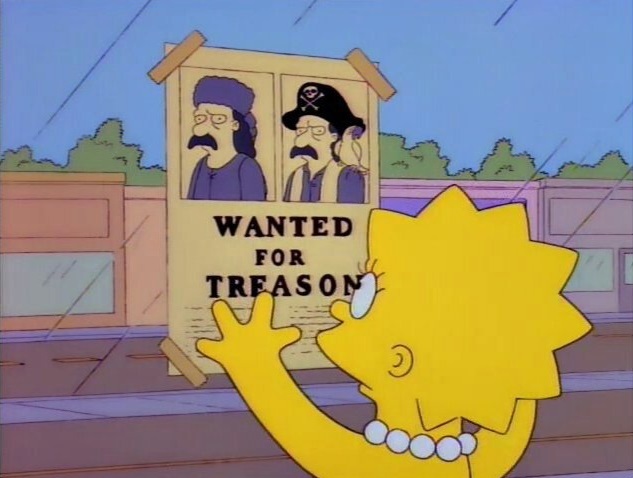
- The Simpsons: In "Lisa the Iconoclast", Lisa finds evidence that the man who founded the town in 1796, Jebediah Springfield, was formerly a pirate named Hans Sprungfeld, and convinces the town to exhume his body to settle the matter. The story was inspired by the exhumation of Zachary Taylor.
- Lucy the Australopithecus was claimed to have died after falling from a tree in a 2016 paper, but other scientists disputed that conclusion.
- Atapuerca's "Skull 17" has been lauded as the oldest unambiguous instance of murder, some 430,000 years ago. The owner of the skull, a male Homo heidelbergensis, was hit with the same hard object, likely a rock, on two different areas of the skull shortly before his death, which excludes an accidental impact. A little more ambiguous is "Skull 5" from the same site and era, who received a single blow to the face and died months or years later from an infected broken tooth. Atapuerca itself has instances of cannibalism going back over 800,000 years ago, but it can't be excluded that those were eaten after their natural death.
- The non-fiction book Cold Case Homicides: Practical Investigative Techniques (2006) argues that the coldest criminal case ever investigated is the death of Ötzi the Iceman ca. 3300 BCE. He was found 5,000 years later in 1991 and initially believed to be a dead tourist. Once dated, he was speculated to have died in an accident or a ritual sacrifice (which would make his death not a crime under the law of the "jurisdiction" it was committed in), but further testing, using the same techniques employed in modern crime investigation (including DNA analysis of weapons found on Ötzi's body, x-rays made of his remains, and examination of blood on his clothes), found unambiguous evidence that he had fought for his life against several people before being murdered. Now we know where he was before his murder, what he ate, how many people were involved in his killing, that they were all men from the area, and that he carried another wounded man over his back before he was shot with an arrow and bled to death. Talk about a cold case.
- The death of Tutankhamun has been debated ever since the discovery of his tomb in The Roaring '20s. An assassination by his vizier was a favored theory for years, only to be replaced later by malaria, Royal Inbreeding, and an accident involving a war chariot.
- Alexander the Great's death has been even more intensely debated, not the least because his body has actually never been found.
- What happened to Edward V and his brother Richard after they were sent to the Tower of London in 1483, ostensibly for their protection, then never seen again after that summer? For over half a millennium, the leading theory was that the boys were killed by their uncle Richard III (their legal guardian at the time of their disappearance) so he could have the throne for himself. The remains of two children were found in the tower in the 1670s, and buried as the princes. In 1933, the bones were removed and studied using more modern scientific techniques. However the study was sloppily done. It's unclear if the bones supposedly belonging to the boys were tested to see if they were male or female or even human as they were originally found with some chickens. One of the skulls was supposedly too large to have belonged to a child. Several of the bones had been destroyed by the original discoverers. Queen Elizabeth II never allowed for the bones to be DNA tested, even after interest in Edward and Richard's fate was renewed due to the discovery of their uncle's remains in 2012. In 2024, historian Tim Thornton discovered what might be the biggest clue yet that the boys were killed by their uncle. Thorton found a reference to a necklace owned by Edward in a woman named Margaret Capell’s will that was written in 1522, long after his disappearance. Capell was the sister-in-law of James Tyrell, Richard’s henchman, who has been suspected of being the one who ordered the killing since almost the beginning. Thomas More is the first person known to have put the accusations to paper. He said Tyrell had confessed while also saying he didn’t know what the killer had done with the bodies before his execution in 1502. A cold case that has been unsolved for well over 500 years is unlikely to be solved, but a family member of one of the long-suspected killers having a personal possession of one of the boys is pretty damning.
- The 1809 death of Meriwether Lewis (of the 1804 Lewis & Clark Expedition) in the Tennessee countryside was considered a suicide by Thomas Jefferson, which tarnished his contemporary reputation and legacy. However his body was only examined by a doctor once, in 1848, and he claimed (without elaboration) that Lewis didn't kill himself but was murdered. From 1993 to 2010 about 200 members of Lewis's family petitioned the government for his body to be exhumed and subjected to forensic analysis, but this was ultimately rejected as this would destroy his grave, which is now a national monument.
- In 2024, the Police Department of Batavia, Illinois identified the oldest Jane Doe by a law enforcement agency using family DNA: a skull found hidden in a house's wall in 1978 turned out to belong to Esther Ann Granger, who died in childbirth in 1866 and was buried in Lake County, Indiana. As a result, her skull must have been robbed from her grave at some point, or stolen by a physician before burial.
- Charles Francis Hall was the subject of this twice. He died of a claimed apoplexy during a polar expedition in 1871 and was buried in Greenland. However, Hall had clashed with several members of the expedition before his death, including sailing master Sidney Budington and physician Emil Bessels, whom Hall had outright accused of poisoning him. A US Navy inquest ended without charges because Hall's body wasn't available for autopsy. Almost a century later, in 1968, Arctic historian Chauncey C. Loom had Hall's body exhumed and autopsied, and found that Hall had consumed great quantities of arsenic in the two weeks leading to his death. Loom suspected Bessels because he had the knowledge to fake apoplexy symptoms with arsenic, unlike Budington, but he didn't find a motive beyond a vague mutual dislike between the men. Then in 2015, a series of romantic letters surfaced, written by Hall to Vinnie Ream, a young unmarried artist who had socialized with both Hall and Bessels in New York before they set sail for the Arctic. The discoverer of the letters, Russell Potter, theorized that Hall's death was a case of Murder the Hypotenuse, "but absent a Time Machine, I don’t think it can ever be 100 percent resolved."
- Jack the Ripper's identity remains widely debated and investigated despite his murders taking place in 1888. The FBI even produced an official criminal profile of him in 1988. Several suspects have been proposed with various degrees of plausibility, but the case remains unsolved.
- Spanish criminologist Francisco Pérez Abellán investigated three magnicides from the 19th and early 20th century in the 2010s:
- He found that Juan Prim (Spanish PM shot in an ambush in 1870) was strangled in his bed while he was recovering from the shooting, concluding that he was victim of a more elaborate conspiracy than commonly believed. However, a second autopsy by Madrid's Complutense University denied these conclusions and attributed the supposed ligature marks on Prim's neck to marks left by his burial clothes.
- He ruled that Mateo Morral, the anarchist that tried to assassinate King Alfonso XIII during his wedding day in 1906, was murdered while in police custody and could not kill himself as historically recorded.
- He confirmed that José Canalejas, Spanish PM assassinated in 1912, was indeed killed the way he is said to have been in History books, but that his killer, the anarchist Manuel Pardiñas, did not kill himself to evade arrest. Instead, he was beaten and shot twice in the head by Canalejas' bodyguard.
- The oldest entry in The Charley Project missing person database is Dorothy Arnold, who disappeared in New York City in 1910. She was 25 years old at the time of her disappearance, and would be 115 years old if she lived to the year 2000. She was excluded as the identity of the Lady of the Well bellow.
- Non-murder example: The "discoverer" of the infamous Piltdown Man, amateur archaeologist Charles Dawson, was exposed as a Con Man with a twenty-year career of faking discoveries in 2003, almost nine decades after Dawson's death, and five after Piltdown was universally decried as fake. Furthermore, in 2016 DNA testing proved that a tooth found by Dawson in 1915 came from the same ape as the Piltdown jaw in 1912, leaving little doubt that Dawson had faked the discovery alone. This put to rest a decades-old theory that Dawson lacked the knowledge to make a convincing hoax and must have been helped (or used as a patsy) by an academic.
- The dismembered, headless remains of a man were found in a cave in Lewiston, Idaho in 1979. He was speculated to be a hiker murdered a couple of decades before at most... until 2020, when he was identified through family DNA as Joseph Henry Loveless, a bootlegger who had disappeared after fleeing from jail in 1916. In a real-life example of Meaningful Name, Loveless was jailed for the murder of his wife, and it is speculated that he was found and lynched by her relatives, as he was known to be dead and even had a cenotaph to his name. Nevertheless, his is still listed as an open case by the Clark County Sheriff's Office.
- The Lady of the Well. In 2006, construction workers found a barrel at the bottom of an old well in the Sutherland neighborhood of Saskatoon, Canada. Inside the barrel there was a burlap sack containing the partially dismembered remains of a murdered woman wearing clothes and objects from The Edwardian Era, along with a man's pants and vest from the same time, when Sutherland was a separate small town of about 1,000 people. In this time, the site was occupied by a hotel, that would go out of business in 1919 and was demolished in 1927. Despite this, the case was treated like a normal crime investigation by the Saskatoon police department, who called on the public to help identify the woman. This came to fruitition in 2025, when the Lady was identified through genealogical DNA as Alice Spence, a wealthy farmer's wife last recorded living in Sutherland in the 1916 census, in a house nearby that was destroyed by fire in 1918. The police also announced that they had a suspect and considered the case solved, but didn't name them because they were deceased and couldn't defend themself.
- In 2007, the students at the police academy in Fürstenfeldbruck, Germany investigated the unsolved Hinterkaifeck family murder of 1922 as if it was a new case. They agreed on a prime suspect but did not make his identity public out of respect for his still-living relatives.
- The disappearance of a 16-year-old servant girl named Emma Alice Smith in rural Sussex in 1926 was reinvestigated as a murder in 2009 after a short film was made about her. A dying man had allegedly confessed the murder to Emma Alice's sister on his deathbed in 1953, but she had herself died without reporting it and the man's name was unknown. After the investigation, however, the police accepted a different theory about her disappearance (that she had eloped with a married man to Ireland) and closed the case.
- A skeleton was found by hikers in October 2019, buried under some rocks in Mount Williamson, California. Family DNA identified him as Giichi Matsumura, a fugitive from a WW2 Japanese-American internment camp in Manzanar. As it turned out, Matsumura was known to have died in a snowstorm after escaping Manzanar, but his burial site had been lost.
- Most European countries have statues of limitation for murder, the UK being the exception. Another common exception is crimes against humanity, including the Holocaust. This has resulted in a few former death camp guards and other personnel being arrested and facing trial into their 80s and 90s, sometimes appearing before juvenile court because they were legally minors at the time.