

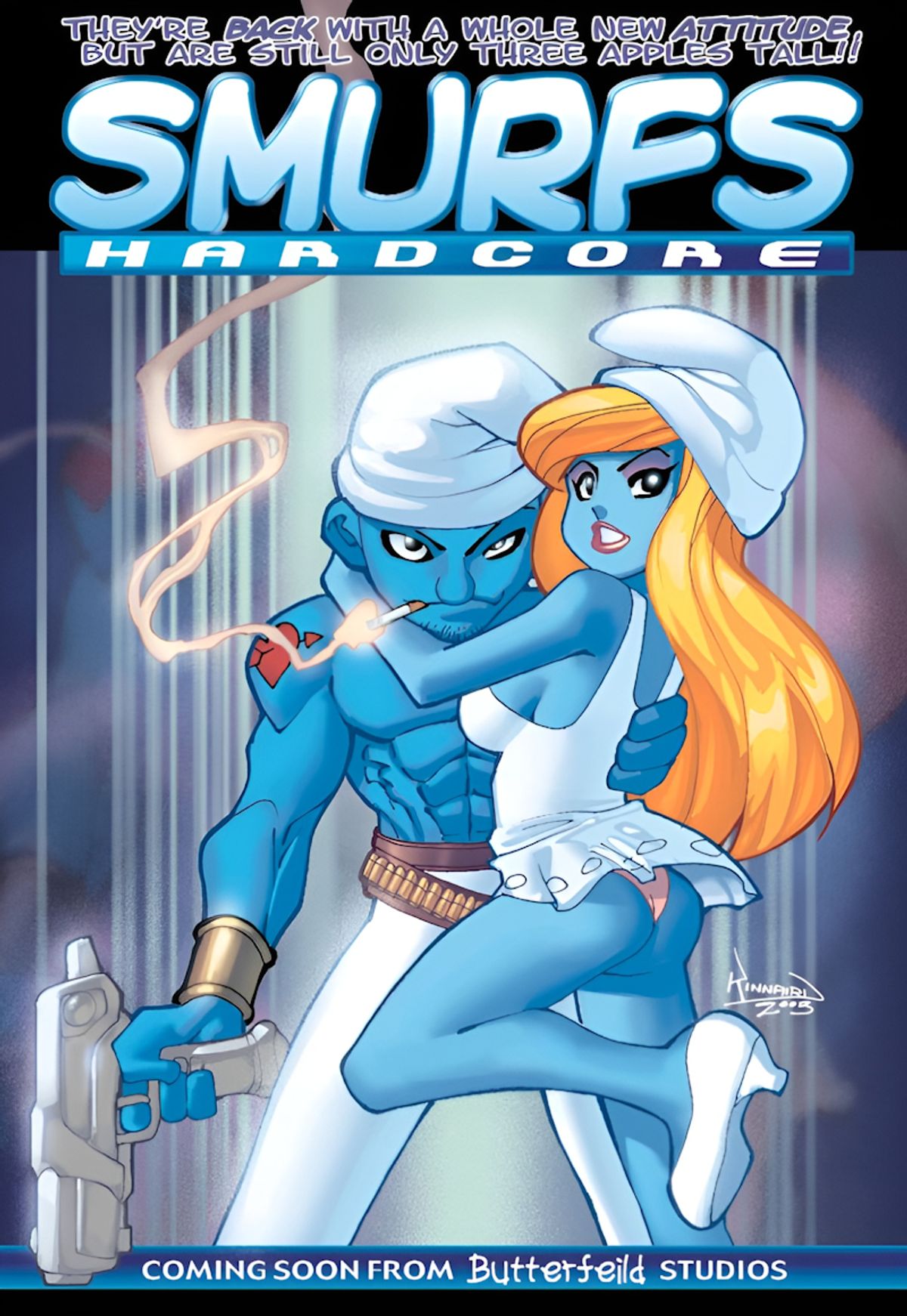
Image
 by RyanKinnaird. Used with permission.
A Tone Shift that seeks to make a work of fiction more gritty and cynical.
An effective use of this tone shift could mean that archetypes which we are accustomed to see acting in a more noble setting will have to act in one where they must think and act grimly in order to make progress, thus forcing re-examination of the tropes involved, or the use of new tropes and expansion of the setting, utilizing different sorts of characters and stories. In practice, however, writers can be too lazy to realize all that potential and end up simply "spicing up" a work with gratuitous gore, cursing, and sex to make it more "adult" — often overdoing it in the process. This is not to be confused with Tough Love.
When done right, Darker and Edgier works are a case of Tropes Are Tools. When a show uses this trope as a tagline, you can expect a mixture of: awful things happening to the characters, twisted backstories giving them a reason to angst, protagonists becoming less heroic, and the setting becoming much bleaker. However, this all works IF it's done right.
As one could predict, this is fairly easy to screw up, and poor use of these tropes may just result in Too Bleak, Stopped Caring if the setting gets too hopeless, or Narm if the edginess becomes just silly. This doesn't make it a bad trope, though— when used subtly, such as in the Harry Potter series, it can create the effect of a series growing up with its audience.
In fact this is often the purpose of a Darker and Edgier turn. Just as a Lighter and Softer tone is typically part of an attempt to bring a fictional world to children or to younger children, a "darker" tone is often intended to make a setting appeal to older children or adults. But unlike its opposite, a Darker and Edgier shift is often used to keep an existing audience as it grows up rather than appeal to a new one. It can also be a result of child fans growing up as its creators and continuing to think of the setting as something aimed at themselves and their peers instead of the original target age group.
This trope became extremely popular in Comic Books as a rebellion against the Silver Age but also led to more than a decade of a lot of clumsy attempts by many writers to show that comics are "not kid stuff anymore." See the Bronze Age, the Dark Age, and '90s Anti-Hero for more details about how this worked.
The excessive version is often known as "Grimdark" (one word), derived from the tagline of Warhammer 40,000. ("In the grim darkness of the far future, there is only war.") Sometimes justified with the phrase "Silly Rabbit, Idealism Is for Kids!". Usually shows up in Dark Fic. If a pre-existing show undergoes a Retool under the guise of making things Darker And Edgier, expect Jumping the Shark, especially if there was Executive Meddling involved. The United Federation of Charles wrote an essay called, What is Grimdark? which explains some of the history of the subject. Overly Sarcastic Productions has a video on this subject as well. "Grimderp" has in many parts of the Net become popular as a term for Grimdark that goes so far that it becomes Narm. When a specific character rather than the work as a whole is perceived as having become excessively Darker And Edgier, a popular term is "Edgelord". Which also gets applied to fanfic writers who produce exclusively Grimdark (or especially Grimderp) works.
As with Lighter and Softer, this practice tends to go better if the change was planned in advance to keep the tone from shifting too abruptly.
This is a common result of an ongoing work suddenly becoming subject to less censorship than it had been previously (as was the case with the Comics Code fading away). When the writers had previously been scarcely allowed to depict any violence, swearing, or innuendo at all, but are then finally given permission, you can fully expect them to go wildly overboard with it for a while. This will of course attract some audience members and repel others, but eventually both the viewers and the writers will likely want to scale things back to some level between the original squeaky-clean version and the later R-rated version. note
Note that this is not the same as a Deconstruction. A Deconstruction plays out the genre's conventions to their logical conclusions in order to criticize the initial genre conventions. This does not have to be dark (see for instance Deconstructive Parody) and it does not prevent things from turning out well. Darker And Edgier just adds "dark" elements and may not have any real intention to deconstruct genre conventions. Often a Deconstruction can cause a work to seem darker because it's calling attention to dark aspects already implied but previously glossed over; see also Ascended Fridge Horror.
Opposite of Lighter and Softer as well as Younger and Hipper. Often found alongside Bloodier and Gorier, Hotter and Sexier, Ruder and Cruder, Sequel Logo in Ruins, Not Wearing Tights, and Real Is Brown. Often a by-product of the franchise growing bigger and more ambitious. Should not be confused with Cerebus Syndrome which means a shift from comedy to drama without necessarily increasing the edginess or adult content. May overlap with Actionized Adaptation.
Compare Grimmification and Fractured Fairy Tale for when this is done with fairy tales and American Kirby Is Hardcore for when this is done with boxart. See also Sugar Apocalypse. For when it applies to a single episode, see Unexpectedly Dark Episode and for when it applies to a parody, see Dark Parody.
Examples subpages:
- Anime & Manga
- Comic Books
- Fan Works
- Films — Animation
- Films — Live-Action
- Literature
- Live-Action TV
- Music
- Tabletop Games
- Video Games
- Web Original
- Western Animation
- Other Media
Other examples:
- The "steel cage" used in Steel Cage Matches transformed over time from something that kids would probably enjoy climbing at Chuck E. Cheese to, well, an actual steel cage. However, the steel cage itself is lighter and softer, as the first cage matches in pro wrestling used chicken wire.
- Lucha Libre Internacional was marginally but still noticeably heavier in tone than EMLL, which it broke away from; one of its most famous angles, which in turn led to the tercias match being associated with Mexican wrestling, was started by heart-attack-causing Fallen Angels, who formerly were El Signo (whose gimmick immediately before this was having blond hair and getting it shaved off), El Texano (formerly a cowboy), and Negro Navarro (the only one with a remotely supernatural or worrying gimmick, which was simply being a fanboy of Black Shadow).
- Kevin Sullivan's Hollywood Satanism heel run in Florida qualifies. He has said that the Dungeon of Doom was supposed to have been darker than it was. As it turned out, due to silly gimmicks and NO INDOOR VOICE overacting, it ended up more as a So Bad, It's Good Guilty Pleasure with plenty of Ham and Cheese and Narm Charm.
- EMLL\CMLL later had two heavier, edgier breakaways in AAA and Perros Del Mal Producciones. Even more in line with the trope, PDM was originally supposed to be a spinoff\sister promotion. AAA itself would get a heavier, edgier spinoff called Lucha Underground.
- Over the years, Scott Levy turned from the effeminate Scotty Flamingo into the brooding, psychopathic Raven
- ECW from 1996 onward was considered a more darker and edgier professional wrestling organization when compared to other organizations like WWE or WCW back in the day as ECW's angles took a more mature approach over the cartoony "storylines" WWF and WCW were using. ECW had actively based itself on older, more serious times in wrestling as well as on garbage wrestling promotions such as FMW.
- The WWF's Attitude Era gained so much attention because it was so much Darker And Edgier than the days of Superhero-like wrestlers like Hulk Hogan, the fact that much of the new flavor was imported directly from ECW aside. It could be argued that this was inspired by WCW's taking its two main wrestlers, Hulk Hogan and Sting, and transforming them overnight. The Sting gimmick morphed from a brightly colored California super-surfer to a grim, vengeful '90s Anti-Hero, a wrestling version of The Crow. Hulk Hogan became "Hollywood Hogan", an all-powerful gangster with a Hollywood-sized ego. This inspired WWF to change their direction as well as ECW's gaining momentum.
- The Undertaker and his Ministry of Darkness gimmick. Undertaker has always been 'dark' so to speak, but when the Ministry came into existence he become a full blown villain, using creepy religious symbolism, crucifying opponents, abducting women, employing a cult of other wrestlers to do his bidding, the whole nine yards. He became less of a wrestling villain and more of something out of a comic book.
- Dustin "Goldust" Runnels's promotion video as "Seven" when he returned to WCW, though that got cancelled.
- Zigzagged with, of all people, Edge. He started off as a dark brooding loner, became a vicious pseudo-vampire, before getting Lighter and Softer as a goofy tag wrestler, became Darker and Edgier after going solo as a vigilante like character hell-bent on taking down Evolution, before his heel turn and becoming a sleazy manipulator, and later became a goofy Comedic Sociopath.
- Shane Helms' original Superhero gimmick "The Hurricane," seemingly imposed on him in 2001 when he came in from WCW as a joke to amuse the writers, but, Helms' talent, charisma and enthusiasm got the character over with the fans. It helped that Helms actually has a genuine love for comic books. When he revived the character years later just before his departure from WWE, he attempted somewhat to reimagine Hurricane as a grim, silent, Dark Is Not Evil avenger.
- Try going from Chikara to CZW like The Kings Of Wrestling, though Chris Hero didn't fully drop the superhero stint and become knockout obsessed until his run in ROH, it was still in CZW where he got a messianic complex. It's often averted though, with The Osirian Portal being just as silly in CZW as in Chikara.
- Unlike WWE, TNA had more violence, blood, and profanity and was rated TV-14. It's also been viewed as Incompetence, Inc..
- Interestingly, while WWE's PG era was initially exactly that, with relatively clean violence and little profanity, it's now gotten more than a bit edgier, the violence is more brutal, the language is dirtier and more frequent, and such Anti Heroes as CM Punk and Randy Orton are starting to become the norm again for faces. Add to that the returns of wrestlers from the Attitude Era like "Stone Cold" Steve Austin and The Rock, and it could very well be only a matter of time before WWE goes back to TV-14. Funnily enough, WWE initially started out as PG before transitioning to the Attitude Era, and then back to PG before starting to get edgier again.
- In his WWE career, CM Punk has continued to become grittier and more visually dark, even when making a Heel–Face Turn. However he's much more on the "softer" side compared to his runs in IWA Mid-South, Full Impact Pro or Ring of Honor.
- Chris Jericho's creepy video with the children before he returned to compete in the Royal Rumble, lose, and then face CM Punk (then face) at WrestleMania, which had been his plan all along.
- With the family friendly + occasional Parental Bonus formula PG-WWE has established with its characters and storylines, the backwoods cult of The Wyatt Family comes off like an Attitude Era gimmick that got off at the wrong stop on a time machine. It has minor shades of the Ministry of Darkness except that it's a lot earthier and slightly less over-the-top, coming across a lot more like a cult you could very well run across in Real Life if you got lost in the wrong area. Bray, unlike The Undertaker, isn't so much a supernatural being, but he is a man that fully believes himself to be some sort of god, and that arguably makes him even scarier.
- Taken to the next level by Bray Wyatt's persona as "The Fiend", which somehow manages to be darker and edgier than even the previous incarnation of Bray Wyatt.
- Bam Bam Bigelow debuted in the WWF in 1987 as a Gentle Giant of sorts, an agile, seemingly fun-loving big man who spurned all the heel managers bidding for his services in favor of the babyface Oliver Humperdink. He would leave the WWF a year later, and in 1992 he returned with the same hairdo, the same ring get-up, but with a heel persona and a slow, dark, ominous ring theme that contrasted to the happy sax music he entered to in 1987-88.
- The WWE Women's Division as a whole as it went from having childish and catty high school girl-style storylines during the Divas Era to more violent and serious feuds since the WWE Divas Division was rechristened as the WWE Women's Division back in 2016. In addition, most of the WWE female roster have tattoos and piercings as opposed to the clean-cut Divas Era.
- The WWE as a whole ever since Triple H took over as WWE Head of Creative as storylines have been more violent and serious and less comedic as the themed shows such as RAW Roulette, the Slammy Awards, Hell in a Cell and Extreme Rules have been phased out in order to focus more on long-term storytelling and realistic characters.
- The 13 Cards spin off season, Joker Presents, is a lot more tragic and nightmare fuel ridden, as it is meant to answer the darkest questions regarding the lore. the first episode even had Body Horror and a main character dying, for instance. The final episode of Joker Presents, Endless, is the darkest one of all, not even beginning with a curain introducing the episode, just the title over a black background and a Drone of Dread.
- Animator vs. Animation: Season 3 is significantly darker than the rest of the series. Victim, the temporary Arc Villain, has quite possibly the most tragic past yet, showcasing how the Animator's actions against him were not harmless. We get to see that the very first episode of the series was only the beginning of a long, prolonged series of abuses at the latter's hands. He escapes, but his Mental Health Recovery Arc amounts to nothing after losing his loved ones in a massacre caused by the Animator's creations. The Dark Lord is also back, and as bad as ever, only this time his plans are actually on a trajectory to coming to fruition. This is easily the Darkest Hour for the heroes yet.
- Season 9 of DEATH BATTLE! has a notably darker tone compared to previous seasons in regards to how it portrays its fights. Several fights are portrayed with an overall tragic angle, with a large amount of them ending on a bittersweet note ("Tanjiro VS Jonathan Joestar", "Omni-Man VS Homelander") or even an outright Downer Ending ("Black Adam VS Apocalypse"). The season also features a lesser number of straightforward heroic characters, with the majority of the fighters being either Anti-Heroes, Anti-Villains, or outright villains.
- The Debbie and Carrie Show: An alternate timeline was depicted in a Spin-Off series, The Debbie and James Show. Among other disturbing things: Debbie is actually RAPED and impregnated by her enemy Ted Wilson and later has an abortion. It is also revealed that a major villain murdered her own mother!
- Disventure Camp takes a more mature turn than the original Total Drama series. Several examples include the topic of animal cruelty (the hosts' plan on killing wildlife to make filming safer), death (Jensen's "Staff Stories" episode feature the first on-screen death in the show), and homophobia (Jake's parents are not approving of his homosexuality, even to the point of calling him a slur).
- The first two seasons of Gotham Girls, an official web series tied to the DC Animated Universe (mainly based on Batman: The Animated Series specifically), had a Denser and Wackier approach than the standard DCAU shows and had every episode consist of a self-contained instance of comedic hijinks. The third season, in contrast, is much darker and realistic, cutting back considerably on the humor and devoting its entirety to a story arc revolving around Dora Smithy causing trouble in Gotham out of a misguided attempt at avenging her twin sister Nora Fries.
- Homestar Runner parodies this with its 2010 April Fools' Day gag, HSR Xeriouxly Forxe.
Singer: There's new demographics when nobody asked for it!
- JibJab, originally, light in tone, went from gently mocking Bush and Kerry in 2004 to mocking McCain and Obama straight up in 2008, along with the broken promises made by presidents in election day that never come to light when they are actually in office. The "Year in Reviews" went from hoping it'll get better to, most recently, the 2008 Year in Review summing up everything that's bad, and adding "wars and famine" to the end.
- Journey to the Quest has its share of heavy moments, but it's a mostly lighthearted affair and primarily leans into the comedy. Its prequel Spin-Off Before the Quest on the other hand puts the focus squarely on the main cast's Dark and Troubled Pasts and even starts off with Elliot attempting suicide.
- The Lobo (Webseries) is considered by DC fans to be R-rated humor compared to Gotham Girls due to excessive profanity and violence.
- Lost Island have more mature themes than the original Total Drama series. Examples include bloody violence, profanity and sometime sex.
- Mario Brothers is this to the Super Mario Bros. franchise. King Koopa is a completely serious and terrifying villain here, and deaths are treated with the seriousness death entails.
- Nyan AH: In a notable departure from most other Nyan Cat-based works, Nyan AH’s duology tells a genuine story with dark themes such as death, loss, and sacrifice, which are treated with complete sincerity. The first entry alone sees Nyan Cat attempting to kill himself after witnessing the death of his girlfriend.
- Power Star manages to be even darker than the aforementioned Mario Brothers, dealing with Mario getting his mind taken over by boos (Here depicted as threatening spirits who intend on eradicating the whole universe, Luigi going out of his way to kill him for the greater good and failing, and not to mention, an excessive amount of blood in every battle that happens.
- In Ratboy Genius, earlier episodes were mostly short slice-of-life adventures, but Ratboy Genius Dreams Minecraft has an actual antagonist in the form of Little King John and a more adventurous plot, which hilariously, grew the fanbase. The sequel miniseries The Flood continues in the same vein.
- Starship Genius kicks off with Big Fish Boss and his army devouring an entire planet, Galactus-style.
- Red vs. Blue: The Blood Gulch Chroniclesnote is a Random Events Comedy, that just gets more insane as it progresses. From Reconstructionnote onwards however, plots are a lot more focused, backstory is elaborated on, justification is provided for The Blood Gulch Chronicles' Random Events Plot (Without even a single Retcon), action scenes are more frequent and intense, and just about every character gets rounded out (Some are surprisingly complex). Revelation and The Project Freelancer Saganote in particular have some genuinely great character drama.
- Season 11 looked like it was a return to the comedy of the original format, but halfway through gets as dark as the series has ever been.
- The Chorus Civil War takes the same format. At first it started the same way as the earlier season, and things get darker as the season progresses.
- Do you want to know the exact moment when RWBY hit this trope? When the main Rooster Teeth webpage has a blog post from one of the writers saying that things will get darker and you'd better think twice about letting your kids watch this.
- This was just after the episode that had Yang being arrested on live television after being tricked via illusion into breaking Mercury's leg. Oh, and she didn't even hurt him anyway - it was all an act, which he laughs about later.
- "Heroes and Monsters" ends with Adam torturing Blake by stabbing her in the stomach, and then slicing off poor Yang's arm when she tries to intervene. Damn.
- "The End of the Beginning", the third season finale, has Pyrrha being murdered onscreen and ends with Weiss being forcibly taken back in by her abusive father, Blake abandoning the rest of the team, and Yang so emotionally broken she can't even get out bed, leaving Ruby to go AWOL on a crazy mission to keep fighting the bad guys. For comparison, the previous finales both neatly restored the status quo in about a minute after a big, fun action scene.
- The theme song When It Falls is pretty dark. It opens with a soft piano interlude, and then the first verse enters
Maybe red's like rosesMaybe it's the pool of bloodThe innocents will lay inWhen in the end you've failed to save themTheir dying eyesAre wide and white like snowAnd now they knowThe cost of trusting you's obliteration - Although already dark, Episode 10 of the webseries Salad Fingers could very well be darker than the previous episodes. The episode in question is entitled "Birthday," and it starts with our protagonist Salad Fingers about to throw a party for Hubert Cumberdale, his finger puppet. He then goes to what he refers to as Milford Cubicle's corpse (which was still hanging from the rack where SF left it in the episode "Nettles") and asks it to take a hot bath and prepare for Hubert's party. SF then gets a knock at the door, and he sees a long pole that's extending to the sky. Worried about Milford, Salad Fingers leaves his horse Horace in charge of the house until he got back. He walks out into the forests and goes through some trash and finds a puppet that he calls Dr. Papanak. Dr. Papanak then examines him and unexpectedly bites him. Salad Fingers then throws him over to a horse that resembled Horace, and the puppet began to cut into the side of the horse. Salad Fingers witnesses this, and assures the horse that he knew it hurt, but he should try to hold still and let the puppet consume its blood. Salad Fingers then takes a nap and when he wakes up, he seemed older stating that he was asleep for probably 'Six Mondays.' He then goes back to his home to discover that more horses were at his house and that the flesh on Milford Cubicle's skeleton had been cleaned off. Salad Fingers is enraged and casts the horses out of his house. He then goes outside and sees the pole again and asks it if it was the ringleader behind Cubicle's fleshless corpse. However, it turns out that five Salad Fingers-like beings had eaten the flesh off of the corpse and were seated at a table. Salad Fingers then goes to the table and sits down. The pole soon extended from the sky and a present was revealed to be at the top of it. Salad Fingers opens it and it turns out to be a hat made out of Cubicle's face. SF puts it on, and stated that he'll wear this hat until his death.
- SNARLED: "Fitcher's Bird" is a darker take on fairy tales, culminating in a dark (but satisfying) ending where our protagonists burn the warlock and his guests alive in his own castle.
- Thomas & Friends Machinima Sodor: Dark Times is far darker then the show it was based on, as the tone is far darker and more depressing, there’s little if any humor, an Ax-Crazy murderous steam engine named Alfred (an alternate version of 98462 from The Railway Series) as the Big Bad, and almost all of the steam engines we’ve come to know and love being Killed Off for Real.
- Short Stories arguably makes the above look tame in comparison. There’s a more horror driven tone with little humor, various characters are Killed Off for Real and a good portion of the characters aren’t as nice as they were in canon.
- Super Smash, the gritty reimagining of Super Mario Bros makes itself to be a rather awesome flash.
- The There she is!! series of videos at Sambakza.net feature Doki and Nabi, a rabbit who falls in love with a cat. The first two videos are cute and funny, showing Doki chasing Nabi despite his arguing that they are different species, then him getting her a birthday cake. The third and fourth videos show how society is REALLY against this pairing, with the two of them getting injured, property destroyed, pet dying, etc. Not so fun anymore, huh?
- Fazbear and Friends (ZAMination): Don't let the series fool you as some of their shorts are much darker with black comedy and very serious themes, however the darkest of all is "The END of Fazbear and Friends" that not only are there no laughs or comic moments, but there is depression and nostalgia everywhere, the characters are mourning the death of music videos, and there is no music in the first minutes, but fortunately this is minimized when everyone starts singing "Bring the Music Back" to make things go back to the way they were before.
- Breakfast of the Gods is a Darker and Edgier and Bloodier and Gorier use of breakfast cereal mascots. Tightly-written and exquisitely drawn, it's D&E&B&G at its finest. Frankenberry is a sadistic thug, Sonny the Cuckoo is batshit insane, The Trix Rabbit is a private investigator, Toucan Sam runs a bar and acts a lot like Rick.
- Butterfly, an Affectionate Parody of Batman, spoofs the phenomenon here. The specific point of reference is Christopher Nolan's The Dark Knight Trilogy.
- Ctrl+Alt+Del. The shift from "two game nerds on a couch" to "personal responsibility and miscarriage tragedy".
- Dan and Mab's Furry Adventures started out as a very light-hearted comic that followed the everyday antics of Dan, Mab, and their friends and family. Later on, things like Dan discovering that he is an incubus, Mab being involved in...something that she claims will kill at least two of her friends, a flashback revealing that on Dan's first adventure one of his friends was brutally killed by Dark Pegasus, and all of Abel's Story made it clear that DMFA is definitely a more mature comic than when it started. Though this to be expected, as the comic was started when the author was in high school, and so it's probably matured along with her.
- Distortion Nuzlocke is this compared to Pokemon and some other Nuzlockes. The Pokemon aren't even real, and it contains a lot of violence and questioning sanity.
- In a May 2008 Dominic Deegan strip, the title characters learns, to his horror, that his favorite comic is about to become Darker And Edgier... by retconning the hero into a demon. It's like making Superman Darker And Edgier by giving him a German heritage, a small mustache, and a great personal hatred of Jews.
- It was foreshadowed at the end of the Storm of Souls arc. One of the cosmic consequences of breaking the storm was that many of the souls normally bound for Heaven or Hell ended up in the wrong place.
- In El Goonish Shive, the "Painted Black" arc is one of the darkest story arcs and as it came after the silly "Q&A #2" and the relatively light "Tam Eh Tedd" storylines its impact was felt all the more heavily.
- The superhero parody webcomic Emokid and Chemokid was initially dark comedy, but eventually became a suspenseful story with deep backgrounds and character development while still maintaining the odd sense of humor that only the writer of Head Trip can provide.
- Erma has been dabbling in drama for a while though, but Spirit's Bloom is quite a bit darker than the rest. Most notably, three innocent extras die very gruesomely toward the end, and Erma is revealed to be a key piece of a plot to destroy the world.
- The original material that Exterminatus Now is based on was 'The Grim Darkness', a project to make the Sonic the Hedgehog (Archie Comics) comic universe GRIMDARK by blending it with Warhammer 40,000. According to Word of God: "...in reflection, one of the worst ideas I have ever had." The actual webcomic makes fun of it.
- Mocked in Fanboys when Paul claims that to appeal to their readers they will have to resort to foul language, gun usage, drug abuse and sex appeal.
- In The Hare's Bride (2010), E. M. Carroll's adaptation of the fairy tale of the same name, the hare is more menacing and monstrous than in the original tale. In the original, he attacks the straw dummy by hitting it on the head. In this comic, he takes on a more monstrous appearance before tearing apart the dummy with his limbs and teeth. There are also some implications that the girl may have been Invited as Dinner.
- Homestuck has several points where it gets darker and grimmer: playing a The Sims Meets EarthBound (1994) game causes The End of the World as We Know It, when we learn that Anyone Can Die and winning the game won't save them, when Eldritch Abominations are revealed to be real, when we meet the Trolls and their Crapsack World ends, and when Rose has started to Screw Destiny with a passion, aided by the aforementioned abominations. Fortunately it never gets too dark:
tentacleTherapist (Rose): I'm not actually trying to caricaturize a grim sorcerer.
TT: There's still a perfectly intact piece of my mind which realizes how ridiculous it is to be flying across rainbow oceans with a couple of magic wands and a salamander in a little cowl.
[a bit later]
ectoBiologist (John): maybe later, i will drop by your planet again and rescue you, thus breaking the spooky spell put on you by your nefarious, shadowy masters.
EB: that way you will stop being so grimdark and ominous, and basically completely off the deep end in every way, as is now painfully obvious to anyone with a brain.
TT: Swoon!- As soon as Rose actually goes grimdark, things seem to take a turn for the worse. It even leads to the Author Avatar getting killed.
- Act 6, being post-Scratch and as such more conducive for the kids to be battle-hardened and able to beat the game, is much darker than its mirror, Act 1. Dirk and Roxy are the only humans left 413 years in the future, Betty Crocker rules the world, the ICP were presidents and Guy Fieri the Antichrist. Post-Scratch Jade got stabbed to death by the Condesce's 2x3dent, PS Dave brutally beheaded the ICP, and PS Rose stabbed Fieri's eyes out with needles and rode his body down a waterfall of blood. Then they died brutally to the Condesce. Hell, at one point, Dirk Portal Cuts his own head off in a Thanatos Gambit to save his friends, two of whom had been impaled through the stomach by an inescapable, planet-obliterating weapon. To reiterate: HE CHOPS HIS OWN HEAD OFF. Kids and fun.
- So for a long while, getting killed only meant you got to live out the rest of your existence in a dream bubble with all the other dead people. You could be happy there. Nepeta finally got a version of Karkat to be with, Equius got Aradiabots, a version of God-Tier Tavros was happy and flying free... but then, in [S] Caliborn: Enter, we see that Lord English, hinted to be the final Big Bad of the series, has the ability to destroy the dreambubbles. He is literally killing dead people. Also, his younger self, Caliborn, escapes his prison by gnawing his own goddamn leg off, complete with gratuitously-spurting candy red blood.
- Then [S] GAME OVER. occurs, killing off damn well near a good chunk of those who managed to survive any of the above events. Good thing John has his Cosmic Retcon powers at that point.
- As soon as Rose actually goes grimdark
- Formerly Lawful Stupid Cale, from Looking for Group has certainly come a long way since the comic started. Due to the influence of undead warlock Richard, cynical companions Pella, Benny, and Krunch Bloodrage, and the fact that his new Kingdom was Powered by a Forsaken Child, Cale has become far more flexible with regards to his morals, and smiles when he sees an old foe intimidated by Richard's undead townsfolk.
- Magick Chicks has always had a more dramatic narrative than Eerie Cuties, in general, even though both comics are PG-13.
- As of Chapter 15, it's become noticeably darker once Cerise turned evil and not only betrayed her friends, she decided popularity was worth killing for - by banishing the student council, whose fates remain unknown. Though she claims to have sent them into a volcano!
- Which was soon followed by Melissa's mother, Dakota attempting to kill her other mom, Anastasia in the following chapter. Except it didn't work.
- As of Chapter 15, it's become noticeably darker once Cerise turned evil and not only betrayed her friends
- Occurred in A Modest Destiny, around the third story arc. Up to that point it was a lighthearted and humorous fantasy spoof. Then came "The War of Fate" arc, which was much more darker and serious, such as the female lead considering getting an abortion.
- Night Terror 2 is far darker than than the one that came before or after it, largely due to the Boogeyman's greater involvement. Fitting, for the (canonically) last entry in the series.
- While it already features a heavy amount of violence and gore, the violence, darkness and outright heavy theming is ramped up in Nixvir. The mostly light-hearted adventures of a snowman and his angel companion become much darker after Erik escapes the giants. Part of this comes from us learning that the snow world, Erik's homeworld, is just as messed-up as the worst theocratic regimes, and part of it comes from the increasing amount of violence and death, especially during the Battle of Conevstall Saga, where Erik is forced to confront the horrors of war, and is deeply scarred to the extent of descending into substance abuse a few chapters later. Even in Chapter XXII, which is set in the Land of Faerie, Erik is forced to confront the harsh truth that he cannot save everyone. On the whole, the comic itself tries to be this when compared to the majority of snowman stories, such as Jack Frost (1998), The Snowman, Santa vs. the Snowman or even, dare we say it, Frozen (2013).
- The Non-Adventures of Wonderella parodied the idea here, when Jokerella tried to invoke this trope.
Hitlerella: Every villain goes through this. You want to be taken more seriously, so you get some edgy new outfit, maybe make a demonic pact to score some evil ambient lighting. It all seems like a great idea at the time. But in six months, all you'll have left is your shame and Halloween contact lenses.
- The Order of the Stick: While the comic has its fair share of darker moments, the prequel book Start of Darkness manages to go further than the comic. Genocide and the murder of one's family is just the tip of the iceberg, culminating in a tragic Downer Ending where Redcloak senselessly kills his own brother to further his own plans.
- qxlkbh parodies this trope in qxlkbh 86 which proudly announces itself as the "DARKER AND EDGIER VERSION". True to its name the comic is darker, and also edgier due to a lack of anti-aliasing; Baseball Cap even trips over an edge.
- Sam & Fuzzy parodies the trope here. And then again here. And then manage to further parody the second parody here. Sam Logan does not seem to like this trope.
- In-universe in Sandra on the Rocks: The developer Tristan tries to do this to Carmen Chamelia (in-universe, an old-school video game heroine famous for her amusing changing powers), giving her a depressing backstory, changes the game to include extremely gory violence, and dresses her in an outfit so skimpy that, when modeled on a living human being, literally needs to be taped to her body. This ends quickly.
- From the third chapter of Sarilho on, there's a decidedly darker tone, in sharp contrast to the initial lighthearted mood of the comic.
- Sleepless Domain, with a first chapter typical of Magical Girl stories, and things going downhill as of the second.
- Sonichu started out with Chris-Chan's poor attempt at making a crossover between Sonic the Hedgehog and Pokémon. The later issues feature events such as the electric hedgehogs having sex in graphic detail and Chris brutally torturing people in retribution for them making fun of him online.
- Spoofed by the Stick-Figure Comic Stickman and Cube in this strip. The cartoonist announces that he is making the comic "Darker And Edgier", gives the characters new Wangst-ridden backstories and sums it up by saying that "basically everyone's just going to shoot each other and swear a lot." At which point Stickman says "Oh, HELL no." The characters later get back at the cartoonist for this. With extreme prejudice.
- The Team Fortress 2 comics go from the offbeat Black Comedy of the games to a wacked-out dramedy with surprisingly solemn moments scattered throughout. Despite these changes, It never loses the humor throughout its run.
- Voldemort's Children gives the appearance of being substantially darker than Harry Potter–the comic opens on a high-security prison deep below the Ministry of Magic–but later pages dial back the darkness due to Hermione Granger's deep considerations of morality and clear unwillingness to permanently harm villains whom she believes can be converted or captured non-lethally. In some ways, this works as a subversion of fan works being darker than source material.
- Walkyverse
- It's Walky! becomes this compared to Roomies!, with the plot now shifting to an epic Superhero tale about saving the world from aliens which gets even darker with Graying Morality and an an increasing number of characters dying in battle.
- Dumbing of Age, on the other hand, despite having far fewer deaths, goes even darker than It's Walky!, with the fantastical elements removed or subverted, a world of Black-and-Gray Morality with the characters now more bitter and broken versions of their former selves, and a bigger emphasis on themes of Depression and Trauma. By book 6, the comic makes It's Walky! look like the Denser and Wackier Shortpacked! by comparison.
- Wapsi Square has certainly gotten much darker and edgier since it shifted from a slice-of-life comedy, to a supernatural drama; dragging in themes of suicide, human sacrifice, manifesting personal demons, and a looming quasi-apocalypse.
- Weapon Brown is Peanuts (and other cartoon characters) made ludicrously grimdark and set in The Apunkalypse.
- There was also the student film Bring Me the Head of Charlie Brown by future Simpsons writer Jim Reardon, which involves the Great Pumpkin hiring the kids as hitmen to kill Charlie Brown in gruesome ways, eventually he snaps and goes on a killing spree.
Charlie Brown: (in a thick Austrian accent) Happiness is a warm Uzi.