

Secretary of Energy: Yeah, it's got electrolytes.
Joe: What are electrolytes? Do you even know?
Secretary of State: It's... what they use to make Brawndo!
Joe: Yeah, but why do they use them to make Brawndo?
Secretary of Defense: 'Cause Brawndo's got electrolytes.
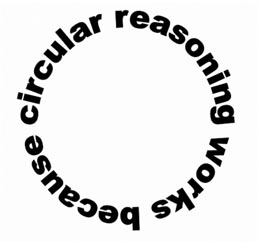
Begging the Question used recursively. A is true because B is true. B is true because A is true. If A, then B; if B, then A. The proof for the statements being asserted simply circles around and around, with nothing in it that isn't being proved by itself. This is a logical fallacy, because it disallows the possibility that both statements are false and, like Begging the Question, presupposes the truth of the thing it's supposed to be providing an argument to prove the truth of. To summarize, the one using it thinks that their claim proves itself; any argument that uses circular reasoning can be boiled down to "it's true because it's true."
If A or B have independent proofs that are "outside the loop", it is no longer circular reasoning.
The simplest form of this is a tautology (like defining "sports writer" as "a writer who writes about sports"). See also Shaped Like Itself and Famous for Being Famous. A similar concept is a logic loop, a type of Logic Bomb where a series of thoughts leads to itself. The Tautological Templar lives by this trope, assuming that they're inherently good and therefore everything they say or do is inherently good, too.
Looks like this fallacy, but isn't.
- Algorithms that describe decision-making processes often loop back to the decision point, but being decisions, they have more than one possible circle. These algorithms, while circular, describe a process rather than making an argument.
- As mentioned above, a logic loop is kind of like circular reasoning but in the other way. Instead of “A is true because B is true because C is true because A is true” (circular reasoning) it's “A is true; therefore B is true; therefore C is true; therefore A is true.” While not a fallacy,note a logic loop is a Logic Bomb and it's best to steer machines away from them. Most humans will recognize the futility of the exercise once one loop has been completed but most machines can't.
- Axioms
 are considered self-evidently valid, and thus are accepted as "true because they are true". (For example, “A = A” or “The whole is greater than the part”, or "If A = B and B = C then A = C".) This is not fallacious because axioms form the basis for other logical arguments. We're not trying to prove axioms; we're using them to prove other things.
- Shaped Like Itself is when something is described recursively, as in “an apple-colored apple” or “a round circle.” This may indicate vague thinking, but isn’t inherently fallacious since we’re describing rather than proving anything.
- Circular Definition: Definitions reference other definitions (a cat is an animal, an animal is a living being, etc.), but this cannot go on forever. So, at some point, you end up defining thing A as thing B and then thing B in terms of thing A. This might look like circular reasoning, but the truth is that some stuff you have to deem undefinable and move on.
Examples:
- The Partnership for a Drug-Free America PSA "Circles": A man (played by John Michael Higgins no less) who is locked in a room says "I do coke so I can work longer so I can earn more so I can do more coke" and so on and so forth while walking in a circle before suddenly disappearing, serving as a pretty good analogy for the circular lives people suffering from addiction often live, and an effective depiction of the way circular reasoning operates.
- In The Creation Alchemist Enjoys Freedom, we have the case of Duke Bragas Regus. He lives in the Dolgaria Empire that fiercely embodies Klingon Scientists Get No Respect. As such, he sees non-combat god-given professions like [Alchemy] as inherently incompetent and useless. His son Thor is an alchemist, as learned through a magical appraisal. This prompts Duke Regus to do everything possible to make Thor appear useless, squashing the boy's chances of being useful and driving his accomplishments into obscurity from everyone, especially himself.
- Gargantia on the Verdurous Planet: The Galactic Alliance see their endless war with the Hideauze as the only way for humanity to survive, but since the conflict orders their entire society, continued fighting is also the only reason for humanity to survive in the first place.
- Cain (MHA): Katsuki engages in this constantly. So far as he's concerned, he's the hottest shit around, a natural choice for All Might's successor thanks to his incredible Quirk and unsurpassable power — clearly better than that powerless, Quirkless, worthless Deku! Yet he also justifies his Irrational Hatred of Izuku by claiming that Izuku's very existence makes his life utterly hellish... even while simultaneously insisting that Izuku's far too weak to actually do anything to him. To hear him tell it, Izuku is both an evil chessmaster masterfully manipulating everyone around him to ruin Katsuki's life, yet also completely unable to touch him. Which is why Katsuki hates him so much.
- Dragon Caught in Amber: Yara uses this to get herself past a mental block when trying to master the Transformation of Kadon in order to properly pass herself off as a human prodigy instead of a shapeshifting dragon. In order to truly take on a dragon's form on top of her human transformation, as opposed to just dismissing the base spell, she has to fully grasp and commune with the abstract concept of the species she's aiming for, and she concludes that the core of "dragonhood" is pride. The problem is that she starts to doubt herself due to wondering whether her having accepted human form and playing by the rules of human society during the past months means that she's given up on her pride. The way that she gets past this is to reason that a dragon that abandons its pride isn't a dragon, and she's a dragon, ergo she can't have abandoned her pride, and problem solved.
- Equestria: A History Revealed: Invoked when the narrator intentionally wants to paint Princess Celestia in a bad light. The author states that if Celestia was willing to lie about the Hearth's Warming Eve Pageant first, then she would be willing to lie about the Hearts and Hooves Day legend too, as she would have experience in lying. But if she lied about the Hearts and Hooves Day legend first, then she would clearly also lie about the Hearth's Warming Eve Pageant, as it held much greater significance.
- Life Is a Lemon: In Chapter 1, Lemon Dreams argues that it's reasonable for her to think she's a lemon, despite having legs and a head. The premise for her argument is that she is a lemon, so it must be the case that lemons can have legs and heads.
- The Urthblood Saga: Arlyn wonders about who will watch Urthblood's swordfox brigade that serves, among other things, as the police force in the army to keep unsavory elements from rebelling. The answer from Tillamook, the hedgehog captain, is simply: "They watch themselves."
- Bill & Ted's Excellent Adventure: The titular characters wish fervently for their band The Wyld Stallyns to become famous. However, they disagree on how they should make this happen:
Bill: The truth is, Wyld Stallyns will never be a super band until we have Eddie Van Halen on guitar.
Ted: Yes, Bill. But, I do not believe we will get Eddie Van Halen until we have a triumphant video.
Bill: Ted, it's pointless to have a triumphant video before we even have decent instruments.
Ted: Well, how can we have decent instruments when we don't really even know how to play?
Bill: That is why we need Eddie Van Halen!
Ted: And that is why we need a triumphant video.
Bill and Ted: EXCELLENT! (air guitar solo) - Clue: The blackmail against Mr. Green is that he's gay. He has no issue with it himself, but he'd be fired if his employers (the State Department) found out because they'd view him as a security risk... which he is solely because of that policy. His stating such is met with a quick Beat.
- Erik the Viking: "Well, if the only reason for the expeditions is the looting and pillaging, and the only reason for the looting and pillaging is to pay for the next expedition, then that's a circular argument, isn't it? They cancel each other out."
- Good Night, and Good Luck.: Fred Friendly, producer of the political news show See It Now, is confronted by two colonels in the US Air Force demanding he retract a story on the trial of Milo Radulovich. Radulovich was a reservist in the USAF who was charged with being a communist spy. The prosecution kept the evidence against him in a sealed envelope and refused to share it with him or his defense attorney on the grounds it was a matter of national security, sabotaging his legal defense while still charging him with treason. When Fridndly points this out, the colonels insist that because the governnment declared the evidence is top secret, there must be a good reason for it, which is why the government declared it top secret.
- Idiocracy: Employed by the Presidential Cabinet members when Joe fruitlessly tries to explain to them why they should stop watering crops with Brawndo (a sports drink).
Attorney General: Brawndo's got what plants crave.
Secretary of Energy: Yeah, it's got electrolytes.
Joe: What are electrolytes? Do you even know?
Secretary of State: It's what they use to make Brawndo.
Joe: Yeah, but why do they use them to make Brawndo?
Secretary of Defense: 'Cause Brawndo's got electrolytes. - In Prisoner of Honor, Picquart says that Dreyfus shouldn't have been convicted of treason based on a letter that didn't really look like it was in his handwriting, but the generals say it's all right to treat him that way because he's a traitor, and they know he's a traitor because he was convicted.
- In Star Trek: The Motion Picture, the ginormous space machine V'Ger is headed to Earth to seek "the Creator". So what is the Creator?
Probe Ilia: The Creator is that which created V'Ger.
Captain Kirk: And what is V'Ger?
Probe Ilia: V'Ger is that which seeks the Creator.
- The Catch-22 of the novel of the same name is Circular Reasoning. The dialogue that explains it:
Yossarian: Is Orr crazy?
Dr. 'Doc' Daneeka: Of course he is. He has to be crazy to keep flying after all the close calls he's had.
Yossarian: Why can't you ground him?
Doc Daneeka: I can, but first he has to ask me.
Yossarian: That's all he's gotta do to be grounded?
Doc Daneeka: That's all.
Yossarian: Then you can ground him?
Doc Daneeka: No. Then I cannot ground him.
Yossarian: Aah!
Doc Daneeka: There's a CATCH!
Yossarian: A catch?
Doc Daneeka: Sure. Catch-22. Anyone who wants to get out of combat isn't really crazy, so I can't ground him.
Yossarian: Okay, let me see if I've got this straight. In order to be grounded, I've got to be crazy. And I must be crazy to keep flying. But if I ask to be grounded, that means I'm not crazy anymore, and I have to keep flying.
Doc Daneeka: You got it, that's Catch-22.- In a minor example, there's also Luciana, who states that she won't let Yossarian marry her, because any man wanting to marry her must be crazy and she doesn't want to be married to a crazy man.
- Discworld:
- In Jingo, the long-lost island of Leshp resurfaces in the sea between Ankh-Morpork and Klatch. Both nations have been at peace for decades and have no reason for conflict, but because Leshp is in such a strategic position and would be a natural staging point for a conflict, they can't afford to let the other country possess it.
Vimes: So we're supposed to go to war over some rock that's only useful if we have to go to war?
- In Making Money, this is why The Department of Post Mortem Communications can't be called necromancynote :
Moist: So what you are saying is that necromancy is a very bad form of magic performed only by evil wizards, and since you are not evil wizards, what you are doing cannot possibly be called necromancy?
Dr. Hicks: Yes.
Moist: And what defines an evil wizard?
Dr. Hicks: Well, for a start, doing necromancy.
Moist: And because you're not evil wizards, what you're doing can't be called necromancy.
Dr. Hicks: Exactly! - According to the description of the Floral Clock in Lu-Tze's Diary of Enlightenment, while it is theoretically possible to tell the time by observing which flowers are opening, roughly, at certain times of year, if the weather's fine, maybe, it's much more effective if you already know what time it is, so you know which flowers you should be paying attention to.
- According to Small Gods, the philosopher Expletus proved the Disc was ten thousand miles wide. The Discworld Companion call this "a lucky guess". Other philosophers had proved it was infinite, too small to see, etc. but "since they turned out to be wrong, Expletus got the Big Brain prize." The circular reasoning here is elided in the phrase "turned out to be wrong" - we know Expletus was right because he was right.
- In Jingo, the long-lost island of Leshp resurfaces in the sea between Ankh-Morpork and Klatch. Both nations have been at peace for decades and have no reason for conflict, but because Leshp is in such a strategic position and would be a natural staging point for a conflict, they can't afford to let the other country possess it.
- Fox in Socks: Luke takes licks in lakes his duck likes, and vice versa.
- The Laundry Files: The Laundry bosses are more logical than the below example - Pinky and Brain are required to attend Pride every year, thereby proving that their sexuality is not a secret that could be held over them.
- The "Gay people cannot have Government jobs, because they're a security risk, because they could be blackmailed, because gay people cannot have Government jobs" policy listed under Real Life is described by Roy Tappen in The Leaky Establishment by David Langford. In a reducto ad absurdum analogy, Tappen points out that if the security men start with "we find this behaviour suspicious", you can apply the same logic to anything. Drinking vodka, for example.
- The Little Prince: The titular character encounters a tippler on his way to Earth. When asked why he drinks, the tippler explains that he wants to forget. Forget what? His shame. And what's he ashamed of? Of drinking. The Prince later meets a businessman who thinks the stars belong to him, and the Prince notes that he reasons in a similar way. The value of owning stars is that they make him rich, and he wants to be rich so he can buy more stars.
- In the Nomes Trilogy book Wings (about a certain almost insignificant subset of living things of Florida):
But they're the ones who matter. At least, in their opinion. And their opinion is the one that matters. In their opinion.
- The School for Good and Evil: In A World Without Princes, the school is divided into a Boy side and a Girl side. Agatha needs to cross to the Boy side, but finds the way blocked by the magic barrier, which defines each side in terms of the other. note
"Try all you want. You won't trick me again," her reflection said. "You're obviously a Girl."
"And what makes a Girl?" Agatha asked.
"All the things a Boy is not."
Agatha frowned. "And what makes a Boy?"
"All the things a Girl is not."
"But you still haven't told me what a Boy or Girl is." - The School for Good Mothers: The mothers are practicing how to talk to their children using robotic dolls as proxies. An instructor tells Beth that her voice should be "as light and lovely as a cloud". When Beth asks how does a cloud sound, Ms. Russo says it sounds like a mother. This does not make sense to Beth, but Ms. Russo tells her that mothering is about a feeling, not about sense.
- Rudyard Kipling nodded at it in a darkly humorous way in "The Sleepy Sentinel" (Epitaphs of the War):
I sleep because I am slain. They slew me because I slept.
- Starting a New Life for the Discarded All-Rounder: Perdu, Roa's country hom, practices a baffling apprenticeship system where 80% of the apprentices end up washing out, which Perdu's leaders tout as the system separating the wheat from the chaff. The reality is that all the apprentices are left at the total mercy of their mentor, who can treat them as an unpaid servant, can decide not to teach them at all, and will claim credit for any of the apprentice's achievements, and if the apprentice attempts to look for someone who will actually act as a mentor, they'll be treated like they are at fault: if anything, that 20% is what succeeds in spite of the system. And, when an expelled apprentice manages to succeed after leaving the system, the leaders, rather than accept fault, will attempt to get said apprentice killed so they can go back pretending the horrible flaws in the system don't exist.
- In Waking Up As A Spaceship, countries discriminate against the artificially created Nekomi race, chase them out of their homes, deny them legal employment, and leave them no option but to turn to crime then use the fact that they're criminals as a result to justify the discrimination in the first place. Kuon, first mate of the protagonist, gets called out on it when Abyssal rescues a Nekomi from space-pirates and Kuon objects, lampshading the circular reasoning.
- X-Wing Series: In Starfighters of Adumar, Wedge points out the use of this trope as he takes apart the concept of a Proud Warrior Race Guy:
Wedge: Circular thinking. I'm honorable because I kill the enemy, and I kill the enemy for the honor. There's nothing there, Cheriss.
- In 8 Out of 10 Cats Does Countdown, while discussing tapeworms, Sean Lock claimed you can only get a tapeworm from pork. When asked where the pigs get them, he responded that they get them from other pigs.
- Corner Gas: Subverted. Brent is convinced to give up coffee, since he only drinks it to stay awake, and he has trouble staying awake because he can't sleep at night, and he can't sleep at night because he drinks so much coffee. Turns out, without coffee he just sleeps all the time instead.
- Curb Your Enthusiasm: Larry and Jason Alexander get into one of these arguments in "Thor" when Larry is late for a meeting with Jason, and keeps trying to claim that his effort should count as the meeting (of course, the real reason why Larry is saying this is because he doesn't want to make the long drive to Jason's office every time), while Jason disagrees and says that the plan (the meeting itself) was never accomplished. Back and forth.
- Grimm: When Monroe's dad learns his son's marrying a Fuchsbau. This starts a huge argument, during which Bart starts ranting that mixed marriages destroy families: "It's happening already!" In other words, he disapproves of Monroe marrying Rosalee, because they're having an argument, because he disapproves of Monroe marrying Rosalee.
- A sketch on That Mitchell and Webb Look had a group of government agents justify covering up the Roswell incident in this way. They could release all the information now in order to gather support and build defences against a possible invasion, but people will be angry with the government when they learn that aliens exist, especially if there is an invasion and it turns out that the government knew about them for decades but did nothing to help gather support and build defences.
- Monty Python's Flying Circus has the 20th Century Vole sketch. In a pitched meeting between movie producer Irving "Larry" Saltzberg and his screenwriters, one of the latter is asked what he likes in particular about an idea that Saltzberg was just about to spell out, resulting in the following conversation:
First Writer: (pointing at second writer) I like what he likes.Larry: What do you like?Second Writer: (pointing at third writer) I like what he likes.Third Writer: (pointing at fourth writer) I like what he likes.Fourth Writer: I like what he likes. (pointing at fifth writer)Fifth Writer: I just crazy about what he likes. (pointing at sixth writer)Larry: What do you like?Sixth Writer: I... I... I... agree with them.Larry: Good! Now we're getting somewhere.
- In the Porridge episode "Rough Justice", Judge Stephen Rawley, convicted of corruption, gets out on appeal. Fletcher notes that Mackay is now calling him Mister Rawley (he refers to prisoners by only their surname).
Mackay: Certainly. If the appeal court judges say his nose is clean, that's good enough for me. They are men of the highest integrity in the land.
Fletcher: What're you talking about? He's one of them!
Mackay: Precisely. And he's innocent, which proves my point. - In Star Trek: Deep Space Nine, when Bashir is accused of being a double agent for the Dominion, Sisko's demands for concrete evidence of this are met with "how can I find evidence against a man who is so good at covering his tracks", which is called out directly as a circular argument. It turns out that the whole scenario is just fabricated to maximize Bashir's stress and see how he reacts when backed into a corner.
- In The Twilight Zone episode, "Five Characters in Search of an Exit," when the major pounds on the wall, the clown sings, "We're here because we're here because we're here because we're here."note
- In German Humor, there's a joke about state officialsnote which explains a way into this:
How did bureaucracy come to life in first place? In the Middle Ages, the citizens of a town built a bridge across a river. The citizens decided that the bridge should be guarded, so they hired a guard. The citizens decided that the guard should be paid, so they hired a paymaster. The citizens decided that a staff of two persons should be supervised, so they hired a personnel administrator. The citizens decided that the whole organization should be guided properly, so they hired a department manager. Then, the citizens found that personnel costs had grown excessively. Thus, they fired the guard...
- The Goon Show:
- In one of the best-known exchanges between Eccles and Bluebottle (it was even included in a 1978 book about the series) Eccles has a piece of paper that he uses to tell Bluebottle the time. The paper reads "8 o'clock". Bluebottle asks Eccles how he knows when it's 8 o'clock. Eccles replies that he's got it written on a piece of paper.
- More unassailably, at one point Major Bloodnok declares: "If I don't eat soon, I'll die... and if I die, I won't eat soon!"
- The Men from the Ministry: How does Mr. Lamb remember the to read the notes on the blotter? He has a notebook in which he writes notes to look at the blotter. How does he remember to look at the notebook? He has a reminder on the blotter.
- Hadestown: The song "Why We Build The Wall" serves as a reminder for the workers Way Down Hadestown, and an explanation for the audience, as to why the workers are working so hard (specifically on the wall) every day and never seem to be done or have any end of their hardship in sight. In the format of Hades, the king of the underworld, asking a question and the workers answering it according to the laws of the underworld, the reasoning unfolds itself with every answer spawning a new question. The further the questions go, the more insane the reasoning seems to get, until the very last question and answer leave you standing with your mouth open: Why are they building the wall? Because then they have a wall to work upon.
Workers:The enemy is poverty
And the wall keeps out the enemy
And we build the wall to keep us free
That's why we build the wall
We build the wall to keep us free
Hades: What do we have that they should want
My children, my children?
What do we have that they should want?
Workers: What do we have that they should want?
We have a wall to work upon
- Autumn Leaves: Arthur believes that Humans Are Bastards because they kill to survive and are savages. Why are they savages? Because they have no knowledge or culture for themselves. If you ask him about the library being used to turn people into cultured human beings, Arthur states that the people of the Mojave don't deserve said knowledge because they are savages. Pointing out this flawed reasoning actually fails the conversation- you're meant to prove that his paranoid personality core is the root of his problems.
- Broken Age: The train robots need the "Young Hero" to save the runaway train. Because the Young Hero is the only one that can save them, the train doesn't start until the he arrives. The robots are thus completely horrified by Young Hero's disappearance, because then no one will save them. The issue is a little justified: they were built to entertain a kid eager for something exciting.
Vella: If the train isn't a runaway until your hero arrives, and your hero is missing, then what's the problem?
Train Conductor: If the Young Hero never arrives, then we have no purpose.
Robot #1: Why do we exist?!
Robot #2: Do we even exist?!
Train Conductor: You see? It's unsafe from a philosophical point of view. - In Fallout 3, it's possible to take down an enemy non-lethally by pointing out that they're using this fallacy. President Eden can be convinced by the player into self-destructing if they have high-enough Intelligence. Eden is using circular reasoning when he declares that he's infallible, and he knows he is such because he was programmed to be infallible. As the player can point out, Eden's argument is "I know because I know", even calling out the fallacy he's using by name. This initiates a Logic Bomb that allows the player to convince Eden to self-destruct without the anti-mutant toxin being taken.
- In Mass Effect 3, Shepherd has a chat with "The God Child" in The Citadel, which reveals that The Reapers, a race of ancient synthetic beings, cleanse the galaxy of sapient life above a certain tech threshold about every 50,000 years on the premise that if they didn't, the organic sapients would create synthetic race(s) that would purge all organic life, and each cycle the Reapers got more efficient at pushing the organics in the direction of the tech that mandates their extinction. The extended cut DLC has the option of pointing this circular reasoning out. Succeed, and it's Non-Standard Game Over.
- The Outer Worlds: Played for laughs as you meet Hortense who, upon being questioned, drops this gem.
Hortense Inglesbee: If you have wealth, you're successful, and if you're successful, you must have earned it. Honestly, it's a simple concept.
- In Ratchet & Clank: Going Commando, Ratchet and Clank come across a Circular Reasoning logic puzzle in the middle of nowhere inside of a desert cavern. The "puzzle" consists of using an upgraded wrench, currently encased in glass, to gain a rock which is also encased in glass, in order to break the glass containing the wrench. Clank is amused by the challenge and briefly tries to deduce how to solve it, but it's obvious that since each requires the other, it's impossible without Taking a Third Option, which Ratchet does by using his own wrench.
- Puffin Forest: On one episode, the town council and guards look the other way in regards to the black market, because the trade of illegal magic items is the lifeblood of the town. Ben's character points out that there is not much point in there being a black market if the town council doesn't oppose it, and they could just make the trade legal, but the Inquisitor argues that shutting down the black market would ruin the town. In other words, the black market is the lifeblood of the town, and they can't legalize it because then there wouldn't be a black market anymore.
- On the Zero Punctuation review of World of Warcraft: Cataclysm, Yahtzee asked another player why he raids. The raider's reason is that it gets stuff. Why does he want stuff? To raid with.
- Basic Instructions: Lampshaded.
Scott: "They were better, because they were superior." That's a good point, on account of its quality.
- When Trawn of Electric Wonderland takes a shortcut to her Home Base through 4chan's domain, she learns from passers-by that everyone there keeps repeating certain catchphrases because they're humorous, those catchphrases are humorous because everyone there keeps repeating them, and everyone there keeps repeating them because they're humorous.
Trawn: Ugh, the logic here drives me crazy on normal days!
- Erika and the Princes in Distress: Prince Aurel desires to become a nurse, despite people around him (including his mother and his best friend), telling him that it is a woman's job. He is told that all great nurses in history were women, which he finds absurd since men are never actually given a chance to be nurses.
- In Freefall, Florence is given a direct order to like the mayor, trust her, and want to make her happy. Much later, when asked if she wants the order canceled, she refuses, stating that she trusts the mayor and removing the order would not make her happy. It's removed anyway, on the grounds that she's "obviously hit a limit in self-diagnostics".
- Girl Genius: In a fantasy sequence, Tarvek insults Gil by claiming his methodology is flawed, and Gil retorts that Tarvek's "proofs are circular".
- Roxy and Kanaya have a conversation that veers into this during Act 6 Act 6 Intermission 5 of Homestuck:
ROXY: so you are roses girlfriend right?
KANAYA: I Dont Know
KANAYA: Is That What Humans Call A Matesprit When The Matesprit Is A Girl
ROXY: umm
ROXY: i dunno
ROXY: is a matesprit the thing trolls call each other when they are girlfriends or boyfriends with each other?
KANAYA: Yes
ROXY: ah ha!
ROXY: then uh
ROXY: the answer is yes?
KANAYA: Yes - In The Non-Adventures of Wonderella: Wonderella and Dr. Shark use this when confronting an high school student about the dangers of marijuana:
Wonderella: Marijuana is illegal, young man.
Student: But, why?
Wonderella: Because it leads to harder drugs [...]
Student: Who says I have to try harder drugs?
Wonderella: Your dealer. [...]
Student: But why do I need to go to a dealer?
Dr. Shark: Because, young man, Marijuana is illegal.
Student: Hmm, I guess it makes sense when you put it like that. - The Order of the Stick:
- Though she ultimately turns out to be right, Elan points out that Haley is using circular logic against Tarquin: She won't tell him that lives are at stake concerning the information she wants because she doesn't trust him, and she doesn't trust him because he's withholding information when lives are at stake. Haley is not pleased at having been out-logicked by The Ditz.
- Grubwiggler accuses the Thieves' Guild of robbing him even though he pays them protection:
Crystal: HEY! Our thieves are only allowed to steal from people our thieves are allowed to steal from!
Bozzok: My colleague's circular logic notwithstanding, she is correct.
- Though she ultimately turns out to be right, Elan points out that Haley is using circular logic against Tarquin: She won't tell him that lives are at stake concerning the information she wants because she doesn't trust him, and she doesn't trust him because he's withholding information when lives are at stake. Haley is not pleased
- xkcd:
- In "Every Major's Terrible" song, a theology major can be seen writing a proof that goes "X, therefore there exists X".
- "AI Methodology": The research group's AI-based methodology has been questioned, but they used AI to prove it's a good methodology.
- In "Every Major's Terrible"
- Existential Comics: This comic notes that a lot of fantasy books and games' morality has been based on rather stark moral contrasts which ultimately are circular, although it's grown less based on inherent nature in recent works.
- This Lutheran Satire video has Richard Dawkins use this method to argue against the resurrection of Jesus.
- In Noob there seems to be little of this going on in Master Zen's situation and it comes up when Omega Zell gives him advice along the lines of "How about you stop harassing us and get yourself a hobby other than the MMORPG we're all playing?". Master Zen's reply can be paraphrased as "I can't keep myself busy with anything else than the MMORPG because I can't leave my hiding place. I escaped jail to be able to harass you guys on the game, remember?"
- SCP Foundation: SCP-6269 is a quarter-operated claw machine that reaches into alternate universes. The Foundation has been using it to obtain D-class personnel, which was determined to be ethical by the Ethics Committee. When it was questioned how SCP-6269 is ethical to use, the Ethics Committee responded that the prime universe is the only one where the SCP is operated, which means that all other universes are less ethical than the prime universe since they aren't making use of a device that has been deemed ethical.
- Vampires SMP: Throughout Episode 1, Avid is convinced from the start that Scott is a vampire, but most of his reasoning for it boils down into "because he's clearly a vampire", e.g. he's wearing a cloak that "screams 'vampire'", or that his presence interrupted the beacon consecration process at Oakhurst because he has the "aura" of a vampire. While Avid's not wrong about the assumption, the fact he can't cite any logical, deductive evidence for that means he's unable to convince his companions the same at the time; he is delighted to finally find concrete evidence by Exact Eavesdropping in Episode 3.
- Arthur: In "Arthur's Big Hit" when Sue Ellen spots Binky hiding from Arthur in the bushes, she asks what he's doing there. Binky answers that he's avoiding Arthur so he doesn't have to hit him. Sue Ellen then asks why Binky wants to hit Arthur, to which Binky replies that he doesn't, which is why he's avoiding him. Since Binky never explains to her that his friends have threatened to kick him out of the club if he doesn't hit Arthur the next time he sees him, Sue Ellen is left confused by what appears to be this trope.
Sue Ellen: Hmm. (walks away) Boys...
- During one Beavis and Butt-Head music video segment, Beavis asks why a certain person in the video is on TV. Butt-head says he's on TV because he's famous. What's he famous for? He's famous for being on TV. This goes back and forth for awhile, with Butt-Head getting increasingly irritated that Beavis doesn't get it.
- On Futurama, Fry says that he is drinking so much coffee because he has a night job, which he needs so he can buy coffee to stay awake for his night job.
- The Adventures of Jimmy Neutron, Boy Genius: In the TV movie, "The League of Villains", during a Kangaroo Court, T is upset that he has to be the court's bailiff instead of being on the jury with the rest of the villains. When he asks why he can't be on the jury, the villains tell him that they already voted on it. He asks why he didn't get to vote, to which the response is, "Because you're not on the jury."
- Invader Zim: GIR ends up giving himself a Logic Bomb with this trope when pointing out that sending a robot back in time to kill Dib would cause a paradox.
GIR: Wait, if you destroy Dib in the past, then he won't ever be your enemy. Then you won't have to send a robot back to destroy him, and then he... will be your enemy, so then you will have to send a robot back- (BOOM)
- In the WordGirl episode "Mr. Big", WordGirl thinks the description of a strange new product called the Thing is very vague and defines the episode's associated vocabulary words, "vague" and "specific", to customers who own their own Things... by saying "vague" means "not specific" and "specific" means "not vague". The customers are confused, and WordGirl defines the words again, this time actually explaining in more detail what they mean.
- One Droopy Knight: Subverted. At the end Droopy says it's a true story, well, just because it's a true story, except he's right there with the princess and the dragon he defeated earlier in the picture lights his cigar for him. Played for Laughs, however, as despite Droopy's fallacious reasoning, he's right there with two other main characters.
- A monarchy is a nation ruled by a monarch; a monarch is someone who rules a monarchy. What with Hereditary Republics, Elective Monarchies, and Presidents-For-Life, that's about the clearest definitions there are, and political scientists often admit that sometimes the only difference between a monarchy and a republic are the titles involved. Practically, it's the same: as someone wrote, "Romans noticed they had an Empire already only when the Court protocol changed".
- In practice, the usual definition of monarch is "ruler who gained their position by virtue of their bloodline", i.e. being the head of the nation's royal family. This distinguishes a monarchy (in which rulership is hereditary) from a republic (in which rulership is granted by a voting body). The question now becomes how the royal family gained the status of "royal family" in the first place, and the answer to that question can only be found in the very beginning of the civilization in question (or the most recent coup d'etat). Furthermore, either a monarchy or a republic can devolve into a dictatorship, the key aspect of that being a ruler seeking to gain, exert, and maintain effectively absolute power. (Many modern dictatorships are republics-in-name-only where elections are blatantly rigged so that only the current ruler has any chance whatsoever of winning (by limiting who can become a candidate, control over mass media, and vote rigging — usually in this order), Iraq under the rule of Saddam Hussein being a textbook example, while some don't even bother with show elections.) Elective Monarchy naturally is an exception to this.
- One of the titles of The Pope is King of Vatican City, and he's the last absolute monarch in Europe. The Pope is elected by the Cardinals from one of their number, and only once did a son directly succeed his father as Pope: Pope Innocent I and Pope Anastasius respectively, in 401.
- North Korea, a dictatorship that has passed from father to son to grandson just like a monarchy, is another example that blurs the boundaries.
- In practice, defining terms in such a way as to avoid circularity (without resorting to another language) can be hard.
- Investing is good because you can make money, and the more money you have, the more you can invest. Here you can break the circle by remembering that money is an instrumental good, but a surprising amount of economic activity is based on using money to make money. This also results in the Catch-22 Dilemma of not being able to invest without capital, but not having any means of gaining capital without investment (like starting a business or going to university).
- Before it gained more acceptance, being gay and holding any sort of government-related position was (and still can be, depending on the government) a fireable offense, due to the belief that gay people would be inherent security risks. Of course, the reason they were guaranteed security risks were because of this policy — blackmailer finds out employee is gay, employee has to capitulate to the blackmail or else lose their job.
- Some trans rights activists try to answer the question "what is a woman?" (or similar questions) with, "a woman is a person who identifies as a woman." Which, of course, begs the question of what, exactly, they're identifying as. Often, this is done intentionally to highlight how vague the definition of "woman" actually is and show the way many opponents of trans rights try to define "what is a woman" with equally circular reasoning like "a woman is someone who was declared female at birth" or "a woman is an adult human female."
- Upon interviewing for a job, there are many things candidates should do or not do because they're professional/not professional. Anyone dressing for the job and not dressing up for the interview is not being professional, because it's considered professional to dress up for job interviews. In many jobs, showing up for an interview with long hair (as a man), tattoos, etc., obviously shows that the candidate is likewise showing indication that they may not be professional because... these are not things professional people do. While there certainly is something to be said for professional conduct, there seems to be a circular reasoning that links the appearance to conduct and then back again.
- According to Isaac Asimov, this was used in The Middle Ages as an excuse not to educate women; all Smart People Know Latin, but women don't know Latin so they must be stupid, which means that there's no point in teaching them Latin (or anything else).note This is also the fallacy of confusing knowledge with intelligence, which also underpins large parts of so-called "intelligence tests".
- In the late 20th century, the then (Tory) government of the UK refused to legalise cannabis on the grounds that "it leads to hard drugs". All evidence is that cannabis leads to hard drugs solely and precisely because it's illegal. If the only way to vote Tory was to visit your local pusher, voting Tory would lead to hard drugs.
- Lt. Col. Dave Grossman has published several reports linking video game violence to desensitization of real-world violence, citing numerous government studies as evidence of the charge. In his book Myths, Lies & Downright Stupidity, investigative reporter John Stossel examined the citations on many of the studies Grossman has used and discovered that several of them listed Lt. Col. Grossman himself as a primary source. In other words, "Here are a bunch of studies that bolster my argument, which use information that I personally supplied to them."
- A fundamental part of any conspiracy theory is that the evidence supporting the theory doesn't exist because the ones responsible are suppressing the evidence. The lack of evidence proves their guilt, because if they weren't guilty, they wouldn't have any reason to hide the evidence. Also, any evidence that proves the conspiracy theory isn't true is actually proof that the conspiracy goes even deeper than previously thought.
- In 2016, convicted terrorist Anders Breivik sued the Norwegian government for about everything he disliked since he was imprisoned. The neutral court gave him exactly one win: it is against his human rights to be deprived of human contact while in prison. Norway's explanation? "We can't force people to visit Breivik, so the only people that we can allow to visit Breivik are people that want to do it, but precisely those are the people that really shouldn't be allowed to visit Anders Breivik."
- As this video on the nature of fascism points out, while most hierarchical social structures have some kind of reasoning for why the rulers deserve to be in charge (The King was trained since birth to be a ruler, the rich guy invented something useful, etc.) fascism pretty much just says "We deserve to be in charge because, well, we just do". And while some fascist societies may attempt at a fig leaf of a justification (typically involving some sort of half-baked Social Darwinism or pseudoscience about the "Master Race", or else a ludicrous conspiracy theory about their enemies) this sort of "reasoning" typically falls apart at the slightest examination.
- The internment of Japanese prisoners in the US was justified, in part, by General John DeWitt because "The very fact that no sabotage has taken place to date is a disturbing and confirming indication that such action will be taken."
- A common frustration with many science majors is monomers and polymers. Monomers are described as "units of polymers" while polymers are "chains of monomers", when in reality both polymers and the monomers that make them up are more than mere combinations and the building blocks that make them; for example, while the polymer cellulose is a structural material, the glucose that makes it up is a unit of energy.
- When the topic of child spanking is brought up, some people state that they were spanked as children and turned out fine. A common response to this is that they didn't — they think it's okay to spank children. This response, however, assumes that spanking children is bad — which is the point being debated in the first place.
- Former Chairman of the Joint Chiefs and Secretary of State Colin Powell recounts a conversation he had with an ARVN (South Vietnamese Army) base commander about concerns he had with where the base was built.
Powell: Sir, I don't think this base should be here. We are in a valley surrounded by hills. The enemy could have forward observers looking down from those hilltops and calling artillery down on us.”
ARVN Commander: Base must be here.
Powell: Why was a base built here?
ARVN Commander: To protect airfield.
Powell: And why was an airfield built here?
ARVN Commander: To resupply base. - A Woozle is a similar concept where one tries to find the source of a claim and finds a relatively tight knit group citing each other at the end of the rabbit hole instead of primary sources or research.
- Particularly poor versions of philosophical arguments become this in some cases. Even calling them "arguments" can be too generous, depending on the specifics. "Design means there is a Designer" and "Creation requires a Creator" are sometimes used as "arguments" for God's existence, but of course those aren't even close to showing design or creation are facts (in which case the second parts may even be redundant). Similar, appeals regarding moral intuition sometimes will be framed with statements such as "Everyone knows murder is wrong". Leaving aside the "everyone" part (which may itself be unsupported; if we assume everyone means everyone, then that vast sample size will naturally include children too young to understand the legal definition of murder, as well as the rare cases of especially naïve or sheltered adults who've never even heard of it) it does not tell us what murder entails. Murder itself generally includes something like "wrongful killing of a person" in its definition, but that does not tell you which killings would qualify.
- A Miscarriage of Justice is sometimes the result after police and prosecutors take such reasoning seriously. In many of the Satanic Panic cases during the 1980s and early 1990s, for instance, many people firmly believed children could or would not lie about having been sexually abused. That's bad enough, but many also claimed that denials of being abused were themselves evidence this happened. Children who were interviewed by police and social workers therefore sometimes got coached along with outright bullied into allegations that were disproven. Many of the witnesses themselves later recanted and said they'd caved in under pressure, including threats. If you made allegations, then rewards were also given. Similar things have also happened in other cases, though these are likely among the most infamous because many people simply believed without question and went from there.