

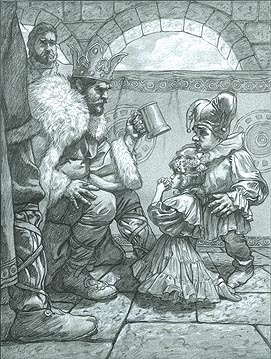
"Hop-Frog", also published as "Hop-Frog; Or, the Eight Chained Ourang-Outangs", is a revenge-themed horror Short Story by Edgar Allan Poe. It was first published on March 17, 1849 in The Flag of Our Union.
A jester with dwarfism, humiliatingly dubbed Hop-Frog, has served the king by providing practical jokes to play for the amusement of the court alongside his dear friend Trippetta, a dancer also afflicted with dwarfism. When the king pressures Hop-Frog into consuming alcohol and Trippetta tries to stop him, the king responds by pushing her and throwing wine in her face.
Unbeknownst to him, his actions would draw out Hop-Frog's ire and he would plot his revenge against the king and his council.
Poe based the crux of the story on the Real Life Bal des Ardents episode of French history. This was a masquerade ball held at the court of King Charles VI on 28 January, 1393. Organized by Charles's wife Isabeau of Bavaria, one part of the program was a performance by six noblemen dressed as mythical wild men. Charles was among them and for a good effect the six men were sewn into their costumes. The costumes were known to be highly flammable and precautions were taken to keep fire out of the hall, but insufficiently so. Charles's brother Louis I didn't get the memo and did bring a torch with him and got too close to the dancers. Five of them caught fire, with Charles getting quickly put under the dress of his aunt Jeanne II d'Auvergne to smother the flames. Four of them died, another one being able to save himself by jumping in a barrel filled with wine. Some accounts state that the dancers were chained together, which is unlikely, but is reflected in "Hop-Frog".
“Hop-Frog” has been adapted to comic twice: once in 1954 in Nightmare #11 as "Hop Frog" and once in 1966 in Creepy Magazine # 11 as "Hop-Frog!". It also shows up (loosely) as a subplot in Roger Corman's version of The Masque of the Red Death, and Julie Taymor did a very stylized adaptation with puppets, called "Fool's Fire", for American Playhouse in 1992.
"Hop-Frog" provides examples of the following tropes:
- Animal Disguise: The king and his court are disguised as orang-utans, allegedly to scare the dancers at the ball, but actually so Hop-Frog can kill them by lighting the costumes on fire.
- Aristocrats Are Evil: A general of the king abducts Hop-Frog and Trippetta for their small stature and sends them as slaves to the king to entertain him. Hop-Frog wasn't born Hop-Frog, but the name was conferred upon him by the king's ministers in mockery over his deformity. Court life is harsh to Hop-Frog while Trippetta is pretty and graceful enough to be treated as a favored pet. The cruelty escalates when one day the king forces alcohol on Hop-Frog knowing well that the little guy can't handle it and hurts and humiliates Trippetta when she asks mercy for her companion.
- Beware the Nice Ones: Long-suffering dwarf Hop-Frog finally snaps when the king dares to strike his beloved. His subsequent revenge is not pretty.
- Break the Cutie: The abuse Trippetta endures is the impetus for Hop-Frog's vengeance.
- Court Jester: Hop-Frog is a court jester who was abducted and forced into his position. He ultimately gets his revenge on the king and his court.
- Decadent Court: The king and his courtiers have nothing better to do than make fun of the jester, who was kidnapped and taken from his homeland, for his appearance and disability. They later harm Trippetta, which doesn’t end well for them. At all.
- Depraved Dwarf: Subverted Trope. The king and his courtiers who torment Hop-Frog and his beloved Trippetta are the depraved ones, while the latter two are pretty nice and decent people.
- The Dog Bites Back: The eponymous jester repays the abuse heaped upon himself and Trippetta by tricking the king and his advisors into letting him turn them into a chandelier. And then lighting it.
- Earn Your Happy Ending: After ages of being tormented by the court, Hop-Frog takes brutal revenge on the king and his courtiers. As they hang, burning alive, he and Trippetta depart to return to their homeland.
- Evil Has a Bad Sense of Humor: The king is described as living only for joking, and his councilors follow. Those "jokes"? Mocking Hop-Frog for being disabled and ugly, forcing him to drink wine so they can laugh at his illness, striking Trippetta, and dressing up as apes so they can terrify the court.
- Fat Bastard: The obese king and his ministers, made more grotesque by their ape costumes.
- Flaw Exploitation: Hop-Frog plays the king like a fiddle by taking advantage of his sadism. He presents "the Eight Chained Ourang-Outangs" as a particularly cruel prank to play on the men and women of the court, emphasizing how much it will scare the ladies, which the king finds utterly delightful.
- Force Feeding: Because Hop-Frog has a strong reaction to alcohol, the king and his councilors force him to drink several goblets full. Tripetta begging them to stop is what prompts the king to hit her, triggering Hop-Frog's revenge.
- Handicapped Badass: Hop-Frog may be a dwarf with deformed legs, but that doesn't stop him from getting his revenge. In particular, even though he walks with a limp, the narrator mentions that he is great at climbing because of the strength in his arms.
- Killer Gorilla: Hop-Frog convinces the king and his men to disguise themselves as orangutans and rampage through a court ball as a practical joke. Just one small problem: to apply the horsehair for the costumes, Hop-Frog uses tar. Flammable tar.
- Masquerade Ball: The king throws a masquerade ball for some occasion or another and as usual Hop-Frog is tasked with arranging the costumes and plays. Hop-Frog has yet to avenge the king's humiliation of Trippetta and suggests that he and his ministers present that day dress up as orangutans he'll lead around on a chain. His plan is to burn the group during the festivities while everyone will believe for too long that the events unfolding are part of a play.
- Monster Clown: Hop-Frog was the king's court jester until he had it with the poor treatment that he and his friend Trippetta had been receiving and dresses eight people as orangutans for an upcoming Masquerade Ball and lit them on fire as an "act", all for Revenge.
- Only Known by Their Nickname: Hop-Frog's true name is never revealed, since the king renamed him when he was abducted. This might also be the case with Trippetta.
- Rage Breaking Point: Hop-Frog was already severely abused by the king, having been abducted from his homeland, renamed, mocked, and forced to drink wine which makes him sick. The king striking his Only Friend Trippetta, however, was the last straw.
- Refuge in Audacity: Hop-Frog doesn't just commit regicide - he does it while the king and seven other aristocrats are hanging from the ceiling of a crowded ballroom, with all eyes on him, in a particularly slow and painful way. He successfully escapes due to the crowd assuming this was part of a show until it's too late.
- Revenge: Hop-Frog burns the king and seven ministers to death at a masquerade for striking his beloved and splashing wine in her face.
- Suddenly Sober: Hop-Frog was becoming woozy and addled by the wine he was forced to drink, but when Trippetta is hit, he snaps out of it immediately.
- Tranquil Fury: When the king abuses Trippetta, at first there is no sign Hop-Frog objects to it... until they realize the hideous grinding sound in the room is Hop-Frog's teeth. He then, with almost exaggerated calm, describes the prank he's come up with, making several references to the king's odious conduct in the process (which the king naturally misses).
- Tricked to Death: A rare case where the pranksters die rather than the pranked. The king and his councilors dress up as apes to terrorize the court for "fun", and Hop-Frog sets them on fire.
- Who's Laughing Now?: Hop-Frog’s revenge effectively makes a mockery of the king and his courtiers after being the subject of their mockeries for so long. This is especially highlighted by his last words to them:"I now see distinctly," he said, "what manner of people these maskers are. They are a great king and his seven privy-councillors — a king who does not scruple to strike a defenceless girl, and his seven councillors who abet him in the outrage. As for myself, I am simply Hop-Frog, the jester — and this is my last jest."
- Would Hit a Girl: The king throws a glass of wine at the dancer Trippetta because she asked him to stop tormenting Hop-Frog. He and the courtiers who laughed pay for their cruelty when Hop-Frog turns them into a human chandelier.