


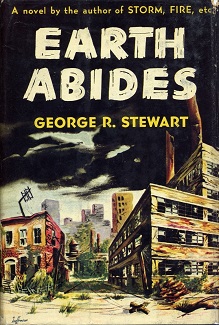
A TV miniseries adaptation premiered on December 1, 2024, on MGM+.
Contains examples of:
- After the End: The novel opens with a mutant strain of measles wiping out civilization.
- All Hail the Great God Mickey!:
- One character knows that the ruins of the cities and bridges were built by people called "the Americans." He then wonders if the land and skies were built by the older Americans depicted on coins.
- A society formed by the descendants of black sharecroppers still grows cotton even though they don't have any use for it, so they burn it as an offering to their Gods.
- Alternate History: By the end of the book, it is around what would have been the 1980s or 1990s, but with the rusting remnants of the 1940s surrounding them.
- Ambiguously Evil: Two of the first people Ish meets are a couple who wave him to him greeting, but who evoke a sinister, predatory aura that causes him to avoid them, although we never find out if he was right to or not.
- Angry Guard Dog: At one point, Ish encounters a pair of sheep dogs who are still protecting and herding a flock of sheep even though their master is dead, and bark hostilely at any stranger passing by.
- Apocalypse How: Class 2, bordering on Class 3. It is speculated, but not definitively proven, that the particular strain of measles that killed billions could have been the result of incautious biological research. The protagonist, Ish, decides that based on past evidence of species extinctions through natural mutations of diseases, that humanity could simply have been unlucky enough to encounter a particularly virulent mutant strain of measles.
- As the Good Book Says...: The title is derived from Book of Ecclesiastes 1:4: "Men go and come, but the earth abides". Ish reads from Ecclesiastes at one point (though this part isn't quoted until much later), and enjoys it, quoting some bits, along with Song of Songs.
- The Beforetimes: Just decades after the Great Disaster, a pandemic which killed most people, the era before then is mythologized and they’re viewed as gods on Earth by the young later generations. Some even believe they made not just the cities, bridges etc whose ruins are still left behind, that in fact they created even the mountains, the sun and the moon.
- Bittersweet Ending: Humanity has mostly died in The Plague, and civilization collapses as a result, despite Ish's efforts to preserve what he can. By the end though, he's no longer certain restoring civilization would be good anyway, knowing it had many negative aspects as well. In any case, though it ends with him near death as an old man, humanity survives (including his descendants), which Ish's comforted by. They even appear to be thriving with as hunter-gatherers, despite everything which they've weathered.
- Black Gal on White Guy Drama: This turns out to be the case between Em and Ish when she reveals the "horrible secret" she was hiding, namely that she's a mixed race woman who's black on her mother's side. It ends up being subverted because Ish doesn't care about any of that and even if he did it wouldn't matter because he loves her anyways. He even seems somewhat amused that she was worried he'd shun her over this after they've become a happy couple, especially considering that most of the human race is dead and it'd be incredibly stupid and arbitrary for survivors to reject each other over something as meaningless as racial "impurity."
- Born After the End: The second half of the novel deals with trying to teach these children the old ways, only to find they take their own path.
- Broken Bird: Possibly Evie. One of the first people Ish encounters when he starts inspecting towns is a wide-eyed teenage girl who flees at the sight of him, leading him to suspect she's been subjected to Attempted Rape.
- Chekhov's Gun: Hiking in the Sierra Nevada mountains researching for a paper he's writing, Isherwood Williams finds a hammer left by miners. He keeps it the whole time, and eventually the children of the tribe he founds see it as a holy relic and the symbol of leadership.
- Cosy Catastrophe:
- Played straight, but also averted as a lot of survivors are shown as being in shock and as unlikely to survive - for example when the book's protagonist Isherwood Williams meets two people living the high life in New York City, and realizes they aren't equipped (in gear or mentality) to make it through the first winter.
- The reservoir conveniently keeps delivering clean water to their houses for a long, long time before a pipe rusts out.
- Somewhat averted with the other survivors Ish meets briefly, a composite family of semi-literate black share-croppers in the southern US. But for the death of those around them (including their landlords), their lives of subsistence farming are continuing just as before.
- Completely averted until Ish leaves California. After being driven off by a cult near Los Angeles, the only even remotely friendly survivors he runs across are a Native American settlement outside Albuquerque (from whom his sons are able to secure seed corn on a later trip), the sharecroppers mentioned above, and the couple in New York. Ish is without meaningful human companionship until after he returns from his trip (almost the first third of the book) when he meets Em.
- Most of the people Ish encounters post-plague are friendly, honest, and basically morally decent.
- Dark and Troubled Past: Em seems to have some kind of unspecified trauma in her past that she's reluctant to discuss with Ish. It's arguably subverted when it turns out the thing she was so worried about telling him is that she's of black descent on her mother's side (but light enough to pass for white). It's worth noting that she did have a troubled past because she lost her family in the plague but she didn't try to conceal that from Ish, seeing as he also lost his family. Besides, it is also possible that Em has faced rejection or other types of prejudice in the past because of her mixed heritage.
- Driven to Suicide: Jean kills herself after getting cancer, which no one can treat after the Great Disaster, presumably to stop the pain. No one judges her for this.
- The End of the World as We Know It: A pandemic later called The Great Disaster wipes out most of human race. As a result, human civilization collapses, and within a few short generations the survivors have become hunter-gatherers or subsistence farmers, with most past knowledge forgotten.
- Evil Stole My Faith: Jean was once fervently religious before The Plague. Since then, she's grown to be anti-religious, recalling how the rest of her congregation all died while praying to God for help.
- Fourth-Date Marriage: Ish and Em have sex almost immediately when they meet, becoming a couple after that. In a few months, they're already discussing having children, and do so as Em soon gets pregnant after the discussion.
- Future Primitive: The small remnant of humanity that survives the plague ends up reverting to a Neolithic lifestyle. Ish tries to teach things like science and math to the children of the survivors, but such knowledge is no longer viewed as valuable when the primary concern is day-to-day survival.
- Gasoline Lasts Forever: Gas even in optimal conditions would last up to three years only, not twenty one. This isn't portrayed as having optimal conditions either.
- God in Human Form: Ish is believed to be divine or at least The Chosen One of the gods by those in The Tribe born decades after the Great Disaster when civilization collapsed.
- Happily Married: Ish and Em. Even though they do have their disagreements, they still love and value each other as they are.
- The Heart: Em is calm, nurturing and holds the new community together. The others nearly always follow her advice.
- Hit So Hard, the Calendar Felt It:"This is the Moment Zero, and we stand between two eras. Now the new life begins. Now we commence the Year One. The Year One!"
- Hope Springs Eternal: Though civilization has not recovered the way Ish hoped it would by the time he reaches old age, he observes that despite their lack of historic knowledge, the younger generations are still carrying out a good quality life. He watches the younger members of his clan finding joy in their daily chatter and in their playtime with their dogs. The clan is even beginning to connect to outside communities.
- Last of His Kind: Eventually, Ish becomes the only one in his community who could be considered "civilized" and remember the old world. Tellingly, he's even referred to by that point as "the Last American."
- May–December Romance: Ish is in his sixties when he marries his second wife at the insistence of other people, since there’s no other husband available. She is implied to be four decades younger at least.
- No Bikes in the Apocalypse: When the cars are gone, they hoof it.
- Only Known by Their Nickname: Ish only says his full name, Isherwood, a couple times. Em also goes by this instead of Emma usually.
- Only the Chosen May Wield: The book, possibly the first viral apocalypse story, developed this well. At the start, Ish (the protagonist) finds a hammer left by miners in the mountains he's walking in, researching his thesis and missing the end of the world. He takes it as an artifact of that time. It comes in handy, but he thinks little of it. Years later, when he's met other survivors and formed a tribe, he asks his son to get the hammer to fix something, and the son is shocked: he couldn't possibly touch such a holy object. At the end, as Ish dies, the younger tribesmen are pressing him to tell them who to pass the hammer to, and with it leadership of the tribe.
- Outliving One's Offspring: Em had two daughters until both of them died in The Plague. It's part of her reason to want another baby later. They later lose a son to a disease, as do other members of The Tribe, with two babies other women have stillborn too. Joey and other children also later die of typhoid.
- Parental Favoritism: Ish absolutely adores his youngest son Joey, praising him mentally often, due to him being most intelligent and intelluctual, sharing Ish's interests. He's devastated at Joey's death, having viewed him as the hope of the future. Ish never acts like this with his other children.
- Passing the Torch: Ish passes on his hammer nearly at the moment of death.
- The Plague: In the course of discovering what went on in the world while he was out of commission with a fever, Ish finds out a particularly virulent form of measles made its way across the Earth, killing a very high percentage of those who caught it.
- Polyamory: Ezra is married to both Molly and Jean. Ish is briefly shocked by this, but then concludes that with most of humanity dead, strict monogamy may be another custom which had to go. Everyone's accepting of this, and it never gets commented on.
- Public Execution: The Tribe publicly hang Charlie after concluding he would always be a danger to them otherwise.
- Ragnarök-Proofing: Paper books left unprotected would likely be largely destroyed by twenty years on due to rats or other vermin getting into them, but this is not mentioned as a problem. Car parts would also not be usable after that long, yet they get a jeep working.
- Reclaimed by Nature: The narration frequently points out how vegetation and wildlife (along with many domestic animals gone feral) is overtaking largely empty cities after humanity has mostly disappeared as a result of The Plague, noting which things will last longer than others along with the specific course it takes in getting reclaimed.
- Scatterbrained Senior: Ish grows senile in his old age, and forgets where he is along with a lot of the past quite often.
- Scavenger World: Played straight, then deconstructed. Ish and his tribe initially live off scavenged canned food and other goods. Ish knows that the tribe cannot life like this forever. The children of the tribe become largely illiterate and uneducated because a conventional education has little to do with day-to-day life as a tribe of scavengers and hunter-gatherers. Eventually, Ish teaches the tribe how to shoot a bow and arrow after he gives up on schooling them, and they become hunter-gatherers.
- Secular Hero: Ish isn't religious. He doesn't pray even while faced with being one of the last survivors from a pandemic, feeling that humanity's mass die off proves God must not care much about them. Ish enjoys reading some books of the Bible, though it appears more as literature than anything more. Later he calls himself a skeptic explicitly.
- Sexy Discretion Shot: Ish and Em have sex very quickly after they meet, which is handled so discretely this could be hard to realize at first by the text (given it's from 1949).
- Slept Through the Apocalypse: The protagonist was hiking in the Rocky Mountains at the novel's opening, gets laid low by a rattlesnake bite, and returns to find the world has ended. The novel suggests that it was the snakebite itself that allowed Ish to survive the plague (while recovering from the bite, he suffers measle-like symptoms, and the plague is described as a kind of super-measles).
- Take It to the Bridge: The tribe is in the middle of the Bay Bridge when Ish realizes it is time for Passing the Torch as noted above.
- Teen Pregnancy: Mary and Roger have their first baby as teenagers within a year after marrying. This appears to be the trend in the following generations later as well. Ish notes this is common in many tribal societies, like they've become.
- Title Drop: Ish thinks of the quote from "an old book" (Ecclesiastes, 1:4): "Men go and come, but the earth abides" right before the end, when he's near death.
- Tragic Hero: Ish becomes this in the end. His dreams of preserving knowledge and rebuilding civilization are a failure. His beloved son Joey dies, the only child who took education seriously. The books in the library will go unread. He lives to old age to see his failure and unwillingly becomes a god-figure to a tribe of hunter gatherers. At least, he taught his people how to shoot a bow and they seem to be happy with their lot in life.
- Wasteland Elder: By the end of the novel, Ish has outlived all of the other original survivors and is seen as a source of odd knowledge and advice by a tribe which now includes his grown great-grandchildren. During his prime, he tries to educate the new generation about the pre-pandemic society to restore their former glory, but it's a losing effort.
- Wide-Eyed Idealist: Isherwood is convinced that the collapse of society caused by the plague is only temporary and that mankind will eventually rebuild. It's only near the end of his life that he accepts that the pre-plague civilization is most likely gone forever.