


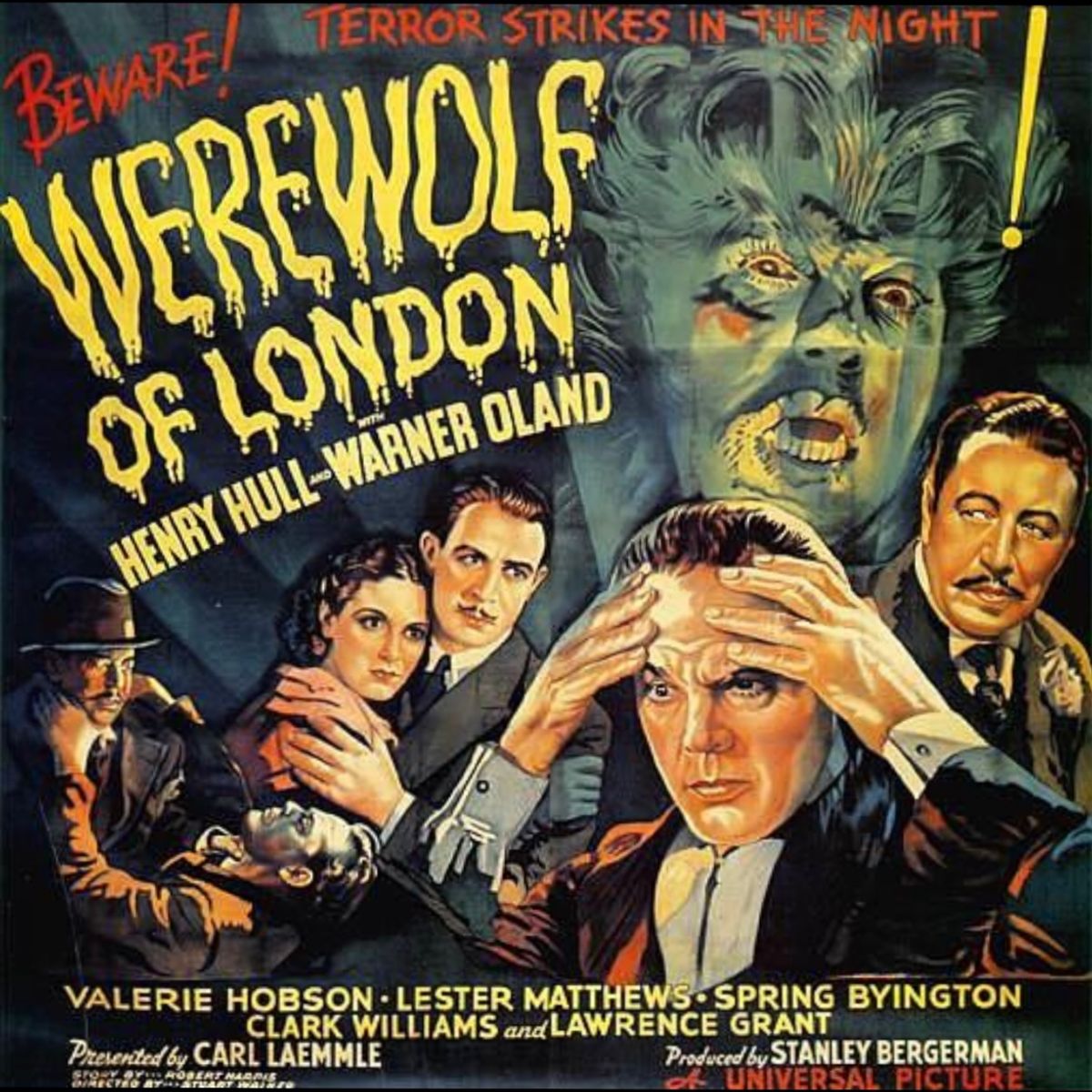
Werewolf of London is a horror film released in 1935. Produced by Universal, it is the first werewolf film made in Hollywood.
While searching for a rare plant in Tibet, wealthy botanist Wilfred Glendon is bitten by a werewolf. After the incident he returns home to find his wife, more and more estranged from her neglectful husband, turning in her loneliness to her childhood sweetheart, Paul Ames. Glendon also meets the mysterious Dr. Yogami, who wishes to see the rare plant that Glendon has found, the Marifasa lupina, as its blossoms form the only cure against werewolf transformation – albeit a temporary one. Soon afterward, the remaining Marifasa is stolen and Glendon starts transforming on the nights of full moon. Each night people die and soon Scotland Yard is after him.
Werewolf make-up was designed by the legendary Jack Pierce, who later worked on that other well-known werewolf film, The Wolf Man (1941).
This film contains the examples of:
- Agent Scully: Wilfred is very skeptical of the notion of "werewolfery", dismissing it as something he ceased to believe in at age six alongside witches and goblins, and terming it a "medieval illness" later.
- And I Must Scream: It's all-but-outright stated that werewolves retain their sapience but are forced into an urge to kill anyway.
- Artistic License – Linguistics: The "medical term" for the malady that makes people into werewolves is referred to as "lycanthrophobia". The Greek word phóbos means "fear" and is medically used to refer to compulsive, disproportionate aversions to some particular thing, which would make "lycanthrophobia" mean "fear of wolf men" if anything.
- Beast Man: Due to practical effect limitations, the design of the werewolves in this film is essentially as humans with an extra coat of hair on them, claw-like fingernails, and enlarged canines.
- Cleaning Up Romantic Loose Ends: A continual feature of the Universal Horror films of this period. The character of Paul Ames is introduced largely for the purpose of being a former flirtation of Lisa Glendon's that she can pair up with when she remains widowed at the end.
- Demorphing Denouement: In the finale, Dr Glendon is shot dead by the police just as he's about to kill his wife, and as he lies dying, he begins reverting to human form and regains just enough of his mind to thank his killer before he expires.
- Didn't Think This Through: Yogami uses the last of the Mariphasa plant on himself while Glendon is changing. This results in him getting killed by another werewolf.
- Dying as Yourself: As Glendon is shot before he gets to Lisa, he regains his normal mental faculty, thanks Forsythe for stopping him, and apologizes to his wife. As he dies, he then transforms back into a human."Thanks... thanks for the bullet. It was the only way. In a... in a few moments now... I shall know... why this all had to be. Lisa — goodbye. Goodbye, Lisa. I'm sorry I... I couldn't have made you... happier."
- Enemy Within: The movie is the trope maker for the modern portrayal of werewolves as involuntarily afflicted beings struggling against an inner monster that emerges by night to kill and hunt. A particular contrast is drawn between the scholarly, genteel, and civilized Dr. Glendon and the similarly civilized and scholarly Dr. Yogami and the murderous, monstrous thing that he must turn into by night.
- Evil-Detecting Dog:
- Aunt Ettie's lapdog begins barking and snarling furiously when Yogami enters the room early in the movie, hinting that he is secretly another werewolf.
- When Glendon sits down in his study to contemplate his condition, his cat, which was sleeping on a cushion near him, wakes up when he reaches near it and reacts to him with furious yowling and swiping before running away. Startled by his pet's reaction, Glendon then looks down at his hands and sees that he has already begun to transform.
- Fainting: Aunt Ettie faints when she sees werewolf Glendon the second time.
- Fantastic Flora: The Mariphasa lumina lupina plant is a rare Tibetan flower sustained only by moonlight, and whose sap can be used to temporarily revert a werewolf's transformation. Physically, it resemble a sort of carrot-like tuber topped by a spray of leaves and lily-like flower. Wilfred's home also contains a greenhouse stocked with exotic plants, including a number of mobile and predatory species that his English neighbors find repulsive.
- Frequently Full Moon: The moon is full for four nights straight.
- Gratuitous Laboratory Flasks: Botanist Wilfred Glendon has a table in his laboratory (otherwise devoted to electrical equipment, his moon lamp in particular) that features among other things an enormous retort half-filled with smoking liquid, several huge graduated cylinders, racks of test tubes with cotton swabs as stoppers, bottles of various liquids and powders, and the expected conical flasks and beakers. He never uses them, and they appear to effectively just be set dressing.
- Interchangeable Asian Cultures: Doctor Yogami has a Japanese surname but lives in Tibet, although his exact ethnic background is not mentioned and he mentions having gone there on his own expedition to retrieve a specimen of the Mariphasa plant.
- Kirk's Rock: In the opening scene, the Vasquez Rocks stand prominently in the background of the mountain camp, their distinctive slope and sharp peak standing in for the mountains of Tibet with the help of the movie's grayscale.
- Love Triangle: Among Glendon, his wife Lisa, and her childhood friend Paul.
- Mad Scientist Laboratory: Wilfred's basement is something of a Mad Botanist's Greenhouse, where he grows rare exotic plants, uses a huge lamp with a crackling electric switch to simulate moonlight for his latest acquisition, and experiments on himself to suppress his curse. There's also a table covered with Gratuitous Laboratory Flasks that sees no use and is evidently there as dress setting.
- Meaningful Name: Mrs. Whack. She gets many whacks to the head from Mrs. Moncaster.
- No Peripheral Vision: While approaching the Glendon household, Paul somehow misses Glendon crouching on the porch roof before he attacks.
- Novelization: A surprisingly decent one by Ramsey Campbell under the pen name, Carl Dreadstone released as part of the Universal Horror Library in the 70's. It is told in the form of an extended flashback from Glendon's point of view so some characters like Paul Ames are barely present, and it has a different ending. Glendon and Yogami try to have themselves hypnotized into not becoming werewolves. It doesn't work.
- Our Werewolves Are Different: Lycanthropy (termed "werewolfery" and "lycanthrophobia" in the film) is treated as a highly physical condition. Werewolves transform under moonlight in the four nights around the full moon, must kill at least one victim after each transformation or lose the ability to turn back to human, don't have any special physical resistances, so that any regular bullet can kill them — the notion of silver harming werewolves wouldn't break into mass media until The Wolf Man — a certain Tibetan plant can counteract the transformation for a night, and they retain human intelligence (enough to think of putting on a coat and hat and to avoid crowds to stay hidden) even in the midst of bloodlust. As Yogami says, they have the worst traits of both men and wolves.
- Screaming Woman: The werewolf's nightly attacks are marked by the loud, sustained, terrified shrieks of its usually female victims.
- Super Window Jump: After Glendon rents a room and transforms, he jumps out a window to escape rather than going through the door.
- Things Man Was Not Meant to Know: A priest answers this way when Glendon and his friend inquire of him about the valley where the Mariphasa lupina is supposed to bloom.
- Those Two Guys: Mrs. Whack and Mrs. Moncaster, two old lady drunks who tend to knock each other about on the slightest provocation.
- Tragic Monster: We get two in this film, Glendon and Yogami, portrayed as cultured and moral men driven into monstrous actions by their desperation to escape their curse. Yogami's characterization is oddly deep for one of these movies — he does evil acts, and happily abandons Glendon to bouts of lycanthropic insanity, but at the same time he deeply regrets his own killings.
- Transformation in Motion: In one of the earliest known examples of this trope in film, Dr Glendon's first transformation into a werewolf occurs while he's walking through his laboratory in a daze, the camera following him through the set — the background having been filmed first and Henry Hull being composited over it. Every time Glendon passes behind one of the room's pillars, he acquires more wolf-like features and looks progressively less horrified, until he's fully transformed.
- Trope Maker: This is essentially the beginning of the modern werewolf genre. While a history of werewolves goes back much further, historic legends tended to portray werewolves as a form of witch in many ways, with the transformation being usually understood as voluntary and driven by magic. Werewolf of London, besides introducing werewolves as a stock horror monster in all the genres "descended" from early-19th century Gothic horror, modified the script to depict the transformation more as a sort of illness, driven by external causes outside of the person's control and robbing them of higher intellect and self-control, associated them with the full moon, and emphasized the idea of special plants as being counters to the transformation (a fictional Tibetan flower here, wolfsbane in most later cases). The stock character of the werewolf itself, a Reluctant Monster trying and failing to control a monstrous course, also begins here. The Trope Codifier would be The Wolf Man (1941) six years later, a more financially successful flick that spread these ideas widely and introduced further elements such as a weakness to silver and the Human-to-Werewolf Footprints shot.
- What Happened to the Mouse?:
- Renwick, the guy with Glendon in Tibet. He is overcome by... whatever and Glendon just sort of abandons him and forgets he exists. He may have been one of the people at the party later but this doesn't answer where the heck he was when Glendon was getting attacked, or why Glendon just left him.
- It's never stated whether or not the London Zoo wolf that were-Glendon sets loose as a distraction was ever caught. Yogami lampshades that it doesn't really matter, as the ordinary wolf isn't the threat.
- Yellowface: The Swedish-born Warner Oland, who by 1935 exclusively played yellowface roles, as Dr. Yogami, most likely meant to be either Tibetan or Japanese. It stands out all the more given that recognizable Chinese-American bit players like Louis Vincenot, Beal Tong and Wong Chung are playing the Tibetan sherpas.
Anyone know the way to Lee Ho Fook's?