





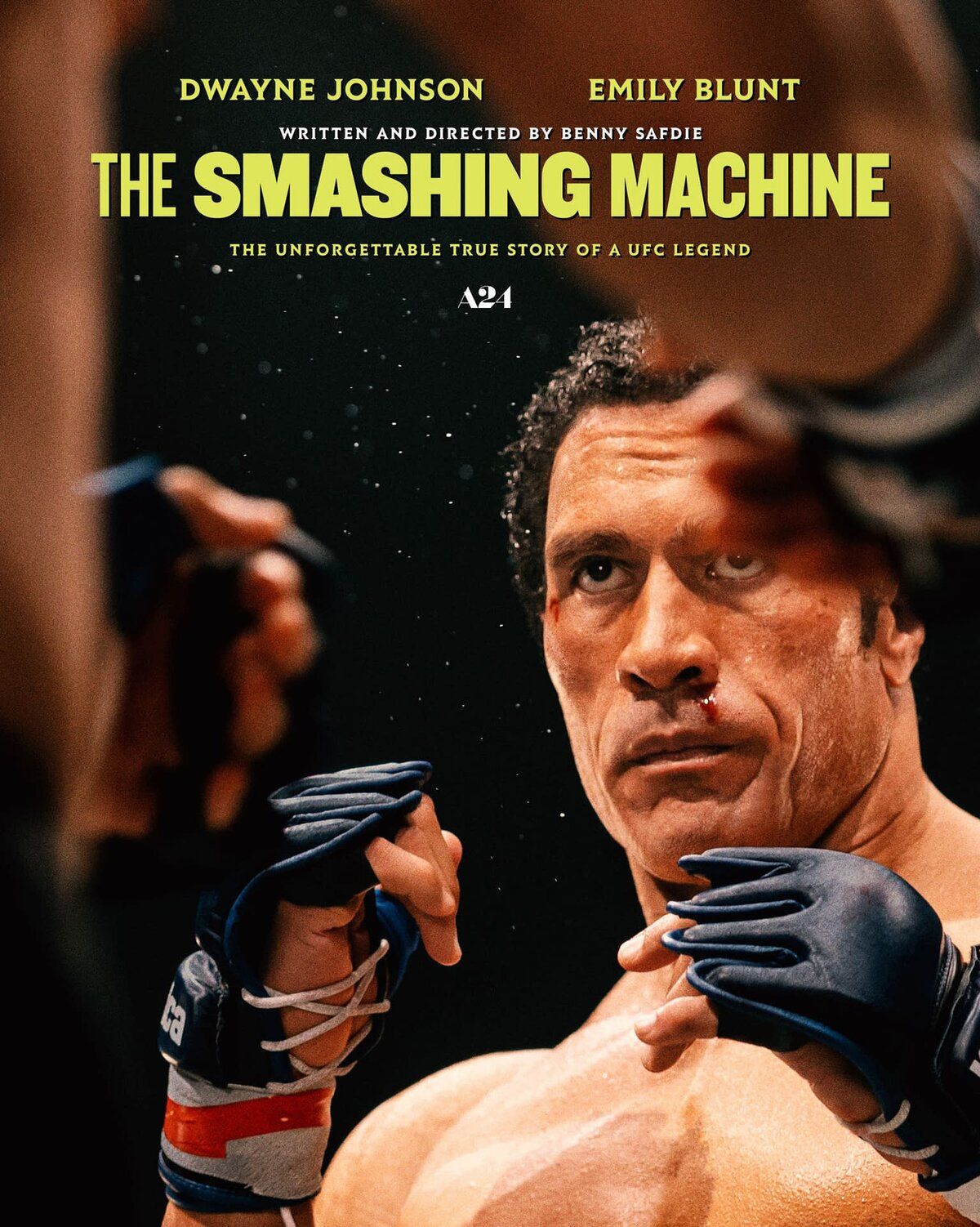
"It's simple: Am I going to hurt him before he hurts me?"
"Winning is the best feeling there is. It's forty-thousand people in there cheering you on. There's no other high like it in the world."
— Mark Kerr
The Smashing Machine is a 2025 Biopic written, directed, co-produced, and co-edited by Benny Safdie.
It concerns the life and times of Mixed Martial Arts champion Mark Kerr (Dwayne Johnson) and his then-wife Dawn Staples (Emily Blunt). It is a dramatization of the period of his life first chronicled on screen in the HBO documentary made about Kerr in 2002, The Smashing Machine: The Life and Times of Extreme Fighter Mark Kerr, although it is not a direct adaptation.
The film was released on October 3rd, 2025 by distributor A24 in the United States.
Preview: Official Trailer
The Smashing Machine contains examples of:
- As Himself:
- Bas Rutten, Kerr's former coach and friend, plays himself in despite being 20 years removed from the film's events.
- Same with Stephen "The Fight Professor" Quadros, a former (English) Combat Commentator for PRIDE.
- The real-life Mark Kerr plays himself in the very last scene.
- Awful Wedded Life: Live-in girlfriend rather than wife, but Mark and Dawn can't seem to go five minutes without getting into it with each other. MMA is nothing. The real war is at home.
- Bittersweet Ending: Mark Kerr loses the tournament and doesn't even make it to the finals to face his friend Coleman (who ends up winning the tournament). However Kerr in contrast to earlier in the film, accepts his lost gracefully. The text reveals he did reconcile with Dawn but they also got a divorce. The last scene shows Kerr living a mundane life but he is happier than he was earlier.
- Breaking the Fourth Wall: The final scene of the movie has the real Mark Kerr look at the camera and say goodbye to the audience before he gets in his truck.
- Deer in the Headlights: Kerr in the last fight just froze, showing a montage of everything that's happened in the movie is shown, leaving him unresponsive as his opponent just wails on him, leading to the referee declaring his opponent the winner.
- Establishing Character Moment: An early scene has Kerr talking to a mother in the waiting room of a hospital about MMA, which ends it with offering her young son his autograph. It establishes Kerr as a mild-mannered, well-spoken and respectful athlete despite the gruesome reputation of MMA at the time.
- Fauxshadow: Much of the film heavily builds up to Kerr facing Coleman in the championship final, hinting at a potential conflict of interest for the two longtime friends having to fight each other for the title. This ultimately never happens, as Kerr loses against another opponent in the semi-final and misses out on the title shot, while Coleman goes on to win the tournament without any issue.
- Foreshadowing: the Kintsugi bowl that Dawn shatters during an argument is put back together with crazy glue as an apology; needless to say, the cheap glue's an analogy for when the second argument happens and Dawn and Mark's eventual divorce, with their differences being too great to be repaired.
- Fourth Wall Farewell: The ending scene is the real Mark Kerr, who looks right into the camera and bids the audience goodbye.
- Graceful Loser: In the end, Kerr gracefully accepts the fact he lost the semi-finals of the tournament, in contrast to his earlier loss reducing him to a sobbing manchild.
- Gray-and-Gray Morality: Mark and Dawn's conflict shows no one is in the right:
- Mark emotionally shuts out Dawn, treats her like a burden (and to add insult to injury, he does this after begging Dawn to come see him in Japan, which is nearly a day of being stuck in a plane), keeps not committing to Dawn wanting kids, thinks reasonable demands like "get sober" or "basic hygiene" is unreasonable nagging, and after he gets sober, nags Dawn for not listening to his overly specific and petty demands, such as cutting a cactus to look like how it does in Road Runner cartoons, not putting the exact amount of bananas in a smoothie, and throwing a fit over a few leaves in the swimming pool. However, his requests for Dawn to not go out drinking and not abuse pills in front of him while he's still recovering from his opioid addiction are completely reasonable, and Dawn's anger that he isn't "loving" when he's sober isn't justified when he's trying to win the biggest tournament of his life after his recovery.
- Dawn is right to be angry that Mark uses her as a maid and shuts her out when she's being nothing but supportive, especially when she's caring for him during the height of his opioid addiction and is the one to save his life when he ODs; she's also right to want to go out and have fun, but the way she goes about it (getting drunk late at night and taking a ton of painkillers in front of a recovering Mark) is unacceptable. Her openly mocking him when he calls his sponsor afterwards too is just plain cruel even if Mark was acting like a asshole. She also hates to admit that she liked Mark on opiates, as he was affectionate, and just wants at least some kindness from Mark when he's being a total diva over dumb shit like a few leaves in a swimming pool.
- Hero of Another Story: While the film primarily focuses on Kerr and his struggles with addiction and his mental health, Mark Coleman is also heavily implied to have challenges in his own life, having to contend with providing for his wife and children and concerns over his age as he continues fighting. After Kerr's loss in the semi-final, Coleman goes on to win the tournament and become the world champion. This was true of the original documentary, which had to transition to following Coleman after Kerr was eliminated from the climactic tournament
- Important Haircut: In the third act, Kerr has his head completely shaved at the barber and grows a small goatee prior to partaking in the semi-finals.
- Jerkass Has a Point:
- While he is primarily motivated by his own wounded ego, Kerr's complaint about the referee does have a legitimate grievance, with the knee to the head that cost him the match having already been declared an illegal move by the officials. The president of PRIDE ultimately agrees with Kerr, which is why the fight then gets ruled a no contest.
- He is being a incredibly judgmental Jerkass when it happens, but Kerr does have a fair point when he complains to Dawn about her going out for drinks is a sensitive spot for him while he is in recovery and equally might be understandably something that makes him uncomfortable while he tries to go sober.
- One-Steve Limit: Averted. Although it primarily focuses on Mark Kerr as the protagonist, his friend and fellow fighter Mark Coleman also appears prominently throughout. The other characters usually refer to the two by their last names in order to get around this.
- Passive-Aggressive Kombat: Mark and Dawn's constant fighting is this, never raising their voices but always knowing exactly what buttons to push.
- The Perfectionist: Much of the strife between Mark and Dawn comes from him wanting her to do things the way he wants them, from making smoothies to trimming a cactus.
- Repurposed Pop Song: The trailer for this film makes use of a dramatic, cinematic rendition of "My Way" by Frank Sinatra.
"My big, strong man. I love you."