





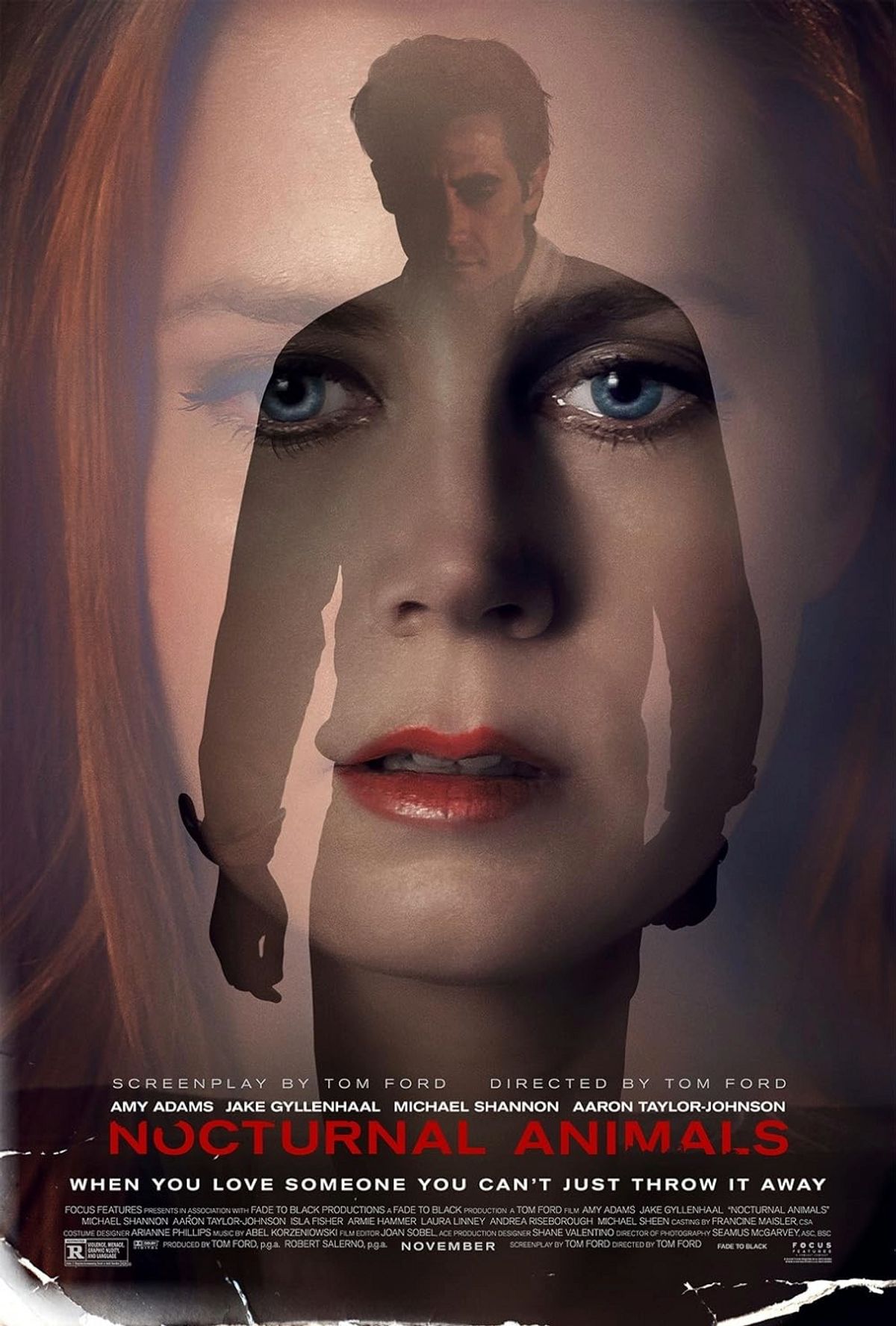
Nocturnal Animals is a 2016 psychological thriller written and directed by fashion designer Tom Ford, based on the 1993 novel Tony and Susan by Austin Wright.
Susan Morrow (Amy Adams) is a Los Angeles-based art gallery owner stuck in an ailing marriage with her husband Hutton (Armie Hammer), who seems more interested in his occupational dealings than repairing their relationship. The morning Hutton leaves for a business trip, she receives a proof copy of a novel called Nocturnal Animals by her ex-husband Edward Sheffield (Jake Gyllenhaal).
In the story, Tony Hastings (also Gyllenhaal) is a Texan man roadtripping with his wife Laura (Isla Fisher) and their daughter India, when they're assaulted by a trio of hoodlums led by Ray Marcus (Aaron Taylor-Johnson) intent on terrorizing him. While Tony makes it out of the ordeal alive, Laura and India are raped and murdered by the men. With the help of Detective Bobby Andes (Michael Shannon), Tony works to bring his family's murderers to justice, even if he loses his own life in the process.
While reading the novel, Susan has flashbacks of her time with Edward, ultimately agreeing to see him again upon finishing the book.
Also starring Laura Linney, Jena Malone, and Michael Sheen in minor roles, Nocturnal Animals is the second film by Ford, who previously wrote and directed the adaptation of novelist Christopher Isherwood's A Single Man.
Nocturnal Animals contains examples of the following tropes:
- Allegory: Edward's novel, Nocturnal Animals, is written as one for his tragic relationship with Susan.
- Ambiguous Situation: Upon reading of Tony and Detective Andes discovering the dead bodies of Laura and India, Susan calls up her daughter. It's left unclear as to whether the girl's father is Hutton or Edward. The circumstances of the call strongly imply the latter, but that also requires assuming that Susan ultimately didn't go through with the abortion, and her conversation with Hutton involves her preparing to do so, but being scared out of it by seeing Edward.
- Asshole Victim: Most of Ray's gang end up getting their comeuppance. Both Ray himself and Lou being the on-screen examples.
- Black-and-Gray Morality: Detective Andes is willing to step outside his legal limits if it means satisfying his own personal sense of justice. It's implied that he used to be more idealistic, but he'd just seen too many rapists and murderers get away unpunished.
- Blood from the Mouth: Downplayed. When Tony wakes up at the cabin the next morning after his shootout with Ray, the latter lies on the floor with blood from his mouth.
- Cell Phones Are Useless: In the manuscript, the nocturnal attack is conveniently set in a location with no phone reception.
- Colour Wash: Scenes in the present day tend to be cold and desaturated, flashbacks are natural, and the film within the film is more saturated and harshly lit.
- Darker and Edgier: Edward states in his letter that Nocturnal Animals is different from the sort of stories he used to write when he and Susan were together. It doesn't take her long to figure out what he means.
- Dead Sparks: Susan and Hutton's marriage is on the rocks.
- Downer Ending: All three plots end this way. In Nocturnal Animals, everyone, including Tony, ends up dead. In the flashbacks, Susan leaves Edward for Hutton. And at the end of the film, Susan goes to her dinner with Edward with the hopes of reconnecting with him but he doesn't show.
- Expy: Tony and his family are obviously intended as fictionalized versions of Susan, Edward, and their daughter. Susan may actually have two. The other one is Ray.
- Fan Disservice:
- The opening credits of the film are set against a series of dancing naked women...who are all morbidly obese.
- The Drop Dead Gorgeous scene.
- Ray shirtless and with his pants around his ankles... taking a dump.
- Fictional Document: Nocturnal Animals, Edward's novel.
- The Film of the Book: This film is based on Austin Wright's 1993 novel Tony and Susan.
- First Love: Susan and Edward were this to one another.
- For the Evulz: Ray and his gang are motivated purely by sadism.
- Framing Device: The bulk of the film's plot is a fictional tale written by Edward.
- Good Girls Avoid Abortion: Susan possibly aborting Edward's child, and him finding out about this, is the final straw where he stops trying to repair their relationship. Given that she expresses strong dislike of the idea, it's possible Susan didn't do it.
- Grey Rain of Depression: It rains in the scene where Susan and Hutton sit in the car and she cries into his chest while contemplating abortion.
- Heartbeat Soundtrack: At the end we hear Tony's heartbeat as it slows down and finally stops.
- Heteronormative Crusader: Susan relates that her mother and father are homophobes who can't stand that her brother is gay.
- Hope Spot: Midway through the altercation on the road, a police cruiser approaches... and passes right on by. Marcus turns to his goons with a relieved smile and holds out his trembling hand to demonstrate how freaked out his was.
- I Have No Son!: Susan says that her parents have disowned her brother because he's openly gay.
- Incompatible Orientation: Susan's gay brother Cooper had a crush on Edward in their youth.
- Ironic Echo: When Lou has Tony at his mercy, he taunts him by saying, "You gon' cry now?" Later, when Andes has Lou at his mercy, he taunts him with the same words. Whether it's a coincidence or Andes read the words in Lou's testimony is unclear. Tony clearly makes the connection, his lips twisting into a slight grin as he watches.
- Ironic Juxtaposition: Laura's daughter Samantha is shown lying nude with her boyfriend (from the back) on her bed, presumably in the wake of consensual sex, when she calls, after getting very disturbed by Edward's book. In the book, his expy's daughter was discovered lying the same way, but next to her mom (who's also naked) dead after both had been raped, then murdered.
- Jerkass Has a Point: Susan's mother is built up as a cold-hearted type who refuses to "understand" people who don't fit her standard (such as Cooper, for being gay). When we finally meet her... as cruel as her words of warning to Susan about marrying Edward sound, we already more-or-less know how it's turned out. And as the flashbacks progress, it's eerie just how point-for-point accurate those warnings actually prove to be.
- Jump Scare: When Susan's coworker shows her iPhone nanny-cam, Susan looks at it when all of a sudden the leering face of Ray fills the screen with no warning whatsoever.
- Match Cut:
- When Susan is reading Nocturnal Animals the novel, and gets to the part where Laura and India's dead naked bodies are discovered laying on a couch, afterwards in the real world, she calls her daughter, Sam, who is naked in bed, in the exact same position as India was.
- The film will occasionally cut between Tony and Susan when they're doing similar things, such as taking a bath.
- Miranda Rights: Ray demands to have his rights read to him, which Detective Andes refuses to do.
- Mockstery Tale: There is a detective subplot (the storyline of Edward's novel), and a few surreal scenes blurring the edges between the two storylines (one of the hoodlums from the novel actually pops out at Susan in a cell phone video, causing her to drop the phone), but it's all just a Framing Device for the story of Susan's relationship with Edward.
- Mr. Fanservice: Jake Gyllenhaal has a Shower Scene as Tony.
- Ms. Fanservice:
- Amy Adams has several moments of this, when we see Susan at home alone—mostly Leg Focus, with a Shower Scene and Bathtub Scene for good measure.
- Susan's daughter Samantha is introduced lying in bed completely naked, after presumably having sex with her boyfriend, with the audience getting a very good view of her backside.
- My Beloved Smother: Susan's mother only shows up in one scene, but she comes across as very overbearing.
- Mutual Kill: Tony shoots Ray, but not before Ray knocks him out with a crowbar. The blow blinds Tony, who ultimately stumbles away, trips, and shoots himself with his own gun.
- Nobody Poops: Averted, as Andes and Tony in the novel approach Ray when he's on his outside toilet. It's just as unappealing as you'd imagine: they (and us) see far more than is preferable.
- "Not So Different" Remark: Susan's mother claims this about the two of them, noting that everyone turns into their mother as they grow up. Susan is adamant in denying that they are anything like each other, but this comes not too long after a scene where she's had to listen to Edward talking about the similarities between her and her mother (something that he invokes later in the film, as well). And, as detailed in Jerkass Has a Point above, Susan's mother is not inaccurate in analyzing how her marriage to Edward would play out.
- Rape as Drama: As written in Edward's book, Laura and India are raped and murdered by Ray and his crew.
- "Ray of Hope" Ending: Despite a lack of reconciliation with Edward, we've still seen Susan changing her mind on certain things regarding her art gallery, indicating that she's working on the parts of herself that had led to so much strife. As such, there's an element of hope amid everything, with Susan improving what she can, at least.
- Riddle for the Ages: We don't find out why Edward stands Susan up. Did something happen to him? Was it a deliberate snub?
- Rom-Com Job: Susan runs an art gallery, but this film is very much not a romantic comedy.
- R-Rated Opening: Witnessing two minutes of nude women (all elderly and obese) doing erotic poses is quite an effective way to remind viewers they're watching an R-rated movie.
- Satellite Love Interest: Hutton only really exists as a source of tension between Susan and Edward.
- Self-Insert Fic: Nocturnal Animals can be seen as this for Edward, written as a way of dealing with his unresolved anguish over his and Susan's divorce. This is backed up by Gyllenhaal's portrayal of both Edward and Tony.
- Settled for Gay: Alessia married Carlos knowing very well that he's gay.
- Sinister Southwest: In Edward's novel, Tony and the family are driving through a rural road in the Texas desert when they get attacked by the gang. It ends with Tony's wife and daughter being sexually assaulted and then brutally murdered.
- Snobs Versus Slobs:
- Susan's family are clearly wealthy, and one of her mother's objections to Edward seems to be that he is not.
- There is an obvious element of class resentment in the confrontation between Tony's family and Ray's gang. Tony drives a Mercedes and is clearly suburban middle class, while Ray and his gang are rural, working-class hoodlums.
- Stood Up: At the end of the film, when Susan has finished reading Edward's book, they plan a reunion at a nice restaurant, but Edward never shows up to meet Susan.
- The Unseen: Susan's gay brother Cooper is mentioned, but never seen.
- Vigilante Man: When there isn't enough admissible evidence against them, Andes leads Tony in tracking down each of their rapists/murderers and then killing them.
- Wham Line: Ray taunting Tony in their final confrontation by calling him "weak"—repeatedly—is seemingly meant to indicate that he's a second Expy for Susan, as we see Edward complaining in the flashbacks that Susan's called him that.