

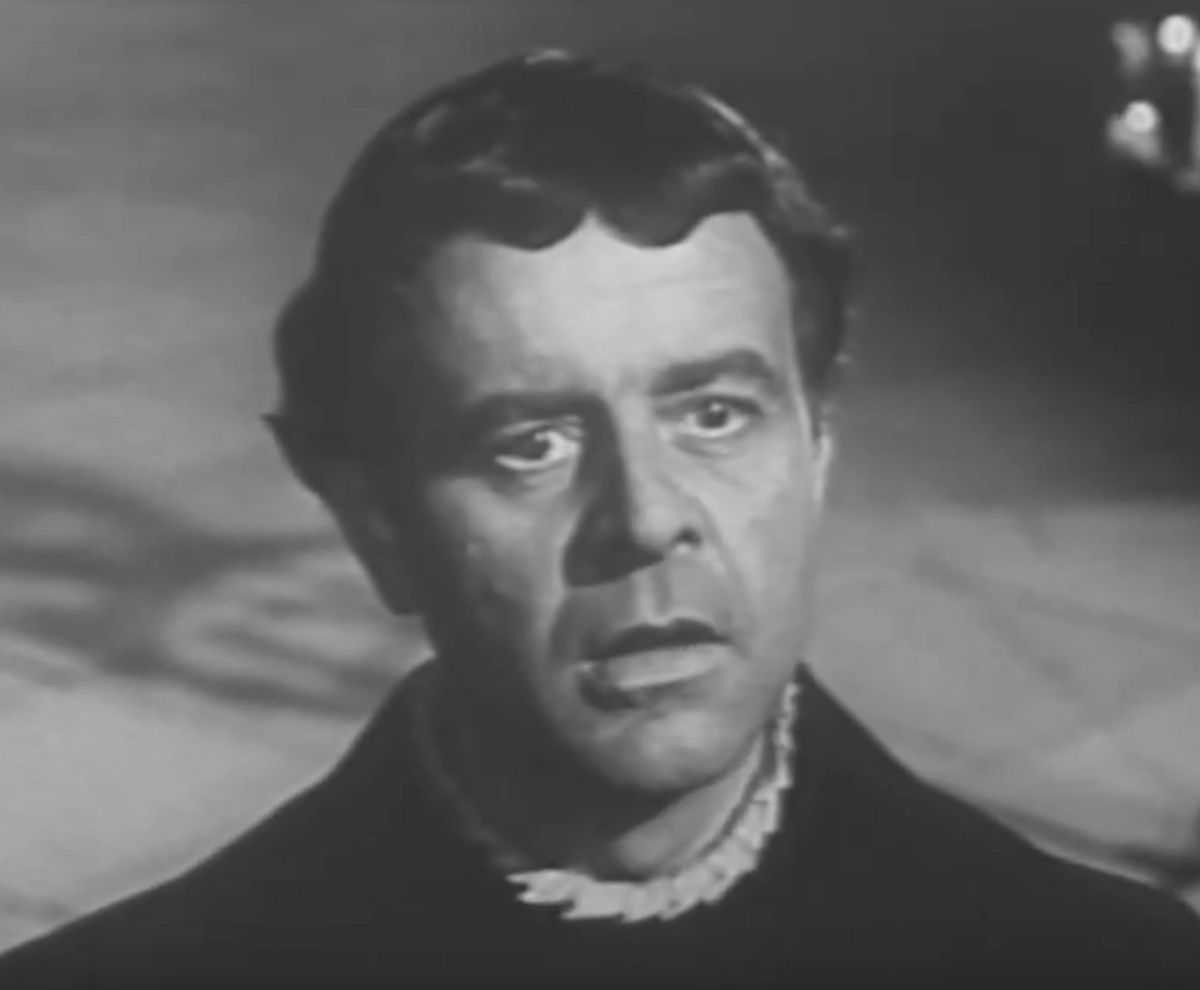
Martin Luther is a 1953 film about the life of Martin Luther (Niall MacGinnis), who became the father of The Protestant Reformation.
The movie starts in 1505 when a group of law students are brought together at a tavern in Eurfurt for a party. The host - a young law student named Martin Luther - soon arrives with his possessions, which he proceeds gives away as he has decided to leave law school and join the Augustinian order. Luther spends the first few years beset by his fear of an angry and vengeful God. Two years after becoming a monk, he is ordained a priest.
After becoming a priest, Luther becomes more and more disillusioned with the state of the church, especially after reading the scriptures and realizing that Christians did not need things like indulgences to ensure salvation, but only faith in Jesus Christ.
Exempla Troporum
- Artistic License – History:
- More than once characters refer to Germany as a nation. However, a unified Germany did not come into existence until the mid-19th century after the fall of the Holy Roman Empire.
- Luther cites Romans 1:17 when justifying his beliefs to his vicar. However, the Bible was not divided up into chapters and verses until approximately five years after Luther had died. Even then the chapters and verses weren't standardized until the introduction of the Geneva Bible
 .
. - Girolamo Aleandro was presented as a Cardinal in the film. In reality Aleandro had not been named a Cardinal until well after Leo's death. Pope Paul III named Aleandro a Cardinal In pectore in December 1536 before the appointment was made public in March 1538.
- One of the Roman officials who debates Dr. Melanchthon implies that Luther's movement is causing the Russian Church to break away from Roman Church in favor of the Lutherans. While there was (and continues to be) a small Catholic presence in Russia, Russians largely followed the Russian Orthodox Church. By 1576, the Lutherans had established a presence in Russia, but it was never as large as was implied in this film.
- Artistic License – Religion: At several points St. Peter's is referred to as a Cathedral. Despite being an extremely important church, St. Peter's is not the Cathedral for the Diocese of Rome as it does not house the Cathedra (Bishop's throne) for the Diocese. That honor instead belongs to the nearby Saint John Lateran Basilica.
- Broken Pedestal: Luther starts out as a loyal son of the church, but seeing the corruption of the church he quickly revises his opinion of the church. Even so, he doesn't completely give up on the church but hopes they'll come around to his vision of what the church should be.
- Corrupt Church: The Catholic Church is presented as such a church, with Leo increasing the sale of indulgences as well as selling Cardinal hats and Bishoprics to those who could pay him.
- Get Out!: Upon returning from exile, Luther declares Wittenberg is not big enough for Carlstadt, and orders Carlstadt to leave Wittenberg.
- The Good King: Duke Frederick, and later on his brother John the Steadfast are both examples of this as they go out of their ways to defend Luther and his fellow reformers within Saxony.
- The Heretic: Luther and his followers are considered ones by the Emperor and the church.
- Historical Beauty Update: While not as attractive as Joseph Fiennes - who played Luther in the 2003 film, Niall MacGinnis certainly looked better than the historical Luther.
- Historical Hero Upgrade: The 1953 film avoided depicting Martin's real-life fondness for crude and scatological humor, along with his raging anti-Semitism. It also avoided his writings against the peasants in the peasants' war in which he called for authorities to violently put down the rebellion. The film only shows a couple scenes where Luther confronts those who are participating in the uprising.
- Jerkass: Tetzel, Albert, Alendar, Charles, and Leo X.
- Kidnapped by an Ally: After Duke Frederick learns that the Emperor has no intention of honoring the safe conduct he had earlier given Luther, Frederick arranges for Luther to be kidnapped and taken to Wartburg Castle.
- Nice Job Fixing It, Villain!:
- Johann Tetzel's efforts in Germany do no good as his behavior turns the people - both noble and peasant - against the fundraising the church is trying to do.
- The efforts of other Catholic officials like Pope Leo also do little good in fixing matters and make the situation worse for them.
- Not Big Enough for the Two of Us: Luther tells Carlstadt that Wittenberg is this when he returns from exile, and tells Carlstadt to Get Out! of Wittenberg.
- Performance Anxiety: Soon after being ordained as a priest, Luther celebrates his first Mass. During the consecration he is positively shaking with anxiety and Father Staupitz has to help him get through the Mass. Afterwards, Staupitz tries to reassure Luther he wasn't the first priest to get really nervous while celebrating their first Mass.
- Protagonist Title: The movie is named after Martin Luther.
- Realpolitik: The real reason Charles V is so worked up about religious affairs in the Empire? As Charles himself all but admits, he's more worried about Turkish forces approaching Vienna than the actual religious disagreements that Luther and other protestants had.
- Shut Up, Hannibal!: After a while, Archbishop Albert finally reaches the limits of his patience with Johann Tetzel and orders him to go back to his monastery and do penance for the damage he has done.
- Surprise Party: At the beginning of the film, a surprise party is held for a group of law students at a tavern in Erfurt by an unknown host. It's soon revealed that the host is Luther, who has arrived to give away his possessions before leaving for the monastery.
- "The Reason You Suck" Speech: Luther has a few choice words for the people of Wittenburg after his return from exile.
- Time Skip: The movie takes place over the course of 25 years, from when Luther leaves for the monastery until shortly after the Diet of Augsburg.
- Token Romance: Luther's marriage to Katherina von Bora occurs later in the film and has little effect on the overall plot.
- Translation Convention: The Germans and Italians are both shown speaking modern English instead of their respective languages. Additionally, at several points materials written in the common language are shown as being written in modern English instead of German.note
- Truth in Television:
- Churches in the film are shown without pews. This is historically accurate, as permanent pews were not commonly placed in churches until later in the Reformation.
- As one of the people who witnessed Luther nailing his 95 Theses up on the door of the castle church stated, the original document was written in Latin. It was not until later that printers reproducing Luther's document had it translated into German in order to make it more widely available.
- While teaching a group of students, Luther asks a student what the Fifth Commandment is, and the student replies, "Thou shall not kill." While Judaism and some Christian churches consider that to be the Sixth Commandment, and the Fifth Commandment to be to honor one's parents, both Catholics and Lutherans both consider the commandment against killing to be the Fifth Commandment, so in this case the student is correct.note