

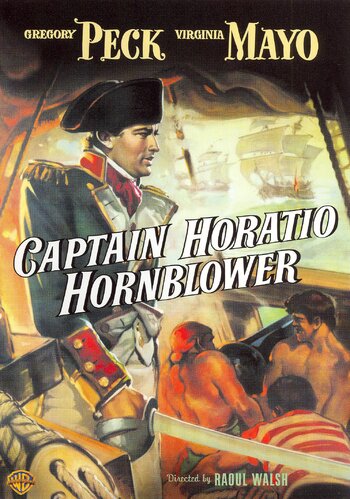
Captain Horatio Hornblower is a 1951 historical sea adventure film based on C. S. Forester's Horatio Hornblower series, directed by Raoul Walsh and starring Gregory Peck in the title role, with Virginia Mayo as Lady Barbara Wellesley.
The story is adapted from the first three novels: Beat to Quarters/The Happy Return, Ship of the Line, and Flying Colours. The character of Hornblower is also altered to make him more typical of a Hollywood hero of that era rather than the socially awkward, brooding character of the books.
The film follows Hornblower's adventures on the Pacific coast of Central America and back up to the seas around Europe during The Napoleonic Wars, as he romances the beautiful Lady Wellesey and outwits various Spanish and French villains.
The film provides examples of the following tropes:
- Abandon Ship: After Hornblower's ship, the Sutherland, successfully destroys several French ships in a fortified harbor, the harbor's defensive guns cripple the Sutherland. The crew abandon ship and most make it to shore, but the English fleet is on their way to save them.
- Adapted Out: The film skips over Hornblower's stay at the Comte de Graçay while escaping.
- Adaptation Dye-Job: Dark-haired Lady Barbara is played by blonde Virginia Mayo.
- Adaptation Name Change: Coxswain Brown becomes Quist.
- Artistic License – History:
- Lady Barbara Wellesley is a sister of the Duke of Wellington. In real life, Wellington did not become a Duke until several years later, and his one sister's name was Anne.
- Hornblower and his officers toast to the King's health while sitting down. This was against regulations until 1830, when William IV, himself a former naval officer, authorized toasting while sitting down in cramped ship cabins.
- Beautiful Dreamer: Hornblower has an opportunity to admire the beautiful Lady Barbara when she's ill and feverish, and he nurses her, taking a vigil.
- Bridal Carry:
- Sailor Quist, a giant of a man, carries an injured midshipman below deck.
- Hornblower takes Lady Barbara in his arms when she gets sick.
- Captain's Log: The opening sets the stage for the film's events by showing Hornblower writing in his log, giving the ship's current position and its serious problems: becalmed, many miles from any shore, and supplies running low. The entry ends with him predicting that a wind will come — at least, he hopes and prays it will, because if it doesn't the crew are all dead men.
- Death of the Hypotenuse: Hornblower and Lady Barbara clearly have feelings for each other but he but rebuffs her as he is married - and on returning to port finds that his wife has died in childbirth.
- Distress Ball: Lady Barbara falls ill after nursing the wounded, which forces Hornblower into quarantine so he can care for her (this doesn't happen in the book).
- Dressing as the Enemy: French flag and knowledge of French code was employed when they plan an attack on the French (they changed colours right before the attack), and also Dutch uniforms when they were escaping from France.
- In Name Only: The basic plot is intact, but major plot elements are changed, new elements and subplots are added, characters are left out completely or turned into The Ghost, characterizations are rewritten (especially Hornblower himself, who makes grand speeches and gives compliments, in direct contrast to his hatred for "unnecessary words").
- Let Them Die Happy: Lady Barbara is comforting a dying midshipman, a young boy who thinks he's come home to his mother. She goes with it. He asks her to kiss him, and Hornblower is able to tell her how his mother kissed him when she was telling him goodbye at the port — on his eyes and lips.
- Mugged for Disguise: As the stay at the Gracays (and the resources they provide to the escape) is left out, Hornblower, Bush, and Quist simply follow three Dutch customs officers into a dark alley and walk back out in green uniforms.
- Not Even Bothering with the Accent: The fact that everyone is British is very much an Informed Attribute.
- Oh, Crap!: When a Spanish officer brings the happy news that Spain and Britain have been allies for the past month, the look of muted horror on Hornblower's face is a sight to behold... and it becomes increasingly less muted as the Spaniard chatters happily
 about how lucky he was to find the Lydia before they could meet the Natividad, which would of course have destroyed the little English ship....
 - Only a Flesh Wound: In Ship of the Line, Bush's foot is shot off by a cannonball and most of his shin is amputated. Here, he's hit by minor shrapnel; after a line about his leg starting to feel better during the coach journey he's walking and running without problems.
- Plucky Middie: Poor boy, he's used in the film just to give Hornblower and Lady Barbara the opportunity to act parental, then he dies tragically.
- Race Lift: In the books, Lady Barbara's maid Hebe is black, but in the film she's a white woman, probably supposed to be of Hispanic or Creole origin.
- Reverse Arm-Fold: Classic Hornblower's position when he's on deck.
- Running Gag: In the first third of the film, Bush and Lieutenant Crystal keep betting on the outcome of Hornblower's actions. Bush always wagers on Hornblower's success, and he always wins.
- Sealed Orders: Discussed. At the beginning, the narrator says that Hornblower's ship sailed "under the most secret of sealed orders".
- Wooden Ships and Iron Men: Somewhat less so than the books, but the genre conventions are followed.