

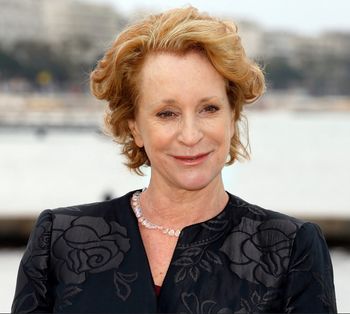
Philippa Gregory CBE (born January 9, 1954 in Kenya) is a British Historical Fiction writer.
She has written about a range of periods in British history, but is best known for her Tudor Court novels - mostly The Other Boleyn Girl, the success of which led to two film adaptations, a resurgent interest in the Tudors, and a flood of Follow the Leader novels about women of the period. She's also well-known for writing the bestselling Cousins' War series, which follows the fortunes of various important women in the preceding historical period, the Wars of the Roses.
Gregory is widely regarded as a decent historian who does her research thoroughly, but her books do frequently diverge from fact, most famously in The Other Boleyn Girl's depiction of Mary Boleyn as a naïve ingénue seduced by the king, when in reality she was not only married but had previously spent some time as the mistress of the King of France. She has, however, eschewed the Dan Brown route, being careful not to claim that her books are totally accurate and open about the fact that she is a fiction writer who will often make things up. That said, it is very important to remember that though Gregory may use the term "historian" to describe herself, her PhD is in Eighteenth Century Literature, not history. She's not exactly the type of person you should cite in a history paper.
Literary Series by Gregory
- Wideacre trilogy
- Wideacre (1987)
- The Favoured Child (1989)
- Meridon (1990)
- Mrs Hartley and the Growth Centre (1992): also published as Alice Hartley's Happiness
- The Wise Woman (1992)
- Fallen Skies (1994)
- A Respectable Trade (1995)
- Perfectly Correct (1996)
- The Little House (1998)
- Tradescant duology
- Earthly Joys (1998)
- Virgin Earth (1999)
- Zelda's Cut (2000)
- The Plantagenet and Tudor novels (also known as the The Cousins' War Series and Tudor Court series; they've since been rebranded as part of one series due to the increasing overlap between the characters and historical events):note
- The Other Boleyn Girl (2001)
- The Queen's Fool (2003)
- The Virgin's Lover (2004)
- The Constant Princess (2005)
- The Boleyn Inheritance (2006)
- The Other Queen (2008)
- The White Queen (2009)
- The Red Queen (2010)
- The Lady of the Rivers (2011)
- The Kingmaker's Daughter (2012)
- The White Princess (2013)
- The King's Curse (2014)
- The Taming of the Queen (2015)
- Three Sisters, Three Queens (2016)
- The Last Tudor (2017)
- Boleyn Traitor (2025)
- The Order of Darkness series
- Changeling (2012)
- Stormbringers (2013)
- Fools' Gold (2014)
- Dark Tracks (2018)
- Fairmile Series
- Tidelands (2019)
- Dark Tides (2020)
- Dawnlands (2022)
Adaptions of Gregory's works with pages on TV Tropes:
- The Other Boleyn Girl (2008)
- The White Queen (2013)
- The White Princess (2017)
- The Spanish Princess (2019 - 2020)
Tropes found in and associated with Gregory works:
- Author Usurpation: For many years, she was known mostly for writing The Other Boleyn Girl and the rest of the Tudor Court series, though especially The Other Boleyn Girl. Gregory had actually written a dozen novels before The Other Boleyn Girl that were quite successful (A Respectable Trade even got a film adaptation in 1998), but her Tudor novels overshadowed them for much of the 2000s, to the point that reprintings of her older works came with "From the author of The Other Boleyn Girl" stamped on the covers. She finally managed to move past this in the 2010s to a degree, becoming better known for the Cousins' War series. These days, Gregory is strongly associated with both her Tudor novels and her Wars of the Roses novels. It probably helps that they've been merged into a single series, containing sixteen books in total as of 2025.
- Historical Villain Upgrade: One must wonder if Margaret Beaufort, Henry VII's mother, kicked her dog with the way she's treated in her books and their adaptations. Anne Boleyn also gets a similar but less egregious treatment:
- Margaret Beaufort goes from a no doubt ambitious but also caring, intelligent, and generous woman to a fanatical, hypocritical shrew helicopter mother from hell :
- Her being obsessed with her son becoming King from the moment he was born is not based on any fact. Her behind the scenes maneuvering was her just understandably trying to get her only child back home. He was way down the pecking order of Lancastrian heirs. Henry VI and his son were alive until 1471 and even then there was one more person in front of him, a man named Henry Holland. Holland drowned under mysterious circumstances while coming back from a trip to France with Edward IV in 1475. During Edward IV's second reign, he was absolutely secure in his position, having stamped out all completion with two sons behind him. It wasn't until Edward's sons disappeared in 1483 and then Richard III's only legitimate son died shortly thereafter that disaffected Yorkists went looking for any other unmarried adult male descendant of Edward III. From there, she and Elizabeth Woodville (who was desperate to protect her daughters and get rid of her brother-in-law) made a deal.
- She's portrayed as being the ones who killed Edward IV's sons. Richard III is and always has been the number one suspect for being the killer of his nephews. She would have had no way to get her hands on the boys. She knew them and was friendly with Elizabeth Woodville before everything happened. It would take a special kind of evil to kill someone you know's sons and then have the audacity to make a deal to marry your son to one of her daughters.
- She never carried on an extramarital love affair with her brother-in-law Jasper. This would have been considered Brother–Sister Incest at the time since Catholic law didn't distinguish between in-laws and blood siblings. They were just close in-laws, co-parents, and political partners.
- She had a close relationship with her mother, Margaret Beauchamp, opposed to her being resentful of being married off so young/ having a child at 13 and then delighting at her death. Marriages of young girls was a very common practice at this time and the elder Margaret didn't do anything out of the norm. The younger Margaret was just very unlucky that she had a husband who didn't abide by the norm of waiting until girls were about sixteen to consummate the marriage. Margaret was a singularly great catch on the marriage market in her childhood (Her father was a grandson of John of Gaunt who had probably committed suicide when she was a toddler. Meaning, she was a rich heiress in her own right and had a tenuous claim to the throne) and her marriage to Edmund Tudor was arraigned by his half-brother Henry VI so it's not like the elder Margaret could have turned this down or foreseen that he would consummate the marriage.
- It is widely believed that Anne Boleyn was innocent of the charges of adultery and incest brought against her. Modern historians consider what happened to her to be a witch hunt after she had a miscarriage that was late enough to tell the fetus was a boy. Her supposed lovers were not where they would have needed to be for them to have sex. She certainly wouldn't have had sex with her brother George either. The charges of them having slept together come from a report of them having spent a night together alone playing cards, which is nothing unusual for siblings to do. This charge was probably to accuse her of the most salacious thing someone can be accused of to add shock value and to get rid of her brother note in one fell swoop. They are portrayed as having actually slept together in The Other Boleyn Girl.
- Margaret Beaufort goes from a no doubt ambitious but also caring, intelligent, and generous woman to a fanatical, hypocritical shrew helicopter mother from hell :
- She Also Did: Gregory is primarily known for writing historical fiction, though she has written a few contemporary novels: Perfectly Correct, Zelda's Cut, Mrs Hartley and the Growth Centre and The Little House (which was adapted into a miniseries in 2010).