

Recurring Characters: Leon S. Kennedy | Claire Redfield | Ada Wong
Groups: Umbrella Corporation (Oswell E. Spencer | Albert Wesker | William Birkin | Brian Irons | Paramilitary) | S.T.A.R.S. | Monsters (Mainstays, Irregulars, Mold) | The Baker Family | The Four Houses
Mainline games: Resident Evil 0 | Resident Evil 1 | Resident Evil 2 | Resident Evil 3: Nemesis | Code: Veronica | Resident Evil 4 | Resident Evil 5 | Resident Evil 6 | Resident Evil 7: Biohazard | Village | Requiem
Spin-offs: Gun Survivor/Dead Aim | Outbreak | The Umbrella Chronicles | The Darkside Chronicles | Revelations | Revelations 2 | Operation Raccoon City
Other media: Degeneration | Damnation | Vendetta | Infinite Darkness | Death Island | The Marhawa Desire | Heavenly Island
Dr. Albert Wesker

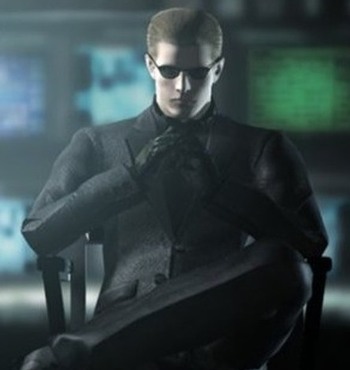
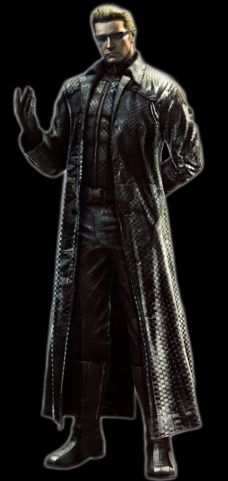
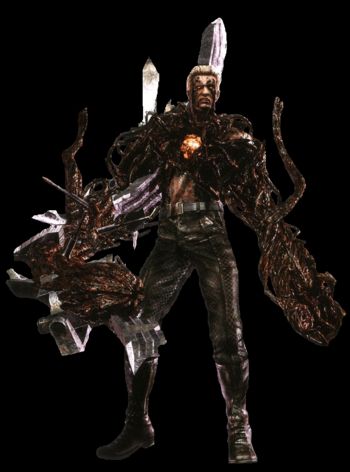
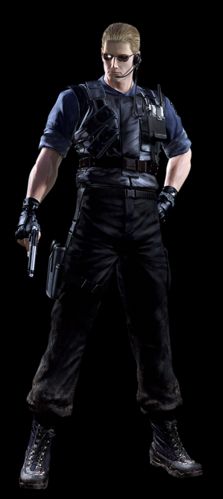
Originally conceived in a eugenics program — dubbed Project W — orchestrated by Oswell E. Spencer, Albert Wesker is a diabolical criminal mastermind, and one of the primary antagonists of the Resident Evil franchise. Initially, he worked at Umbrella, where he served as a chief scientist and close advisor to Dr. Spencer. During this time, Wesker went undercover as a police captain, forming the elite SWAT unit S.T.A.R.S. as a pet project.
In 1998, Wesker decided to betray Umbrella and joined an unnamed rival company. His decision to dispose of S.T.A.R.S. at the Spencer Mansion would seemingly lead to his death. However, he infected himself with an experimental strain of the Progenitor Virus, which led to him resurrecting with superhuman abilities and going into hiding. Wesker then became an influential bioterrorist, casting a shadow over most of the subsequent major events in the series.
See here for tropes relating to him in Dead by Daylight as "The Mastermind''.
- 13 Is Unlucky: Inverted. Subject #13 of Project W. While unlucky to anyone who deals with him, he's actually lucky being one of two "survivors" of Project W, in addition to gaining superpowers. He does finally die for good in RE5, however.
- '90s Hair: In Code: Veronica, 5, and in his Mercenaries/Wesker Mode reappearances using his 5 appearance, he has hair with bleached, frosted tips gelled backward.
- The Ace: He's an effective squad leader, has the appearance of a top model, is a master in martial arts and firearm usage, and is a brilliant planner who excels in intelligence gathering and manipulation. Ominously, he was engineered to be like this via Project W. Learning about the details of his conception causes Wesker to rationalize that his talents are meant to bolster him to godhood, a direction Wesker wholeheartedly embraces.
- Achilles' Heel:
- Despite having superhuman abilities that allow him to dodge bullets and shrug off certain explosions, he can only focus on one opponent at a time. As such, one can still sneak up on him for a surprise attack on Wesker when out of his line of sight and not being the target of his attention. This is how Chris and Jill were able to deal with him in Lost in Nightmares. In the main campaign of 5, Chris and Sheva eventually realize that they cannot take him on in a fair fight and resort to hiding so they can strike him from behind. Also, due to his notorious use of Sunglasses at Night, a player can disable light sources during his boss fight at the hangar to keep Wesker literally in the dark and attack him while he's distracted.
- The Super Serum that he needs to maintain his powers turns out to be his biggest weakness as well. As Jill informs Chris, specific doses of PG67A/W must be administered to keep Wesker's powers. A higher amount of the serum's dosage makes the virus inside him go haywire due to an overdose. During the final battle against him, the player has to immobilize Wesker and inject it into him to win the boss battle.
- Action Dad: It's posthumously revealed in Resident Evil 6 that he fathered a son named Jake Muller. Whether he knew about his son's existence or not, or what their relationship would have been like, Wesker is certainly a master in martial and firearm combat.
- Adaptational Badass:
- In the original version of Code: Veronica, he was rather clearly outclassed by Alexia
 , which also terrified him. Code: Veronica X changed it up and put them around the same level, with Wesker even feeling confident in being able to capture her.
 - Also happens in the first game's remake where he easily defeats Chris on the bad ending route, whereas in the original Resident Evil, there was no indication he even knew martial arts.
- In the original version of Code: Veronica, he was rather clearly outclassed by Alexia
- Adaptational Jerkass: In the original "Separate Ways", Wesker maintained a somewhat professional and respectful relationship with Ada, although he's still demanding her to obey him like she has no choice. In the remake's version, he's much more abrasive and hostile to her, going as far as to threaten her life if she continues to fail him.
- Always Someone Better:
- Despite his superpowers, he clearly demonstrates martial art finesse to Chris' roughneck brawling and wrestling techniques. With only a few gestures, Wesker always easily kicks Chris' ass until the climax of 5, and even before this, the first game's remake sees him easily dispatch Chris on the bad ending route despite not having powers at that point in time yet. This makes sense when you consider Wesker trained him as captain.
- Despite being nearly untouchable when Chris encounters him in Code: Veronica, Wesker faces a t-Veronica-empowered Alexia and decides to leave the situation to his former subordinate when Chris arrives, stating the latter could handle it better. In the original version of Code: Veronica, Alexia rather casually trounced Wesker, firmly establishing her as this to him.
- Despite his superpowers, he clearly demonstrates martial art finesse to Chris' roughneck brawling and wrestling techniques. With only a few gestures, Wesker always easily kicks Chris' ass until the climax of 5, and even before this, the first game's remake sees him easily dispatch Chris
- Ambiguous Situation:
- His relationship with Jake's mother. All that is known is that she raised Jake to respect Wesker and was still enamored with him, but what Wesker thought about her, what the relationship was like, or how the relationship even happened to begin with are mysteries. And with both Wesker and Jake's mother being dead, it'll likely remain that way.
- Despite its Excuse Plot, Umbrella Corps is a canonical entry in the series set in both 2012/2013 (after Resident Evil 5) and 2016 (after Resident Evil 6), and Wesker's distinctive voice can be heard in both the single player campaign and in multiplayer, suggesting he's somehow around even though the official word is he died at the end of 5. Because Wesker is never seen, however, this leaves many possibilities for the details behind his apparent return, ranging from a miraculous survival to another resurrection to cloning. Resident Evil Requiem implies that this could easily be chalked up to his clone, Zeno, who has his exact voice.
- Animal Eyes: After returning from the dead, the only prominent side-effect of the experimental serum appearance-wise is granting Wesker reddish-colored slitted pupils, which he hides behind his sunglasses.
- Animal Motifs:
- Big cats. He has eyes with slit pupils like a cat, and while his attacks are named after various animals, several of them are big-cat-themed: the Panther Fang, Jaguar Dash, Jaguar Kick, and Tiger Uppercut. His personality definitely fits the theme of "Charismatic, exotic predators with an air of grace and power about their every move. Awe-inspiring even as they crush you.". He's also arrogant, manipulative, smug, and good at stealth and espionage, more traits commonly associated with big cats, and his fighting style is fast and agile with a lot of jumps, flips, rolls, dodging, and even Wall Runs.
- Also, snakes. His final bioweapon, Uroboros, is based on the snake eating its own tail. Wesker is known for being highly manipulative, much like a certain snake in a garden.
- Arch-Enemy: Wesker's top enemy is Chris Redfield, largely due to the preexisting coworker relationship they had, which made Wesker's betrayal especially hard. The two have been fighting against each other for decades, with each of Wesker's appearances being up against Chris and his allies up until Wesker's death in 5.
- Ascended Extra: In the remake version of Separate Ways, Wesker has a larger presence in the story aside from sitting in his control room, and even assists Ada after she loses consciousness at the village.
- Ax-Crazy: Wesker is a bloodthirsty madman who enjoys killing as much as he does lording his superiority towards others, his eventual plans to exterminate humanity not even withstanding. He conceals this very well under a cool and calm presentation; the fact that he commits violence with the same sort of stoicism further demonstrates how much of a detached individual he is. That is, until his last bout with Chris where his bloodthirsty nature is really let out, though Wesker had completely lost his mind by that point.
- Badass Bookworm: He's a brilliant virologist who happens to have superhuman powers. Even without said powers, it says something that he's both an accomplished scientist and a former US military man.
- Badass in a Nice Suit: When he's not wearing a long coat or military uniform, Wesker is always dressed in expensive designer suits.
- Badass Longcoat: During the raid on Sergei's holdout in 2003, Wesker wears a winter long coat over his suit. During the events of 5, he dons a black leather coat for the entire running time — even up to flashbacks.
- Bad Boss: Somewhat. The audience is treated to many business interactions with Ada and Wesker throughout the series, and in these conversations, Wesker is very callous but never angry or overly berating. Even in one instance where he dangles death over Ada, it's very subtle and impersonal. However, when Ada references Wesker to others in business arrangements, she warns it'd be a grave mistake to waste his time.
- Bare-Handed Blade Block: In the Mercenaries mode of the remake of 4, Wesker parries melee attacks with his own arms.
- Beauty Is Bad: Wesker is, if nothing else, an incredibly handsome man. Keep in mind that he's 38 years old as of the first game, and barely looks it. By the time of the fifth game, he's in his late 40s and looks like he hasn't aged a day in 10 years (likely due to the virus). Despite his good looks, he is very much an evil and devious man.
- Became Their Own Antithesis: Besides the fact Wesker is killed by his Arch-Enemy Chris, he dies completely consumed by power figuratively and literally — in direct contrast to his belief that power is meaningless if it consumes its wielder.
- Big Bad: For the original game and 5. His influence is felt across the entire series as well.
- Big Bad Duumvirate: With William Birkin, his longtime friend and rival. Admittedly, their time as this is mostly in the series backstory and 0, but they went to college and later worked as top researchers at Umbrella together for years.
- Big Bad Ensemble: He's responsible for the attack on Rockfort Island in Code: Veronica, but he has Alexia Ashford to contend with when she awakens from her cryostasis. Alexia summarily curb-stomps him, but Wesker outlives her and is able to retrieve samples of the t-Veronica Virus from Steve's body.
- Blackmail: Threatens to have Barry's family killed if he doesn't help Wesker kill off their team and cover up what happened at the Mansion. Turns out he was bluffing, and on Jill's route, Barry overhears this and knocks Wesker out.
- Blade Below the Shoulder: After infecting himself with Uroboros, Wesker's right arm becomes a tentacle-like mass with large pieces of shrapnel attached to it.
- Bond Villain Stupidity: As intelligent as Wesker is, he doesn't seem to know when to keep his mouth shut. Case in point, in the RE4 remake, Ada asks what he plans to do with the Amber containing the Plagas, only to tell her he doesn't pay her to think... only to almost immediately tell her that he plans to kill off billions of humans with it, causing Ada to force the pilot at gunpoint to change courses. Had he simply kept his mouth shut instead of monologuing, he would've easily gotten the Amber. "Separate Ways" goes further, revealing that his repeated hostility and Bad Boss nature towards Ada for even the smallest hang-ups, despite her proven competence by that point, meant that he likely wasn't going to honor any deal, which made her suspicious of his intentions in the first place and ultimately caused her to betray him. The only saving grace he has is that Krauser's mutated body, which he obtained, would allow him to continue both his experiments and plans rather than Ada's defiance serving as a Spanner in the Works to him.
- Breakout Villain: He was essentially a stock Survival Horror character in the first game (The Mole). From Code: Veronica onward, he's been elevated to one of the main villains and most recognizable characters in the series. He's even become a Breakout Character in his own right, being a Guest Fighter in Dead By Daylight and Marvel Vs. Capcom 3.
- Brought Down to Badass: Deconstructed. After getting an overdose of his own special serum by Chris and Sheva in 5, Wesker slowly loses his enhanced physical abilities while also suffering from migraines, but is still a force to be reckoned with due to his previous military-like training and experience. However, seeing that he'll be at a very bad disadvantage without his powers while Chris and Sheva are still armed, Wesker made the final choice to use the last of his Super-Strength to punch a hole in the rocket containing Uroboros and infected himself.
- Character Development: After gaining his superhuman powers, Wesker becomes more egotistical and ambitious throughout the series. While he initially served as a middle manager at Umbrella, he wanted to make his own path and his own individual accomplishments — sacrificing his S.T.A.R.S. unit for his own greed. Wesker did hold some Social Darwinist views at the beginning of the series, but lacked the god complex he would later hold. This takes shape beginning with Code: Veronica but is most prevalent in Wesker's Report, where he writes that he wants to surpass Spencer's seemingly omnipotent reach and rub it in his face before killing him. When Spencer mentions his plan to become a god, Wesker decides that the way to ultimately surpass him is to become a god himself and rule over a new world of superior metahumans. This character arc appears to have been planned as far back as the first game, with writer Kenichi Iwao saying in an interview that he envisioned Wesker as already contemplating the idea of using the virus for "mass extinction and forced evolution".
- Characterization Marches On:
- A zig-zagged example. Wesker in the original game and (to a certain extent) its remake is noticeably very outspoken and cocky. Starting from 0 and cemented by The Umbrella Chronicles, his well-known stoic and calculating personality came into effect. However, even in The Umbrella Chronicles he has some one-liners, including a truly terrible pun ("your Umbrella has folded") and some evil laughter and villainous monologues, so the cockiness isn't entirely absent. He ditched this by the time 5 came around, hamming it up more than ever and regaining his cocky disposition. Since 5, this side of Wesker is now much more famous than his calm side, being synonymous with all his depictions in crossover media since.
- His fighting style in Code: Veronica is different from later games. In CV, and specially the CVX re-release, Wesker fights by simply abusing his super strength. Starting from the first's game's remake, Wesker in the bad ending route (Where Rebecca is dead) overwhelms Chris with flashy, martial arts-like moves, something he kept in all other games even after getting super powers.
- He only really was characterized as a mastermind starting in 4. In 1 he's more of an opportunist who, while he succeeded in manipulating STARS, was ultimately killed by the Tyrant (Later retconned to have been part of his plans), the same ultimate weapon he thought was perfect. In Code: Veronica, he talks about selling his soul to another organization (The nameless rival company), invaded Rockfort Island with other soldiers, is actively involved in the plot, and in the X Updated Re-release, while he was attacking Claire, he left after receiving a call, so Wesker in that game is a grunt following someone else's orders. Starting in 4 is when he became a mastermind who orders others around, and while that can be excused as him simply raising his own ranks, Umbrella Chronicles still writes him that way once he leaves Umbrella, even during Death's Door (Takes place right before Raccoon City was nuked). All of this also changed how the nameless rival company was treated, as they went from Umbrella's opportunist rival, slowly growing in power, to effectively just Wesker's company that only exists to give him funds.
- The Charmer: He can put on the charm only when it suits his purposes. Just ask Excella Gionne.
- The Chessmaster: Nothing, no one (except Ada, once), and no event is out of his scope when he's scheming; you will be accounted for.
- Chronic Backstabbing Disorder: First as The Mole for S.T.A.R.S., then double-crosses Umbrella, kills Spencer, and then pulls a You Have Outlived Your Usefulness on Excella. It is also revealed in 0 that he betrayed his former mentor, Dr. James Marcus. Ultimately, if one's going to work with Wesker, then Wesker will see no problem with betraying them. Chris angrily lampshades this, saying, "Wesker doesn't give a damn about anyone but himself."
- Clipped-Wing Angel: It's made painstakingly apparent his Uroboros-infused form at the end of 5 is something Wesker only took out of desperation. Compared to his original skilled self, his attacks post-mutation are wild, clumsy, and Wesker is easily winded or struggling to control his powers, leaving him open for attacks. When his left arm mutates, he is even exasperated before turning smug, indicating he didn't intend for that to happen either. Lastly, he visibly struggles to maintain his footing with his newfound weight, which proves fatal when he sinks into the lava from the uneven arena he was battling Chris and Sheva in. And to add insult to injury, Word of God explicitly stated that, despite his impressive genetics allowing him to accept a prototype version of T-virus without any significant downsides whatsoever, he would have eventually died to his Fusion Dance with Uroboros as not even being a genetically engineered superhuman would have let him withstand Uroboros's very corrosive, mutative nature to the human body.
- Combat Tentacles: After infecting himself with Uroboros, Wesker's arms become mass tentacles that allow him to have a longer reach, with his right arm being a Blade Below the Shoulder due to the shrapnel attached. Also, he can create a tentacle barrier by slamming them into the ground.
- Comic-Book Fantasy Casting: Wesker's (initial) design was primarily influenced by English musician David Bowie. This is most prominent in his official◊ artwork◊ from 1, where he looks exactly like Bowie in a cop uniform. As for the voice, D.C. Douglas, Wesker's voice from Umbrella Chronicles to TEPPEN, stated that he based the voice on Bowie.
- Cool Shades: His expensive designer sunglasses, manufactured by Umbrella, are a core part of his iconic look. They have a practical function, too- they hide his glowing red eyes, the one change to his physical form brought on by the virus he infected himself with.
- Cop Killer: Given that he intentionally leads the S.T.A.R.S unit to their doom. He also personally kills Enrico Marini for uncovering his treachery way before the other survivors do.
- Curb-Stomp Battle: Doled out a brutal one to Jill and Chris at the same time when they confront him in the Spencer Mansion, by the end of the fight, Jill has to perform a Heroic Sacrifice just to keep Chris alive, and she got kidnapped, and brainwashed into subservience for her troubles.
- Dark Is Evil: Dresses primarily in black and is evil to the core. This color contrasts with his sister Alex who dresses primarily in white, but is just as evil.
- Dark Messiah: What he wants to be after his fateful final meeting with Spencer. During his Villainous Breakdown in 5, he rants to Chris that he doesn't plan on destroying the planet Earth, but rather he plans to "save" it. Unfortunately, his method of doing so involves exterminating humanity with the Uroboros virus. Ironically, given that Jake Muller, Wesker's son, carries the only thing that would remove the bioterrorist viruses from the world, Wesker may have saved the world, in a sense.
- Death-Activated Superpower: After the Tyrant does him in during the Arklay disaster, the experimental virus he took beforehand activates, granting Wesker his now-famous powers.
- Deceptive Disciple: Along with Birkin, he was this to Marcus, who trusted them even as his sanity fell apart. Wesker ends up murdering him on Spencer's orders, completely callous to his anguished surprise at the betrayal.
- Designer Babies: A low-tech example. Project W was an early Umbrella program intent on creating a superior race of humanity through selective breeding, lifelong indoctrination, and the Progenitor virus. It involved kidnapping the children of couples of "superior genetics", raising them under Umbrella observation, exposing them to the Progenitor virus, and programming them to seek out Lord Spencer. Wesker does not take this revelation well.
- Diabolical Mastermind: Wesker is behind just about most of everything in the greater Resident Evil canon. He was a researcher under the man who created the T-Virus, organized the destruction of S.T.A.R.S to get combat data on the first generation T-viral B.O.W.s, faked his death at the hands of the Tyrant, had Ada Wong enter Raccoon City to recover a sample of Birkin's G-Virus, caused the outbreak on Rockfort Island by attacking it, leaked the location of Umbrella's last remaining bio-weapons facility to Chris and Jill so that he could use their diversion to steal all of the research data from its servers, released said data to get the company shut down, dispatched Krauser and Ada to recover the Las Plagas sample from the Los Illuminados cult, and finally tried to conquer the world, starting in Africa, with his Plagas-based Uroboros virus. He and his private army, H.C.F., are also responsible for the collaboration for the E-Series B.O.W in 2000 that would kickstart the events of 7. Wesker has so much influence over the Resident Evil storyline that his shadow continues to haunt the franchise long after his death.
- Didn't Think This Through: Back in the original Resident Evil, he thought he had the Tyrant entirely under his command when he releases it to kill Chris/Jill. Depending on the story path, however, he severely underestimated just how violent a Tyrant lacking proper programming may be, and gets impaled for it. This was later retconned into both being the canonical outcome, yet also part of Wesker's plan; the fatal brush with death would awaken the latent Progenitor Virus within him that Birkin had given him a prototype sample of, effectively allowing Wesker to come out on top in the end despite the Tyrant's demise.
- Dirty Cop: As a cover job during his time as an Umbrella researcher, he was the leader of S.T.A.R.S., whereupon he informed his superiors of police activity and obstructed investigations into their business.
- Dodge the Bullet: Due to his freakishly heightened senses, it is impossible to successfully shoot him upfront. He loves to showboat by often dodging bullets stylishly.
- Double Reverse Quadruple Agent: Between Umbrella and their competitors, the US Army, S.T.A.R.S., and Tricell, there is simply no faction that Wesker cannot infiltrate and ultimately betray.
- Dramatic Irony: He may have taken Spencer's remaining assets for his own plans after killing the founder of Umbrella... but he does not know there is one last asset Spencer had hidden and taken that secret to the grave: the Elpis anti-virus facility as revealed in Requiem.
- Dual Boss: In Resident Evil 5, Chris and Sheva end up having to fight Wesker and a brainwashed Jill in an abandoned Ndipaya palace. After Wesker leaves, Chris and Sheva are left to fight Jill alone, and are fortunately able to free her from Wesker's control by ripping off the device on her chest that was injecting a chemical compound known as P30 into her system.
- Empowered Badass Normal: After taking the experimental T-Virus strain provided to the Wesker children, he gains borderline superpowers. However, as he's already the product of a heinous eugenics program, Wesker was implied to already have some abnormally heightened traits before his resurrection, with The Umbrella Chronicles showing that he was able to canonically defeat a T-001 and an Ivan, both of them being Tyrants, with only a handgun and his martial training.
- Even Evil Has Loved Ones: Not in the present day, of course, but in his backstory, Wesker admits feeling genuine gratitude towards William Birkin, and Alex has nothing but good things to say about him, implying he was at least pleasant to her for a while. In the games proper, after his resurrection, Wesker abandons all these connections.
- Even Evil Has Standards:
- Subverted with Lisa Trevor. The journal (later audio drama), Wesker's Report II details his reaction to the experiments performed on Lisa Trevor: he is disturbed by the realization of what Spencer is willing to do... but only because of the possibility that he could end up being turned into a test subject in a similar way. He shows no sympathy for her at any time, and barely even views her as a person.
- Subverted when talking about the Ebola virus. He says it is "fortunate" that Ebola does not have the ability to create zombies, but goes on to clarify that the reason for this statement is that it allows Umbrella to monopolize such an ability.
- However, the same file does later show a genuine standard of his — while unfazed by the idea of experimenting on people and creating viruses, he genuinely doesn't want a worldwide Zombie Apocalypse and is concerned about the possibility of one. Also, while it's not so much a moral standard, he is opposed to unprofessional behavior such as conducting rushed and poorly planned experiments that don't follow proper procedure, seeing it as a waste of potentially useful test subjects. And he's angered by Umbrella's constant nepotism, seeing it as foolish to judge people by their family instead of their own abilities. Of course, given his Sanity Slippage into his growing God complex by the time of 5 and his open participation in causing an outbreak of Uroboros with intent to eventually cleanse the Earth of all but the most fittest of people, this one genuine standard seems to have died and wasn't going to be reanimated any time soon.
- He points out that the bioweapons and viral research of Umbrella is so utterly expensive and impractical at best, not to mention a risk of endless lawsuits if it's ever legally discovered, that it all seems rather pointless and straight up wasteful of resources rather than having any logical rhyme or reason behind it all, not to mention his open contempt of fellow researchers who gleefully embrace such projects besides William Birkin. Notably, he's all for sticking to Umbrella's profitable gains through their legal pharmaceuticals, but Spencer's madness causes Wesker be so horrified that he snaps, and shifts his priorities post-resurrection to ultimately embrace the darker path and usurp the madman's plans.
- There's also the time in the very first game where Wesker allegedly is holding Barry's wife and kids hostage with the threat of killing them if he didn't act as The Mole against S.T.A.R.S. Eventually, his mouth runs ahead of his brain in the right scenario as he reveals it was all a bluff, inclining that at the very least Wesker either didn't actually have the leverage, or even he was above trying to do such a horrible thing compared to the rest of Umbrella. He also did this in earshot of Barry, who proceeds to give him a good ol' Pistol-Whipping upside the head now that the leverage is gone. Wesker learns from this mistake and goes on to be a genuine threat to both Jill and Claire when they're in his grasp in later games.
- For all of his selfish, narcissistic pride, Wesker admonishes the notion of judging people based on bloodline instead of ability.
- Evil Brit: Wesker speaks with a Transatlantic accent, making himself sound upper class and intelligent. He is also a sadistic Mad Scientist who wants to to kill off most of the human population so that a subset of advanced humans live on. Subvered for the Resident Evil 4 remake, which completely removes the Transatlantic accent for the first time in the series.
- Evil Gloating: Towards the end of the Arklay incident, he gloats to Jill and Chris over everything concerning his deception — figuring they're going to die anyway. In Jill's scenario, it actually bites him in the ass when Barry overhears him and knocks him out after knowing the leverage he claimed to have over his family is a bluff.
- Evil Is Petty: He has several moments that illustrate how childish he actually is under all his bluster. Interestingly, all these moments concern Chris.
- He shoots Rebecca in the chest just to pointlessly prove to her and Chris that, yes, he is a soulless bastard that murdered all their beloved friends.
- On Rockfort Island, he beats up Claire just to get revenge on Chris by proxy. All the while, Wesker whines to her about how much he hates her brother.
- The main reason he sets up Jill as his brainwashed assassin is to hurt Chris. When he unveils her true identity, he's positively relishing in Chris' anguish.
- Eviler than Thou: Wesker is this to Oswell E. Spencer. For decades, Lord Spencer has spent a considerable amount of his fortune and betrayed countless allies to achieve his dreams of godhood but he is nowhere close to achieving it, especially after the Raccoon City Incident has bankrupted his company and turned him into a wanted fugitive. Wesker kills him and takes his remaining assets to pursue the same goal of becoming a God-Emperor with Uroboros, kicking off the events of the game.
- Evil Mentor: As the captain of S.T.A.R.S., he is behind their training. He sarcastically remarks Chris and Jill make him proud for surviving various events across the series. It should be noted, however, that he is admiring himself in these instances of compliments.
- Evil Sounds Deep: Wesker is constantly portrayed as a misanthrope with a deep voice.
- Evilutionary Biologist: He was one of Umbrella's top scientists before defecting. As read in the research notes in the lab at the end of the first game, Wesker had a hand in the development of all the monsters seen in the Arklay Mansion.
- Evil Versus Evil: By all accounts, Wesker is an egotistical bastard out for himself and his own power above all else, but his betrayal of Umbrella and especially Oswell Spencer helps define a lot of the series thoroughly. Without Wesker, Umbrella could've been nigh-untouchable until the Raccoon City aftermath, and much of their downfall can be attributed to his acts of sabotage. He effectively did much of the work for the heroes, even if it made him a Dragon Ascendant in their place, to the point that Spencer's already dead by Wesker's hand by the time Chris and Jill finally move to confront the old man.
- Evil Wears Black: Has always had a thing for black outfits. His S.T.A.R.S. uniform is black and dark blue, his HCF uniform is an all-black version of that outfit, he adopts a slick all-black business suit in 4, and wears a black leather Badass Longcoat in Umbrella Chronicles and 5.
- Excellent Judge of Character: For all of his sociopathic factors and his twisted mental state about the world, the one thing Wesker is good at is determining what kind of a person someone is. He knows Chris all too well for the latter to give up the Chronic Hero Syndrome, estimates that Ada Wong would sooner keep her silence on his involvement in the Las Plagas outbreak than go to the U.S. Government, and manages to manipulate and surround himself with individuals he personally approved for his Uroboros project, even if he didn't care one iota for their well being. He also knows damn good and well which researchers (which is nearly all of them) to betray at Umbrella because they'd be an unstable thorn in his plans or worse, besides his earnest friend William Birkin. About the one major time he has a severe miscalculation of what a person might try to do is failing to realize Barry may betray him if the right circumstances happen in the original Resident Evil. He also doesn't seem to be aware of Ada's feelings for Leon, as he's never aware that Ada is putting no effort in killing Leon in 4.
- Eye Beams: He has a non-canon Cyclops-like optic laser blast in the "Wesker Mode" added in the HD port of 0 that is never displayed in subsequent appearances.
- Failure Is the Only Option: Despite his attempts to become the god of a new humanity grown by the spread of Uroboros, ultimately it was confirmed by the series creators that Wesker was, after everything said and done in all of his betrayals, self-experimentation, meticulous planning and beyond, incompatible with Uroboros once he was overdosed; even if he somehow won the final battle with Chris in 5, his own virus would've consumed him anyway, meaning no matter what, he was never leaving the final battle alive and certainly not going to be able to even see his proverbial throne above all.
- Faking the Dead: The Umbrella Chronicles reveals that Wesker survived his impalement by the T-002 Tyrant by injecting the prototype strain of the Progenitor Virus that Birkin developed and gave to him, allowing him to escape Umbrella undetected. Years after Umbrella's fall, he would go on to do this a second time in Resident Evil 5 when Jill performed a Heroic Sacrifice to save Chris, by tackling Wesker through a window facing a cliff at the Spencer estate, which sent both plummeting to their apparent demise. By the end of 5, he's dead for real this time, on account of Chris and Sheva firing two rocket launchers at him in an active volcano, causing an explosion that incinerated him completely.
- False Friend: To S.T.A.R.S. all the way. While keeping up the act, he even acts believably friendly in the instances Jill and Chris meet him during the Arklay disaster.
- Fan Disservice:
- Wesker takes in Uroboros out of desperation during the last phase of the final battle in 5, turning his shirtless torso into a tentacled monstrosity with an exposed heart and elongated right arm infused with plane debris. After taking enough damage, his left arm turns into a mass of tentacles.
- Subverted in his appearance in Mercenaries 3D, where apart from a mutated arm, nothing detracts from his good looks.
- Fatal Flaw:
- Obviously, his gargantuan ego and god complex. As Chris puts it, Wesker cares for no one other than himself, and it's so bad that he could constantly betray those who display genuine loyalty to him and deprive himself of allies that could've helped him survive in situations that even he couldn't get out of on his own. Also, due to his high intelligence, Wesker would never fathom the idea that any of his creations could be flawed, which is why Uroboros is so highly mutatable to the point that only a very rare select amount of humans are compatible with it, and he's not on that list, according to
 Word of God. This ultimately plays to Wesker's death in 5, as while he could've simply used the last of his superhuman abilities to run away from Chris and Sheva and still have a chance to start over, he decides to stay behind and infect himself with Uroboros in a desperate attempt to personally finish off his long-time adversary.
 - As shown in his fight with Chris throughout 5, and their previous encounter in the Lost In Nightmares DLC, Wesker has a rather nasty tendency to toy and torment his opponents and aim to make them suffer a slow death instead of simply going immediately for the kill, which would be a Curb-Stomp Battle thanks to his superhuman powers. Unsurprisingly, Chris and his allies were able to survive in their battles against Wesker thanks to this flaw most of the time. While Wesker lampshades that he should've killed Chris when he had the chance plenty of times in the past just before their final battle in 5, he still can't help but continue and try to Kick the Dog in order to get one over his arch-enemy (not helping that his unchecked and already degraded sanity and god complex has taken a further dive from the pain of the serum overdose to the Progenitor Virus inside him and then infecting himself with Uroborosnote to turn the tide against Chris), which eventually leads to his death.
- Obviously, his gargantuan ego and god complex. As Chris puts it, Wesker cares for no one other than himself, and it's so bad that he could constantly betray those who display genuine loyalty to him and deprive himself of allies that could've helped him survive in situations that even he couldn't get out of on his own. Also, due to his high intelligence, Wesker would never fathom the idea that any of his creations could be flawed, which is why Uroboros is so highly mutatable to the point that only a very rare select amount of humans are compatible with it, and he's not on that list, according to
- A Father to His Men:
- A subversion considering his allegiances. While he doesn't overly show this in the first game, supporting material suggests the members of S.T.A.R.S, especially Chris, greatly looked up to Wesker as captain.
- Wesker is upset that he has to sacrifice S.T.A.R.S. because he admires them for their considerable talents as police officers. However, Wesker's new employers refuse to pay him unless he can provide combat data to them, and who better to test the B.O.W.s against than seasoned police officers? Wesker elects to betray his unit so he can earn a quick buck. Any fondness he has for the S.T.A.R.S. unit, even Chris, whom he considers his best man, is secondary to the fondness he has for himself.
- Faux Affably Evil: You'd think he took some of his lessons from Bond villains with how he constantly tries to seem aloof, cool-headed and relatively reasonable on the surface, but the moment anything slights or annoys him, the veneer tears off to reveal a sociopathic monster of a man manipulating everyone around him to get what he wants while taking a sadistic delight in inflicting suffering on those that stand in his way. This especially goes with his developments; he genuinely is suave and straightforward at the Spencer Mansion with some seeming regrets for selling out his own special forces team for combat data, but by the time his later plans get rolling, he's so self-indulgent in his own ego that he plays this trope to the hilt not for the sake of pleasantries, but because he genuinely believes himself to be above everyone else that it's more akin to showboating his superiority.
- The Fighting Narcissist: In most fights, he takes the time to readjust his looks or admire himself as the heroes ineffectually try to hurt him. It even carries over to his depiction in Marvel vs. Capcom 3, with his taunt having Wesker stop to pull out another pair of his Cool Shades if he's currently without them.
- Final Boss: Wesker is the last foe you face in 5, and appropriately enough, he mutates himself with the Uroboros Virus for the occasion. Rather fitting, huh?
- Foil:
- To Sergei Vladimir, their rivalry making up the spine of Umbrella Chronicles' original story. They're both mutant gunmen entrusted to do Oswell Spencer's bidding, but Sergei remains unfailingly loyal to the end while Wesker is defined by his treacherous nature. They also acted as prototypes for Spencer's eugenic plans: Wesker was a Psycho Prototype (or at the very least the sole surviving byproduct besides Alex Wesker) for Project W, a project dedicated to using the Progenitor virus to transform people into superhumans, whereas Sergei was the base model for the Tyrant B.O.W.s.
- He is also one to Ada whether he knows it or not, as noted by her closing narration in her scenario from UC. However, while Wesker descends further into villainy, Ada's morals and ethics become stronger.Ada: We were both used to being backstabbed and manipulated. I had a feeling our partnership would last a little while longer.
- He is this to Grace Ashcroft from Requiem as both are blonde children taken in by Spencer. However, the difference is that he grows up haughty and megalomaniac under Umbrella while Grace was given away to be raised by Alyssa Ashcroft as a normal kindhearted girl. He mocks him as pathetic before killing the old man and taking the latter's remaining assets for his schemes of dooming humanity while Grace puts her trust in Spencer after discovering he's The Atoner and unlocks the Elpis anti-virus facility to save the world.
- Flash Step: By 5 his Super-Speed takes this form at times, especially when dodging bullets. His speed is so extreme that it looks like he straight-up vanishes, showing that Wesker is moving faster than the human eye can perceive.
- Friendly Rivalry: It's noted him and Birkin were extremely competitive with each other back in their academy days, fighting tooth and nail to surpass each other's theories and work. In contrast to the bitter hatred most relationships like this forged (such as Birkin and Alexia), it just made the two genuinely enjoy the other's company in their debates and discussions.


- Gambit Pileup: Wesker uses Umbrella's "X-Day" plan as a smokescreen to conceal his betrayal of the company, intending to fake his death and join a rival organization.
- Genius Bruiser: He is of prodigious intellect by way of the eugenics program, Project W, serving as a top scientist during his time at Umbrella. He can also punch a person across a room and through doors made of stone. Even before he faked his death and mutated, he was skilled enough in martial arts to take down zombie dogs with no effort and was actually able to defeat (and kill) the T-001 Tyrant and go toe-to-toe with an Ivan during the Arklay disaster.
- The Ghost:
- In the original RE4 he's talked about by Leon, Ada and Krauser, but doesn't show up in the main game, although he does show up in Assignment Ada, Mercenaries, and for versions after the gamecube's, Separate Ways, so his model was always there, he just didn't show up in the main game.
- After his death in RE5, games/series that take place before it and have Tricell being behind the scenes generally allude to his presence, but don't show him. Even Darkside Chronicles' retelling of Code: Veronica tones down his presence to the point he only shows up in two scenes, he doesn't fight Alexia, and he and Chris only see each other when Chris escapes, so they don't even talk to each other.
- A God Am I: By 5, he's fully gone this way after absorbing too much of Spencer's deluded philosophy. However, even before then, he's had shades of a god complex, especially after his resurrection.Wesker: And so I was reborn like a phoenix emerging from the flame. I no longer needed Umbrella. A new horizon stretched out before me. I had risen beyond the human race and cheated death itself, leaving nothing to oppose me.
- Goggles Do Nothing: Inverted. In Resident Evil 5, his sunglasses protect him from Flash Grenades, and if you shoot them off, throwing a Flash Grenade will leave him vulnerable for a heavy stun, which allows you to do a very damaging melee combo on him.
- Go Mad from the Revelation: Prior to paying Spencer a visit, Wesker was very level-headed Chessmaster despite his superiority complex. Afterward (once he learns of his origins), he jumps off the deep end and forms his insane plan with Uroboros.
- Good Eyes, Evil Eyes: He has freaky orange and gold eyes slit like a feline — that is, when you actually see them. Naturally, he's evil.
- Greater-Scope Villain: He's this for the entire franchise. Since faking his death, though he's not the main villain in most post-RE1 installments, he has been playing from behind the scenes in most Resident Evil media set before 5, and continues to cast a shadow posthumously on events taking place after he actually dies.
- While he didn't instigate the outbreak there, he sent Ada to Raccoon City to retrieve a sample of the G-Virus, which would throw Leon and Ada into conflict with William and Annette Birkin in Resident Evil 2.
- He plays the role of secondary antagonist in Code: Veronica, being the one who attacked Rockford Island and spread the T-Virus there as well, in an attempt to seize Alexia Ashford's T-Veronica Virus.
- In the "Operation: Javier" storyline of The Darkside Chronicles, he is Javier Hidalgo's backer and is the one who sold him the T-Veronica Virus.
- In Resident Evil 4, Wesker manipulates the events from behind the scenes and is the true mastermind responsible for Ashley's kidnapping. Krauser infiltrates the cult under his orders and uses Ashley as a means to get closer to Saddler, in order to steal a Plagas sample. Ada is sent in as backup but throws a wrench in Wesker's plans along the way. He still wins in the end, with a rival organization destroyed and a master Plagas sample obtained from Krauser's corpse. This is still mostly true in the remake, except that Krauser isn't one of his agents and Wesker wasn't involved with Ashley's kidnapping, simply using the situation to complete his own goals while Los Iluminados is distracted by her rescue.
- In Degeneration, his people bought over WilPharma after the events of the movie, had Senator Davis assassinated and collected the remains of Curtis Miller.
- While partnering with Tricell, he inserted Jessica Sherawat into the BSAA and had her steal a sample of the T-Abyss Virus during Revelations.
- Infinite Darkness reveals that Tricell is also involved with the usage of B.O.W.s by Senator Wilson who used infected soldiers during the Penamstan Civil War and nearly caused a war between the US and China as part of Wilson's False Flag Operation to create an anti-China alliance.
- According to the Wesker Report, he has been keeping an eye on Sherry ever since she was in government custody. Knowing about his threat, Derek Simmons had kept Sherry under his custody for 10 years, during which he performed many experiments on her, including the creation of the C-Virus. This would lead to the Marhawa and Lanshiang bioterror incidents perpetrated by Carla Radames, in The Marhawa Desire and Resident Evil 6 respectively.
- His "sister", Alex Wesker, is the mastermind behind the Sein Island experiments in Revelations 2 and managed to obtain samples of Uroboros, which she would use to mutate herself in an attempt to kill the remaining survivors after her initial plan to possess Natalia Korda's body failed.
- In Resident Evil 7, it's revealed he and H.C.F. collaborated with The Connections to create the E-Series B.O.Ws in 2000.
- Guest Fighter: He made his way as a Killer into Dead by Daylight in its second Resident Evil crossover.
- Healing Factor: Wesker has a regenerative healing factor that allows him to recover from any wounds very quickly, which makes him a very powerful foe in addition to his Super-Toughness.
- The Heavy: He's still working for Spencer in Resident Evil 1, but it's Wesker who actually moves the plot along. He becomes the Big Bad in his own right in Resident Evil 5.
- Hell-Bent for Leather: His main outfit in Resident Evil 5 is a black leather longcoat which, combined with his sunglasses, looks as if he just came right out of The Matrix. It also helps to accentuate his nature as a diabolical mastermind.
- He Knows Too Much: During the Mansion Incident, he murders Enrico Marini when he reveals that S.T.A.R.S. has a traitor among their ranks.
- Hellish Pupils: After he is revived by Birkin's prototype virus — actually the Wesker Project's Progenitor virus — his eyes take on a monstrous crimson shade with vertical slits for pupils. It is somewhat explained that his eyes are mutated that way in order to compensate for his Super-Speed and reflexes, as human eyes cannot keep up with the visual information processes at that speed.
- I Don't Pay You to Think: He outright tells Ada in the remake of 4 "I don't pay you to ask questions" when she asks what he plans to do with the Amber.
- Immortality: Implied to be a Type 2, as he looks like he is only in his twenties, even when, by the time of his true death, he was a lot closer to his late forties. Most likely, this was the result of the virus he injected himself with. Word of God confirms he was designed to look older in 5 than in the earlier games, but he still doesn't really look 49, so he might just age more slowly.
- Implacable Man: Throw something at him. Chances are, it won't hit him in the first place, or it won't keep him down for more than a minute at most. For example, Wesker has a crane full of steel girders dropped on his head in Code: Veronica. It only fazes him for a few moments.
- Improvised Weapon: To start the final battle off in 5, he throws his sunglasses at Chris, briefly dazing him for an immediate upper hand.
- In a Single Bound: As a result of his powers, he is capable of leaping to inhuman heights, which he often does to either close the gap in a fight or make a getaway.
- Informed Ability: He's stated to be a very talented and skilled martial artist who personally trains Chris and Jill before revealing his true colors as The Mole in the BSAA, and while he does demonstrate those skills, it's only after being enhanced by the Progenitor virus. Downplayed in the bad ending route of the first remake, where Wesker easily dispatches Chris during their final confrontation of the game.
- Inhuman Eye Concealers: Since the events of Code: Veronica, he has worn his shades to hide his eerie red eyes — the only visible mutation induced by his virus.
- In Your Nature to Destroy Yourselves: This is the fundamental belief that drives Wesker to release the Uroboros Virus into Earth's atmosphere, which would have killed 90% of the human population and created a new race of Progenitor Virus-compatible "advanced" humans that Wesker himself would rule, "saving them" from their own self-destruction."Every day, humans come one step closer to self-destruction. I'm not destroying the world, I'm saving it.''
- Irony: For such a huge believer in superior genes to the point of believing himself a god, Wesker's superhuman abilities are revealed to not be perfect in 5, as the Progenitor virus is unstable and that he needed a periodic injection of a special chemical or otherwise he will lose his powers (and overdosing will cause him immense pain and slowly lose his powers as well). Even Uroboros, something that Wesker created himself and constantly boasts about being perfect in allowing the selection of superior humans to survive, is not only incredibly corrosive and incompatible with even him, but the one host it's capable of bonding with can still be considered a Power-Up Letdown.
- It's All About Me: Chris explicitly mentions to Sheva that Wesker "doesn't give a damn about anyone but himself." Even before he became enhanced and after Chris and Jill figure out his true ties in the first game, Wesker's So Proud of You line to either of them clearly frames himself as the sole reason they managed to survive up to that point, due to being their former mentor.
- It's Personal: His complete and utter hatred for Chris Redfield is so extensive that this is probably one of the most iconic cases of the trope in gaming. He mostly disregarded Chris from being a threat at the Spencer Mansion, up until his Tyrant was laughed at by the man, and then proceeded to kill the abomination. Once Wesker recovered from the incident and tried to set his own plans into motion, he very explicitly keeps an eye out for Chris from then on, going on to try to harass and murder him during Code: Veronica simply for being baited into trying to save Claire, to the point of losing all of his concentration in a fight with Alexia and trying to kill Chris the instant he spots him. By 5, once Chris and Sheva finally meet Wesker face-to-face, he utterly ignores Sheva outside of fighting circumstances and completely concentrates on his unstoppable hatred and spite for Chris, even flaunting the Brainwashed and Crazy Jill and sending her against him for kicks. By the time Wesker's having his Villainous Breakdown, one of the consistent things Wesker's spouting at that point is screaming Chris's name at the top of his lungs in absolute rage.
- Jerk with a Heart of Jerk: Wesker is a megalomaniacal narcissist who looks down on almost everyone with smug disdain with the exception of his sister Alex and colleague Birkin. Whenever he is shown to have a seeming compassionate side, such saving Ada from the Ganado horde and sparing her from her betrayal in the RE4 remake, or in 5 having a personal connection with Excella when she has a crush on him, it is only because he uses these actions as a means to his twisted ends and he will stab his affiliate in the back not long after.
- Joke Character: Bizarrely enough he's this in Code: Veronica's Battle Game. While everyone else has guns with infinite ammo, Wesker only has a knife, and the game doesn't implement his superpowers in any way. Later games subvert this as his powers are implemented, and he tends to have the strongest loadouts too.
- Joker Immunity:
- No matter how many times Chris and Jill put him down, he keeps coming back until 5. Possibly.
- Arguably downplayed. Between Code: Veronica and RE5, he only fought Chris and Jill in the latter game's prequel DLC (Lost in Nightmares), and his meeting Chris and Jill there was a Contrived Coincidence, something Wesker's in-game file lampshades). Most games that take place before Lost in Nightmares have him generally staying behind the scenes, and even after it he still remained hidden as Chris thought he was dead at first in RE5. Even in the "Dark Legacy" scenario of Umbrella Chronicles, he doesn't meet Jill and Chris, despite all of them being in Umbrella's last remaining facility and Wesker being aware they're there. While Wesker lived for far longer than any other villain, he was generally smart enough not to put himself in the spotlight that much.
- Karma Houdini Warranty: After years of getting away with treachery, murder, and bioterrorism, he finally gets comeuppance in 5 when he's killed by Chris and Sheva.
- Karmic Death: Having considered himself a superior being to all of humanity, he dies to humans he believed inferior to him, and his grand plan to utilize the Progenitor Virus against the entire planet is a failure. Chris Redfield, his longtime Arch-Enemy, is one of the protagonists to have the honor of slaying him, and Jill Valentine, who he attempted to kill along with Chris since the first game, and was subjected to Mind Control for three years, assists him in facilitating Wesker's demise. Also, he would've died by infecting himself with Uroboros in the final battle against Chris and Sheva, despite hyping it up as the perfect virus to weed out humanity with inferior genes.
- Killed Off for Real: After surviving being impaled in the first game by injecting himself by Birkin's prototype virus, conducting most of his plans behind the scenes for years, and then surviving being thrown off a cliff courtesy of Jill, he's finally killed off for good at the end of 5 when Chris and Sheva fire two rocket launchers at his head while he's burning alive in a volcano's lava; which also causes a massive explosion for good measure. Word of God from producer Masachika Kawata has him firmly deny the possibility of Wesker surviving, stating there's no way he could come back from that.
- Kill It with Fire: To finish Wesker off, Chris and Sheva fire two rocket launchers at him in an active volcano, which causes an explosion from the lava that finally kills him for good.
- Large Ham: While he was a Cold Ham in previous appearances, he is this by 5 courtesy of going off the deep end (with his most villainous British accent to date).
- Last-Name Basis: He is addressed solely by his last name in most of his appearances. The only exceptions are 5, which has Excella refer to him by his first name affectionately while trying to play the part of Femme Fatale, and Revelations 2, which has characters use his first name to avoid confusion with the other Big Bad Wesker running around, Alex.
- Lightning Bruiser: Wesker can move too fast to be seen, and he's strong enough to punch straight through a person's chest, catch and throw rockets at you, or kick you through a stone door.
- Lovecraftian Superpower: Wesker gives himself Uroboros and everything that comes with it in order to face the heroes one last time.
- Mad Scientist: He was a top scientist during his time as an Umbrella researcher. He still uses his expertise in virology to finance his criminal escapades and megalomaniacal ambitions.
- The Man Behind the Man: Too much of 0, 1, 4, and parts of Umbrella Chronicles. A great deal of the plot is the result of him and Sergei trying to outdo one another in this department.
- Master Actor: Up until the very end of the Mansion Incident, where he deliberately drops the act, no one in S.T.A.R.S. suspected Wesker of being anything less than a great man.
- Mighty Glacier: After his drug overdose and subsequent Uroboros absorption at the end of 5, he loses his superhuman speed, but is still unbelievably durable and strong.
- Misanthrope Supreme: Wesker looks down on humanity at large, claiming they bring war and pestilence everywhere they go. His master plan is to eradicate most of it with only a few survivors to start anew, with himself as the god, of course.
- Mole in Charge: Wesker was the commanding officer of S.T.A.R.S. and used his authority to undermine police investigations into Umbrella. He was also undermining his team the entire time during the Mansion incident, despite outwardly appearing as their trustworthy captain.
- Motive Rant: During his second and final fight with Chris. The last one has him ranting and raving pretty much non-stop until Chris and Sheva shut him up for good."Has it never occurred to you that this planet is overpopulated? Only a handful of humans truly matter. Everyone else is just so much chaff. So now, I have to separate this chaff from the wheat. And with Uroboros, I can finally accomplish this."
- Mr. Fanservice: For starters, his deep voice. He sports some Hell-Bent for Leather attire that partially shows off his body, and if you ever manage to see him shirtless◊... oh dear.

- Narcissist: Wesker clearly lacks empathy, has a ridiculously high opinion of himself to the point of seeing himself as a superior being and even a god, and wants to achieve power at all costs, believing himself to be entitled to greatness. He's condescending and takes every opportunity to show off, and is generally incredibly vain and self-centered. While he is capable of a genuine Villainous Friendship with Alex and Birkin, up to even trying to save the latter from Raccoon City, and can show genuine respect for people with skills like Birkin, Alex, and Ada, his own ego and hunger for power always come first. Also, wanting to surround oneself with other "superior" or "special" people is not an uncommon trait in people with this disorder.
- Narrator: Of Umbrella Chronicles and his self-titled documentary Wesker's Report, a canonical audio drama where he narrates mostly upon events he didn't directly take part in.
- A Nazi by Any Other Name: Wesker is a tall, blond-haired, and blue-eyed man whose origins in Project Wesker have disturbing parallels to Reichsführer-SS Heinrich Himmler's Lebensborn project. Like Lebensborn, Project Wesker was a breeding program aimed at creating a "superior" breed of humans strong in mind, body, and soul from abducted children with desirable traits while being conditioned into embracing Spencer's eugenicist viewpoints. There is a big difference in that Umbrella doesn't care about ethnicity as Nazi Germany did, and Wesker admonishes people for judging based on bloodline instead of ability. Nonetheless, he aims to use Uroboros to trigger the "next stage" in human evolution: killing those with what he considers "inferior genes" while ruling the world as a fascistic God-Emperor.
- Nice Job Fixing It, Villain!:
- Wesker was the mastermind behind the creation of "Blue Umbrella," taking advantage of innocent scientists and researchers who would unknowingly provide him with important B.O.W.-related data. At the same time, his other company, "Tricell," used the data to develop deadlier B.O.W.s. This was all part of a plan for global dominance by selling B.O.W.s on the market to various countries/terrorists, thus pitting everyone against each other and making Wesker indispensable to the world. But after developing a megalomaniacal god complex in the aftermath of finding the original Umbrella Corporation's founder, Oswell Spencer, Wesker abandoned his pet project, leaving the scientists of "Blue Umbrella" to focus their attention on finding ways to kill B.O.W.s more effectively. This meant Wesker provided many former scientists of the original Umbrella Corporation - all of whom wanted to redeem themselves after learning they had unknowingly helped create deadly B.O.W.s - with the means to do so, giving them money and important research information from the original Umbrella Corporation as well as from his findings.
- He unwittingly denied the Connections their prize to Elpis by killing Spencer, forcing them to spend a huge money pit in trying to bring back Umbrella's founder in a new body (all of them were female clones) so they can extract the correct password ("Hope") to access the secret facility or else risk its self-destruction if they get the password wrong once. It results in their efforts to be All for Nothing when Zeno finds out the hard way that it's a De-power anti-virus after Grace Ashcroft opens it.
- Not So Above It All: His very specific attire and hairstyle suggest that Wesker is very conscious about his looks. He can often be seen running a hand over his hair to slick it back, sometimes even during (or just after) a fight.
- Not-So-Well-Intentioned Extremist: He claims during the climax of 5 that his releasing Uroboros across the world and kick-starting a biological apocalypse will save the world, since humans come closer to self-destruction every day anyway, but it's obvious to anyone who's paying attention that he's nothing but a misanthropic Social Darwinist whose actions are centered around fueling his raging god complex.
- Obviously Evil: Not as apparent back in the day, but since Umbrella Chronicles, with his current voice, would you imagine him as a good guy? Surprisingly, aside from Chris Redfield mocking him for taking cues from comic book supervillains, no one in-universe lampshades about it.
- Odd Friendship: He shares this with William Birkin, despite the latter being a normal man due to their Commonality Connection as fellow scientists who want to evolve humanity by any means necessary.
- Oh, Crap!: A brief moment after Alexia's transformation in Code: Veronica, as it actually manages to catch him off-guard as he realizes he's face-to-face with a powerful entity not unlike himself. The original release gives him a Curb-Stomp Battle that he has no choice but to retreat from, despite him doing the same to Chris previously, while the X version has him caught in a deadlock, unable to meaningfully attack her, showing his concern was warranted.
- Omnicidal Maniac: Becomes this in 5. Although he wants to keep a few people alive, Wesker is so insane he doesn't consider (and likely doesn't care) the nature of Uroboros and the possibility it will simply kill everyone (even possibly himself).
- One-Winged Angel: After his plan to spread Uroboros crashes and burns with the stealth bomber he was going to do it with, Wesker decides that he has little left to lose and infects himself with Uroboros from one of the bomber's missiles, transforming his arm into a massive tentacle flail studded with shrapnel to engage Chris and Sheva for one last time.
- Parental Abandonment: In 1992 Wesker had a sexual relationships with émigré woman from Edonia who became pregnant with his child. The resulting son, Jake Muller, grew up convinced that his father abandoned them. The official report on Ms. Muller, however, indicates only that she went back to Edonia without informing Wesker of her pregnancy.
- Playing Both Sides: Plays every single freaking side to his own advantage.
- Power Creep, Power Seep: Whenever Wesker is playable, typically in the non-canonical Mercenaries game modes or the railgun games, his superpowers are heavily neutered to balance him out. Realistically, nothing should touch him outside of overwhelming pressure or enemies that are The Juggernaut, nor should he require such extensive use of guns.
- Pragmatic Villainy:
- Wesker is ruthlessly pragmatic, willing to do just about anything in order to accomplish his goals. He also knows when to stay in the shadows, or outright leave when a situation proves too troublesome and not worth the effort.
- He repeatedly orders Ada to kill Leon during the Plagas incident. However, when Leon kills Krauser, he admits he will doubtlessly kill Saddler and stops making any effort on his behalf.
- Psychopathic Manchild: At his core, Wesker is arguably this with his plot to reshape humanity as a "god." The very idea stemming from his creator is outrageously childish, and Chris even derides Wesker for ostensibly getting his insane ideas from comic book villains.
- Race Lift: He is black in the Netflix series, making him as the Scary Black Man.
- Rasputinian Death: How he's done in come 5. He's blasted with multiple RPG rounds, injected with a fatal overdose of the serum he uses to keep his powers under control, and has his chest turned into a scratching post by Sheva when he tries to kill Chris. He then survives a plane crash into a volcano and has his heart shot repeatedly with high-power weapons after injecting himself with Uroboros. Even getting dunked in lava doesn't immediately do him in, as he attempts a Taking You with Me on Jill's and Josh's rescue copter. He only goes down for good once Chris and Sheva hit him with two rocket launchers one last time.
- Razor-Sharp Hand: He can fatally impale a human with only his fingertips. Of course, it has less to do with his hand being a blade of any sort and rather Wesker being brutally strong enough to simply shove his hand through solid bone.
- Red and Black and Evil All Over: Wesker hides his red eyes behind dark sunglasses and wears black clothing.
- Red Eyes, Take Warning: Despite his pupils being orange, they can flash red in the dark or during moments of high distress or anger.
- Red Oni, Blue Oni: Ever calm and collected, Wesker is, or rather was the Blue to Birkin's red. By 5, Wesker's sanity has crumbled entirely, and he ends up making Birkin look downright subtle.
- Refuge in Audacity: After faking his death in the very first game, and becoming a superhuman entity off-screen before antagonizing Chris and Claire in Code: Veronica as he continued to operate from the shadows otherwise, the actual next showing of Wesker isn't on-screen but between games - at the Umbrella Trials. Albert Wesker reappeared in public court solely to bring his witness testimony of Umbrella to the forefront as one of the most damning chains of evidence in utterly destroying the corporation and Spencer's ambitions. And because of the technicalities of everything involved, no one could do anything about it before he disappeared again to resume his hunt for Spencer.
- Renaissance Man: Geneticist, virologist, corporate executive, corporate spy, elite SWAT team commander, supersoldier, and criminal mastermind.
- Ret-Canon: Before Code: Veronica, and especially the first Wesker's Report, the only time it was hinted at that Wesker would be infected (whether deliberately or not) with any strain of the T-Virus was in the optional Battle Mode included in the Sega Saturn version, where Wesker appears as an enemy zombie that's tougher than the usual kind.
- The Rival: He had a very personal rivalry with Sergei Vladimir until his death. On a less personal note, Marcus deliberately set up Wesker to compete with Birkin during his days as a student.
- Rogue Soldier: He eventually joined the United States Army as a spy for Umbrella, before faking his death in 1998 and going on to be an influential figure in the bioweapons black market.
- Sadist: For all his sociopathic and Well-Intentioned Extremist boasting, Wesker has shown shades of this. He greatly enjoys tricking Barry to do his bidding, and later takes every other opportunity he has to specifically hurt Chris for foiling his plans at the mansion, from brutally beating Claire to brainwashing Jill. S.D. Perry took this characterization and ran with it.
- Satanic Archetype: He's a handsome charismatic man who fooled his allies into thinking he was a hero before betraying them, he manipulates and corrupts others (such as making Family Man Barry work for him and transforming Jill a into loyal minion) and he's prideful to the core, believing himself no less than a god who will turn the world into a "paradise". Even his role as Mad Scientist who creates monsters is fitting, as the Devil is said to create demons and monsters in mockery of God's creations, or turns angels into demons, which is akin to what Wesker does to Jill. The Satanic allusions become most overt while Wesker fighting Chris is literally bathed in molten lava, "a lake of fire" at the end of Resident Evil 5.
- Shock and Awe: He gains mild electric powers after absorbing Uroboros and the plane cargo at the end of 5, empowering his attacks.
- Skewed Priorities: When he notices Chris watching his fight with Alexia in Code: Veronica X, Wesker's sheer contempt for Chris suddenly overwrites all the urgency he had in the fight as he goes for his ex-subordinate first. This causes him to take a direct blast of Alexia's flaming blood, realize what he was doing, and decide to leave the fight to Chris instead.
- Sinister Shades: In later games, he uses them to hide his inhuman eyes, but he wore them even before his augmentations as seen in a lab photo, probably due to Rule of Cool.
- Smug Smiler: When he isn't wearing his unflappable frown, he wears a smug as hell grin.Chris (to Hulk): And there he is...That guy with the sunglasses and the smug look.
- Smug Snake: Wesker's ridiculously inflated ego and sense of self-worth ultimately become his undoing. Even up to the final battle with Chris and Sheva, he toys with them and believes he will come out on top regardless. He's proven wrong, and only when it's apparent he will lose does his smugness evaporate.
- Smug Super: Wesker never misses an opportunity to boast about his perceived superiority over his opponents.
- The Social Darwinist: Believes the vast bulk of humanity is worthless and that only a minority of people — with superior talent, intelligence, physical stats, etc. — have ever actually mattered throughout human history. He assumes that Uroboros will weed out the weak while the strong will survive and attain superhuman status. Bear in mind, however, that the only reason he could handle it was probably due to all the experiments performed on him and the fact that he was already superhuman in the first place. Word of God implied that even he would have been killed by Uroboros had he won the fight, with his plan having the strong likelihood of wiping out every living thing on the planet. Even as far back as the original Resident Evil, Wesker quips, "All weak people exist to be eaten" before attempting to unleash the Tyrant against Jill.
- The Sociopath: Wesker checks all the boxes for being a textbook sociopath, being cruel, narcissistic, murderous, falsely charming, and thinking absolutely nothing of anyone or anything but himself. He's actually such a blatant, cold-blooded sociopath that the few people who know him personally will always remark on one of the aforementioned traits.
- Soft-Spoken Sadist: He will commit all sorts of atrocious acts whilst maintaining the same cold expression and eloquent vocal tone that he usually uses in casual interactions.
- So Proud of You: He frequently, sarcastically remarks that Chris makes him proud — as if he were still his superior.
- Speed Blitz: Wesker can move so fast that it looks like he's teleporting between short distances to the naked eye, making it nearly impossible for anyone to react accordingly and land a hit.
- Standard Female Grab Area: He does it to Claire in CVX, which is justified since he has Super-Strength. In RE5 he has a grab animation during his second boss battle where he not only can do it to Sheva, he can do it to Chris.
- The Starscream: To Umbrella, although it's several more years before he actually kills Spencer, Spencer was able to predict and even manipulate some of his actions, even after his betrayal.
- Starter Villain Stays: He's the franchise's very first Big Bad, but he continues to instigate and influence events long after the original Resident Evil, only dying in 5.
- Start of Darkness: Played with. When he first became joint Chief Researcher at Arklay at the age of 18, Wesker had already been studying at Umbrella's training centre for a year, working for Marcus, and was well aware of the human experimentation they performed and unfazed by the idea of creating bioweapons. He'd also been described as cruel and ruthless while at the training centre. Still, he seemed fairly focused on scientific curiosity and not that different from other new Umbrella researchers, such as Birkin, rather than being a full-blown scheming supervillain. The moment Wesker was introduced to Lisa Trevor, however, is described as a pivotal moment in his life, showing him exactly what Spencer was willing to do, and made him realize, along with Birkin, that there was no turning back — lest they end up like her.
- The Stoic: He always maintains a calm demeanor throughout the series until he snaps in the fifth game.
- Straight Edge Evil: He's never shown drinking or smoking. This is noteworthy because it creates a contrast between him and Zeno, his (supposed) clone in Requiem. Unlike Wesker, he is shown smoking multiple times.
- Strong and Skilled: He was a martial arts master long before he turned himself into a transhuman capable of punching through walls, dodging bullets, and tanking RPG explosions.
- Stupid Evil: Mostly inverted, as the big reason it takes so long for anyone to actually do anything about Wesker until he's at the threshold of a Near-Villain Victory is because he knows not to constantly confront the heroes and when to Exit Villain, Stage Left, works pragmatically to ensure that his foes don't easily learn about his plans until they're already in motion, and continuously makes a number of tactical and situational decisions focused around trying to evade outside trouble from intervening. It's only because his enemies are some of the best heroes in the whole world by the series' standards, and regular slip ups from his subordinates that expose his plans, that they can keep a leg up against him. The "mostly" part eventually shows the cracks, however, when his sheer ego inevitably blinds him every so often into grave errors. Despite this, he still has a considerably better head on his shoulders than the sheer Incompetence, Inc. that was Umbrella and their successors.
- Sunglasses at Night: His trademark. Comes back to bite him during the second fight with him in 5: for all his physical abilities, he apparently doesn't have night vision, and the trick to catching him off-guard is to blow out the lights and sneak up on him in the dark.
- Super Serum: Even after his resurrection, he needs periodic injections of a special chemical to maintain his powers. An overdose of it causes him pain and seems to alter his judgment and ability to effectively use them, which is the key to beating him in 5.
- Super-Soldier: The virus strain that he injected himself with to fake his death to Umbrella essentially made him this. The virus was actually designed by Spencer as part of his ultimate scheme, making the virus almost a Super Serum — Albert was one of two Wesker children to survive to the present day and the only one who proved compatible with it, gaining superhuman abilities and reflexes in the process.
- Super-Speed: After taking the experimental virus, he moves faster than the human mind can process. See Dodge the Bullet above. To the naked eye, it looks like he's teleporting.
- Super-Strength: Capable of lifting missiles with one hand, piercing through his enemies' chests with his fingers, and holding Chris with one hand by the throat, among other feats of his strength, after his upgrade.
- Super-Toughness: Almost nothing can bring Wesker down, thanks to his viral enhancement. To wit:
- The injury that necessitated his injection with the virus in the first place- having a hole punched into his chest by a Tyrant's claw- heals with no trace soon after.
- Chris drops an entire pallet of steel bars on Wesker in the Antarctic base, which barely slows him down.
- The Antarctic base itself is leveled by a massive explosion, with Wesker still in it- who suffers some burn scars that later heal without a trace.
- Jill throws both of them out of a window in a Heroic Sacrifice, hoping gravity will do the job that guns couldn't... and all it accomplishes is enabling Wesker to fake his death and capture Jill for experimentation.
- Chris overdoses Wesker with the chemical designed to keep his viral powers in check, and while it weakens and disorients him, it doesn't actually hurt him in any meaningful way- he can still tank an RPG going off in his face with zero damage.
- During the climax of 5, Chris and Sheva shoot him out of the cargo hatch above the bomber, a fall of at least a thousand feet... and he shows up on top of it after its crash, shirtless and winded but otherwise completely intact.
- The final fight takes place in a volcano, and Wesker ends up waist deep in lava- and he still has the strength to attempt to bring down Chris and Sheva's helicopter before they finally finish him off with two RPGs at once.
- Surrounded by Idiots: In co-op game modes, he is as insufferable as ever with his superiority complex. When his partner is down or letting him down, he'll say this trope verbatim.
- Supervillain Lair: We get several glimpses of his lair during his hiding in 4 and Umbrella Chronicles. It just reeks of a supervillain with how it's a dark room surrounded by high-tech computers.
- Take Over the World: His life's goal. Later on, he decides to exterminate most of humanity beforehand.
- Taking You with Me: Once the aircraft carrying Uroboros missiles begins to crash, Wesker hangs onto Sheva’s boots and attempts to make her and Chris fall with him before Sheva shoots him off. After losing to Chris and Sheva again, he emerges from the lava and uses a Uroboros tendril to pull the helicopter Chris and Sheva are on towards the volcano, but Jill supplies them with rocket launchers, which the two of them use to kill Wesker for good.
- Terms of Endangerment: Continues to call Chris by his first name long past when the two could even remotely be considered friends.
- Tom the Dark Lord: "Albert" isn't an awful scary name for an Evilutionary Biologist and global terrorist who later gets augmented with a virus that makes him able to dodge bullets.
- Tranquil Fury: Wesker is actually easily irritable despite his stoic demeanor, though his anger is almost always conveyed through smooth calmness.
- Tyke-Bomb: Revealed to be one of several Wesker children by Spencer.
- Underestimating Badassery: His personal S.T.A.R.S. unit was a special police operations group with some military hardware and training, which is arbitrary in the face of his super creation, the Tyrant; he even admits in certain paths that he very much just wanted to take advantage of the outbreak in the Spencer Mansion by putting his squad against the infected and Tyrant for combat data. Then Chris/Jill proceeded to kill it. It takes Wesker getting his own superhuman powers before he considers flaunting them against Chris down the line, in which Wesker should be Nigh-Invulnerable, but he continuously gets so caught up in his own ego that it gives his enemies the opportunities they need to undermine him.
- Ultimate Showdown of Ultimate Destiny: He is a playable character in Marvel vs. Capcom 3 with Chris, Jill, and (in Ultimate) Nemesis.
- Undignified Death: For a Diabolical Mastermind with grand ambitions, his death is somewhat pathetic in that he spends the last moments of his life as a rabid monster spitting out darwinistic nonsense and cursing Chris, even when he is about to be vaporized by two rockets shot by Chris and Sheva.
- Unexplained Recovery: In the first game's remake, he can be killed by Lisa (the same battle on Jill's side gets Barry killed if he's hit by Lisa). He still shows up in the lab afterwards as if nothing happened, and Chris doesn't comment on it, and this was before Wesker got his powers. Supposedly, the game was going to have a different ending if he had been killed by Lisa, but even if so, they didn't implement it.
- Unwitting Pawn: Was revealed to have partly been this to Spencer in 5. While Wesker never really trusted Spencer, started scheming against him early on, and eventually betrayed him (which, judging by Spencer's Memoirs referring to the "mistakes" he made with Albert that led to the betrayal, seems to have genuinely caught him off guard), he hadn't Out-Gambitted Spencer as thoroughly as he believed. Spencer was still able to predict and manipulate many of his actions, and Wesker remained unaware of the influence Spencer had had over his upbringing and his beliefs. Suffice to say, he doesn't take this revelation very well and kills Spencer to truly take over as Big Bad. Even then, Requiem reveals Spencer created the Elpis anti-virus to undo his mistakes and locked it inside a secret facility that can only be accessed by Grace Ashcroft, along with concealing the anti-virus's true nature. And the old man deliberately lets Albert Wesker kill him as a Death Seeker so that his secrets will go down with him.
- Unskilled, but Strong: After infecting himself with Uoroboros, Wesker becomes far from the Lightning Bruiser he originally was, in no small part thanks to having trouble controlling the virus and being slowly consumed by it. However, he's much more powerful and hard to kill, and gains a longer reach with Combat Tentacles.
- The Un-Reveal: After leaving Umbrella, he joins an unnamed company he uses for his Uoroboros scheme, and so far, its name is never revealed. Grace's Report in Requiem reveals that it was The Connections, as Tricell turns out to have strong ties to the syndicate.
- Uriah Gambit: He personally leads S.T.A.R.S. Alpha Team to the Arklay Mountains under the pretense of searching for S.T.A.R.S Bravo Team, whose disappearance he was also responsible for. He's actually luring them to their doom in the Spencer Mansion as part of the "X-Day" plan to destroy incriminating evidence leading back to Umbrella. That being said, Wesker's actual execution of the plan is in fact him going along with Umbrella's agenda before he has the opportunity to secretly betray them by faking his death and joining a rival company.
- Villain Ball: Before the climactic battle in 5, Wesker disappointingly expresses that he should have killed Chris a long time ago, given the many chances he had. Chris throws it back at him, saying it's his own fault for not doing so.
- Villainous Breakdown: In 5. The moment he gets injected with his Weaksauce Weakness serum, he completely loses his shit, and by the final battle, he's reduced to Darwinistic ranting and feral screaming.
- Villainous Friendship: With William Birkin. They're shown together in multiple scenes of 0, they went to the Umbrella Executive Training Centre together as teenagers, and worked at Umbrella alongside one another for years. In some versions of Wesker's Report, it's even mentioned that Wesker had a plan to get Birkin out of Raccoon City and save his life, although he didn't succeed. It's also heavily implied he has this with his "sister" Alex Wesker, who speaks nothing but positive things about Albert, commissioned a family portrait of the two of them together, and took the news of his death quite hard.
- Villainous Legacy:
- After being Killed Off for Real in 5, his influence leaves a shadow throughout the rest of the franchise. Alex Wesker makes use of the Uroboros virus he created in Revelations 2 to finish her own t-Phobos project (and decides to speed up her plans after learning of his death), his illegitimate son Jake Muller is one of the protagonists of 6, and a file in 7 reveals that his organization, the H.C.F., had a role in the creation of Eveline and the Mold.
- Requiem reveals Zeno, who strongly resembles Albert Wesker and is the head of The Connections. Like Albert, he has his own ambitions with the Elpis; he believed it to be "Spencer's miracle virus" that would enhance his own abilities to become a god.
- Villainous Rescue: In the remake version of Separate Ways, Wesker personally saves Ada from a bunch of Ganados when an infection causes her to fall unconscious. However, he makes it very clear to her that he only did so because he still requires her services in retrieving the Amber, warning her that she should ensure she remains an asset and not a liability to him.
- Villain Protagonist: In Umbrella Chronicles and various bonus levels.
- Villain Team-Up: With Doctor Doom in Marvel vs. Capcom 3.
- Weak, but Skilled: Before he was enhanced, Wesker was capable of defeating an Ivan and killing a Flawed Prototype Tyrant simply being a very good marksman with his Samurai Edge handgun.
- Weapon Specialization: His S.T.A.R.S.-issued Beretta handgun, which he still carries during the events in Kijuju in 5. It is likely Wesker still uses his old Samurai Edge to remind Chris of his betrayal all those years ago, as when Chris sees this handgun again, he glares at Wesker intensely.
- What Happened to the Mouse?: Was this in the original Code: Veronica. After he loses a fight with Alexia, he runs away with his tail between his legs and disappears from the story. It's only his Battle Game victory screen that implies he escaped by using a submarine, and even that doesn't explain whether or not he managed to get a t-Veronica sample. Code: Veronica X added an extra scene where it's made clear he got what he came for and will be a threat afterward.
- Why Don't You Just Shoot Him?: In all of his fights against Chris and his allies, it's very clear that Wesker could've killed all of them with little effort if it weren't for his habit to prolong their fights to toy with them and aim for a Cruel and Unusual Death. Even as Wesker himself lampshades this, he still can't help but continue doing so.
- With Great Power Comes Great Insanity:
- Assuming that Wesker wasn't a nut to begin with, his injecting himself with a virus (and being revived by it) certainly made him such. Even if he was, it certainly made him a lot nuttier than before.
- Lampshaded by the trope namer for this trope's opposite in Marvel vs. Capcom 3:Spider-Man: You've got great power, Albert... but you're not very responsible with it.
- The Worf Effect: Is on the receiving end of this in the original version of Code: Veronica. When he meets Chris earlier in the story, Wesker rather clearly outclasses him, but when Wesker fights Alexia, she outclasses him to show how powerful she is. Code: Veronica X changed this scene and made them be roughly on the same level, and none of Wesker's later fights had him looking weak for someone else to look strong.
- Worf Had the Flu: By the time that Wesker decides to kill Chris once and for all in the first half of the final fight in 5, he spends most of the fight toying with Chris and Sheva to the point that they manage to inject him with the same serum he used to keep the Progenitor virus under control. After suffering from the overdose, he has much more trouble trying to kill the duo, to the point that he's essentially forced to infect himself with Uroboros to regain the advantage. Then, afterward, Wesker struggles to kill Chris and Sheva due to his body slowly being consumed while also trying to control his new mutation.
- Would Hit a Girl: He has no compunctions at all about hurting or manipulating women. Most notably, he sadistically beats down Claire on Rockfort just to childishly get revenge on Chris by proxy.
- Would Hurt a Child: If Wesker's Report is any indication, he planned to abduct the 12-year-old Sherry due to her containing the G-Virus within her, which resulted in Sherry being placed in government custody to prevent this from happening, allowing them to conduct their own Golgotha research. Wesker also sought to use a 17-year-old Steve Burnside as a test subject due to Steve having a strain of the T-Veronica Virus in his body. There's also the fact that children would have been definitely killed by the Uroboros bioweapon he's been making to "purify" the world.
- Worthy Opponent: Wesker's hatred for Chris may be very mutual, but the latter at the very least respected him enough as a warrior to name the Albert-01, the Cutsom-Built Anti-B.O.W pistol that helped Ethan slay the Mold bioweapon Eveline in Resident Evil VII: Biohazard, after his long-deceased adversary.
- You Have Outlived Your Usefulness: His modus operandi for subordinates in time. Ada herself lampshades this, planning to jump ship before he decides to pull this on her. She successfully does this after the Valdelobos incident.
- Xanatos Speed Chess: Despite his failure to procure an intact Queen Plaga, he nonetheless managed to achieve his goal of getting the next best thing — a Dominant Plaga from Krauser, which still helped in his plans.