Marvel’s Avengers: My Back (Comic Book) Pages

Being overdosed on gamma rays might be something I should look into.

I hate to give away my age, but when I was 11 Stan Lee and Jack Kirby invented the Silver Age of Marvel superheroes. I missed the very beginning, which is to say Fantastic Four #1, apparently because Marvel (which was not yet called Marvel) wisely refused to divvy up the kickback required by the magazine distributor in the metropolitan area where I lived, so the early issues didn’t show up at the drugstore where I usually got my comic book fix. I caught up with what Lee and company were doing by haunting used bookstores and by convincing my parents to drive to outlying newsstands on the pretext that the drive would be educational. (There were a number of historical sites within easy driving distance and there were always drugstores nearby to service the medical needs of tourists.) As far as my aging memory can recall, the first Marvel superhero comic I read was Fantastic Four #10, with Reed Richards looking malevolent on the cover. Evil was a good look for his generic Kirby face.

All of which is to say that Marvel has been in my blood from a very early age. So when I saw that Crystal Dynamics, which developed the first pair of superb Tomb Raider reboots, was creating an RPG entitled Marvel’s Avengers, all I could think was, Dear God, sign me up now!

And then I saw the reviews when the game hit Steam. They were…unenthusiastic. Some called it boring. Others called it buggy. A few seemed to like it, but with reservations. So I waited until it was on half-price sale (which happened remarkably fast) and told Steam to take my money.

It’s a good game for about the first hour. The graphics, as I would expect from Crystal Dynamics, are fine. Teenage Kamala Khan, AKA Ms. Marvel, is a convincingly geeked-out comic book fan, about like me when I was her age. Her visit to an Avengers convention is a good way to start the game, even if the convention itself is a bit underwhelming. The opening tutorial, with Iron Man, Hulk, Captain America, Black Widow and Thor fending off alien invaders (or was it AIM agents? I wasn’t entirely clear) is fairly well done and does an effective job of introducing you to each hero’s powers.

Unfortunately, the tutorial is followed by an actual game.

The Avengers assemble and get rowdy.
What my mother thinks I do for a living.

I can’t say that Marvel’s Avengers is bad. It’s just bland (though I gotta say that making Hulk smash every destructible object in sight has a kinetic joy that makes me wonder if being overdosed on gamma rays might be something I should look into). Most of the early gameplay involves holding down security nodes, glowing circles on the ground marked by holographic Avengers logos. It’s a tough job, because you’re assaulted by automated laser guns, AIM agents and Hulk-sized mechs while Tony Stark’s wiseass AI Jarvis reminds you not to wander too far from the nodes you’re supposed to be guarding. That takes a lot of the fun out of smashing enemy assholes, though at least the Hulk can throw large chunks of concrete without leaving his post.

Kamal holding down a security node

I’m still early in the game and so far the story has involved finding missing members of the Avengers and getting a crashed helicarrier flying. At this point I’ve tracked down Bruce Banner and Tony Stark, though Black Widow keeps showing up as a supporting character on missions even though we haven’t been formally introduced. There are three similar-looking locations where security nodes can be found — tundra, forest and a city that I’m pretty sure is Manhattan. Only the last of those is visually interesting. The others are about as exciting as the kind of nature trails that hikers routinely avoid.

The missions are tough enough that they require multiple, highly frustrating attempts to complete and they’re not compelling enough to make the frustration worthwhile. I’ll try to finish them, because even at half price I plan to get my money’s worth. And playing the Hulk is just, uh, smashing, even if my enthusiasm for breaking things is waning.

I’ve read that the game gets better once you level your characters up to the point where they have some minimal competence, but that’s gonna take some willpower. Most of which will be supplied by that 11-year-old boy inside me shouting, “Hulk smash!!”

Lara Croft and Scrooge McDuck: Tomb Raiders of a Feather

I feel almost embarrassed that I’m enjoying Rise of the Tomb Raider so much. This is the kind of overproduced, overly linear, overly prompted AAA shooter that sophisticated game commentators tend to disdain, but my sophistication as a game commentator can be measured in nanometers. I enjoy well-produced AAA games, even when they’re part of a series that began in the 1990s as masturbatory fantasies for 14-year-old Playstation owners who enjoyed watching Lara Croft’s ample curves trotting down the hallway ahead of them with a pair of guns in her shapely arms. Guns and curves: If it weren’t for those low-res  Playstation graphics, the original Lara could have been a centerfold model for Gun Owners Monthly.

Lara Croft shooting at a wolf
Low-res Lara Croft, unlocked and unloading.

The newer Lara Croft is a lot higher resolution, though, and except for her uncanny ability to survive landslides on ice-covered landscapes (which usually requires a half dozen returns to the game’s last checkpoint for less agile tomb raiders like me), she could pass as a credible young woman just realizing that her life has a purpose beyond cramming for final exams and wondering when the hunkier archaeology nerds at Oxford were going to notice her subdued but undeniable attractiveness. This is a Lara Croft that young women can identify with and that young men might actually consider an intellectual equal rather than (purely) a sex object. (For some reason, though, she spends much of the game’s cut scenes hanging around with handsome older men, maybe because she has an almost Freudian obsession with her father, Tomb Raider, Sr., whose suicide over the rejection of his archaeological theories is something she blames herself for.)

The new, subtler Lara.

In this post, though, I don’t want to talk about Lara so much as I want to talk about the tradition her character and her stories grew out of. And this tradition is not so much a gaming one as it is a literary and a cinematic one. It’s a tradition that in my case I learned to love at the age of five when my mother began reading me comic books about a feathered zillionaire named Scrooge McDuck. Yes, that Scrooge McDuck.

A Duck Tale

Most Americans not of my generation are probably familiar with Scrooge McDuck from the Disney Duck Tales animated TV series that began in the 1980s. But the avian mogul goes back a lot farther than that, to the comic books of the 1950s, and he was created by a man whose very name has an almost godlike resonance for me: Carl Barks.

For those who aren’t into older comic books (or who aren’t European; for some reason Barks has a much higher recognition factor in the hemisphere opposite the one where I’m sitting), Carl Barks was a Disney animator who produced Donald Duck cartoons in the 1930s, but his job as an animation artist never suited him. He wanted the creative freedom that self-employment would give him and in 1942 moved from creating Disney animation to creating Disney comic books.

It’s not surprising that he settled on the Disney ducks, Donald and his nephews Huey, Dewey and Louie, as his subjects, but the Donald of the comic books was a very different duck from his animated counterpart. He was no longer given to incoherent explosions of anger, but became more adventurous, not strong on initiative but encouraged by his nephews, who were members of the Boy-Scout-like Junior Woodchucks, to engage in exploration. Under Barks’ tutelage he would uncover pirate treasure and discover Viking ships encased in ice. But it wasn’t until Barks introduced Donald’s uncle Scrooge that the duck family’s wandering ways began taking them into the realm of genuine legend.

Scrooge McDuck swimming in his Money Bin.
Scrooge McDuck wallows in his luxurious Money Bin.

Scrooge first appeared in 1947 as a miserly old curmudgeon as dislikeable as his Dickensian namesake, but when he was given his own comic book in 1952 Barks turned him into something else entirely. He was still greedy and given to uncontrolled outbursts of anger not unlike those Donald was prone to in the cartoons, but he was also wistful for the adventures of his bygone youth, when he had been poor but ambitious, chopping firewood in the forests of his native Scotland and prospecting for gold in the wilds of the Yukon.

In later life he would be drawn into explorations, along with his relatives, that promised monetary gain but that turned out to be mythic in scope. He wanted to find the golden fleece sought by Jason and his Argonauts, but to find it had to negotiate the Greek island of Colchis, with its dragons and its larkies (the Disney version of harpies). He wanted to find the Philosopher’s Stone, which would transmute ordinary materials into gold, but ended up almost turning into gold himself. He wanted to find the fabled treasures of the Seven Cities of Cibola, but instead found an underground metroplex wired to trigger an ancient, horrible, spectacular trap.

Barks was actually working from an even older tradition, one started by novelist H. Rider Haggard, whose much-filmed 1885 bestseller King Solomon’s Mines launched a craze for stories of lost cities and lost civilizations buried in the last unexplored corners of the earth. It was a tradition that was later followed by Edgar Rice Burroughs in his Tarzan novels, where the archaeological genius raised by gorillas was constantly stumbling on the populated remains of bygone empires. Barks simply took Haggard’s hero Allan Quatermain and Burrough’s Tarzan and refashioned them as ducks, but they were such ingeniously conceived ducks that they brought a kind of wry yet thrilling humor to the Haggard-Burroughs sensibility that appealed to me immensely when I was five years old and still appeals to me today.

Sharon Stone and Richard Chamberlain in King Solomon's Mines.
Sharon Stone goes all Lara Croft in the 1985 film version of King Solomon’s Mines, with Richard Chamberlain as Allan Quatermain.

George Lucas and Stephen Spielberg also grew up with the Uncle Scrooge adventures and Indiana Jones is basically Donald Duck in Harrison Ford drag. (In the third film, Indiana Jones and the Last Crusade, Sean Connery essentially becomes his Uncle Scrooge.) And given that Lara Croft was quite consciously modeled on Indiana Jones she’s a linear descendant of Scrooge, Donald and the Haggard and Burroughs heroes who had preceded them. Lara, like Scrooge and Indy, is always in search of an artifact of ancient power. And like her predecessors she discovers lost cities and lost civilizations on her way to locating them. Rise of the Tomb Raider reminds me more of the Uncle Scrooge story “The Land of Tra-La-La” (the Barks version of James Hilton’s Shangri-La) than it does of any Indiana Jones stories. Both Scrooge and Lara stumble on peaceful societies of good shepherds living in nearly inaccessible mountain valleys, endangered by the encroaching forces of civilization and the greed that those forces represent.

The peaceful society of Shangri-La.
The peaceful society of Shangri-La in Frank Capra’s film version of James Hilton’s Lost Horizon.

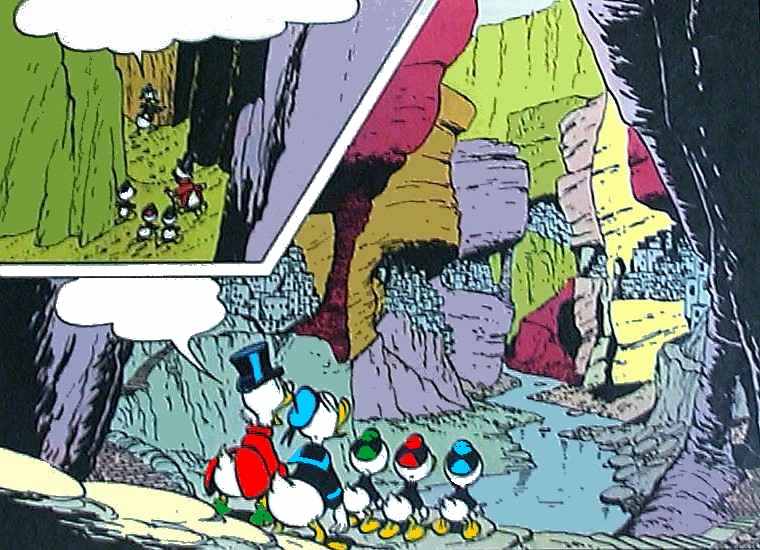
I like the new Lara for many other reasons too, not just for her more realistic personality but for the meticulous graphics of her lost cities, which remind me of Barks’ work at its best. Compare these two images of Scrooge and Lara:

Uncle Scrooge and the Seven Cities of Cibola
Scrooge and his relatives get their first view of the Seven Cities of Cibola.

Lara Croft in Rise of the Tomb Raider
Lara Croft gets her first view of a barely ruined civilization in Rise of the Tomb Raider.

Lara’s stories are still basically linear, though there are large, explorable areas and multiple ways to get past some of the game’s obstacles. She still climbs walls of rock and falls off them a lot. But the Scrooge stories are, by their nature, even more linear and the thrill of discovery, heightened by the sense of learning that a piece of the ancient past is still alive, is always present in stories about both characters. In Rise of the Tomb Raider even more than in the previous reboot (or the earlier games) Lara finds herself treading the path that Allan Quatermain, Tarzan and Scrooge McDuck have trod before her. And I love both Lara and Scrooge for that magical voyage into living history as much, or more, than for anything else about them.

Design a site like this with WordPress.com
Get started