Telegraph
Also found in: Dictionary, Thesaurus, Legal, Idioms, Wikipedia.
Telegraph
a device for transmitting and/or receiving electric signals in telegraph communication.
The first practical telegraph, an electromagnetic design, was invented by P. L. Shilling and demonstrated in 1832. In the early days of telegraphy, coded messages were transmitted by keyboard devices or telegraph keys. The received messages were recorded by a register in the form of broken lines, for example, with a siphon recorder, or as a series of dots and dashes, as with the Morse telegraph. With the Wheatstone telegraph and Creed printer, the received telegraph signals were recorded on a perforated paper tape; the Creed printer could also reproduce printed characters. Improved letter-printing telegraphs were developed by Iakobi (M. H. Jacobi), Hughes, and Siemens, and Baudot developed the multiplex telegraph. The “copying” telegraph, or teleautograph, which copies letters in script, was also invented.
The first Soviet telegraphs were built by A. P. Trusevich (1921), V. I. Kaupuzh (1925), and A. F. Shorin (1928); Shorin’s telegraph was put into service in 1929. Other Soviet inventors and scientists who made important contributions to the development and design of the telegraph included L. I. Tremí’, S. I. Cha-sovnikov, E. A. Volkov, N. G. Gagarin, A. D. Ignat’ev, L. N. Gurin, G. P. Kozlov, and V. I. Kerbi.
Modern telegraphs use either an equal-length or an unequal-length code. The unequal-length code is rarely used in telegraphy because it is less economical and not suitable for use with a receiver’s teleprinter. In the equal-length code, each code combination contains the same number of elements, thus facilitating reception by a teleprinter. Depending on the transmission method used, telegraphs may be designed for start-stop or synchronous operation.
Modern telegraphs usually consist of a transmitter and a receiver, which are usually supplied with direct current from 60-volt rectifiers or with alternating current from a direct connection to electric power mains.
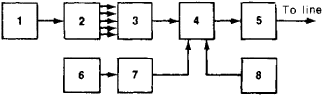
The transmitter encodes the characters being transmitted by producing combinations of elementary signals according to the given code. It then converts the parallel code combination into a serial combination. The receiver inserts service signals into the code combination for the synchronization and phase alignment of the receiver and transmits to the communications line a sequence of electrical signals of the required duration and amplitude. When the transmitter is operating (Figure 1), each character of the transmitted message passes from the message source to the encoder, where it is automatically converted to a code combination. The elements of the combination appear simultaneously at the encoder output and pass into a selector. The transmitting distributor successively converts each element of the code combination into an electrical signal of specific duration. The output device generates electrical signals of the required power, polarity, and wave form, and a sender produces the service elements for the code combination. The transmission speed is controlled by an actuator, and the method of transmission—start-stop or synchronous—is determined by the operational mode of a control device.
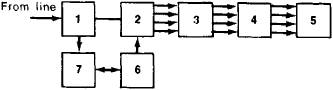
The telegraph receiver (Figure 2) receives the electrical signals of the code combination, determines the polarity of each elementary signal, decodes the code combination, and prints the received characters. The electrical signals of the code combination enter an input device, which determines the signal polarity and corrects distortions. From there the elementary signals of the code combination pass through the receiving distributor to a selector, where they are stored and passed on to the decoder. Signals from the decoder output are fed to the printer, where the message is recorded on a paper tape (in a tape telegraph) or on a roll (in a page teletypewriter). Synchronization and phase alignment of the receiver are carried out by the receiver’s distributor and control device operating together. The speed of operation is controlled by the actuator.
Telegraphs may also have accessory equipment to perform automated functions, such as reperforators, transmitters, and automatic answering and shut-off devices. Such accessories provide automatic transmission and reception of messages, automatic verification of switching connections, and automatic on-off switching of the actuator.
Until the middle of the 20th century, all telegraphs were electromechanical devices. By the 1970’s, however, series production of electronic telegraphs was organized in the USSR and many foreign countries. Most of the devices used in such equipment usually have no contacts. In the transmitter such contactless components include the coding and output devices, the distributor, the actuator, the control device, and the service element sender. In the receiver they include the input device, the selector, the distributor, and the decoder. In comparison with electromechanical systems, the electronic telegraph has many advantages, including higher transmission speed, longer service life, lower power consumption, and provision for making rapid changes in transmission speed and code type. Work on an electronic telegraph with no mechanical elements is in progress.
REFERENCES
Balagin, I. Ia., V. A. Kudriashov, and N. F. Semeniuta. Peredacha diskretnoi informatsii i lelegrafiia. Moscow, 1971.Printsipy postroeniia elektronno-mekhanicheskikh telegrafnykh apparatov. Moscow, 1973.
A. I. KOBLENTS