


Replacement migration
In demography, replacement migration is a theory of migration needed for a region to achieve a particular objective (demographic, economic or social).[1] Generally, studies using this concept have as an objective to avoid the decline of total population and the decline of the working-age population.
Often, these overall declines in the population are influenced by low fertility rates. When fertility is lower than the replacement level of 2.1 children per woman and there is a longer life expectancy, this changes the age structure over time.[2] Overall, the population will start to decline as there will not be enough children born to replace the population of people lost and the proportion of older individuals composing the population will continue to increase. One concern from this is that the age-dependency ratio will be affected, as the working-age population will have more dependents in older age to support. Therefore, replacement migration has been a proposed mechanism to try and combat declining population size, aging populations and help replenish the number of people in the working age groups.
Projections calculating migration replacement are primarily demographics and theoretical exercises and not forecasts or recommendations. However, this demographic information can help prompt governments to facilitate replacement migration by making policy changes.[3]
The concept of replacement migration may vary according to the study and depending on the context in which it applies. It may be a number of annual immigrants,[4] a net migration,[5] an additional number of immigrants compared to a reference scenario,[6] etc.
Replacement with immigrants can have partisan motivations.[7]
Types of replacement migration
[edit]Replacement migration may take several forms because several scenarios of projections population can achieve the same aim. However, two forms predominate: minimal replacement migration and constant replacement migration.
Minimal replacement migration
[edit]Replacement migration is a minimum migration without surplus to achieve a chosen objective. This form of replacement migration may result in large fluctuations between periods. Its calculation will depend on the chosen objective. For example, Marois (2008) calculates the gross number of immigrants needed to prevent total population decline in Quebec.[8] The formula is then the following:
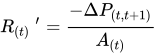
Where:
- R(t)' = Replacement Migration avoiding the decline of population in year t
- A(t) = retention rate of immigrants year t, defined by (1 - instantaneous departure rate)
- ∆P(t,t+1) = change in the total population in the time interval t, t+1
Constant replacement migration
[edit]The constant replacement migration does not fluctuate and remains the same throughout the projection. For example, it will be calculated with a projection providing a migration of X throughout the temporal horizon.[citation needed]
Examples
[edit]Canada's immigration policy is fundamentally designed to support its economy by addressing labour shortages and mitigating the effects of an aging population.[9] Former Prime Minister Brian Mulroney supported the Century Initiative, a group advocating Canada grow its population to 100 million by 2100, seeing it as vital for economic growth, an aging workforce, and global influence, though this goal sparks debate about infrastructure strain and immigration levels.[10][11]
Prime Minister Anthony Albanese's government has viewed skilled migration as crucial for tackling Australia's ageing population and workforce shortages.[12]
Chancellor Olaf Scholz's government has actively pursued increased skilled immigration to address Germany's labour shortage and mitigate the effects of its aging population.[13] Scholz indicated that Germany would need to accept approximately 288,000 foreign workers annually.[14]
Spanish Prime Minister Pedro Sánchez has advocated for policies promoting immigration as a means to address Spain's demographic decline and aging population.[15] In January 2026, Sánchez approved a decree to regularize approximately 500,000 undocumented immigrants living in Spain.[16]
Replacement migration as a factor in the culturalization of national identity
[edit]Europe
[edit]According to M.S. Salkina, replacement migration has become a societal challenge for European countries experiencing a demographic crisis and practicing a model of strict civic assimilation.[17]
According to M.S. Salkina, intensive migration flows inevitably raise the question of whether quantitative changes can transform into qualitative ones, i.e., the transformation of Europe's cultural and, consequently, political landscape.[17]
According to demographic statistics, the share of foreigners in the European Union will increase, as the insufficient natural population growth in Europe is compensated for by replacement migration.[17]
According to M.S. Salkina, the inability of Europe's ruling elites to develop an effective policy for the adaptation of Muslim migrants has given rise to a complex of problems that have led to the development of two complementary trends:
1) the actualization of the concept of national identity;[17]
2) the culturalization of political processes, within which culture is viewed as a "causal explanation" of politics and, consequently, of national identity itself as a politically significant cognitive construct.[17]
W. Lagrange also notes that migration-related issues have long been analyzed from the perspectives of sociology and economics, but not culture. Until recently, this approach also dominated political practice; however, changes are currently emerging in the situation, primarily due to the strengthening of far-right parties for the first time since World War II. As a result, replacement migration has gradually come to be viewed not so much as biological compensation for low natural growth, which allows for the maintenance of the economic system, but rather as a process of cultural substitution, threatening, among other things, the political landscape of European nation states.[17]
In the next 50 years, i.e., by 2050, the population of almost all developed countries will decrease and become older due to low birth rates and increasing life expectancy. Thus, in the absence of measures to increase the birth rate of the constituent population or without replacement migration, population decline is inevitable. Despite the likelihood of increased fertility, few experts believe it will be sufficient to reach replacement levels in the foreseeable future. The number of immigrants required to avoid overall population decline significantly exceeds previous UN estimates. By 2050, immigrants who arrived after 1995 and their descendants could comprise up to 40% of the population (for example, in the case of Germany).[17]
As C. Keeley writes, if fertility rates fall below replacement levels (as indicated by the UN report), the number of members of the original population steadily declines and eventually disappears, establishing a direct correlation between the preservation of language and culture, on the one hand, and the policy of accommodating migrants of other cultures, on the other.
This conclusion refers to the concept of societal security of a state, introduced by the Copenhagen School—that is, its ability to maintain its essential character in changing conditions, as well as in the face of potential or actual threats. Ensuring this requires measures aimed at stimulating natural population growth in the host society and assimilating representatives of other cultures. Currently, no EU member state is pursuing an assimilationist approach.[17]
France
[edit]France, along with Germany, which serves as the main political and economic pillar of the European Union, is no exception in this regard, and the problem of cultural displacement has found resonance in political and intellectual circles, as demonstrated by the following chronology:
- In 2011, the book "Le Grand Remplacement" ("The Great Replacement") by R. Camus, a political activist who went from membership in the Socialist Party to a pronounced right-wing conviction, was published;[17]
- In 2013, the suicide of historian and journalist D. Wenner, an adherent of far-right views, in Notre Dame Cathedral in Paris became a significant event for the French intellectual community; The suicide note listed the erosion of national identity and cultural displacement as the motives;[17]
- In 2014, journalist E. Zemmour's book "Le suicide français" ("The Suicide of France") was published, and in 2016, philosopher M. Onfray's work "Penser l'islam" ("Understanding islam") was published.[17]
According to M.S. Salkina, the leitmotif of these publications is a disagreement with the predominance of the political content of national identity over the cultural and an approach to the demographic problem from the perspective of societal security.[17]
Regarding the demographic situation in France, according to the aforementioned UN Population Division report, the number of immigrants needed to prevent a decline in the active population is 2-4 times higher than the number required to halt the overall decline.[17]
At the same time, France is perceived in the EU as having a high birth rate (for Europe): 12.3 births per 1,000 inhabitants (1.6-1.8 births per woman) as of 2013.[17]
France can be considered notable among other EU member states because:
1) It is characterized by ideological polarization, as noted by the philosopher and sociologist R. Aron. This characteristic is also evident in the field of demography, where the "left-leaning" (and, due to the political situation, more in demand) P. Vey, E. Le Bras, and J. Noiriel, on the one hand, confront each other, and the "right-leaning" F. Boursier de Carbon, M. Tribalat, and J.-F. Dumont, on the other.[17]
2) The issue of replacement migration falls under the 1905 law on the separation of church and state. As a result, religion and cultural traditions remain private and can be freely instilled in second- and third-generation immigrants—that is, from a political perspective, future voters. Consequently, the state attempts only "civic assimilation" toward individuals of non-European descent, while the religious problem proves virtually insoluble. The formation of the French nation, in the modern sense of the term, proceeded along the lines of assimilationism: the country's population was linguistically and culturally heterogeneous (as recently as 1883, approximately a quarter of the population did not speak French), and therefore, eliminating this diversity for the purpose of administrative and cultural unification was one of the primary tasks of the republican regime. However, it is important to emphasize that the focus was on introducing the European, Christian population to the civic concepts and values of the new political reality; the issue of Islam was not a concern for the authorities at that time.[17]
3) The main source of immigration to France is the Maghreb countries, and France is home to the largest Muslim community in the EU (after Bulgaria). The highest concentrations of Muslims are found in the regions of Ile-de-France, Provence-Alpes-Côte d'Azur, and Rhône-Alpes. However, official statistics that would allow an accurate determination of the number of Muslims in the country are lacking, as an 1872 law prohibits questions on religious topics in state censuses. This prohibition was further formalized in a 1978 law, which prohibits the collection and processing of personal data that directly or indirectly indicates racial or ethnic origin, as well as political, philosophical, or religious beliefs. Nevertheless, it is estimated that approximately 5 million Muslims currently live in France, whose electoral weight became evident in 2012 after the election of Francois Hollande. According to demographer Jean-François Dumont, the overwhelming majority of Muslims voted for him.[17]
Dynamics and extent of changes in the population structure of France
[edit]According to Insee data, in 2014, 29% of newborns born in mainland France had at least one parent born abroad, 25.3% of whom were born outside the EU.[17]
Forty percent of children born between 2006 and 2008 had at least one parent or grandparent who was an immigrant, of whom 10% had both parents who were immigrants, 27% of whom were of non-European origin (16% were from the Maghreb).[17]
In 2015, 7.3 million people (11% of the population) born in France had at least one parent who was an immigrant, and 55% of these were of non-European origin (42% of whom were from Africa, primarily Algeria, Morocco, and Tunisia).[17]
That same year, historian P. Blanchard noted that 12-14 million French people (18-22% of the total population) had at least one ancestor in their grandparent's generation born outside of Europe.[17]
It is important to emphasize that the country's Muslim population is generally much younger: the proportion of people over 50 in this category is approximately half that of the rest of the French population. It is estimated that approximately half of the Muslims living in the country are under 24 years old. Furthermore, Islam plays the greatest role in the lives of younger generations of Muslims. As M. Onfray notes, "in France, with the help of demography, spirituality in its active form has become less Judeo-Christian and more Muslim." This is illustrated by the examples of communes such as Trappes, Châteauneuf-sur-Cher, and Clichy.[17]
Trappes exemplifies the transition from demographic to cultural replacement: in 2018, 70% of the commune's population was Muslim. Châteauneuf-sur-Seine has become known for an unusual phenomenon: the emergence of a Muslim community in the countryside. The community is led by Moroccan imam Mohammed Zakaria Shifa, a salafist who advocates the creation of Muslim villages. Furthermore, the community insisted on receiving a plot in the commune's cemetery, as most local Muslims are "native French or French by birthright".[17]
In the commune of Clichy, a nearly year-long conflict has been ongoing between the mayor's office and the local Union of Muslim Associations, which is protesting the closure of a mosque in the city center and organizing worship services right on the street.[17]
The situation in the department of Seine-Saint-Denis is also noteworthy, as it has as many Muslims as the entire Provence-Alpes-Côte d'Azur region and where a third of residents aged 18 to 50 are Muslim. Moreover, for every 117 Catholic places of worship in the department, there are 145 Muslim ones, which philosopher A. Finkielkraut described as a takeover.[17]
This situation has naturally generated a backlash: for example, the period from 2014 to November 2017 was marked by controversy surrounding the Christmas crèches installed in administrative buildings, including city halls. C. Bertrand, a member of parliament for the center-right Union for a Popular Movement party, emphasized that France is a secular state founded on Christian tradition, adding: "We must not apologize for who we are."[17]
The cultural dimension of national identity in French politics
[edit]Traditionally, in French political circles, the concept of national identity and its cultural foundations was seen as an indicator of pronounced right-wing convictions.[17]
However, in the final years of Francois Hollande's rule, these concepts also entered the rhetoric of the French left, which, according to M.S. Salkina, was guided more by pragmatic considerations than by ideological ones. In the eyes of the population, approaches to resolving the migration issue (primarily the problem of interaction with various branches of Islam) became one of the most important criteria for evaluating political programs. Therefore, left-wing parties could not allow the concept of national identity, inextricably linked to this issue, to remain exclusively in the ideological arsenal of their opponents. Nevertheless, this can be seen as an important shift, signifying that the cultural issues of national self-identification can no longer be ignored even by those politicians who defended the inclusive model of self-identification typical of left-wing parties.[17]
Results
[edit] |
The raw results of replacement migration are not necessarily comparable depending on the type of replacement migration used by the author. Nevertheless, major demographics conclusions are recurrent:
- The replacement migration reached impossible levels in practice to avoid aging the population, to maintain dependency ratio or influence significantly the age structure of a region.
- For regions with a relatively high fertility rate, replacement migration avoiding a decline in the total population or the working age is not excessively high. However, for regions with very low fertility rate, migration replacement is very high and unrealistic.
- The level of fertility is a much more important than the Immigration on aging and age structure.
- The principal effect of immigration is on aggregate population without substantially modifying its structure.
Criticism
[edit]Replacement migration as presented by the United Nations Population Division in 2000 is largely perceived as unrealistic as a singular way of fighting population ageing.[18][19][20] One reason being that replacement migration tends to only be a temporary fix to aging populations. Instead of using replacement migration to combat declining and aging populations, government policy and social changes could be implemented.[21] Therefore, replacement migration is said to be more useful as an analytical or hypothetical tool.[19]
Increased migration could decrease the old age dependency ratio, which is expected to grow considerably in the next decades.[19] However, the immigration need to effectively counter the greying of many industrialised economies is unrealistically high.[22]
A 2019 paper reasserted the conclusions of the 2000 UN Population Division paper, arguing that while immigration could play a role in moderating the effects of an ageing population, the number of immigrants required to actually halt the ageing of the population (expressed in terms of maintaining the potential support ratio) was too high to be realistic.[23] A 2016 paper on the impact of migration on the projected population trends of the Scandinavian countries reached similar conclusions.[24]
Replacement migration is also feared to negatively impact the environment.[21] Declining and aging populations are typically seen in more developed countries, as more developed countries have better health care infrastructure and access to education that both decreases mortality rates and subsequently fertility rates in the population.[25] Immigrants are typically moving from areas that have fewer resources or economic opportunities, as access to more resources and economic prosperity can be a pull factors for these migrants to move to a new country. A large influx of immigrants from an area that is low or lacks resources to a country that has more resources may change the availability of resources since there will be more people.[21] Resources could be food, water, land, energy etc.
There are concerns about a brain drain from developing countries, with professionals such as doctors and nurses leaving for better-paid jobs abroad.[26]
Certain countries may be opposed to international immigration. Reasons such as xenophobia can subject new immigrants to discrimination, thus, the immigrants may have trouble assimilating to their new country.[25] The native population of said countries may also resent and oppose the loss of national identity, homogeneous national culture, and the loss of advantages for native people that replacement immigration leads to.[citation needed]
Advances in robotics and AI could diminish the need for migrant workers, especially in low-skilled jobs.[27]
See also
[edit]Notes and references
[edit]- ^ Marois, Guillaume (2008). "La « migration de remplacement » : un exercice méthodologique en rapport aux enjeux démographiques du Québec" (PDF). Cahier québécois de démographie. 37 (2): 237–261. doi:10.7202/038132ar.
- ^ United Nations Secretariat. Department of Economic and Social Affairs. Population Division (2001). "Replacement Migration: Is it a Solution to Declining and Ageing Populations?" (PDF). ESA/P/WP. United Nations. p. 177. Retrieved 19 April 2023.
- ^ Bijak, Jakub (2008). "Replacement Migration Revisited: Simulations of the Effects of Selected Population and Labor Market Strategies for the Aging Europe, 2002-2052". Population Research and Policy Review. 27 (3): 321–342. doi:10.1007/s11113-007-9065-2. JSTOR 41217953. S2CID 154813850.
- ^ Marois, Guillaume (2007). "Démystification de l'impact de l'immigration sur la démographie québécoise : des résultats surprenants" (PDF). Mémoire déposé lors de la Consultation publique en vue de la planification triennale des niveaux d’immigration pour la période 2008–2010. Commission de la culture, Gouvernement du Québec. p. 15. Archived from the original (PDF) on 6 July 2011. Retrieved 14 November 2009.
- ^ "Replacement Migration". Archived from the original on 30 May 2017. Retrieved 29 June 2017.
- ^ Bijak, Jakub (2005). Replacement Migration Revisited: Migratory Flows, Population and Labour Force in Europe, 2002–2052 (PDF). UN ECE Work Session on Demographic Projections. Vienne. p. 37. Archived from the original (PDF) on 21 July 2011. Retrieved 14 November 2009.
- ^ "Irene Montero: "Tras la regularización de inmigrantes, vamos a por la nacionalidad y a que puedan votar"". El Mundo (in Spanish). 31 January 2026. Retrieved 1 February 2026.
Ojalá teoría del reemplazo, ojalá podamos barrer de fachas y de racistas este país con gente migrante, con gente trabajadora. Claro que yo quiero que haya reemplazo: reemplazo de fachas, reemplazo de racistas, reemplazo de vividores, y que podamos hacerlo con gente trabajadora tengan el color de piel que tengan.
[I hope the replacement theory works, I hope we can rid this country of fascists and racists with migrants, with hard-working people. Of course I want replacement: replacement of fascists, replacement of racists, replacement of freeloaders, and I hope we can do it with hard-working people, whatever their skin color.] - ^ Marois, Guillaume (2008). "La « migration de remplacement » : un exercice méthodologique en rapport aux enjeux démographiques du Québec" (PDF). Cahier québécois de démographie. 37 (2): 237–261. doi:10.7202/038132ar.
- ^ "CIMM – Labour Shortages – November 25, 2024". Canada.ca.
- ^ Ibbitson, John (31 March 2021). "It's time for Canada to focus on expanding our population". The Globe and Mail.
- ^ "Canada Welcomes Record Number of Immigrants, Seeks More". VOA News. 2 February 2023.
- ^ "Australia's Albanese faces immigration heat as house prices soar". Nikkei Asia. 6 December 2023.
- ^ "'Serious politics': Scholz backs government's migration policies". Euronews. 11 September 2024.
- ^ "German chancellor praises 'well-integrated' immigrants in party meeting". Anadolu Agency. 30 November 2024.
- ^ "Spain will legalize hundreds of thousands of undocumented migrants". VOA News. 20 November 2024.
- ^ Millar, Paul (28 January 2026). "Why Spain is offering amnesty to 500,000 undocumented migrants". France 24.
- ^ a b c d e f g h i j k l m n o p q r s t u v w x y z aa ab "Замещающая миграция как фактор культурализации национальной идентичности: опыт Франции". 2018.
{{cite web}}:|first=missing|last=(help) - ^ Wilson, Chris; Sobotka, Tomáš; Williamson, Lee; Boyle, Paul (2013). "Migration and Intergenerational Replacement in Europe". Population and Development Review. 39: 131–157. doi:10.1111/j.1728-4457.2013.00576.x. hdl:10023/6271.
- ^ a b c McDonald, Peter; Kippen, Rebecca (March 2001). "Labor Supply Prospects in 16 Developed Countries, 2000–2050" (PDF). Population and Development Review. 27 (1): 1–32. doi:10.1111/j.1728-4457.2001.00001.x. JSTOR 2695153. Archived from the original (PDF) on 20 May 2006. Retrieved 20 March 2016.
- ^ Coleman, DA (2002). "Replacement migration, or why everyone is going to have to live in Korea: a fable for our times from the United Nations". Philos. Trans. R. Soc. Lond. B Biol. Sci. 357 (1420): 583–98. doi:10.1098/rstb.2001.1034. PMC 1692968. PMID 12028794.
- ^ a b c Meyerson, Frederick A. B. (2001). "Replacement Migration: A Questionable Tactic for Delaying the Inevitable Effects of Fertility Transition". Population and Environment. 22 (4): 401–409. Bibcode:2001PopEn..22..401M. doi:10.1023/A:1006749722702. S2CID 151180628.
- ^ Bongaarts, John (2004). "Population Aging and the Rising Cost of Public Pensions" (PDF). Population and Development Review. 30 (1): 1–23. doi:10.1111/j.1728-4457.2004.00001.x. S2CID 8474752.
- ^ Craveiro, Daniela; Tiago de Oliveira, Isabel (2019). "Back to replacement migration". Demographic Research. 40: 1323–1344. doi:10.4054/DemRes.2019.40.45. hdl:10400.11/6732. S2CID 182339089.
- ^ Heleniak, Timothy; Sanchez Gaussen, Nora (2016). The impact of migration on projected population trends in Denmark, Finland, Iceland, Norway and Sweden: 2015–2080 (Technical report). Nordregio. 5.
- ^ a b Weeks, John R. (2015). Population: An Introduction to Concepts and Issues. Cengage Learning. ISBN 978-1-305-09450-5.
- ^ "Germany to welcome Kenyans in labour deal". BBC. 14 September 2024.
- ^ Strauss, Delphine (2016). "Robots could replace migrant workers, says think-tank". Financial Times.