


Portal:India


Introduction

.svg)
India, officially the Republic of India, is a country in South Asia. It is the seventh-largest country by area, the most populous country in the world and, since its independence in 1947, the world's most populous democracy. Bounded by the Indian Ocean on the south, the Arabian Sea on the southwest, and the Bay of Bengal on the southeast, it shares land borders with Pakistan to the west; China, Nepal and Bhutan to the north; Bangladesh and Myanmar to the east. In the Indian Ocean, India is near Sri Lanka and the Maldives. Its Andaman and Nicobar Islands share a maritime border with Myanmar, Thailand and Indonesia. (Full article...)

 Featured article –

-

The Marwari, also known as the Malani is a rare breed of horse from the Marwar region of Rajasthan, in north-west India. It is closely related to the Kathiawari breed of the Kathiawar peninsula of Gujarat, with which it shares the distinctive inward-curving ears. Marwari horses are found in all equine colours, including piebald and skewbald. It is a hardy riding horse and may exhibit a natural ambling gait.
The Rathores, traditional rulers of the Marwar region of western India, were the first to breed the Marwari. Beginning in the 12th century, they espoused strict breeding that promoted purity and hardiness. Used throughout history as a cavalry horse by the people of the Marwar region, the Marwari was noted for its loyalty and bravery in battle. The breed deteriorated in the 1930s, when poor management practices resulted in a reduction of the breeding stock, but today has regained some of its popularity. The Marwari is used for light draught and agricultural work, as well as riding and packing. In 1995, a breed society was formed for the Marwari horse in India. The exportation of Marwari horses was banned for decades, but between 2000 and 2006, a small number of exports were allowed. Since 2008, visas allowing temporary travel of Marwari horses outside India have been available in small numbers. Though they are rare they are becoming more popular outside of India due to their unique looks. (Full article...) -

Core area of Western Chalukya architectural activity in modern Karnataka state, India
Western Chalukya architecture, also known as Kalyani Chalukya or Later Chalukya architecture and broadly classified under the Vesara Style, is the distinctive style of ornamented architecture that evolved during the rule of the Western Chalukya Empire in the Tungabhadra region of modern central Karnataka, India, during the 11th and 12th centuries. Western Chalukyan political influence was at its peak in the Deccan Plateau during this period. The centre of cultural and temple-building activity lay in the Tungabhadra region, where large medieval workshops built numerous monuments. These monuments, regional variants of pre-existing dravida (South Indian) temples, form a climax to the wider regional temple architecture tradition called Vesara or Karnata dravida. Temples of all sizes built by the Chalukyan architects during this era remain today as examples of the architectural style.
Most notable of the many buildings dating from this period are the Mahadeva Temple at Itagi in the Koppal district, the Kasivisvesvara Temple at Lakkundi in the Gadag district, the Mallikarjuna Temple at Kuruvatti in the Bellary district and the Kallesvara Temple at Bagali in the Davangere district. Other monuments notable for their craftsmanship include the Kaitabheshvara Temple in Kubatur and Kedareshvara Temple in Balligavi, both in the Shimoga district, the Siddhesvara Temple at Haveri in the Haveri district, the Amrtesvara Temple at Annigeri in the Dharwad district, the Sarasvati Temple in Gadag, and the Dodda Basappa Temple at Dambal, both in the Gadag district. (Full article...) -
Mughal-e-Azam (transl. The Great Mughal) is a 1960 Indian epic historical drama film produced and directed by K. Asif. Starring Prithviraj Kapoor, Dilip Kumar, Madhubala, and Durga Khote, it follows the love affair between Mughal Prince Salim (who went on to become Emperor Jahangir) and Anarkali, a court dancer. Salim's father, Emperor Akbar, disapproves of the relationship, which leads to a war between father and son.
The development of Mughal-e-Azam began in 1944, when Asif read the 1922 play Anarkali, by playwright Imtiaz Ali Taj, which is set in the reign of Emperor Akbar (1556–1605). Production was plagued by delays and financial uncertainty. Before its principal photography began in the early 1950s, the project had lost a financier and undergone a complete change of cast. Mughal-e-Azam cost more to produce than any previous Indian motion picture; the budget for a single song sequence exceeded that typical for an entire film of the period. The soundtrack, inspired by Indian classical and folk music, comprises 12 songs voiced by playback singer Lata Mangeshkar along with Mohammed Rafi, Shamshad Begum, and classical singer Bade Ghulam Ali Khan, and is often cited among the finest in the history of Hindi cinema. (Full article...) -
Kareena Kapoor Khan (pronounced [kəˈriːna kəˈpuːr xɑːn]; née Kapoor; born 21 September 1980) is an Indian actress. She has been known for her leading roles in Hindi cinema since 2000. Kapoor is the recipient of several awards, including six Filmfare Awards, and as of 2024, is one of Hindi cinema's highest-paid actresses.
Born into the Kapoor family, she is the daughter of actors Babita and Randhir Kapoor, and the younger sister of actress Karisma Kapoor. After making her acting debut in 2000 in Refugee, Kapoor established herself the following year with several roles, including in the top-grossing drama Kabhi Khushi Kabhie Gham. This was followed by a series of commercial failures and negative reviews for her repetitive roles. An against-type performance as a sex worker in the 2004 drama Chameli marked a turning point in her career. She earned critical recognition for her portrayal of a riot victim in the 2004 drama Dev and a character based on Desdemona in the 2006 crime film Omkara. Her performance as a loquacious woman in the romantic comedy Jab We Met (2007) earned her the Filmfare Award for Best Actress. (Full article...) -
Andha Naal (pronounced [an̪da naːɭ] transl. That Day) is a 1954 Indian Tamil-language mystery and thriller film, produced by A. V. Meiyappan and directed by S. Balachander. It is the first film noir in Tamil cinema, and the first Tamil film to be made without songs, dance, or stunt sequences. Set in the milieu of World War II, the story is about the killing of a radio engineer Rajan (Sivaji Ganesan). The suspects are Rajan's wife Usha (Pandari Bai), the neighbour Chinnaiya Pillai (P. D. Sambandam), Rajan's brother Pattabi (T. K. Balachandran), Rajan's sister-in-law Hema (Menaka), and Rajan's mistress Ambujam (K. Sooryakala). Each one's account of the incident points to a new suspect.
Balachander watched Akira Kurosawa's Rashomon (1950) at a film festival, was inspired by it and wrote a play in the same narrative style, but the script was rejected by All India Radio; Meiyappan later agreed to produce it as the film that would later be titled Andha Naal under AVM Productions. The screenplay was written by Javar Seetharaman, who also played a prominent role as an investigative officer in the film. The cinematography was handled by S. Maruti Rao, and the background score was composed by AVM's own music troupe, Saraswathy Stores Orchestra. The film was shorter than most contemporaneous Tamil films. It was the only film directed by Balachander for AVM. (Full article...) -
Ram Narayan (IPA: [raːm naːˈɾaːjəɳ]; 25 December 1927 – 9 November 2024), often referred to with the title Pandit, was an Indian musician who popularised the bowed instrument sarangi as a solo concert instrument in Hindustani classical music and became the first internationally successful sarangi player.
Narayan was born near Udaipur and learned to play the sarangi at an early age. He studied under sarangi players and singers and, as a teenager, worked as a music teacher and travelling musician. All India Radio in Lahore hired Narayan as an accompanist for vocalists in 1944. Narayan relocated to Delhi following the partition of India in 1947, and moved to Mumbai in 1949 to work in Indian cinema. (Full article...) -
Kalki Koechlin (/ˈkʌlki kɛˈklæ̃/ ⓘ; born 10 January 1984) is an Indian–born French actress who works in films and stage. Known for her unconventional body of work, primarily in Hindi films, she is the recipient of several accolades, including a National Film Award and a Filmfare Award. Although a French citizen, she has been raised and lived most of her life in India.
Born in Pondicherry, Koechlin was drawn to theatre from a young age. She studied drama at Goldsmiths, University of London, and worked simultaneously with a theatre company. After returning to India, she made her Hindi film debut as Chanda in the black comedy-drama Dev.D. (2009), winning the Filmfare Award for Best Supporting Actress. She subsequently starred in two of the highest-grossing Hindi films of their respective years, the comedy-dramas Zindagi Na Milegi Dobara (2011) and Yeh Jawaani Hai Deewani (2013), both of which garnered her Filmfare Award for Best Supporting Actress nominations. Koechlin also starred in and co-wrote the crime thriller That Girl in Yellow Boots (2011). (Full article...) -
Rani Mukerji (Hindustani pronunciation: [raːni mʊkʰərdʒi]; born 21 March 1978) is an Indian actress who works in Hindi films. One of the highest-paid actresses of the 2000s, She is the recipient of multiple accolades, including a National Film Award and eight Filmfare Awards.
Born into the Mukherjee-Samarth family, Mukerji began acting as a teenager by starring in her father Ram Mukherjee's Bengali-language film Biyer Phool and in the social drama Raja Ki Aayegi Baaraat (both 1996). Mukerji had her first commercial success with the action film Ghulam and breakthrough with the romance Kuch Kuch Hota Hai (both 1998). Following a brief setback, the year 2002 marked a turning point for her when she was cast by Yash Raj Films as the star of the drama Saathiya. (Full article...) -
Arthur Edward Jeune Collins (18 August 1885 – 11 November 1914) was an English cricketer and soldier. He held, for 116 years, the record of highest score in cricket: as a 13-year-old schoolboy, he scored 628 not out over four afternoons in June 1899. Collins's record-making innings drew a large crowd and increasing media interest; spectators at the Old Cliftonian match being played nearby were drawn away to watch the junior school house cricket match in which Collins was playing. Despite this achievement, Collins never played first-class cricket. Collins's 628 not out stood as the record score until January 2016 when an Indian boy, Pranav Dhanawade, scored 1009 in a single innings.
Collins joined the British Army in 1902 and studied at the Royal Military Academy, Woolwich, before becoming an officer in the Royal Engineers. He served in France during the First World War, where he was killed in action in 1914 during the First Battle of Ypres. Collins had been mentioned in despatches and also represented the Royal Military Academy at cricket and rugby union. (Full article...) -
Margarita with a Straw is a 2014 Indian Hindi-language drama film directed by Shonali Bose. It stars Kalki Koechlin as an Indian teenager with cerebral palsy who relocates to the United States for her undergraduate education and comes of age following her complex relationship with a blind girl, played by Sayani Gupta. Revathi, Kuljeet Singh, and William Moseley play supporting roles. Produced by Bose in partnership with Viacom18 Motion Pictures, Margarita with a Straw was co-written by Bose and Nilesh Maniyar. The film deals with themes of sexuality, inclusion, self-love, and self-acceptance.
Bose conceived the idea for the film in January 2011 during a conversation with her cousin Malini Chib, a disability rights activist, about the latter's desire to have a normal sex life. Inspired by Chib's story, Bose wrote the first draft of a script. After winning a Sundance Mahindra Global Filmmaker Award for the draft, she modified the script to reflect her own perspective, incorporating several personal experiences into the narrative. Bose completed the screenplay with co-writer Maniyar and the advisory council of the Sundance Institute. (Full article...) -
Chandralekha (also spelt Chandraleka) is a 1948 Indian historical and adventure film produced and directed by S. S. Vasan of Gemini Studios. Starring T. R. Rajakumari, M. K. Radha and Ranjan, the film follows two brothers (Veerasimhan and Sasankan) who fight over ruling their father's kingdom and marrying a village dancer, Chandralekha.
Development began during the early 1940s when, after two successive box-office hits, Vasan announced that his next film would be entitled Chandralekha. However, when he launched an advertising campaign for the film he only had the name of the heroine from a storyline he had rejected. Veppathur Kittoo (one of Vasan's storyboard artists) developed a story based on a chapter of George W. M. Reynolds' novel, Robert Macaire: or, The French bandit in England. Original director T. G. Raghavachari left the film more than halfway through because of disagreements with Vasan, who took over in his directorial debut. (Full article...) -
The 2000 Sri Lanka cyclone (IMD designation: BOB 06 JTWC designation: 04B) was the strongest tropical cyclone to strike Sri Lanka since 1978. The fourth tropical storm and the second severe cyclonic storm of the 2000 North Indian Ocean cyclone season, it developed from an area of disturbed weather on December 25, 2000. It moved westward, and quickly strengthened under favorable conditions to reach top wind speeds of 75 mph (121 km/h). The cyclone hit eastern Sri Lanka at peak strength, then weakened slightly while crossing the island before making landfall over southern India on December 28. The storm degenerated into a remnant low later that day, before merging with another trough on the next day.
The storm was the first cyclone over Sri Lanka with winds of at least hurricane strength since a cyclone of 1978 hit the island in the 1978 season, as well as the first tropical storm to hit the island since 1992. The storm was also the first December tropical cyclone of hurricane intensity in the Bay of Bengal since 1996. It produced heavy rainfall and strong winds, damaging or destroying tens of thousands of houses and leaving up to 500,000 homeless. At least nine people died as a result of the cyclone. (Full article...) -
Loev (pronounced love) is a 2015 Indian romantic drama film written and directed by Sudhanshu Saria. It stars Dhruv Ganesh and Shiv Panditt as two friends who set off to the Western Ghats for a weekend trip and focuses on their complex emotional and sexual relationship. It was Ganesh's final film, as he died from tuberculosis before its release. Loev also features Siddharth Menon and Rishabh Chaddha in supporting roles. The film's title is a deliberate misspelling of the word "love".
Saria wrote Loev's script while he was working on the draft of the unreleased film I Am Here and drew heavily from his personal experiences. It was eventually picked up for production by Arfi Lamba and Katherine Suckale despite Saria's own doubts on its viability. Principal photography took place at Mahabaleshwar, in the Western Ghats in peninsular India, and at Mumbai. The film was shot in the summer of 2014 over the course of sixteen days by the cinematographer Sherri Kauk in 2K resolution. It relied on crowdfunding and cost-cutting measures; its budget was relatively low at US$1 million. (Full article...) -
The Rani of Jhansi (Hindi: Jhānsi Ki Rāni; born Manikarnika Tambe; 1827–30, or 1835 – 18 June 1858), also known as Rani Lakshmibai, was one of the leading figures of the Indian Rebellion of 1857. The queen consort of the princely state of Jhansi from 1843 to 1853, she assumed its leadership after the outbreak of the conflict and fought several battles against the British. Her life and deeds are celebrated in modern India and she remains a potent symbol of Indian nationalism.
Born into a Marathi family in Varanasi, Manikarnika Tambe was married to the raja of Jhansi, Gangadhar Rao, at a young age, taking the name Rani Lakshmibai. The couple had one son but he died young, and so when Gangadhar Rao was on his deathbed in 1853, he adopted Damodar Rao, a young relative, to be his successor. The British East India Company, which by then had subjugated much of India, including Jhansi, refused to recognise this succession and annexed Jhansi under the Doctrine of Lapse, ignoring the Rani's vigorous protests to the Governor-General Lord Dalhousie. (Full article...) -
The Western Chalukya Empire (/tʃəˈluːkjə/ chə-LOO-kyə) ruled most of the western Deccan, South India, between the 10th and 12th centuries. This Kannada dynasty is sometimes called the Kalyani Chalukya after its regal capital at Kalyani, today's Basavakalyan in the modern Bidar district of Karnataka state, and alternatively the Later Chalukya from its theoretical relationship to the 6th-century Chalukya dynasty of Badami. The dynasty is called Western Chalukyas to differentiate from the contemporaneous Eastern Chalukyas of Vengi, a separate dynasty. Before the rise of these Chalukyas, the Rashtrakuta Empire of Manyakheta controlled most of the Deccan Plateau and Central India for over two centuries. In 973, seeing confusion in the Rashtrakuta empire after a successful invasion of their capital by the ruler of the Paramara dynasty of Malwa, Tailapa II, a feudatory of the Rashtrakuta dynasty ruling from Bijapur region defeated his overlords and made Manyakheta his capital. The dynasty quickly rose to power and grew into an empire under Someshvara I who moved the capital to Kalyani.
For over a century, the two empires of South India, the Western Chalukyas and the Chola dynasty of Thanjavur fought many fierce wars to control the fertile region of Vengi. During these conflicts, the Eastern Chalukyas of Vengi, distant cousins of the Western Chalukyas but related to the Cholas by marriage, took sides with the Cholas further complicating the situation. During the rule of Vikramaditya VI, in the late 11th and early 12th centuries, the Western Chalukyas convincingly contended with the Cholas and reached a peak, ruling territories that spread over most of the Deccan, between the Narmada River in the north and Kaveri River in the south. His exploits were not limited to the south for even as a prince, during the rule of Someshvara I, he had led successful military campaigns as far east as modern Bihar and Bengal. During this period the other major ruling families of the Deccan, the Hoysala Empire, the Seuna dynasty, the Kakatiya dynasty and the Kalachuris of Kalyani, were subordinates of the Western Chalukyas and gained their independence only when the power of the Chalukya waned during the later half of the 12th century. (Full article...) -
Deepika Prakash Padukone (pronounced [d̪iːpɪkaː pəɖʊkoːɳeː]; born 5 January 1986) is an Indian actress who works predominantly in Hindi films. Her accolades include three Filmfare Awards. Time named her one of the 100 most influential people in the world in 2018 and awarded her the Time100 Impact Award in 2022.
Padukone, the daughter of the badminton player Prakash Padukone, was born in Copenhagen and raised in Bangalore. As a teenager, she played badminton in national level championships but left her career in the sport to become a fashion model. She soon received offers for film roles and made her acting debut in 2006 as the title character of the Kannada film Aishwarya. Padukone then played a dual role opposite Shah Rukh Khan in her first Bollywood release, the romance Om Shanti Om (2007), which won her the Filmfare Award for Best Female Debut. Padukone received praise for her starring role in the romance Love Aaj Kal (2009), but this was followed by a brief setback. (Full article...) -
Phoolan Devi (Hindi: [pʰuː.lən d̪eː.ʋiː], 10 August 1963 – 25 July 2001), popularly known as the Bandit Queen, was an Indian dacoit (bandit) who became a politician, serving as a member of parliament until her assassination. She was a woman of the Mallah subcaste who grew up in poverty in a village in the state of Uttar Pradesh, where her family was on the losing side of a land dispute which caused them many problems. After being married off at the age of eleven and being sexually abused by various people, she joined a gang of dacoits. Her gang robbed higher-caste villages and held up trains and vehicles. When she punished her rapists and evaded capture by the authorities, she became a heroine to the Other Backward Classes who saw her as a Robin Hood figure. Phoolan Devi was charged in absentia for the 1981 Behmai massacre, in which twenty Thakur men were killed, allegedly on her command. After this event, the Chief Minister of Uttar Pradesh resigned, and calls to apprehend her were amplified. She surrendered two years later in a carefully negotiated settlement and spent eleven years in Gwalior prison, awaiting trial.
Phoolan Devi was released in 1994 after her charges were set aside. She subsequently became a politician and was elected as a member of parliament for the Samajwadi Party in 1996. She lost her seat in 1998, but regained it the following year. She was the incumbent at the time of her death in 2001. She was assassinated outside her house by Sher Singh Rana, who was convicted for the murder in 2014. At the time of her death, she was still fighting against the reinstituted criminal charges, having lost a 1996 appeal to the Supreme Court to have the charges dropped. Phoolan Devi's worldwide fame grew after the release of the controversial 1994 film Bandit Queen, which told her life story in a way she did not approve of. Her life has also inspired several biographies and her dictated autobiography was entitled I, Phoolan Devi. There are varying accounts of her life because she offered differing versions to suit her changing circumstances. (Full article...) -
Aitraaz (transl. Objection) is a 2004 Indian Hindi-language romantic psychological thriller film directed by Abbas–Mustan and produced by Subhash Ghai. It stars Akshay Kumar, Priyanka Chopra and Kareena Kapoor.
Aitraaz tells the story of a man accused of sexual harassment by his female superior, and was released on 12 November 2004 to positive reviews. Chopra received widespread critical acclaim for her performance. Loosely based on the 1994 film Disclosure, the film was moderately successful at the box office, doing a business of ₹26 crores at the box office against a budget of ₹11 crores, and has been noted for its bold subject of male sexual harassment. (Full article...) -

Tiruchirappalli (Tamil pronunciation: [ˈt̪iɾɯtːʃiɾapːaɭːi] ⓘ), also known as Trichy or historically as Trichinopoly, is a major tier II city in the Indian state of Tamil Nadu and the administrative headquarters of Tiruchirappalli district. The city is credited with being the most livable and cleanest city in Tamil Nadu, as well as the fifth safest city for women in India. It is the fourth largest urban agglomeration in the state. Located 322 kilometres (200 mi) south of Chennai and 374 kilometres (232 mi) north of Kanyakumari, Tiruchirappalli sits almost at the geographic centre of Tamil Nadu. The Cauvery Delta begins 16 kilometres (9.9 mi) west of the city where the Kaveri river splits into two, forming the island of Srirangam which is now incorporated into the Tiruchirappalli City Municipal Corporation. The city occupies an area of 167.23 square kilometres (64.57 sq mi) and had a population of 916,857 in 2011.
Tiruchirappalli's recorded history begins under Chola rule in the 3rd century BC. The city has also been ruled by the Pallavas, Pandyas, Vijayanagar Empire, Nayak Dynasty, the Carnatic state and the British. The most prominent historical monuments in Tiruchirappalli include the Rockfort at Teppakulam, the Ranganathaswamy temple at Srirangam dedicated to the reclining form of the God Vishnu, serving as the largest functioning temple in the world, and the Jambukeswarar Temple at Thiruvanaikaval, which is also the largest temple for the God Shiva in the world. The archaeologically important town of Uraiyur, capital of the Early Cholas, is now a neighbourhood in Tiruchirappalli. The city played a critical role in the Carnatic Wars (1746–1763) between the British and French East India companies. (Full article...) -
Elephants are the largest living land animals. Three living species are currently recognised: the African bush elephant (Loxodonta africana), the African forest elephant (L. cyclotis), and the Asian elephant (Elephas maximus). They are the only surviving members of the family Elephantidae and the order Proboscidea; extinct relatives include mammoths and mastodons. Distinctive features of elephants include a long proboscis called a trunk, tusks, large ear flaps, pillar-like legs, and tough but sensitive grey skin. The trunk is prehensile, bringing food and water to the mouth and grasping objects. Tusks, which are derived from the incisor teeth, serve both as weapons and as tools for moving objects and digging. The large ear flaps assist in maintaining a constant body temperature as well as in communication. African elephants have larger ears and concave backs, whereas Asian elephants have smaller ears and convex or level backs.
Elephants are scattered throughout sub-Saharan Africa, South Asia, and Southeast Asia and are found in different habitats, including savannahs, forests, deserts, and marshes. They are herbivorous, and they stay near water when it is accessible. They are considered to be keystone species, due to their impact on their environments. Elephants have a fission–fusion society, in which multiple family groups come together to socialise. Females (cows) tend to live in family groups, which can consist of one female with her calves or several related females with offspring. The leader of a female group, usually the oldest cow, is known as the matriarch. (Full article...) -
The black stork (Ciconia nigra) is a large bird in the stork family Ciconiidae. It was first described by Carl Linnaeus in the 10th edition of his Systema Naturae. Measuring on average 95 to 100 cm (37 to 39 in) from beak tip to end of tail with a 145-to-155 cm (57-to-61 in) wingspan, the adult black stork has mainly black plumage, with white underparts, long red legs and a long pointed red beak. A widespread but uncommon species, it breeds in scattered locations across Europe (predominantly in Portugal and Spain, and central and eastern parts), and east across the Palearctic to the Pacific Ocean. It is a long-distance migrant, with European populations wintering in tropical Sub-Saharan Africa, and Asian populations in the Indian subcontinent. When migrating between Europe and Africa, it avoids crossing broad expanses of the Mediterranean Sea and detours via the Levant in the east, the Strait of Sicily in the center, or the Strait of Gibraltar in the west. An isolated non-migratory population lives in Southern Africa.
Unlike the closely related white stork, the black stork is a shy and wary species. It is seen singly or in pairs, usually in marshy areas, rivers or inland waters. It feeds on amphibians, small fish and insects, generally wading slowly in shallow water stalking its prey. Breeding pairs usually build nests in large forest trees—most commonly deciduous but also coniferous—which can be seen from long distances, as well as on large boulders, or under overhanging ledges in mountainous areas. The female lays two to five greyish-white eggs, which become soiled over time in the nest. Incubation takes 32 to 38 days, with both sexes sharing duties, and fledging takes 60 to 71 days. (Full article...) -
Shah Rukh Khan (pronounced [ˈʃaːɦɾʊx xäːn] ⓘ; born as Shahrukh Khan on 2 November 1965), popularly known by the initials SRK, is an Indian actor and film producer renowned for his work in Hindi cinema. Referred to in the media as the "Baadshah of Bollywood" and "King Khan", he has appeared in more than 90 films and earned numerous accolades, including a National Film Award and 15 Filmfare Awards. He has been awarded the Padma Shri by the Government of India, as well as the Order of Arts and Letters and Legion of Honour by the Government of France. Khan has a significant following in Asia and among the Indian diaspora worldwide. In terms of audience size and income, several media outlets have described him as one of the most successful film stars in the world. Many of his films thematise Indian national identity and connections with diaspora communities, or gender, racial, social and religious differences and grievances.
Khan began his career with appearances in several television series in the late 1980s and made his Hindi film debut in 1992 with the musical romance Deewana. He was initially recognised for playing villainous roles in the films Baazigar (1993), Darr (1993), and Anjaam (1994). Khan established himself as a leading actor by starring in a series of top-grossing romantic films, reaching international audiences with hits such as Dilwale Dulhania Le Jayenge (1995), Dil To Pagal Hai (1997), Kuch Kuch Hota Hai (1998), Mohabbatein (2000), Kabhi Khushi Kabhie Gham (2001), Kal Ho Naa Ho (2003), Veer-Zaara (2004), and Kabhi Alvida Naa Kehna (2006). He earned critical acclaim for his portrayal of an alcoholic in the period romantic drama Devdas (2002), a NASA scientist in the social drama Swades (2004), a hockey coach in the sports drama Chak De! India (2007), and a man with Asperger syndrome in the drama My Name Is Khan (2010). Further commercial successes came with the romances Om Shanti Om (2007) and Rab Ne Bana Di Jodi (2008), and with his expansion to comedies in Chennai Express (2013) and Happy New Year (2014). Following a brief setback and hiatus, Khan made a career comeback with the 2023 action thrillers Pathaan and Jawan, both of which rank among the highest-grossing Indian films. For Jawan, he received the National Film Award for Best Actor in a Leading Role. (Full article...) -
Prince Sadruddin Aga Khan (17 January 1933 – 12 May 2003) was a French-born statesman and activist who served as United Nations High Commissioner for Refugees from 1966 to 1977. During his tenure, the agency expanded its operational focus to include refugee situations outside Europe.
He married twice, but had no children of his own. Sadruddin died of cancer at the age of 70, and was buried in Switzerland. (Full article...) -

Profile of a Hoysala temple at Somanathapura
Hoysala architecture is the building style in Hindu temple architecture developed under the rule of the Hoysala Empire between the 11th and 14th centuries, in the region known today as Karnataka, a state of India. Hoysala influence was at its peak in the 13th century, when it dominated the Southern Deccan Plateau region. Large and small temples built during this era remain as examples of the Hoysala architectural style, including the Chennakesava Temple at Belur, the Hoysaleswara Temple at Halebidu, and the Kesava Temple at Somanathapura. These three temples were accorded UNESCO world heritage site status in 2023. Other examples of Hoysala craftsmanship are the temples at Belavadi, Amruthapura, Hosaholalu, Mosale, Arasikere, Basaralu, Kikkeri and Nuggehalli. Study of the Hoysala architectural style has revealed a negligible North Indian influence while the impact of Southern Indian style is more distinct.
Temples built prior to Hoysala independence in the mid-12th century reflect significant Western Chalukya influences, while later temples retain some features salient to Western Chalukya architecture but have additional inventive decoration and ornamentation, features unique to Hoysala artisans. Some three hundred temples are known to survive in present-day Karnataka state and many more are mentioned in inscriptions, though only about seventy have been documented. The greatest concentration of these are in the Malnad (hill) districts, the native home of the Hoysala kings. (Full article...) -
Iravan also known as Iravat and Iravant, is a minor character from the Hindu epic Mahabharata. The son of Pandava prince Arjuna (one of the main heroes of the Mahabharata) and the Naga princess Ulupi, Iravan is the central deity of the cult of Kuttantavar (Kuttandavar) which is also the name commonly given to him in that tradition—and plays a major role in the sect of Draupadi. Both these sects are of Tamil origin, from a region of the country where he is worshipped as a village deity and is known as Aravan. He is also a patron god of well-known transgender communities called Alis (also Aravani in Tamil, and Hijra throughout South Asia).
The Mahabharata portrays Iravan as dying a heroic death on the 8th day of the 18-day Kurukshetra War, the epic's main subject. However, the South Indian traditions have a supplementary practice of honouring Aravan's self-sacrifice to the goddess Kali to ensure her favour and the victory of the Pandavas in the war. The Kuttantavar tradition focuses on one of the three boons granted to Aravan by the god Krishna in honour of this self-sacrifice. Aravan requested that he be married before his death. Krishna satisfied this boon in his female form, Mohini. In Koovagam, Tamil Nadu, this incident is re-enacted in an 18-day festival, first by a ceremonial marriage of Aravan to Alis (hijra) and male villagers (who have taken vows to Aravan) and then by their widowhood after ritual re-enactment of Aravan's sacrifice. (Full article...)


_(cropped).jpg)
.jpg)

(2).jpg)


.png)


_by_Erling_Mandelmann.jpg)


Selected pictures
-
 Image credit: Vaikunda RajaThe Lotus-Namam is the symbol of Ayyavazhi, a Dharmic belief system that originated in South India in the 19th century. The lotus represents the 1,008-petalled Sahasrara and the flame-shaped white Namam represents the Aanma Jyothi or ātman, sometimes translated as 'soul' or 'self'. The number of practitioners is estimated to be between 700,000 and 8,000,000, although the exact number is unknown, since Ayyavazhis are reported as Hindus during censuses.
 -
 Photograph: Muhammad Mahdi KarimThe Bara Imambara is an imambara complex in Lucknow, India. Built by Asaf-ud-Daula, Nawab of Awadh, in 1785, the building reflects a maturation of ornamented Mughal design (as seen in the Badshahi Mosque).
 -
 Papilio demoleus matingPhotograph: JkadavoorA mating pair of Papilio demoleus, a common and widespread Swallowtail butterfly, photographed at Kadavoor, Kerala, India. After successful mating the female goes from plant to plant, laying a single egg at a time on top of a leaf, and flies off as soon as the egg is laid.
 -
 Photograph credit: Jeevan JosePapilio polymnestor, the blue Mormon, is a species of swallowtail butterfly found in southern India and Sri Lanka. It is a woodland species, often seen on forest paths and near streams. The larvae feed on trees in the family Rutaceae, such as citrus. Young larvae are green with white markings and position themselves on the upper surface of leaves, relying on their cryptic colouring, which resembles bird droppings, for protection. Older larvae seek less conspicuous locations, and have a unique habit of securing their balance by weaving silk on the substratum. This adult male P. polymnestor butterfly was photographed in the Indian state of Kerala.
 -
 Photograph: KennyOMGA view of the Lidder Valley at Pahalgam. This valley, found in Jammu and Kashmir, India, is a Himalayan sub-valley that forms the northeastern corner of the Vale of Kashmir. In the center is the Lidder River.
 -
 Photograph credit: Jeevan JoseLyriothemis acigastra is a species of dragonfly in the family Libellulidae, found in India. Until 2013, it was thought to be restricted to the northeastern states of Assam and West Bengal, but it has now also been recorded in the southern state of Kerala. It is a small dragonfly with brown-capped greenish-yellow eyes and a blackish-brown thorax marked with yellow. Laterally, there are three stripes. Its wings are transparent, palely tinted with yellow at the base. The female is similar to the male, but the abdomen is cylindrical instead of tapered from base to end and reddish yellow instead of blood red. This picture shows a male L. acigastra individual.
 -
 A potter at work in Jaura, Madhya Pradesh, India. Pottery, defined by ASTM International as "all fired ceramic wares that contain clay when formed, except technical, structural, and refractory products", originated during the Neolithic period.
 -
 Photograph credit: Muhammad Mahdi KarimThe Dharmaraya Swamy Temple is one of the oldest temples in Bangalore, India. It is thought to be more than 800 years old and is built in the Dravidian style, with a gopuram, an ornate monumental entrance tower. Gods worshipped here include Dharmaraya, Krishna, Arjuna, Draupadi and Bhima.
The Karaga festival starts from the temple each year; the festival is dedicated to Draupadi, the most important female character in the Hindu epic, the Mahabharata. Starting at midnight, a priest dressed as a woman carries an earthen pot filled with water and adorned with decorations several feet high on his head in procession through the town, preceded by hundreds of bare-chested, dhoti-clad, turbaned Veerakumaras bearing unsheathed swords. -
 Photograph credit: Charles J. SharpThe southern plains gray langur (Semnopithecus dussumieri) is a species of Old World monkey native to the Indian subcontinent. It is about 62 cm (24 in) tall and lives in groups in various forest habitats, feeding mainly on leaves, fruit and flowers in the canopy, supplementing these with insects, gum, grasses, herbs and roots. The monkeys are considered sacred in India, and some are used by Hindu priests for religious purposes. They have adapted to living in close proximity to humans in urban settings; they are often fed by humans and accept cakes, millet, and other foods. The species is protected by law in India, but some are still persecuted for damaging crops, hunted for food and captured for pets.
This photograph of a female southern plains gray langur was taken in Kanha Tiger Reserve, in the Indian state of Madhya Pradesh. The park was created on 1 June 1955 and was designated a tiger reserve in 1973. -
 Photograph credit: Sudipta MaulikNaba Kailash Mandir is a Hindu temple in Kalna City, West Bengal, India. The temple structure consists of 108 smaller temples, each with a height of around 6 metres (20 feet) and width of around 3 metres (9.5 feet), arranged in two concentric circles. The site is dedicated to the Hindu deity Shiva. The inner circle has a circumference of about 102 metres (336 feet), and the outer circle has a circumference of about 220 metres (710 feet). The temples are built on low raised base-altars. This aerial photograph of Naba Kailash Mandir was taken in 2020.
 -
 Bangalore Town Hall is a neoclassical municipal building in Bangalore, India. It is sometimes known, after a former president of Bangalore, as the Sir K. P. Puttanna Chetty Town Hall. Built by Mirza Ismail in 1935, it underwent renovations in 1990 at a cost of ₹6.5 million (US$371,400 at the time).
 -
 Photograph credit: Prathyush ThomasMacrotyloma uniflorum, commonly known as horse gram, is a legume native to tropical southern Asia. The plant grows from a rhizome, sending up annual shoots to a height of 60 cm (24 in). The flowers are cream, yellow or pale green and are followed by short pods. The seeds, pictured here, have been consumed in India for at least 4,000 years and are used both for animal feed and human consumption, including Ayurvedic cuisine. In other tropical countries in southeastern Asia, and in northern Australia, the plant is grown mainly as a fodder crop and for use as green manure. It is a drought-tolerant plant, largely cultivated in areas with low rainfall.
 -
 Photograph credit: Jakub HałunThe City Palace of Jaipur, constructed between 1727 and 1732, is a royal residence located in Jaipur, Rajasthan, India. It was the ceremonial and administrative seat of the Kingdom of Amber, and home of its rulers, from the time of the state's foundation in 1727 by Maharaja Sawai Jai Singh II until 30 March 1949. The palace continues to be a residence of the royal family of Jaipur and is a popular tourist attraction. This picture shows the Leheriya gate, one of four intricately designed gates in an inner courtyard of the palace. The gate is dedicated to Hindu god Ganesha (carved above the door) with the green colour representing the season of spring.
 -
 Photograph: Muhammad Mahdi KarimA panoramic view of Bangalore from Corporation Circle, with UB City to the left and Richmond area to the right. Kanteerava Indoor Stadium is in the foreground. The third largest city in India, the city is known as the Silicon Valley of India for its numerous IT exports.
 -
 Photograph credit: Basavaraj K. Korkar; edited by UnpetitproleXWangath temple complex is a group of Hindu temple monuments in Wangath, close to Naranag, Jammu and Kashmir, India. The current structure was built by Lalitaditya Muktapida of the Karkota dynasty in the 8th century CE but are now ruins. The temple is constructed out of local grey granite and consists of two complexes, dedicated respectively to Shiva Jyeshthesa and Shiva Bhuteshwara, with a central pavilion in between. The temple marks the starting point of pilgrimages to the Gangabal Lake, a high-altitude alpine lake in the Himalayas considered by Kashmiri Hindus to be an abode of Shiva. This photograph shows the main temple of the site's western complex.


_female_head.jpg)


Featured list –
-
In cricket, a batsman reaches a triple century if they score 300 or more runs in a single innings. The Ranji Trophy is the premier first-class cricket championship played in India. Conducted by the Board of Control for Cricket in India, it was founded in 1934 as "The Cricket Championship of India". As of January 2020[update], a triple century has been scored on 46 occasions by 41 different batsmen in the Ranji Trophy.
The first triple century in the Ranji Trophy was scored by Maharashtra's Vijay Hazare against Baroda in the 1939–40 season. As of November January 2023[update], the most recent triple century in the tournament was scored by Prithvi Shaw from Mumbai, who made 379 against Assam in the 2022–23 season. The highest score in the competition was made by B. B. Nimbalkar, who scored 443 runs not out for Maharashtra against Kathiawar in the 1948–49 season. It is the only instance of a quadruple century in the tournament. The highest number of triple centuries are scored by Ravindra Jadeja, who has reached the milestone three times while playing for Saurashtra. Jadeja is followed by V. V. S. Laxman, Cheteshwar Pujara, and Wasim Jaffer, with two triple centuries each. Tamil Nadu's Woorkeri Raman and Arjan Kripal Singh are the only two batsmen to score triple centuries in the same innings. As of December 2016[update], five batsmen have scored 290–299 runs in an innings, and three of them were not out. (Full article...) -

Khurrana in 2012
Ayushmann Khurrana is an Indian actor, playback singer and television host who works in Hindi films. Khurrana first appeared in 2004 teen drama reality show MTV Roadies, winning the second season of the show. He went to star in many other MTV shows, including MTV Fully Faltoo Movies, Cheque De India and Jaadoo Ek Baar, and hosted multiple television shows, including India's Got Talent and Music Ka Maha Muqqabla. In 2012, he made his feature film debut with the romantic comedy Vicky Donor, about sperm donation, which received critical acclaim and performed strongly at the box office. Khurrana won the Filmfare Award for Best Male Playback Singer (for the song "Pani Da Rang"). He then starred in a series of commercially unsuccessful films, including the comedy-drama Nautanki Saala (2013), romantic comedy Bewakoofiyaan (2014), and drama Hawaizaada (2015).
In 2015, Khurrana starred in the Sharat Katariya-directed romantic drama Dum Laga Ke Haisha opposite Bhumi Pednekar. His performance was praised, and the film emerged as a commercial success. He then starred in Meri Pyaari Bindu (2017), Bareilly Ki Barfi (2017), and Shubh Mangal Saavdhan (2017). The latter two were commercially successful. In 2018, he starred in the black comedy Andhadhun and the comedy-drama Badhaai Ho. The former grossed ₹4.56 billion (US$64 million) worldwide, and became one of Indian cinema's biggest grossers; for his performance he won the National Film Award for Best Actor (shared with Vicky Kaushal for Uri: The Surgical Strike) and the Filmfare Critics Award for Best Actor. Badhaai Ho became a sleeper hit, earning over ₹2.21 billion (US$31 million) worldwide. This success continued with Khurrana's 2019 releases, Article 15, Dream Girl, and Bala. For the first of these, he won the Filmfare Critics Award for Best Actor. In the comedy Bala, he played a man plagued with premature balding. (Full article...) -

Vijay in 2018 at the Nadigar Sangam Protest
Vijay is an Indian actor, playback singer, and politician who works in Tamil cinema and who is currently the chief minister of Tamil Nadu. He made his cinematic debut in 1984 with Vetri, directed by his father, S. A. Chandrasekhar. After appearing in Chandrasekhar's films as a child artist, Vijay made his debut as a lead actor with Naalaiya Theerpu (1992) at the age of 18. He followed it with a role opposite Vijayakanth in Senthoorapandi (1993). Vijay went on to play lead roles in his father's directorial ventures such as Rasigan (1994), Deva (1995) and Vishnu (1995). Most of those films were successful commercially.
Vijay's first commercial blockbuster was the rom-com Coimbatore Mappillai in 1996, followed by his breakthrough blockbuster romance film, Poove Unakkaga. His subsequent films, Love Today (1997) and Kadhalukku Mariyadhai (1997), were critically and commercially successful. His performance in the latter won him the Tamil Nadu State Film Award for Best Actor. Thullatha Manamum Thullum (1999), where he played a passionate singer gained him the reputation of a romantic hero. (Full article...) -
The high courts of India are the highest courts of appellate jurisdiction in each state and union territory of India. However, a high court exercises its original civil and criminal jurisdiction only if the subordinate courts are not authorized by law to try such matters for lack of peculiar or territorial jurisdiction. High courts may also enjoy original jurisdiction in certain matters, if so designated, especially by the constitution, a state law or union law.
The work of most high courts primarily consists of adjudicating on appeals from lower courts and writ petitions in terms of Articles 226 and 227 of the Constitution. Writ jurisdiction is also the original jurisdiction of a high court. (Full article...) -

Matondkar at an event in 2015.
Urmila Matondkar is an Indian actress known for her work in Hindi films. She has appeared in over 60 films. She has been praised by the critics for her acting and dancing skills. She made her screen debut as a child artist in B.R. Chopra's Karm (1977), and later appeared in Shekhar Kapur's highly acclaimed Masoom (1983). In 1991, she acted in the critically acclaimed film Dacait.
After making her debut as the heroine in 1989 Malayalam thriller Chanakyan, Urmila began a full-time acting career, with a leading role in the 1991 action Narsimha. She rose to prominence with Ram Gopal Varma's blockbuster Rangeela (1995) Which Marked Her Breakthrough Role . Her portrayal of an aspiring actress, Mili Joshi, opposite Aamir Khan received praise from critics, and garnered her first nomination for the Filmfare Award for Best Actress. (Full article...) -
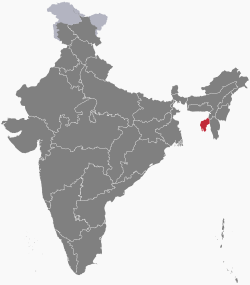
Location of Tripura (highlighted in red) within India
The Tripura Legislative Assembly is the unicameral legislature of the state of Tripura, in Northeast India. The seat of the legislative assembly is at Agartala, the capital of the state. The assembly sits for a term of five years, unless it is dissolved early. Tripura is the third-smallest state in India, covering 10,491 km2 (4,051 sq mi); and the seventh-least populous state with a population of 3.67 million. The Tripura Legislative Assembly has existed since 1963, when it had 30 constituencies. Since 1972, it has had 60 single-seat constituencies, each of which directly elects a representative.
Since the independence of India, the Scheduled Castes (SC) and Scheduled Tribes (ST) have been given reservation status, guaranteeing political representation, and the Constitution lays down the general principles of positive discrimination for SCs and STs. The 2011 census of India stated that indigenous people constitute 32% of the state's total population. The Scheduled Tribes have been granted a reservation of 20 seats in the assembly, while 10 constituencies are reserved for candidates of the Scheduled Castes. (Full article...) -
Dhanush is an Indian actor, film producer, screenwriter and film director known for his work in Tamil cinema. He has also appeared in some Hindi, Telugu, English, and Malayalam films. He made his acting debut in 2002 with the coming of age drama, Thulluvadho Ilamai, directed by his father Kasthuri Raja. His role as a mentally-disturbed man in Kaadhal Kondein (2003)—directed by his brother Selvaraghavan—won him critical acclaim. The following year, he starred in Subramaniam Siva's Thiruda Thirudi, a commercial success. This was followed by a series of commercial failures—Pudhukottaiyilirundhu Saravanan (2004), Sullan (2004) and Dreams (2004). He had two releases in 2005—Devathaiyai Kanden and Adhu Oru Kana Kaalam.
In 2006, Dhanush starred in the gangster film Pudhupettai, which was critically acclaimed and moderately successful at the box-office. He next collaborated with debutant director Vetrimaaran in Polladhavan (2007). It was critically acclaimed and commercially successful. His subsequent releases—Yaaradi Nee Mohini (2008) and Padikkadavan—were box-office successes. He collaborated with Vetrimaaran for the second time in Aadukalam (2011). His role as a rooster fight jockey in the film won him that year's National Film Award for Best Actor and the Best Tamil Actor Award at the 60th Filmfare Awards South. In 2012, he received international attention with the song "Why This Kolaveri Di", which was recorded for Aishwarya R. Dhanush's directorial debut 3. His role as a man who is suffering from bipolar disorder in the film won him his second Filmfare Award. (Full article...) -

Shetty in 2018
Shilpa Shetty is an Indian actress who is primarily known for her work in Hindi films, in addition to a few Telugu, Kannada and Tamil films. Shetty made her acting debut opposite Shah Rukh Khan in the 1993 thriller Baazigar. Shetty's performance earned her two Filmfare Awards nominations for Lux New Face of the Year and Best Supporting Actress. She subsequently earned recognition with dual roles in the 1994 action-comedy Main Khiladi Tu Anari. After initial success, Shetty's films fared poorly at the box office for the next five years. Films Shetty starred in including action drama Aag, romantic drama Aao Pyaar Karen, comedy Haathkadi and Chhote Sarkar proved to be financially unsuccessful.
The 2000 romantic drama Dhadkan marked a turning point in her career, earning her several nominations in the Best Actress category at various award ceremonies. Shetty played the lead female in films such as family drama Apne, police drama Garv: Pride and Honour and musical drama Life in a... Metro. Her comic performance as an eccentric fisherwoman in 2002 action-drama release Rishtey earned her a nomination for the Filmfare Best Supporting Actress Award. Shetty became a global figure after winning the 2007 British reality television series Celebrity Big Brother, after comments made by other contestants about Shetty fell afoul of Ofcom rules and caused an international controversy over racism. (Full article...) -
The prime minister of India is the chief executive of the Government of India and chair of the Union Council of Ministers. Although the president of India is the constitutional, nominal, and ceremonial head of state, in practice and ordinarily, the executive authority is vested in the prime minister and their chosen Council of Ministers. The prime minister is the leader elected by the party with a majority in the lower house of the Indian parliament, the Lok Sabha, which is the main legislative body in the Republic of India. The prime minister and their cabinet are at all times responsible to the Lok Sabha. The prime minister can be a member of the Lok Sabha or of the Rajya Sabha, the upper house of the parliament. The prime minister ranks third in the order of precedence.
The prime minister is appointed by the president of India; however, the prime minister has to enjoy the confidence of the majority of Lok Sabha members, who are directly elected every five years, unless a prime minister resigns. The prime minister is the presiding member of the Council of Ministers of the Union government. The prime minister unilaterally controls the selection and dismissal of members of the council; and allocation of posts to members within the government. This council, which is collectively responsible to the Lok Sabha as per Article 75(3), assists the president regarding the operations under the latter's powers; however, by the virtue of Article 74 of the Constitution, such 'aid and advice' tendered by the council is binding. (Full article...) -

The Madhya Pradesh Legislative Assembly is the unicameral state legislature of the state of Madhya Pradesh in India. It is housed in the Vidhan Bhavan, a building located at the center of the Capital Complex, in the Arera Hill locality of Bhopal, the capital of the state. Madhya Pradesh is the second-largest state in India, covering 308,245 km2 (119,014 sq mi); and the sixth-most populous state with a population of 72.6 million. The term of the assembly is five years, unless it is dissolved early. The Madhya Pradesh Legislative Assembly has had 17 terms since independence. After the latest election in 2023, the assembly is dominated by the governing Bharatiya Janata Party, which won 163 out of the 230 seats. Indian National Congress, the largest opposition party, has 66 seats.
Constituency boundaries are periodically redrawn by the delimitation commission which tries to keep them as geographically compact areas, and with due consideration to existing boundaries of administrative units. The latest census is used to draw the boundaries and every assembly constituency has to be completely within a parliamentary constituency. Since 2000, the Madhya Pradesh Assembly has had 230 single-seat constituencies, each of which directly elects a representative based on a first past the post election. (Full article...) -
The 2025 Indian Premier League was the 18th edition of the Indian Premier League (IPL), a professional Twenty20 (T20) cricket league held in India, organized by the Board of Control for Cricket in India (BCCI). It has been held annually since the first edition in 2008. In July 2024, the IPL Governing Council held a meeting with the owners of the franchises and announced that a mega auction would be conducted ahead of the 2025 season. It was the sixth mega auction after 2008, 2011, 2014, 2018 and 2022.
The franchises were required to submit their retention lists before 31 October 2024, and a total of 46 players were retained ahead of the auction. The auction was held on 24 and 25 November 2024 in Jeddah, Saudi Arabia, with the auction purse for each franchise set at ₹120 crore (US$13 million), the highest in the history of the IPL. A total of 1,574 players registered for the auction, of which 574 players were shortlisted to feature in the auction and 182 were sold in the auction. Rishabh Pant became the most expensive player in the history of IPL when he was bought by the Lucknow Super Giants for ₹27 crore (US$2.8 million), surpassing ₹26.75 crore (US$2.8 million) paid by the Punjab Kings for Shreyas Iyer earlier in the same auction, and ₹24.75 crore (US$2.6 million) paid by the Kolkata Knight Riders for Mitchell Starc in the 2024 auction. Vaibhav Sooryavanshi became the youngest player sold in the IPL history at the age of 13 years, being bought by the Rajasthan Royals for ₹1.1 crore (US$120,000). (Full article...) -
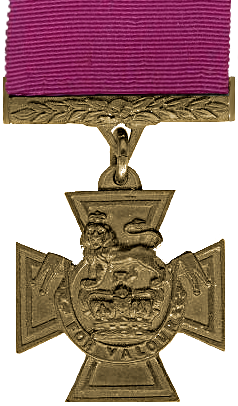
The Victoria Cross
The Victoria Cross (VC) is a military decoration bestowed on members of the British or Commonwealth armed forces for acts of valour or gallantry performed in the face of the enemy. In the British honours system and those of many Commonwealth nations it is the highest award a soldier can receive for actions in combat. It was established in 1856 and since then has been awarded 1,356 times, including to three recipients who were awarded the VC twice.
The British Army's Brigade of Gurkhas, units composed of Nepalese soldiers—although originally led by British officers—has been a part of the army since 1815. When raised, it originally focused on conflicts in the Far East, but the transfer of Hong Kong from British to Chinese hands necessitated that the brigade move its base to the UK. A battalion is still maintained in Brunei and as at 2016, units serve in Afghanistan. (Full article...) -
The Kerala State Film Award for Best Director is an honour presented annually at the Kerala State Film Awards of India since 1969. It is given to a film director who has exhibited outstanding direction while working in the Malayalam film industry. Until 1997, the awards were managed directly by the Department of Cultural Affairs of the Government of Kerala. Since 1998, the Kerala State Chalachitra Academy, an autonomous non-profit organisation functioning under the Department of Cultural Affairs, has been exercising control over the awards. The recipients are decided by an independent jury formed by the academy. They are declared by the Minister for Cultural Affairs and are presented by the Chief Minister.
The first Kerala State Film Awards ceremony was held in 1970 with cinematographer-director A. Vincent receiving the Best Director award for his work in Nadhi (1969). Throughout the years, accounting for ties and repeat winners, the Government of Kerala has presented a total of 50 best director awards to 25 different filmmakers. The recipients receive a figurine, a certificate, and a cash prize of ₹2 lakh (US$2,100). (Full article...) -

S. S. Rajamouli received several awards and nominations for directing the film.
Baahubali: The Beginning is a 2015 Indian epic historical fiction film written and directed by S. S. Rajamouli and produced by Arka Media Works. Shot simultaneously in Telugu and Tamil languages, the film stars Prabhas, Rana Daggubati, Anushka Shetty, and Tamannaah while Sathyaraj, Ramya Krishnan and Nassar appear in supporting roles. The soundtrack and music score was composed by M. M. Keeravani while K. K. Senthil Kumar provided the cinematography. Kotagiri Venkateswara Rao, Sabu Cyril and V. Srinivas Mohan were in charge of the film's editing, art direction and special effects respectively.
The first of two cinematic parts, The Beginning opened worldwide on 10 July 2015 to critical acclaim and record-breaking box-office success, becoming the highest-grossing film in India and the third-highest grossing Indian film worldwide, and the highest-grossing South Indian film. Grossing over ₹6.5 billion worldwide against a budget of ₹1.2 billion, the film became the first South Indian film, and the first non-Hindi film to gross over ₹1 billion in the dubbed Hindi version. The Beginning garnered several awards and nominations with praise for Rajamouli's direction, cinematography, production design, costumes and performances of the cast members. (Full article...) -
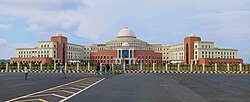
There are 81 constituencies of the Jharkhand Legislative Assembly, the unicameral legislature of the state of Jharkhand in Eastern India. Its seat is at Ranchi, the capital of the state, and it sits for a term of five years unless it is dissolved early. Jharkhand is India's fourteenth largest state by population and the fifteenth largest by area.
Constituency boundaries are periodically redrawn by the delimitation commission which tries to keep them as geographically compact areas, and with due consideration to existing boundaries of administrative units. The latest census is used to draw the boundaries and every assembly constituency has to be completely within a parliamentary constituency. Jharkhand's constituencies are single-seat ones, and they each directly elect a representative based on a first past the post election. (Full article...) -

Rai in 2015
Aishwarya Rai is an Indian actress who has appeared in 50 films in five languages, predominantly in Hindi and Tamil. She made her acting debut in 1997 with dual role in Mani Ratnam's Tamil political drama film Iruvar, and her Bollywood debut that same year in the romantic comedy Aur Pyaar Ho Gaya opposite Bobby Deol. Rai followed it with a leading role in Jeans (1998), a high-profile Tamil film that was submitted as India's official entry to the Academy Awards. She won the Filmfare Award for Best Actress for her breakthrough role in Sanjay Leela Bhansali's romantic drama Hum Dil De Chuke Sanam and starred as a singer in the musical drama Taal (both 1999).
Rai had six film releases in 2000, including Kandukondain Kandukondain, a Tamil adaptation of Jane Austen's novel Sense and Sensibility, and Aditya Chopra's romantic drama Mohabbatein. In 2002, Rai starred opposite Shah Rukh Khan in Bhansali's period romance Devdas, an adaptation of the novel of the same name. Her performance in the top-grossing production earned her a second Best Actress award at Filmfare. In 2003, Rai played a sexually repressed widow in Rituparno Ghosh's Bengali film Chokher Bali, a sleeper hit. However, the failure of her two Hindi film releases of the year—Dil Ka Rishta and Kuch Naa Kaho—led to a setback in her Bollywood career. The following year, Rai played a character based on Elizabeth Bennet in a Bollywood-style adaptation of Austen's novel Pride and Prejudice, entitled Bride and Prejudice, a British production directed by Gurinder Chadha. Also in 2004, she reunited with Ghosh to play an unhappily married woman in the drama Raincoat. (Full article...) -
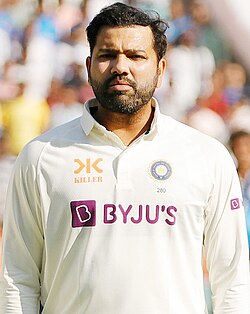
Rohit Sharma has scored 50 centuries in international cricket.
Rohit Sharma is an Indian cricketer who has represented the national team since 2007. He has made 50 centuries in international cricket—33 in One Day Internationals (ODI), 12 in Tests and 5 in Twenty20 Internationals (T20Is)— as of October 2025.
His first century came during the 2010 Tri-Nation Tournament in Zimbabwe when he made 114 against the hosts. In the 2013 bilateral series against Australia at home, he made two centuries, including a double-century. The next year, he scored 264 against Sri Lanka at the Eden Gardens, Kolkata. The score remains the highest individual total by a batsman in the format. In January 2016, he made 171 not out against Australia; it remained the highest score by a visiting batsman against Australia until England's Jason Roy made 180 in 2018. Sharma set the record for most centuries scored in a World Cup when he scored five centuries in the 2019 World Cup. He has scored centuries against nine different opponents and has the joint-highest number of centuries (nine) against Australia in the format. As of January 2020[update], Sharma has eight scores in excess of 150, and three double-centuries, both of which are records in ODIs. He has the second highest number of centuries for an active player in the format. (Full article...) -
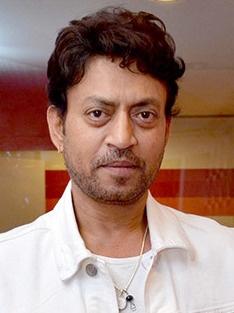
Khan in 2015
Irrfan Khan (7 January 1967– 29 April 2020) was an Indian actor who worked in Indian and British-American films. His on-screen debut was a minor role in Mira Nair's Salaam Bombay! in 1988. He followed this with appearances in a variety of television shows in the late 1980s to 1990s including playing ʽAbd al-Qadir Badayuni in Bharat Ek Khoj (1988), Makhdoom Mohiuddin in Kahkashan (1991), Vladimir Lenin in Lal Ghas Per Neele Ghodey (1992), a dual role in Chandrakanta (1994), and Valmiki in Jai Hanuman (1997). Khan found his television work unfulfilling and considered quitting acting.
His career experienced a turnaround with his breakthrough role as the lead in Asif Kapadia's The Warrior (2001), which won the BAFTA Award for Outstanding British Film. He followed this with critically acclaimed villainous roles in Haasil and Maqbool (both in 2003). For the former performance, where he played a devious politician, Khan received the Filmfare Award for Best Performance in a Negative Role. In 2006, Khan portrayed a first-generation Bengali immigrant in the Nair-directed film The Namesake with Tabu and a hitman in The Killer. The following year, he won the Filmfare Award for Best Supporting Actor for his performance as a 38-year-old man waiting to marry the right woman in Life in a... Metro, directed by Anurag Basu. In 2008, he received international recognition for his role as a police inspector in Danny Boyle's Slumdog Millionaire, which won the Academy Award for Best Picture. (Full article...) -

The National Film Award for Best Actress in a Supporting Role is an honour presented annually at India's National Film Awards ceremony by the National Film Development Corporation of India (NFDC), an organisation set up by the Indian Ministry of Information and Broadcasting. Since 1984, the award is given by a national panel appointed annually by the NFDC to an actress for the best performance in a supporting role within Indian cinema. It is presented by the President of India at a ceremony held in New Delhi. Since the 70th National Film Awards, the name was changed to "Best Actress in a Supporting Role".
The winner is given a "Rajat Kamal" (Silver Lotus) certificate and a cash prize of ₹2,00,000. Including ties and repeat winners, the NFDC has presented a total of 41 Best Supporting Actress awards to 35 different actresses. Although Indian cinema produces films in more than 20 languages, the performances of films that have won awards are of 11 languages: Hindi (20 awards), Malayalam (8 awards), Bengali (4 awards), Tamil (4 awards), English (2 awards), Gujarati (1 award), Haryanvi (1 award), Marathi (1 award), Meitei (1 award), Odia (1 award) and Urdu (1 award). (Full article...) -

Rajinikanth at Inauguration of MGR Statue (2018)
Rajinikanth is an Indian actor, film producer, screenwriter and also a playback singer who has appeared predominantly in Tamil cinema. He began his film career by playing antagonistic and supporting roles before graduating to a lead actor. After starring in numerous commercially successful films throughout the 1980s and 1990s, he has continued to hold a matinée idol status in the popular culture of Tamil Nadu. Writing for Slate, Grady Hendrix called him the "biggest movie star you've probably never heard of," alluding to the fact that the West mainly considers Hindi cinema actors as Indian film stars. Rajinikanth has also worked in Hindi, Telugu, Kannada, Malayalam, and Bengali film industries.
He made his cinematic debut with K. Balachander's 1975 Tamil drama Apoorva Raagangal, in which he played a minor role of an abusive husband. He had his first major role in Balachander's Telugu drama film Anthuleni Katha (1976), and got his breakthrough in Tamil with Moondru Mudichu (1976)—also directed by Balachander. His style and mannerisms in the latter earned recognition from the audience. In 1977, he acted in 15 films, playing negative characters in most of them, including Avargal, 16 Vayathinile, Aadu Puli Attam and Gaayathri. He had positive roles in Kavikkuyil, the Kannada film Sahodarara Savaal, and the Telugu film Chilakamma Cheppindi, in which he played the protagonist for the first time in his career. His role as a failed lover in S. P. Muthuraman's Bhuvana Oru Kelvi Kuri (1977) won him critical acclaim. In 1978, he was cast as the main lead in the Tamil film Bairavi. The same year, he received critical acclaim for his roles in Mullum Malarum and Aval Appadithan; the former earned him a Tamil Nadu State Film Award Special Prize for Best Actor. He made his Malayalam cinema debut with I. V. Sasi's fantasy Allauddinum Albhutha Vilakkum (1979), an adaptation of a story from One Thousand and One Nights. By the end of the decade, he had worked in all South Indian languages and established a career in Tamil cinema. (Full article...) -

Zinta at a promotional event for Bhaiaji Superhit (2018)
Preity G Zinta is an Indian actress known for her work in Hindi films. She made her debut in 1998 with a supporting role in the drama Dil Se... Later that year, she starred in the commercially successful thriller Soldier. For the films, she won a Filmfare Award in the Best Female Debut category. In 1999, Zinta played the role of a CBI officer in the psychological thriller Sangharsh. She followed this with the role of a teenage single mother in the Kundan Shah-directed drama Kya Kehna (2000), a sleeper hit. That same year, she starred in the romance Har Dil Jo Pyar Karega, and the crime drama Mission Kashmir, the third highest grossing Bollywood film of the year.
In 2001, Zinta featured in the dramedy Dil Chahta Hai, which is cited in the media as a defining film of Hindi cinema. Later that year, she portrayed a prostitute-turned-surrogate in the romantic drama Chori Chori Chupke Chupke. Her only screen appearance of 2002 was in the box-office flop Dil Hai Tumhaara. Zinta featured in four films in 2003. Her first role of the year was opposite Sunny Deol in Anil Sharma's drama The Hero—the most expensive Bollywood film to that point. She played a negative role in the romantic drama Armaan, which saw her portray a rich, schizophrenic woman. Following this, she starred in two blockbusters—the science fiction film Koi... Mil Gaya and the drama Kal Ho Naa Ho. For the latter, she won the Filmfare Award for Best Actress. (Full article...) -
The Chameli Devi Jain Award for Outstanding Woman Mediaperson is an Indian journalism award named after Chameli Devi Jain, an Indian independence activist who became the first Jain woman to go to prison during India's independence struggle. The award was instituted in 1980 by The Media Foundation and is given to women in the field of journalism. According to Business Standard, the award is "perhaps India's longest running media award for women".
The Media Foundation was founded in 1979 by B. G. Verghese, Lakshmi Chand Jain, Prabhash Joshi, Ajit Bhattacharjea and N. S. Jagannathan. The award was instituted in 1980 by Verghese and the family of Chameli Devi. The criteria for selection include social concern, dedication, courage and compassion in the individual's work. Journalists in print, digital and broadcast are eligible including photographers, cartoonists and newspaper designers; the entries are judged by an independent jury. Preference is given to rural or small-town journalists and journalists in regional Indian languages. (Full article...) -

Mohammad Azharuddin is a former international cricketer who represented and captained the India national cricket team. Considered to be one of the greatest batsman to emerge from Indian cricket, he was well known for his "wristy strokeplay". A right-handed middle order batsman, Azharuddin scored 29 international centuries before the Board of Control for Cricket in India (BCCI) accused him of match-fixing in 2000, which marked the end of his cricket career. In a career that spanned 15 years, he played 99 Tests and 334 One Day Internationals (ODI) accumulating 6,215 and 9,378 runs respectively. Azharuddin was the first cricketer to score 9,000 runs in ODI cricket and remained the leading run-scorer until October 2000. He was named the "Indian Cricket Cricketer of the Year" before being included by Wisden as one of their five Cricketers of the Year in 1991.
Azharuddin made his Test and ODI debuts during England's 1984–85 tour of India. In Tests, he made centuries against all nations except West Indies and Zimbabwe. In his first Test appearance Azharuddin made 110, thus becoming the eighth Indian player to score a century on debut. With scores of 105 and 122 in the subsequent matches of the series, he became the first player to score a century in each of his first three Tests. Azharuddin equalled the record of Kapil Dev for the fastest century by an Indian in Test cricket, when he scored a century from 74 balls against South Africa in 1996. His highest score of 199 came against Sri Lanka at Kanpur in 1986. Azharuddin's 22 Test centuries were made at fifteen cricket grounds, nine of which were outside India. He scored a century in his last Test innings—against South Africa—in March 2000. As of July 2026, he is joint thirty-first among all-time century makers in Test cricket, and sixth in the equivalent list for India. (Full article...) -
My Name Is Khan is a 2010 drama film directed by Karan Johar. The film features Shah Rukh Khan and Kajol in the lead roles with Jimmy Sheirgill, Zarina Wahab, Sonya Jehan, Vinay Pathak and Parvin Dabas playing supporting roles. Set in the United States, the film's story focuses on Rizwan Khan (Khan), a non-resident Indian with Asperger syndrome whose wife, Mandira (Kajol), has a child, Sameer, from a previous relationship. During the aftermath of the September 11 attacks, Sameer dies as a result of a racist assault by school bullies. Mandira blames Sameer's death on Rizwan due to his religion, and tells him not to come back until he can convince the President of the United States that he is not a terrorist. Rizwan takes Mandira's words literally and tries to meet the President so as to win her back. My Name Is Khan was co-produced by Johar's brother, Hiroo Yash Johar, and Khan's wife, Gauri Khan, under the Dharma Productions and Red Chillies Entertainment banners respectively. Shankar–Ehsaan–Loy composed the soundtrack while Niranjan Iyengar and Javed Akhtar wrote the lyrics for its songs. Ravi K. Chandran, Deepa Bhatia and Sharmishta Roy handled the cinematography, editing and production design respectively.
Produced on a budget of ₹850 million (about US$19 million in 2010), My Name Is Khan was released on 12 February 2010 and received positive reviews. It was commercially successful, grossing ₹2.048 billion (about US$45 million in 2010) worldwide. The film won 25 awards from 84 nominations; its direction, story, screenplay, performances of the cast members and music have received the most attention from award groups. (Full article...) -
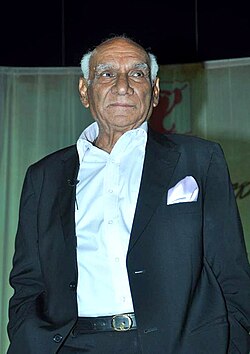
Yash Chopra, the founder of Yash Raj Films, pictured in 2012. He directed 13 films for the company between 1973 and 2012,
Yash Raj Films (abbreviated as YRF) is an Indian entertainment company, established by filmmaker Yash Chopra in 1970, that produces and distributes motion pictures. As of 2022, the company has produced over 80 Hindi films and one Tamil film. YRF started a film distribution business in 1997; in addition to distributing their own productions, the company has handled the domestic and/or international distribution of over 50 films from other companies. The most frequent collaborations of the company have been with the actors Amitabh Bachchan, Raakhee, Rishi Kapoor, Shah Rukh Khan, Kajol, Rani Mukerji, Anushka Sharma, Katrina Kaif, and Saif Ali Khan.
YRF's first release came in 1973 with the Chopra-directed Daag, a drama about bigamy, starring Rajesh Khanna, Raakhee and Sharmila Tagore. The company had four more releases in the 1970s, including the ensemble romantic drama Kabhi Kabhie and the action film Kaala Patthar, both of which starred Amitabh Bachchan and Raakhee. YRF's sole commercial success in the 1980s was the Sridevi-starring romantic musical Chandni. The year 1995 marked the directorial debut of Chopra's elder son Aditya Chopra with the highly successful romantic drama Dilwale Dulhania Le Jayenge. Starring Shahrukh Khan and Kajol, the film has the longest theatrical run in Indian cinema history. Other successful releases of the 1990s were Darr (1993) and Dil To Pagal Hai (1997), both starring Khan. (Full article...)


.jpg)

.jpg)


.jpg)
_03.jpg)


.jpg)

 Good article –

-
Huma Saleem Qureshi (pronounced [ˈɦʊmaː səˈliːm qʊˈɾɛːʃiː]; born 28 July 1986) is an Indian actress who primarily appears in Hindi-language films. Her accolades include a Filmfare OTT Award along with nominations for three Filmfare Awards.
Qureshi studied history in Delhi while she worked as a theatre actor and model. She then moved to Mumbai and signed a two-year contract with Hindustan Unilever to appear in television commercials. During the shoot for a Samsung mobile commercial, Anurag Kashyap noticed her acting ability and signed her for a three-film deal with his company, marking her film debut with a supporting role in the two-part 2012 crime drama Gangs of Wasseypur. Her performance in the film earned her a nomination for the Filmfare Award for Best Supporting Actress. (Full article...) -
Sahib Bibi Aur Ghulam (transl. The Master, the Wife, and the Slave) is a 1962 Indian Hindi-language drama film directed by Abrar Alvi, produced & co–directed by Guru Dutt, who also co-stars in it alongside Meena Kumari, Rehman, and Waheeda Rehman. It is a remake of the 1956 Bengali film Saheb Bibi Golam, which itself is based on Bimal Mitra's 1953 novel of the same name. It is set in the 19th century during the British Raj and focuses on Bhoothnath (Dutt), who meets Chhoti Bahu (Kumari), the lonely wife of a zamindar (Rehman). The film follows Chhoti Bahu's effort to keep her husband—who likes drinking and watching tawaifs perform—at their home by drinking with him. She becomes addicted to alcohol, leading both of them into bankruptcy.
The book's rights were bought after his production venture Chaudhvin Ka Chand (1960) became commercially successful and covered his company's loss following the failure of Kaagaz Ke Phool (1959), his previous directorial project. Mitra and Alvi took a year to write the screenplay, facing difficulties in translating the novel from Bengali to Hindi. Principal photography took place in Andheri and Dhanyakuria with cinematographer V. K. Murthy; the film was edited by Y. G. Chawhan. Hemant Kumar composed the soundtrack and Shakeel Badayuni wrote the lyrics. (Full article...) -
Dhoom 2 (transl. Blast 2), also known as Dhoom 2: Back in Action, is a 2006 Indian Hindi-language action thriller film directed by Sanjay Gadhvi and produced by Aditya Chopra under Yash Raj Films. Written by Vijay Krishna Acharya from a story by Chopra, it serves as a sequel to Dhoom (2004) and the second installment in the Dhoom franchise. The film stars Hrithik Roshan, Abhishek Bachchan, Aishwarya Rai, Bipasha Basu, and Uday Chopra. The narrative follows a series of high-profile heists carried out by the elusive thief Aryan (Roshan), and the attempts by police officers Jai Dixit (Abishek Bachchan) and Ali (Uday Chopra)to apprehend him, culminating in a cat-and-mouse chase that spans multiple continents.
Principal photography took place in India, South Africa (Durban), and Brazil (Rio de Janeiro), making it the first major Hindi film to be shot extensively in Brazil. The soundtrack was composed by Pritam with lyrics by Sameer, and the action choreography was handled by Allan Amin. The film was noted for its stylized visuals, elaborate stunt sequences, and glamorous presentation. (Full article...) -
Soni is a 2018 Indian Hindi-language crime drama film directed by Ivan Ayr. Produced by Kimsi Singh and Kartikeya Narayan Singh, the film stars Geetika Vidya Ohlyan and Saloni Batra in the lead roles. It was written by Ayr and Kislay and chronicles the life of police officer Soni (Ohlyan) and her superintendent in Delhi Police Kalpana (Batra), who deal with crimes against women in the city.
The idea for Soni occurred to Ayr in 2014 when he was reading that Delhi was being put under scrutiny for not being safe for women, especially after the 2012 gang rape case. Ayr read several articles and interviews about the Delhi police and was interested in woman officers' reactions to cases of sexual violence. He spent time with several Delhi police personnel and observed their daily routine. Pre-production started in November 2016 and Ayr finished the script in January 2017 and the film was shot for 24 days in Delhi in February. David Bolen served as the director of photography while Ayr and Gurvinder Singh edited the film. (Full article...) -
Gunday (transl. Outlaws) is a 2014 Indian Hindi-language period action drama film written and directed by Ali Abbas Zafar and produced by Aditya Chopra under Yash Raj Films. The film stars Ranveer Singh, Arjun Kapoor, Priyanka Chopra, and Irrfan Khan in the lead roles. Set in 1971–1988 Calcutta, the film follows two best friends who are also outlaws that both fall in love with a cabaret dancer, which causes rivalry and misunderstandings between them while a police officer tries to take advantage of this situation to eliminate them.
Zafar conceived the film, which was the last to be narrated to founding patron Yash Chopra, as an amalgam of stories he had heard from his father as a child about the effects of war-caused immigration and the Mafia Raj's illegal marketing of coal. He wrote the film as a tale of the consequences of the struggle of two outlaws against the system, using his father's stories as a backdrop for the characters. Principal photography began in Mumbai in December 2012 before moving to Kolkata, where extensive filming was done. The soundtrack was composed by Sohail Sen, and the lyrics were penned by Irshad Kamil, while Julius Packiam composed the background score, taking over Sen's duties from Zafar's debut, Mere Brother Ki Dulhan, eventually becoming a regular collaborator. (Full article...) -
Morya Gosavi or Moraya Gosavi (Morayā Gosāvi) alias Moroba Gosavi was a saint of the Hindu Ganapatya sect, which considers Ganesha as the Supreme God. Morya Gosavi is considered the chief spiritual progenitor of the Ganapatyas and has been described as the "most famous devotee" of Ganesha.
The lifetime of Morya Gosavi is speculated between the 13th to 17th century. Numerous legends recall his life. Morya became devoted to Ganesha when he started visiting the Morgaon temple of Ganesha. It is believed that due to the hindrance in Morya's services to the god in the popular Ganesha shrine, Ganesha told Morya that he would appear in Chinchwad for Morya to worship, so Morya moved from Morgaon to Chinchwad, where Morya built a Ganesha temple. Consequently, Morya took sanjeevan samadhi by burying himself alive in his tomb. (Full article...) -
U Me Aur Hum (transl. You, Me, and Us) is a 2008 Indian Hindi-language romantic drama film co-written, directed, and produced by Ajay Devgn. The film tells the story of Ajay (Devgn), who meets barmaid Piya (Kajol) on a cruise with his friends (Sumeet Raghavan, Divya Dutta, Karan Khanna, and Isha Sharvani). They fall in love and marry; a few months later, Piya is diagnosed with Alzheimer's disease.
The film was announced in May 2007 and was the directorial debut of Devgn, who had long wanted to direct a film. He wrote the story, and the screenplay was written by Robin Bhatt, Sutanu Gupta, and Akash Khurana. Principal photography, by Aseem Bajaj, began in India shortly after the film was announced. It was edited by Dharmendra Sharma, and the background score was written by Monty Sharma. The soundtrack was composed by Vishal Bhardwaj, with lyrics by Munna Dhiman. (Full article...) -
Bengaluru, also known as Bangalore (its official name until 1 November 2014), is the capital and largest city of the southern Indian state of Karnataka. As per the 2011 census, the city had a population of 8.4 million, making it the third most populous city in India and the most populous in South India. The Bengaluru metropolitan area had a population of around 8.5 million, making it the fifth most populous urban agglomeration in the country. It is located towards the southern end of the Deccan Plateau, at an altitude of 900 m (3,000 ft) above sea level. The city is known as India's "Garden City", due to its parks and greenery.
Archaeological artefacts indicate that the human settlement in the region happened as early as 4000 BCE. The first mention of the name "Bengaluru" is from an old Kannada stone inscription from 890 CE found at the Nageshwara Temple in Begur. The region was ruled by the Western Ganga dynasty since 350 CE, and became part of the Chola Empire in the early eleventh century CE. In the late Middle Ages, it formed a part of the Hoysala kingdom and then the Vijayanagara Empire. In 1537 CE, Kempe Gowda I, a feudal ruler under the Vijayanagara Empire, established a mud fort which is considered the foundation of the modern city of Bengaluru with the earlier established areas (petes) still in existence. After the fall of the Vijayanagara Empire, Kempe Gowda declared independence, and the city was expanded by his successors. In 1638 CE, an Adil Shahi army defeated Kempe Gowda III, and the city became a jagir (feudal estate) of Shahaji. The Mughals later captured the city and sold it to Chikka Devaraja Wodeyar, the Maharaja of the Kingdom of Mysore. After the death of Krishnaraja Wodeyar II in 1759 CE, Hyder Ali seized control of the kingdom and with it, the administration of Bengaluru, which passed subsequently to his son, Tipu Sultan. (Full article...) -
Andhra Pradesh is a state on the east coast of southern India. It is the seventh-largest state and the tenth-most populous in the country. Telugu, one of the classical languages of India, is the most widely spoken language in the state and serves as its official language. Amaravati is the state capital, and Visakhapatnam is the largest city. Andhra Pradesh shares borders with Odisha to the northeast, Chhattisgarh to the north, Karnataka to the west, Tamil Nadu to the south, Telangana to northwest and the Bay of Bengal to the east.
According to archaeological evidence, Andhra Pradesh has been continuously inhabited from early archaic hominins through Neolithic settlements. The earliest known reference to the Andhras appears in the Aitareya Brahmana (c. 800 BCE) of the Rigveda. Around 300 BCE, the Andhras living in the Godavari and Krishna river deltas were described by contemprory sources as having military strength only to the Maurya Empire in the Indian subcontinent. The first major Andhra polity was the Satavahana dynasty (2nd century BCE – 2nd century CE), which ruled over the entire Deccan Plateau and extended into western and central India. The Satavahanas established trade relations with the Roman Empire, and according to historian Stanley Wolpert, their capital, Dhanyakataka, may have been the most prosperous city in India during the 2nd century CE. Subsequent major dynasties included the Vishnukundinas, Eastern Chalukyas, Kakatiyas, Vijayanagara Empire, and Qutb Shahis, followed by British rule. After India gained independence, Andhra State was carved out of Madras State in 1953. In 1956, it merged with the Telugu-speaking regions of the former Hyderabad State (Telangana) to form Andhra Pradesh. The state reverted to its earlier form in 2014, when the new state of Telangana was bifurcated from it. (Full article...) -

The Bharat Ratna (Sanskrit pronunciation: [bʱaːɾət̪ ɾət̪n̪ə]; lit. 'Jewel of India') is the highest civilian award of the Republic of India. Instituted on 2 January 1954, the award is conferred in recognition of "exceptional service/performance of the highest order", without distinction of race, occupation, position or gender. The award was originally limited to achievements in the arts, literature, science, and public services, but the Government of India expanded the criteria to include "any field of human endeavour" in December 2011. The recipients receive a Sanad (certificate) signed by the president and a sacred fig leaf-shaped medallion. Bharat Ratna recipients rank seventh in the Indian order of precedence.
The first recipients of the Bharat Ratna were: the former governor-general of the Union of India C. Rajagopalachari, the former president of the Republic of India Sarvepalli Radhakrishnan; and the Indian physicist C. V. Raman, who were honoured in 1954. Since then, the award has been bestowed upon 53 individuals, including 18 who were awarded posthumously. The original statutes did not provide for posthumous awards but were amended in January 1966 to permit them to honour former prime minister Lal Bahadur Shastri, the first individual to be honoured posthumously. In 2014, cricketer Sachin Tendulkar, then aged 40, became the youngest recipient, while social reformer Dhondo Keshav Karve was the oldest recipient when he was awarded on his 100th birthday. Though usually conferred on India-born citizens, the award has been conferred on one naturalized citizen, Mother Teresa, and on two non-Indians: Abdul Ghaffar Khan (born in British India and later a citizen of Pakistan) and Nelson Mandela, a citizen of South Africa. (Full article...) -
Andhadhun (pronounced [əndʱaːdʱʊn] transl. Indiscriminate, blind, reckless, or without thinking) is a 2018 Indian Hindi-language black comedy crime thriller film co-written and directed by Sriram Raghavan. It stars Tabu, Ayushmann Khurrana, Radhika Apte and Anil Dhawan. The film tells the story of a blind piano player who unwittingly becomes embroiled in the murder of a retired actor.
The script of Andhadhun was written by Raghavan, Arijit Biswas, Pooja Ladha Surti, Yogesh Chandekar and Hemanth M. Rao. The film was edited by Surti, and K. U. Mohanan was its director of photography. Amit Trivedi composed songs for the film and Jaideep Sahni wrote the lyrics; Raftaar and Girish Nakod co-wrote the title song as guest composers, while Daniel B. George composed the background score. The film was shot in Pune in 44 days spread over more than a year; principal photography began in June 2017 and ended on 17 July 2018. (Full article...) -
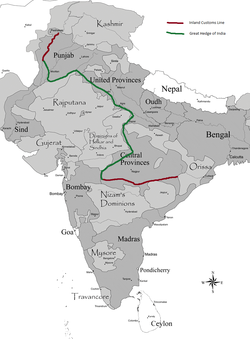
The route of the 1870s Inland Customs Line (red) and Great Hedge (green)
The Inland Customs Line, incorporating the Great Hedge of India (or Indian Salt Hedge), was a customs barrier built by the British colonial rulers of India to prevent smuggling of salt from coastal regions in order to avoid the substantial salt tax.
The customs line was begun under the East India Company and continued into direct British rule. The line had its beginnings in a series of customs houses established in Bengal in 1803 to prevent the smuggling of salt to avoid the tax. These customs houses were eventually formed into a continuous barrier that was brought under the control of the Inland Customs Department in 1843. (Full article...) -
Rain water sample (left) and after the particles settled (right). Dried sediment (centre)
The Kerala red rain phenomenon was a blood rain event that occurred in Wayanad district of the southern Indian state Kerala on Monday, 15 July 1957 , and also from 25 July to 23 September 2001, when heavy downpours of red-coloured rain fell sporadically in Kerala, staining clothes pink. Yellow, green and black rain was also reported. Coloured rain was also reported in Kerala in 1896 and several times since, most recently in June 2012, and from 15 November 2012 to 27 December 2012 in eastern and north-central provinces of Sri Lanka.
Following a light-microscopy examination in 2001, it was initially thought that the rains were coloured by fallout from a hypothetical meteor burst, but a study commissioned by the Government of India concluded that the rains had been coloured by airborne spores from a locally prolific terrestrial green algae from the genus Trentepohlia. (Full article...) -
The Murugan Temple at Saluvankuppam, Tamil Nadu, India, is a shrine dedicated to Tamil deity Murugan (also known as Seyyon) of Kaumaram and Hinduism. Archaeologists believe that the shrine, unearthed in 2005, consists of two layers: a brick temple constructed during the Sangam period (the 3rd century BCE to the 3rd century CE) and a granite Pallava temple dating from the 8th century CE and constructed on top of the brick shrine making it the oldest temple in India. The Archaeological Survey of India (ASI) team which conducted the excavation believe that brick temple could be the oldest of its kind to be discovered in Tamil Nadu.
The temple was discovered by a team of archaeologists from the ASI based on clues found in a rock inscription left exposed by the 2004 Indian Ocean tsunami. Initially, excavations revealed an 8th-century Pallava-era shrine. Further excavations revealed that the 8th-century shrine had been built on the brick foundation of an earlier shrine. The brick shrine has been dated to the Sangam period. (Full article...) -
Kumaraswami Kamaraj (15 July 1903 – 2 October 1975), popularly known as Kamarajar was an Indian independence activist, politician, social reformer and statesman who served as the Chief Minister of Madras from 13 April 1954 to 2 October 1963. He also served as the president of the Indian National Congress between 1964–1967 and was responsible for the elevation of Lal Bahadur Shastri and later Indira Gandhi to the position of Prime Minister of India, because of which he was widely acknowledged as the "Kingmaker" in Indian politics during the 1960s. Later, he was the founder and president of the Indian National Congress (O).
Born as Kamatchi, Kamaraj had dropped out of school early and had little formal education. He became active in the Indian Independence movement in the 1920s and was imprisoned by the British Raj multiple times due to his activities. In 1937, Kamaraj was elected to the Madras Legislative Assembly after winning in the 1937 Madras Presidency Legislative Assembly election. He was active during the Quit India Movement in 1942, because of which he was incarcerated for three years till 1945. (Full article...) -
Chak De! India (transl. Let's go! India – transl. Go! India) is a 2007 Indian Hindi-language sports drama film directed by Shimit Amin, written by Jaideep Sahni and produced by Aditya Chopra under the banner of Yash Raj Films. The film stars Shah Rukh Khan as Kabir Khan, the former captain of the India men's national field hockey team. After a disastrous loss to Pakistan, Khan is ostracized from the sport owing to religious prejudice. 7 years later in an attempt to redeem himself, he becomes the coach of the India women's national field hockey team, with the goal of turning its 16 contentious players into an award-winning team.
Sahni was inspired by the women's national field hockey team's win at the 2002 Commonwealth Games to develop Chak De! India's script after reading about it in a newspaper. The screenplay was fictional and the characters, while inspired by the real team and coaches, were invented by Sahni. Kabir Khan's struggles bore resemblance to those faced by real-life hockey player Mir Ranjan Negi, although Sahni was unaware of Negi's tribulations while writing the script. On the suggestion of Maharaj Krishan Kaushik, then coach of the women's hockey team, Sahni invited Negi to join the film's production team. A combination of professional players and actors were cast as the sixteen team members; workshops were conducted for training the actors in hockey and the players in acting. Kaushik and Negi would train Sahni, Khan and the other cast members over a period of six months. The sports scenes were choreographed by Rob Miller, and the soundtrack was composed by Salim–Sulaiman, with lyrics written by Sahni. (Full article...) -
Parsurameswara Temple (IAST: Paraśurāmeśvara) also spelt Parashurameshvara, is a Hindu temple, located in the East Indian city of Bhubaneswar, the capital of Odisha, India, is considered the best preserved specimen of an early Odia Hindu temple dated to the Shailodbhava period between the 7th and 8th centuries CE. The temple is dedicated to the Hindu god Shiva and is one of the oldest existing temples in the state. It is believed to have been built around 650 CE in Nagara style and has all the main features of the pre-10th century Kalinga Architecture style temples. The temple is one among the Parashurameshvara group of temples.
Parashurameshvara Temple has a vimana, the sanctum, and a bada, the curvilinear spire over its roof, rising to a height of 40.25 ft (12.27 m). It is the first temple to have an additional structure called jagamohana, compared to the earlier temples that had only the vimana. Though the temple is dedicated to Shiva, it contains sculpted images of Shakta deities, which are otherwise normally part of Shakta temples. The temple is the first in Bhubaneswar to contain depictions of Saptamatrikas, namely, Chamunda, Varahi, Indrani, Vaishnavi, Kaumari, Shivani and Brahmi. The temple is maintained and administered by the Archaeological Survey of India (ASI) as a ticketed monument. Parashurashtami is the major festival celebrated in the temple during June–July every year. The temple is one of the most prominent tourist attractions in the state of Odisha. (Full article...) -

The 1995 North Indian Ocean cyclone season was below-average and was primarily confined to the autumn months, with the exception of three short-lived deep depressions in May. There were eight depressions in the basin, which is Indian Ocean north of the equator. The basin is subdivided between the Bay of Bengal and the Arabian Sea on the east and west coasts of India, respectively. Storms were tracked by the India Meteorological Department (IMD), which is the basin's Regional Specialized Meteorological Center, as well as the American-based Joint Typhoon Warning Center (JTWC) on an unofficial basis.
Tropical activity was largely affected by the monsoon trough, which spawned the three deep depressions in May, as well as the two strongest cyclones in November. The first storm of the season formed on May 5 in the Bay of Bengal, the same location as two additional depressions later in the month. Collectively, the three systems killed 146 people, mostly related to the third system which produced a deadly storm surge in Bangladesh. After two weak depressions in September, the season's lone Arabian Sea storm developed on October 12, and remained largely away from land. The final two storms of the season were the most notable. On November 10, a cyclone struck southeastern India, killing 173 people in India and Bangladesh. Its remnants produced a rare snowstorm in eastern Nepal that caused landslides and avalanches, killing 63. The last storm of the season was also the most powerful, causing 172 deaths when it struck southeastern Bangladesh. (Full article...) -
Parineeti Chopra (pronounced [pəriːniːt̪iː ˈtʃoːpɽaː]; born 22 October 1988) is an Indian actress who primarily works in Hindi films. Chopra has received several accolades, including a Filmfare and a National Film Award. Chopra has appeared in Forbes India's Celebrity 100 list since 2013.
After obtaining a triple honours degree in business, finance and economics from Manchester Business School, Chopra made her acting debut with the 2011 romantic comedy Ladies vs Ricky Bahl, winning the Filmfare Award for Best Female Debut. She followed it by garnering acclaim for her starring roles in the box-office hits Ishaqzaade (2012), Shuddh Desi Romance (2013) and Hasee Toh Phasee (2014). The first of these won her the National Film Award – Special Mention. This success was followed by a three-year hiatus and several poorly received films, with the exception of the horror-comedy Golmaal Again (2017) and the war drama Kesari (2019), in which she had a brief role. Chopra has since earned praise for her roles in the black comedy Sandeep Aur Pinky Faraar (2021) and the biographical drama Amar Singh Chamkila (2024), and had a supporting role in the ensemble film Uunchai (2022). (Full article...) -
Nuggehalli Raghuveer Moudgal (4 March 1931 – 8 May 2011) was an Indian reproductive biologist, endocrinologist and the chairman of the Department of Biochemistry and dean of Faculty of Science at the Indian Institute of Science. He was known for his pioneering researches on gonadotropin and was an elected fellow of the Indian Academy of Sciences and the Indian National Science Academy. He was an associate of noted scientists, Choh Hao Li and Rodney Robert Porter and discovered the role of hormones in generating immune response in living beings, during his association with the former. The Council of Scientific and Industrial Research, the apex agency of the Government of India for scientific research, awarded him the Shanti Swarup Bhatnagar Prize for Science and Technology, one of the highest Indian science awards for his contributions to Medical Sciences in 1976. (Full article...)
-
Air India Express Flight 812 was a scheduled international flight from Dubai International Airport, Dubai, to Mangalore International Airport, Mangalore. On 22 May 2010, the Boeing 737-800 passenger jet operating the flight crashed on landing at Mangalore. The captain had continued an unstabilised approach, despite three calls from the first officer to initiate a "go-around", resulting in the aircraft overshooting the runway, falling down a hillside, and bursting into flames. Of the 166 passengers and crew on board, 158 were killed (all 6 crew members and 152 passengers); only eight survived. This was the first fatal accident involving Air India Express. (Full article...) -
Armaan (transl. Desire) is a 2003 Indian Hindi-language medical drama film co-written and directed by Honey Irani. It stars an ensemble cast of Amitabh Bachchan, Anil Kapoor, Preity Zinta, Gracy Singh, and Randhir Kapoor. The film is set in a hospital and follows the travails of its principal, Dr. Akash (Anil Kapoor), to sustain the institution financially. Meanwhile, a mentally unstable woman named Sonia (Zinta) comes into his life and offers to help by donating to the hospital on the condition that Akash marries her.
Irani wrote the story of Armaan and also wrote the screenplay with Javed Akhtar. Principal photography (handled by Ravi Varman) took place in India and Africa, and Shirish Kunder edited the film. It was released on 16 May 2003 and declared a commercial failure, only earning ₹149.2 million (US$1.6 million) against a ₹100 million (US$1.0 million) budget. Although the film garnered mixed reviews, critics praised Irani's direction and the actors' performances, particularly those of Bachchan and Zinta. Zinta received nominations for her performance as the film's antagonist at the Filmfare Awards, the Producers Guild Film Awards, and the Screen Awards. (Full article...) -
Govindudu Andarivadele (transl. The lord is a people's man), also known by the acronym GAV, is a 2014 Indian Telugu-language romantic action comedy film written and directed by Krishna Vamsi. Produced by Bandla Ganesh for Parameswara Art Productions, the film stars Ram Charan, Kajal Aggarwal, Srikanth, Kamalinee Mukherjee, Prakash Raj, Jayasudha, Rahman and Adarsh Balakrishna. Yuvan Shankar Raja composed the film's soundtrack and score while Sameer Reddy was the cinematographer, and Naveen Nooli the film's editor.
The film is partially inspired by the 1991 Telugu film Seetharamayya Gari Manavaralu directed by Kranthi Kumar. Govindudu Andarivadele portrays a non-resident Indian named Abhiram who visits his grandfather Balaraju's house as a student of agriculture. He actually came to reconcile the differences between his father, Chandrasekhar Rao, and Balaraju. The pair parted ways as Chadrasekhar went to the UK while Balaraju stayed and built a charitable hospital for local people. Abhiram succeeds in winning over family members, and Balaraju understands the truth behind Abhiram and his attempts. (Full article...) -

Indian captain Talimeren Ao (right) and French captain Gaby Robert (left) shaking hands before Swedish referee Gunnar Dahlner prior to the commencement of India's first Olympic match on 31 July 1948 against France.
Football was first introduced as an Olympic sports at the Summer Olympic Games held in France in 1900. It was played by only three club teams from three nations as an exhibition sport and played again at the 1904 Games. National sides played for the first time at the 1908 Summer Olympics. India did not send a football side to the Olympics until the 1948 Games; it participated in the next three Games. An Indian team last participated in the 1960 Games. India's best appearance was at the 1956 Summer Olympics where its team reached the semi-finals. Beginning with the 1992 Summer Olympics, the rules were changed so that only under-23 national teams are allowed to compete in the Games. India's U-23 national team has yet to qualify for the Olympic football competition. (Full article...) -
Kazi Nazrul Islam (24 May 1899 – 29 August 1976) was a Bengali poet, short story writer, journalist, lyricist, and musician. He was later honoured with the title of national poet of Bangladesh. Nazrul produced a large body of poetry, music, messages, novels, and stories with themes that included equality, justice, anti-imperialism, humanity, rebellion against oppression and religious devotion. Nazrul Islam's activism for political and social justice as well as writing a poem titled "Bidrohī", meaning "the rebel" in Bengali, earned him the title of "Bidrohī Kôbi" (Rebel Poet). His compositions form the avant-garde music genre of Nazrul Gīti (Music of Nazrul).
Born in the British Raj period into a Bengali Muslim Kazi family from Churulia in Asansol, then in the Burdwan district in the Bengal Presidency (now in West Bengal, India), Nazrul Islam received religious education and as a young man worked as a muezzin at a local mosque. He learned about poetry, drama, and literature while working with the rural theatrical group Leṭor Dôl, Leṭo being a folk song genre of West Bengal usually performed by the people from the Muslim community of the region. He joined the British Indian Army in 1917 and was posted in Karachi. Nazrul Islam established himself as a journalist in Calcutta after the war ended. He criticised the British Raj and called for revolution through his famous poetic works, such as "Bidrohī" ('The Rebel') and "Bhangar Gan" ('The Song of Destruction'), as well as in his publication Dhūmketu ('The Comet'). His nationalist activism in the Indian independence movement led to his frequent imprisonment by the colonial British authorities. While in prison, Nazrul Islam wrote the "Rajbôndīr Jôbanbôndī" ('Deposition of a Political Prisoner'). His writings greatly inspired Bengalis of East Pakistan during the Bangladesh Liberation War. (Full article...)


_02.jpg)


.jpg)


.jpg)


News
- 18 July 2026 –
- Eight people are killed and nine others are injured after an unauthorized firecracker factory explodes in Ahmedabad, Gujarat, India. (NDTV)
- Five people, including three women, drown in the Godavari River whilst fishing near Polavaram district, India. (The Hindu)
- 18 July 2026 – Space industry of India
- Skyroot Aerospace successfully launches Vikram-1, India's first privately built orbital rocket, from the Satish Dhawan Space Centre in Andhra Pradesh, carrying small satellite payloads into low Earth orbit on its maiden flight. (AFP via Asharq Al-Awsat)
- 15 July 2026 – Middle Eastern crisis
- India in the 2026 Iran war
- India's Directorate General of Shipping warns companies not to deploy Indian sailors onto vessels transiting through the Strait of Hormuz after two Indian seafarers were killed in separate ship attacks in the waterway. (The Indian Express) (Reuters)
Did you know...
- ... that a Doctor Who episode took place during the partition of India, and used a unique Indian adaptation of the usual closing theme?
- ... that optical physicist Franklin Dollar grew up on a Native American reservation without electricity or running water?
- ... that in 2026 India became the first team to win two consecutive Men's T20 World Cup finals?
- ... that Arthur France founded the Leeds West Indian Carnival, the first Caribbean carnival in Europe, in 1967?
- ... that in 2025, Royal Challengers Bengaluru became the first in the Indian Premier League to win all away games in a season?
- ... that Asha Sobhana is the first Indian player to take a five-wicket haul in the Women's Premier League?
Topics related to India
Timeline of Indian history, Indus Valley Civilisation, Dholavira, Science and technology in ancient India, Meluhha, Aryan invasion theory, Out of India theory, Greek conquests in India, Indian maritime history, Maurya Empire, Ashoka, Shunga Empire, Hoysala Empire, Vijayanagara, Satavahana dynasty, Indo-Greek Kingdom, Indo-Scythians, Indo-Parthian Kingdom, Kushan Empire, Western Satraps, Gupta Empire, Chola dynasty, Pala Empire, Islamic incursions in India, Mughal Empire, Maratha Empire, British Raj, East India Company, Governor-General, Viceroy, War of Independence, 1857, Indian independence movement, Indian National Army, Azad Hind, Quit India Movement, Partition of India, History of Republic of India, Non-Aligned Movement, Sino-Indian War, Indo-Pakistani War of 1947–1948, Indo-Pakistani War of 1965, Indo-Pakistani War of 1971, Kargil War, 2001–02 India–Pakistan standoff, Military, Demographic
Law, Hindu law, Constitution, Political parties (Indian National Congress, Bharatiya Janata Party), Foreign relations, Elections, Political divisions, Reservation in India
Government agencies, Legislative branch (Lok Sabha, Rajya Sabha) Executive branch (President & Vice President, Prime Minister & Deputy Prime Minister, Cabinet Ministers, Cabinet Secretary, Election Commission, Foreign Minister; Law enforcement: CBI, CID, Intelligence: IB, RAW), Directorate General of Income Tax Investigation Judicial branch (Supreme Court), Armed Forces (Army, Navy, Air Force, Border Security Force, Coast Guard)
Himalayas, Western Ghats, Eastern Ghats, Indo-Gangetic Plain, Deccan Plateau, Thar Desert, Ganges, Rann of Kutch, Brahmaputra River, Northeast India; Mountains, Valleys, Islands, Rivers; States and union territories, Cities, Districts, Regions, Fauna, Flora
Rupee, Bombay Stock Exchange, National Stock Exchange, Standard of living, Companies, Reserve Bank of India, Energy policy (Solar, Wind, Nuclear), Tourism, Transport (Expressways, Rail transport, Auto rickshaw),
Languages, Standard of living, Religion
Music (Carnatic, Hindustani, Indi-pop), Dance, Languages, Literature, Architecture, Film & TV, Cuisine, Holidays, Folklore, Education, Media, Indian martial arts
Indian Council of Agricultural Research (ICAR), Indian Institute of Astrophysics, National Centre for Software Technology, AIIMS, IISc, IIT, NIT, BITS-Pilani, INRegistry, Indian numbering system, Indian Space Research Organisation, National Internet Exchange of India, ICRISAT, International Institute of Information Technology, Hyderabad
Indian English, Indian nationality law, Numbering system, Indian Space Research Organisation, Telecommunications, National Highways Development Project, Flag, Vehicle registration plates, Indian nationalism, Metrication in India
Categories

Related portals


.svg)
Religions in India


.svg)

Regions


_in_Amritsar,_India.jpg)
Cities


Other topics


.svg)

Indian Subcontinent


Other countries


Wikipedias in Indian languages
- অসমীয়া (Assamese)
- বাংলা (Bengali)
- भोजपुरी (Bhojpuri)
- বিষ্ণুপ্রিয়া মণিপুরী (Bishnupriya Manipuri)
- गोंयची कोंकणी / Gõychi Konknni (Konkani)
- ગુજરાતી (Gujarati)
- हिन्दी (Hindi)
- ಕನ್ನಡ (Kannada)
- कॉशुर/كشميري (Kashmiri)
- मैथिली (Maithili)
- മലയാളം (Malayalam)
- मराठी (Marathi)
- नेपाली (Nepali)
- नेपाल भाषा
- (Newari)
- ଓଡ଼ିଆ (Odiya)
- ਪੰਜਾਬੀ (Punjabi)
- पालि (Pali)
- संस्कृत (Sanskrit)
- ᱥᱟᱱᱛᱟᱲᱤ (Santali)
- سنڌي (Sindhi)
- தமிழ் (Tamil)
- తెలుగు (Telugu)
- ತುಳು (Tulu)
- اردو (Urdu)
Associated Wikimedia
The following Wikimedia Foundation sister projects provide more on this subject:
-
 Commons
Free media repository -
 Wikidata
Free knowledge base -
 Wikiquote
Collection of quotations -
 Wikisource
Free-content library -
 Wikiversity
Free learning tools -
 Wikivoyage
Free travel guide -
 Wiktionary
Dictionary and thesaurus


