


Introduction
The later second millennium bc in Europe has been seen as a fundamental turning point for prehistoric societies. Globalizing trends came to be shared through frequent, long-distance interactions manifested as common cosmologies, crafts, rituals, economic ideologies, combat practices, mortuary conventions, foodways, and artistic expressions. Kristiansen and Larsson (Reference Kristiansen and Larsson2005) were key advocates of this view and, with regard to cosmology, ritual, and beliefs, they drew heavily on the symbolism embodied in the Dupljaja chariot model from Serbia (Figure 1 and https://bit.ly/dupchariot1). In a detailed reappraisal of this object and a second fragmentary chariot (Figure 2 and https://bit.ly/dupchariot2) we evaluate the models as: 1) media that embody and display widely shared religious symbolism and beliefs of Europe, 2) representing LBA functional chariot design, and 3) local ritual objects made and used within a particular community.
Dupljaja, Chariot 1. Courtesy of the National Museum of Serbia, Belgrade.

Dupljaja, Chariot 2. Courtesy of the City Museum Vršac.
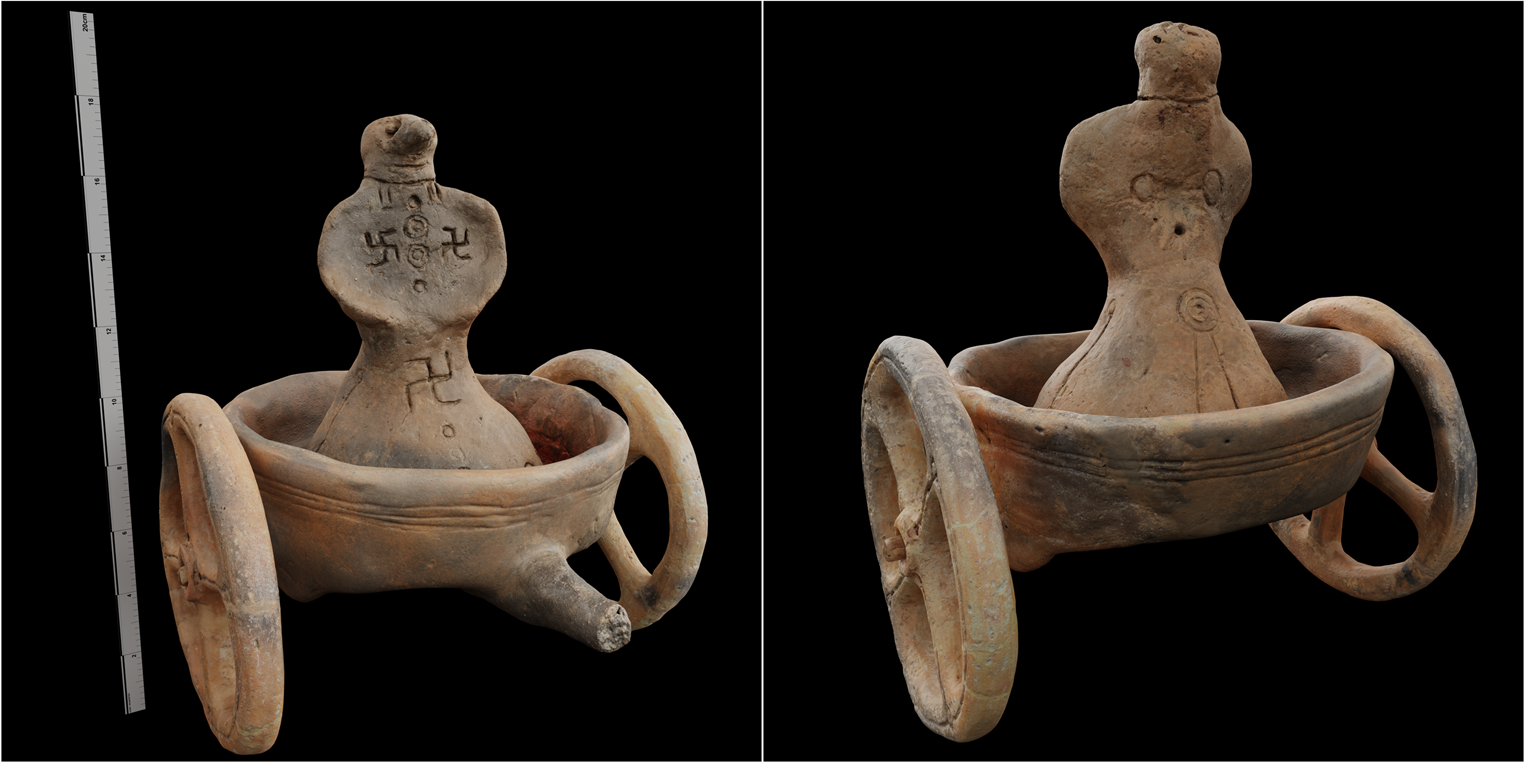
The Dupljaja chariots were recovered in the early twentieth century by a local farmer and sold to a collector, Leonard Behm. In 1929, Chariot 1 was purchased by the National Museum in Belgrade and Chariot 2 by Felix Milleker for the City Museum of Vršac from Behm's son following his death. They are said to have come from a cremation cemetery near the village of Dupljaja (South Banat in Serbia) in the south Carpathian Basin, but no details were recorded (Milleker, Reference Milleker1930; Garašanin, Reference Garašanin1951). 3D models of the Dupljaja chariots can be accessed at https://bit.ly/dupljaja.
Anthropomorphic figurines of the same general form have the same posture, but flat faces, and have been recovered from urns from several other cemeteries in the surrounding area (Пековић, Reference Пековић2015). Their decoration is typical of the Dubovac-Žuto Brdo style of encrusted pottery common to the hinterlands of the middle Danube in present-day Serbia (Szentmiklosi, Reference Szentmiklosi2006). Absolute dates (Molloy et al., Reference Molloy, Jovanović, Bruyère, Birclin, Estanqueiro and Milašinović2023: table S2) of stratified finds of this pottery style come from settlements near to Dupljaja, at Pančevo 2-Stari Tamiš (1515–1434 cal bc), Bavanište (1498–1411 cal bc), and Kačarevo 2 (1421–1291 cal bc). A cremation burial with a Dubovac-Žuto Brdo style figurine from Mali Akač was accompanied by a footed-juglet of a form found in Trench 10 at Gradište Iđoš dated to the late fifteenth to fourteenth century cal bc (Molloy et al., Reference Molloy, Jovanović, Bruyère, Birclin, Estanqueiro and Milašinović2023: table S2). The relative chronology established for the Dubovac-Žuto Brdo style also suggests a late sixteenth to late fourteenth century bc date for the chariots.
Chariot Design
Chariots can briefly be characterized as light, two-wheeled vehicles with a draught pole to harness horses and with standing space for a crew of one to three people (Crouwel, Reference Crouwel2012: xiii). The earliest evidence for wagons with two spoked wheels, possibly chariots, comes from the Sintashta-Petrovka cultural complex of the Eurasian steppe and dates no later than 1900 bc (Lindner, Reference Lindner2020). Though horses had been domesticated since c. 3500 bc, the lineage (DOM2) of modern horses began in the Volga-Don area of the steppe as late as 2000 bc (Librado et al., Reference Librado, Khan, Fages, Kusliy, Suchan and Tonasso-Calvière2021). This selective breeding focused on critical locomotor and behavioural adaptations, including reduced back pathologies and greater docility. This may have enhanced the possibility to connect horses to light draught vehicles such as chariots. DOM2 horses spread to the Carpathian Basin between 2200 and 2000 bc, establishing a new, shared tradition of equitation and chariotry in western Eurasia (Librado et al., Reference Librado, Khan, Fages, Kusliy, Suchan and Tonasso-Calvière2021).
Focusing on horse-tack, Maran (Reference Maran, Maran, Băjenaru, Ailincăi, Popescu and Hansen2020) and Makarowicz et al. (Reference Makarowicz, Ilchyshyn, Pasicka and Makowiecki2023) have argued that chariots emerged at the same time in the Carpathian Basin as in the Sintashta-Petrovka cultural complex (Figure 3A). Notably, the rod-shaped cheekpieces common to the Carpathian Basin (Figure 3B) are distinct from the disc-shaped early varieties of the Eurasian steppe, indicating coeval but distinct traditions (Maran, Reference Maran, Maran, Băjenaru, Ailincăi, Popescu and Hansen2020: 509–10; Metzner-Nebelsick, Reference Metzner-Nebelsick, Baragli, Dietz, Földi, Heindl, Lohmann and Schlüter2021). The earliest known spoked wheel models from the Carpathian Basin are dated to the twentieth to nineteenth centuries bc (Mengyán et al., Reference Mengyán, Gémes, Szeniczey and Hajdu2023). Chariots must have incrementally developed over many decades or centuries within the vast area between the above stated western and eastern limits rather than springing fully formed into widespread use.
Sites mentioned in the text. Key: 1) Sintashta-Petrovka core area; 2) Kültepe-Kanesh; 3) Kavrochori larnax, Chania and Kephala Lilianou peak sanctuary; 4) Mycenae; 5) Mitrou and Kazanaki; 6) Arcalia, Negrilești, and Oarţa de Sus; 7) Husiatyn; 8) Dupljaja and Bela Crkva; 9) Stubarlija; 10) Pecica, Ateaș; 11); Sălacea, Săcueni,; 12) Obišovce, Encs and Vel'ké Raškovce; 13) Hasfalva ‘throne’; 14) Pierstnica and Kałowice; 15) Lubuskie area; 16) Potsdam Eiche and Burg Spreewald; 17) Trundholm and Trudshøj18) Småland, Skåne, Kivik, and the Balkåkra throne; 19) Bohuslän; 20) Solana de Cabañas, Antegua and El Viso. A) Rod bridle-bits core area; B) Disc bridle-bits core area. Map by Marta Estanqueiro (basemap ESRI Physical; source: US National Park Service).

Wheels on European chariots were invariably four-spoked, making them different from vehicles of the Sintashta-Petrovka cultural complex, where six to twelve-spoked wheels were typical. Tracing their development is therefore important. The earliest depiction of a four-spoked wheel directly related to a ‘proto-chariot’ occurs on a seal impression from Level II at Kültepe-Kanesh in Turkey (1950–1836 cal bc), though this wheel form remained rare thereafter in that area (Novozhenov, Reference Novozhenov2012; Metzner-Nebelsick, Reference Metzner-Nebelsick, Baragli, Dietz, Földi, Heindl, Lohmann and Schlüter2021: 113). The earliest physical models of four-spoked wheels in Europe associated with absolute dates are finds from Grave 1290 at Encs and the tell settlement of Pecica in the Carpathian Basin, dated to late twentieth to early eighteenth and the eighteenth century cal bc, respectively (Nicodemus & O'Shea, Reference Nicodemus, O'Shea and Gyucha2019: 71; Mengyán et al., Reference Mengyán, Gémes, Szeniczey and Hajdu2023: 209). Wheel models from other Carpathian sites have a relative chronological date of 2000–1500 bc (Mengyán et al., Reference Mengyán, Gémes, Szeniczey and Hajdu2023: table 3). It is probable that spoked wheels developed before chariots, plausibly paving the way for their development. The use of only four spokes—leaving large segments of the felloe unsupported—may indicate this type of wheel was designed to increase potential speed for vehicles at the expense of their load capacity.
Finds of four-spoked wheel models are most common in the northern Pannonian Plain, and Mengyán and colleagues (Reference Mengyán, Gémes, Szeniczey and Hajdu2023: fig. 9) document wheels, or images of wheels, at twenty-three sites. A further pair of 8 cm diameter wheels were deposited together in an urn in Grave 23 at Stubarlija (location in Figure 3.9; Medović, Reference Medović2007: 36-38). These solid-disc wheels had spokes rendered in incised decoration and had a central perforation to accommodate an axel (Figure 4.4), suggesting they were from a two-wheeled vehicle, possibly including now-decayed organic elements. Finds of both wagon models and spoked wheels are known from a few sites (e.g. Encs, Sălacea, and Săcueni), but only contextually associated at Encs Grave 1290 (Gogâltan et al., Reference Gogâltan, Cordoş and Ignat2014; Mengyán et al., Reference Mengyán, Gémes, Szeniczey and Hajdu2023). This contained a wagon model deposited beside four model four-spoked wheels. The find demonstrates that spoked wheels could be associated with miniature wagon models as well as other model/ritual vehicle forms.
Depictions of four-spoked wheel motifs and chariots from Europe. 1) Gold disc from ‘Ireland’; 2 and 3) Ceramic wheels from Sălacea; 4) Ceramic wheel from Stubarlija; 5) Flask from Mazali/Dikastiri in Chania with spoked wheel motif; 6) Bronze and wooden wheel from Arcalia; 7) Bronze vehicle from Kałowice; 8) Chariot from a stela from Kivik; 9) Chariot from a stela from Shaft Grave V, Mycenae; 10) Chariot from the Kavrochori larnax; 11) Chariot depicted in rock art, Frännarp; 12) Chariot from a stela from Ategua. Images not to scale. Images reproduced with permission of National Museum of Ireland (1), Museum of Oradea (2, 3), Museum of Vojvodina (4), Chania Ephorate of Antiquities and the Hellenic Ministry of Culture (5), Hungarian National Museum (6), Muzeum Miejskie Wrocławia (7). Images redrawn by Barry Molloy (8–12).

Farther south, the four-spoked wheel symbol and swastikas, a possible derivative of this motif, appear in the eighteenth to seventeenth centuries bc in Crete on painted Kamares pottery. A contemporary three-dimensional model with the hub and spokes preserved comes from the Kephala Lilianou peak sanctuary in Crete. This is dated by the excavator to the nineteenth to seventeenth century bc on the basis of the ceramic fabric and associated finds (G. Rethemiotakis, pers. comm.). By the sixteenth century bc, four-spoked wheels appear in Mycenaean art of mainland Greece on chariots in motion (Figure 4.9).
Surviving prehistoric wheels are rare anywhere in Europe and the Mediterranean, but two pairs of full-sized bronze and wood composite four-spoked wheels were found at Obišovce in Slovakia (location on Figure 3.12) and Arcalia in Romania (location on Figure 3.6; wheels illustrated in Figure 4.6). Their diameters measure 55 cm and 70 cm respectively and they probably date to the thirteenth to twelfth century bc (Pare, Reference Pare1987: 36 figs 10, 13). Pare (Reference Pare1987) documents differences in four-spoked wheel technology across Europe, such as how the spokes connect the felloes and hubs, that have temporal and regional relevance. This suggests that, as a tradition, visual or symbolic conservatism may have suppressed technological innovation.
A fifteenth-century bc tomb at Husiatyn in Ukraine, immediately east of the Carpathian Mountains, included a double horse burial accompanied by rod-shaped cheekpieces of Carpathian Basin style (Makarowicz et al., Reference Makarowicz, Ilchyshyn, Pasicka and Makowiecki2023). A double horse burial just west of the Carpathians at Negrilești is dated by Bălășescu and colleagues (Reference Bălășescu, Ilie, Adamescu, Sava and Simion2018) to 1691–1408 cal bc (at 94% probability) or 1612–1492 cal bc (at 54.5% probability). A Noua culture (fifteenth to thirteenth century bc) double horse burial was excavated at Oarţa de Sus in the Carpathian Basin, which included bone plate cheekpieces (Boroffka, Reference Boroffka1998).
Kanne (Reference Kanne2022) argued that the earliest rod-shaped cheekpieces in the Carpathian Basin were initially used for riding but in the Late Bronze Age the form was used for chariotry. That role is supported by the later use of rod and bar-shaped cheekpieces for chariotry (Crouwel, Reference Crouwel2012: 44–48). Rod-shaped cheekpieces from the Aegean, characterized by finds from Mycenae and Mitrou (location on Figure 3.4–5), are closely related in form and decorative motifs to pieces from the Carpathian Basin. Links between Late Helladic and Carpathian horse-tack are well-established, and it is argued the areas shared a linked ‘Carpathian-Mycenaean style’ (Metzner-Nebelsick, Reference Metzner-Nebelsick, Baragli, Dietz, Földi, Heindl, Lohmann and Schlüter2021: 115). Maran (Reference Maran, Maran, Băjenaru, Ailincăi, Popescu and Hansen2020: 511) makes a compelling case that the direction of flow of equestrian technologies was from north to south, originating in the Carpathian Basin.
Depictions of chariots in figural art in Europe are known from the fifteenth century bc onwards. In Scandinavian rock art, chariots are typically depicted in an exploded bird's-eye view, with the box viewed from above and wheels lying flat on either side (Figure 4.11; Johannsen, Reference Johannsen2011). No occupants are depicted. The same schema is used on the ‘warrior stelae’ of the Iberian Peninsula, such as those from Ategua, Solana de Cabañas, or El Viso (location on Figure 3.20; depiction from Ategua on Figure 4.12; Harrison, Reference Harrison2004). The thirteenth-century bc Kavrochori larnax from Crete depicts a unique (for the region) exploded view of a chariot (location on Figure 3.3; illustration on Figure 4.10; Marinatos, Reference Marinatos2010: fig. 11.4). Looking much farther east, rock art representations of chariots in an exploded view and with four-spoked wheels exist at the Karatau ridge in Kazakhstan and Tkhor in the Indus Valley (Novozhenov, Reference Novozhenov2012: 37, 40). This perspective contrasts with the profile-view common to Aegean art. Such a profile-view also occurs in Kivik in Sweden (location on Figure 3.18; illustration on Figure 4.8), suggesting that iconographic influences may have moved in both directions. A chariot incised on a fourteenth-century bc ceramic vessel from Vel'ké Raškovce in Slovakia combines the exploded and profile perspectives and uses four-spoked wheels and a D-shaped platform with no charioteer. Though media and formats vary, images of chariots with four-spoked wheels occur widely in Europe and are likely to attest to closely linked conventions. The only three dimensional models of chariots from the Carpathian Basin are those from Dupljaja, while simple, miniature ceramic 3D models from Greece date from the fourteenth century bc onwards.
The Dupljaja Chariots
Dupljaja Chariot 1 (https://bit.ly/dupchariot1) has six separate components: a chariot body, three wheels, a charioteer and a ‘parasol’ (Figure 1). The chariot's bowl-shaped platform (https://bit.ly/dup1body) is supported by two wheels with hubs (https://bit.ly/chariot1wheel1 and https://bit.ly/chariot1wheel2) on each side and a third wheel set at the front of a pair of draught-poles. This was needed to balance the model (https://bit.ly/chariot1front). The necks and heads of three waterfowl are set on the draught-poles. The charioteer (https://bit.ly/charioteer1) sits on the chariot platform, covering a four-spoked wheel symbol rendered in encrusted decoration. The charioteer's face is stylized, with a protruding conical nose reminiscent of a bird's beak. The figure has male primary sexual features modelled under the skirt (Figure 5). A final component of this group is a conical ceramic object that Petrović (Reference Petrović1930) interpreted as a parasol to be suspended above the charioteer (https://bit.ly/dup1parasol).
Dupljaja, Charioteer 1 sexual characteristics.

Dupljaja Chariot 2 (Figures 2 and 6; https://bit.ly/dupchariot2) is fragmentary but has the same bowl-shaped platform (https://bit.ly/dup2body) decorated with cross-in-circle wheel motif, triple bracket under the body of the chariot, and a pair of hubbed wheels (https://bit.ly/chariot2wheel1 and https://bit.ly/chariot2wheel2). This was reconstructed with a single draught-pole, though it is unclear if a second pole, as in Chariot 1, was originally in place (Figure 6E). Charioteer 2 (https://bit.ly/charioteer2) is similar to Charioteer 1, with personal ornaments, elaborate hair, and beak-like nose, but without primary sexual characteristics. Swastikas are rendered on the chest.
A) Dupljaja, Charioteer 2; B) Chariot 2; C) Charioteer 2 part-covering wheel symbol on Chariot 2; D) Charioteer 2; E) Chariot 2 body; F) Wheel 2 from Chariot 2 (D–F taken during recent conservation works).

A further chariot wheel model was found recently as a stray find without any associated finds at Bela Crkva near Dupljaja and is now at the City Museum of Vršac (shown in Figure 8.3–4; https://bit.ly/vrsacwheel). It is decorated in the Dubovac-Žuto Brdo style using motifs similar to those on the wheels of the Dupljaja chariots. This wheel, however, is only rendered to be viewed from one side as the other side is unformed, flattish, and uneven. It has a central opening for an axle but no traces of wear, suggesting this was not from a model that moved.
Both chariots from Dupljaja have circular, bowl-shaped platforms that deviate from the design of functional chariots, perhaps because this feature is related to their role as ritual objects. Nonetheless, their wheel hubs with integral collars are a feature of functional wheels supporting them rotating around a fixed axle (Crouwel, Reference Crouwel2012: 26–28). The three-point connection was typical to functional chariots, with the central point commonly linked to a draught-pole (Crouwel, Reference Crouwel2012: fig. 8). This triple-bracket feature is markedly different from the tubular arrays to house axels on earlier ceramic wagon models (Mengyán et al., Reference Mengyán, Gémes, Szeniczey and Hajdu2023: fig. 5).
The Dupljaja chariots provide space for only one occupant. In a rare depiction of a charioteer from Kivik in Sweden one occupant is depicted (Figure 4.8). This may hint that chariots in Europe were single-person vehicles. A solo charioteer appears on the Shaft Grave stelae at Mycenae (Figure 4.9), but either one or two occupants were regularly rendered in later Mycenaean art.
Material characterization
To better understand the chariots, we documented aspects of their manufacture, use, and modification and created high-resolution 3D models (visit https://bit.ly/dupljaja). The purpose was to evaluate whether the parts of each model were made as a package and whether both chariot groups were made of the same raw material. The models have high intrinsic value, so non-destructive analyses were essential, which meant analysing their surface only. This is not ideal because of surface geometry and risk of contamination by dust or traces of conservation materials; the results should therefore be treated with caution. Screening of the data ensured that we included only the best readings in our statistical analysis, which should be regarded as semi-quantitative. We used an Olympus Vanta M-Series handheld XRF instrument, the method used was geoChem-Extra, and each measurement lasted forty-five seconds. The analyses suggest that the components of each chariot group were manufactured using the same clay sources. That is, we believe the charioteer, wheels, and platform of each chariot were manufactured at the same time as part of a coherent group (Figure 7). Differences were observed between the two chariots.
Bivariate plots of the pXRF results for the Dupljaja Chariots 1 and 2.

For Chariot 1, the data suggest a similar, yet slightly different clay source (e.g. higher Al; lower Mn, Fe, and Ca; see Supplementary Table S1) was used than for Chariot 2. The concentration of sulphur is variable but measurements with higher amounts of sulphur also correlate with higher Ca contents, indicating that the clay either includes natural gypsum to a varying degree or that the surface was contaminated by gypsum during conservation. As this was related to smaller areas of the chariot, the latter seems likely. The data also suggest that the ‘parasol’ was manufactured from the same clay as Chariot 1, supporting their association. The measurements on Chariot 2 suggest that all parts analysed used a single type of calcareous clay. These semi-quantitative analyses concur with colour-tone differences between the two chariots groups.
To complement the compositional analyses, detailed measurements were taken of individual components (Figures 6.1–2). On both chariots, the cross-section of the wheel felloes is slightly oval and of similar proportions, and the hub internal diameter varied by only up to 1.1 mm across all five wheels (Table 1). The external diameters of the wheels on each side of the chariots are also consistent, being c. 100 mm. While decorative motifs indicate that the wheels are correctly paired for each chariot, their dimensions suggest that they could have been interchangeable between models in the past. The only discrepancy is the front wheel of Chariot 1, whose decoration differs from that of the other two wheels of this model but is identical to those of Chariot 2 and the new Bela Crkva find. This may perhaps indicate that it was re-used from an older model or was a later replacement, suggesting the models were modified over time using local resources.
Chariot 1: wheel dimensions.

Wear analysis
The interiors of the triple axle brackets and wheel hubs were studied for wear traces using a Dinolite AM7915MZTL digital microscope (up to 50× magnification). No wear was detected inside the triple bracket on either chariot, indicating that the axles did not rotate within them. However clear traces of abrasion striations were observed inside the wheel hubs, which indicates that the wheels rotated on the axle (Figure 8.1). This wear therefore suggests that the vehicles reproduced features derived from real chariots and that the models were actively used in the past.
1) Wear inside hub of left wheel of Dupljaja, Chariot 1; 2) Wheel component terminology; 3) Bela Crkva wheel obverse; 4) Bela Crkva wheel reverse.

The upper arms of Charioteer 1 are worn in the same place on both sides on its front. This wear was formed by abrasion and consists of three rounded and shallow notches in each arm. Their symmetry on both arms suggests that this was intentional, perhaps to accommodate cords to serve as reins or to attach other organic paraphernalia to the charioteer. This hints at the complex biography linking the figurine to the activities of its users, who chose modification over replacement. The right hand on Charioteer 1 has five fingers whereas only four remain on the left hand, two clearly visible and two as faint lines. This is probably due to slight abrasion through wear owed to handling, as seen for Charioteer 2 (Figure 6A).
Charioteer 1 was intentionally modified in antiquity, with two conical holes 7 mm in diameter and one aborted hole drilled into the figure's back and a further conical hole 5 mm in diameter drilled into the head, all being 5–8 mm deep. It has been argued that an organic element was fixed to these holes to suspend the parasol above the figurine, but the holes’ conical profile is poorly suited to this end. Furthermore, the XRF data indicate that the parasol was made at the same time and hence an ad hoc post-firing modification to accommodate it is unlikely. Charioteer 2 has a single conical hole 3 mm in diameter on the lower back made after firing; while less substantial than changes to Charioteer 1, this suggests a similar history of modification.
The Four-Spoked Wheel in European Bronze Age Religious Symbolism
In Bronze Age art, chariots invariably used four-spoked wheels. The wheels mirror the cross-in-circle symbol found on the chariot’s platforms, but this latter need not always represent a real wheel. Instances of cross-in-circle motifs in western Europe on gold foil and ceramic ornamentation of the later third millennium bc predate any known spoked wheels (Figure 4.1; Cahill, Reference Cahill2015). Between the twentieth and the fourteenth centuries bc, this motif occurs on ceramic vessels from various cultural traditions of the Pannonian Plain, where it is often interpreted as solar symbolism (Pásztor, Reference Pásztor and Ruggles2015, Reference Pásztor, Gheorghiu, Pásztor, Bender and Nash2017; Sofaer, Reference Sofaer, Sofaer, Bender Jørgensen and Stig Sørensen2018). Notably, these pots were used in domestic contexts, indicating widespread and diverse consumption of cosmological imagery (Sofaer, Reference Sofaer, Bergerbrandt and Sabatini2013). The pair of wheels from Grave 23 at Stubarlija replicate precisely the cross-in-circle motif found on the exterior of the base of vessels from the same cemetery (Medović, Reference Medović2007). The design of these discs directly connects the solar motif used on vessels with wheel symbolism and plausibly two-wheeled vehicles. Furthermore, the cross element is defined by three narrow, encrusted channels, the same as the image on the platform of Chariot 1. Similarly, the wheel symbol rendered on the platform of Chariot 2 replicates the motifs used on the front wheel of Chariot 1 and the Bela Crkva wheel.
We interpret the cross-in-circle symbol as sigil that was a bi-referential device, simultaneously or distinctly referencing the sun and wheels. This sigil may have been imbued with religious or magical meaning. The dual symbolism of a chariot wheel and cross-in-circle motif was combined in the case of the Dupljaja chariots, where physical wheels and incised symbols of wheels and swastikas occur together. Through this entanglement, the chariot may absorb cosmological meaning as a solar vehicle, and conversely prestige may be conferred on real chariots (Kristiansen & Larsson, Reference Kristiansen and Larsson2005: 324–25).
Beginning between the sixteenth and fifteenth centuries bc, this symbol was used to depict functional wheels on chariots from Scandinavia to the Aegean. Examples of chariots carrying sun-wheels are possibly depicted in rock art in Bohuslän and Småland in Sweden (locations on Figure 3.18–19; Kaul, Reference Kaul and Maraszek2012: figs 5 and 6). Kristiansen (Reference Kristiansen, Bech, Eriksen and Kristiansen2018: 70, fig. 1 a–c) discusses depictions of solar discs associated with birds, broadly dated to 1500–1100 bc and a solar disc being drawn by a horse. This horse drawing the sun is a common motif on Scandinavian Bronze Age razors from the later second millennium bc. It also occurs as the fifteenth-century bc Trundholm sun chariot from Denmark. This metal model consists of two wheels and an axle supporting a solar disc made of bronze and gold pulled by a horse supported by four wheels. The two wheels supporting the disc may invoke chariot imagery and the four-spoked wheels may simultaneously reference chariots and solar symbolism. Kaul (Reference Kaul, Meller and Bertemes2009) argues that the purpose of the wheels is primarily to enable the sun-horse pair to be moved in rituals.
Simpler, highly schematized, bronze solar vehicles are known in Bronze Age Europe. Several combine four-spoked wheels with waterfowl symbolism. Examples from northern Europe include pieces from Burg Spreewald and Eiche-Golm, both near Potsdam in Brandenburg (location on Figure 3.16), Pierstnica, Lubuskie area, and Kałowice in Poland (locations on Figure 3.15–16; illustration of Kałowice on Figure 4.7; see Hänsel, Reference Hänsel2008; Blume, Reference Blume and Maraszek2012: fig. 7; Kaul, Reference Kaul and Maraszek2012). These objects were placed on wooden shafts via a socket and were designed to be used. The wheels could rotate, creating a means to convey movement, while the single axle potentially referenced chariots.
The use of the cross-in-circle sigil alone on bronze armour and on shields depicted in Scandinavian rock art suggests that it was invoked to protect, indicating it held wider meaning beyond direct references to chariots or the sun (Pásztor, Reference Pásztor and Ruggles2015; Mödlinger, Reference Mödlinger2018). Indeed, this sigil became the most widely shared image of any form in Bronze Age Europe (Kaul, Reference Kaul2005). It is known from Iberia to Scandinavia and Ireland to Greece on rock and stone, as miniature metal and coroplastic models, as dress pins, sheet metal ornaments and weapons, and as motifs on pottery vessels at various times between the third and the first millennium bc.
Wheel-headed pins from Central Europe and Greece may have four-spoked or more abstracted wheel symbols, one of the few cases where deviation from the four-spoked formula occurs (Pare, Reference Pare1987: 58). A possible use as a sigil occurs on the lintel of a tholos tomb at Kazanaki near Volos in Thessaly (location on Figure 3.5) where the cross-in-circle symbol is repeated three times, making it unlikely to constitute Linear B text (Adrimi-Sismani & Alexandrou, Reference Adrimi-Sismani and Alexandrou2009). The symbol also appears independently of chariots on ceramic vessels from the Mycenaean palatial period in Greece, most often on stirrup jars (alone or with other Linear B symbols) but also on other vessels (Figure 4.5).
The circularity between solar cosmologies—symbolic wheel/solar vehicle/functional chariot—was deeply ingrained since at least the fifteenth century bc. We cannot fully ascertain whether the symbol influenced the wheel design, or the wheel design gave new meaning to the symbol, but the sustained relationship throughout the second millennium bc is notable.
The Dupljaja Chariots and Charioteers in Ritual and Religion
The waterfowl on Chariot 1 are a common feature in Bronze Age religious iconography in Europe (Vasić & Vasić, Reference Vasić and Vasić2003; Pásztor, Reference Pásztor, Gheorghiu, Pásztor, Bender and Nash2017). Kaul (Reference Kaul and Maraszek2012: 16) argues they symbolized liminality, being capable of negotiating distant places by air, travelling locally by land, or descending into watery environments. This symbolism embraces the new emphasis on mobility and connectedness that characterized the second millennium bc, though it also speaks to death and otherworldly journeys (Pásztor, Reference Pásztor, Gheorghiu, Pásztor, Bender and Nash2017: 195).
Kaul (Reference Kaul and Maraszek2012: 14) has suggested that a solar deity was widely worshipped in much of Europe; although there seems to have been regional variation in belief systems even between geographically proximal regions such as Crete and the Greek mainland (Palaima, Reference Palaima and Shelmerdine2012; Peatfield & Morris, Reference Peatfield, Morris, Rountree, Peatfield and Morris2012). It is possible that the Dupljaja charioteers represent a solar deity on a special vehicle. This would be a unique contextual manifestation of a divinity alongside its attributes in pre-Iron Age Europe. Drawing on the concept of animism in Bronze Age religion, however, the bird-like faces of the charioteers may also suggest that they represent a human shaman or religious intermediary using a costume to assume bird-like characteristics for performing religious activities (Ahlqvist & Vandkilde, Reference Ahlqvist and Vandkilde2018).
The frontal profile created by the posture of the charioteers with arched arms—typical of the Dubovac-Žuto Brdo figurines—closely resembles the ubiquitous bronze ‘heart-shaped pendants’ of the later Bronze Age Pannonian Plain (Blischke, Reference Blischke2000). The similarity of profile implies that both figurine and pendants were invoking a bodily posture related to the expression of beliefs. This may have been akin to ritual or meditative postures that Peatfield and Morris (Reference Peatfield, Morris, Rountree, Peatfield and Morris2012) argue were part of religious praxis in Bronze Age Crete and were reproduced materially in peak sanctuary coroplastic figurines.
The male genitals of Charioteer 1 throw into question Kristiansen and Larsson's (Reference Kristiansen and Larsson2005: 150, 152, 307) interpretation that the charioteer represents an Indo-European goddess. A non-binary gender, liminal, or even transgressive identity for this figure has been convincingly argued for by Matić (Reference Matić2010). Robb and Harris (Reference Robb and Harris2018: 132–34) argue that binary male–female identity was essentialized through ‘quite clear and explicit gender structures’ during the European Bronze Age. Acknowledging divergences, Robb and Harris’ core argument is that the use of material signs to differentiate male and female identity became widespread during the second millennium bc (but see Gaydarska et al., Reference Gaydarska, Rebay-Salisbury, Ramírez Valiente, Fries, Hofmann and Augereau2023). Even such binary symbolism accommodates the capacity for individuals to exercise choice or, as Matić (Reference Matić2010: 150–51) argues, to subvert norms in particular contexts. The biologically male features of Charioteer 1 may well be intended to define a male identity, but this also raises questions about using attire and ornamentation to gender other figurines from the region that lack primary sexual characteristics.
Ritual in practice: using the chariots
It may be that some of the value of our chariot groups emerged as performance during their creation and/or when these acts were witnessed by others. The size and shape of the Dupljaja charioteers is conducive to easy handling (Figure 6A and B). While their symbolism is often discussed, the wear traces on the wheels indicate that they were also actively used. The wheels enabled the chariot and the birds to be viewed in motion, reflecting ‘cosmological, eternal movement materially in the here and now’ (Becker, Reference Becker, Sofaer, Bender Jørgensen and Stig Sørensen2018: 219). The bowl shape of the Dupljaja chariots is a divergence from real chariots and must have related to their ritual function. For example, it was well-suited to storing liquid or grains, perhaps as part of ritual actions. Model ceramic sub-rectangular/ovoid, bowl-shaped, four-wheeled wagons dated to the first half of the second millennium bc come from six locations in the northern Pannonian Plain and may have fulfilled a similar function. The term wagon invokes a workaday vehicle, but the role of model wagons in ritual may indicate some functional wagons held prestige value. The dating of the Dupljaja chariots coincides with the end of the use of wagon models, but also the shift from tell-centred settlement networks to an expansive network of densely spaced flat settlements in the sixteenth century bc (see below). This may have reflected changes in the importance and nature of interaction and mobility at local to regional scales. With regard to the models, the individual riders certainly mark chariots as distinct from the bulk-carrying wagon symbolically, though being vehicle models that also performed a container function demonstrates continuity. The continued or renewed use of wagons after 1200 bc is demonstrated by four-spoked, four-wheeled solar vehicles supporting a metal vessel (dated c. 1200–800 bc). Models adorned with waterfowl from Trudshøj in Jutland, Orǎštie in Transylvania, and Bujoru on the Lower Danube (Pare, Reference Pare1987: 48, fig. 6; Kaul, Reference Kaul and Maraszek2012: fig. 8) may be cited in support of this hypothesis.
The chariots and charioteers from Dupljaja were designed to be viewed together and in isolation. The cross-in-circle symbol on the inner surface of the platform on both chariots is only visible when the charioteer is lifted (Figure 6C). Furthermore, the male genitals hidden under Charioteer 1's skirt suggest that the figure was intended to be handled and viewed. The so-called parasol from Chariot 1 is the nearly same diameter as the charioteer's skirt, suggesting that it could be used to cover the space left by the figure when it was ‘absent’. Switching the charioteer and parasol may have accentuated the figure's absence while retaining the ability to cover or expose the sigil. The triangular motifs surmounted by dots on the base of the conical skirt of Charioteer 1 and those on the parasol are identical, constituting a multi-point solar motif when viewed from above, similar to that on the Sălacea wheel (Figure 4.3). This lends support to the idea of substitution and credence to the notion that the chariot could appear in different states according to stages of a ritual or times of year. Kaul (Reference Kaul and Maraszek2012: 15) argued for different daytime and nighttime visual vocabularies for a solar deity, and this may have been manifested when using the Dupljaja chariots, decorated with solar symbols, with and without the charioteer.
The manner the chariots were removed from use may also relate to ritual. Chariot 1 had some breakages, particularly to the draught-pole and wheels, and Chariot 2 was broken into many smaller pieces (Figure 6D–F). Both charioteers had their heads broken off in prehistory. The breakage and incomplete state of Chariot 2 upon deposition may fit Chapman's model for ritual fragmentation (Chapman, Reference Chapman2000). Such acts are two-fold in meaning: the act of breakage is a participatory event transforming the relationships of people with the object, be it as a sacrifice or decommissioning; and the broken elements can be taken away by people and become enchained in new relationships as tokens of this event or as a remembrance of the object. Intentional breakage may be seen in the overkill of Chariot 2's Wheel 2, which had been broken into at least twenty-four pieces.
The Dupljaja Community in Context
Until recently, exceptionally little was known about the society that created the Dupljaja cemetery. The recent discovery of A network of over 100 massive enclosed sites in the southern Carpathian Basin, known as the Tisza Site Group (TSG), has recently been discovered and changes this picture. Its constituent communities used a combination of Belegiš and Dubovac-Žuto Brdo pottery types (Molloy et al., Reference Molloy, Jovanović, Bruyère, Birclin, Estanqueiro and Milašinović2023). The cemetery at Dupljaja lies within the south-eastern limit of this settlement network. Metalwork and ceramics from TSG settlements, cemeteries, and hoards show robust connections with Italy and Central Europe (Cavazzuti et al., Reference Cavazzuti, Arena, Cardarelli, Fritzl, Gavranović and Hajdu2022; Gavranović et al., Reference Gavranović, Mehofer, Kapuran, Koledin, Mitrović and Papazovska2022; Molloy et al., Reference Molloy, Bruyère, Jovanović, Fernandez-Gotz, Nimura, Stockhammer and Cartright2023). Links to the Mediterranean include Aegean metalwork, the presence of Cypriot copper, and, in the thirteenth to twelfth century, the spread of metalwork types into the Eastern Mediterranean and pottery styles into northern Greece (Molloy, Reference Molloy and Molloy2016; Bulatović et al., Reference Bulatović, Molloy and Filipović2021).
The Dupljaja community was a participant in the polities formed by TSG settlements and the chariots contribute to the suggestion that this area was an influential node driving and enabling long-distance networks linking the Mediterranean and Europe through river corridors. Dupljaja was ideally situated for ideologies to develop that integrated local and regional influences.
Conclusion
The people who used the Dupljaja chariots were intimately linked to long-distance networks connecting far-flung parts of western Eurasia and the Mediterranean during the later Bronze Age. Set in the context of the Tisza Site Group of settlements, external connections attested by pottery, mortuary practice, settlement ideologies, metalwork forms, and metal resources also extended to trans-European cosmological knowledge networks. These links are embodied in the Dupljaja chariots and their symbolic grammar. Communities of the south Pannonian Plain appear as a driving force in chariot symbolism, and probably chariot technology, relevant at a European scale.
The range of symbols and functional features combined in these chariots find parallels throughout Europe independently or sometimes in combinations. The multi-referential nature of the cross-in-circle sigil in Bronze Age European religious imagery has been emphasized in this article. Functional wheels sharing this form first appeared in the Carpathian Basin in the late twentieth to eighteenth century bc. The design and arguably symbolic power of this wheel design was widely employed in Europe by the sixteenth century bc, stretching from Scandinavia to the Aegean. In iconography and on operational vehicles, four-spoked wheels became the virtually exclusive form of spoked wheel in Europe in the second millennium bc.
Four-spoked wheels in Europe were consistently depicted in isolation from vehicles, serving as a sigil in their own right. This drew the chariot into solar symbolism both conceptually and physically, so that the cross-in-circle sigil may at once have represented the sun and a vehicle to transport it through the cosmos (Kaul, Reference Kaul2005). The iconographic circle is completed in Dupljaja Chariot 1, where waterfowl—the other ubiquitous Late Bronze Age symbol—are drawing a chariot with motifs and functional wheels rendered together. In this way travel by air, water, and land are all embodied in a single object.
The Dupljaja chariot models represent a materialization of supra-regional traditions through the lens of local beliefs. Whether a deity or shaman, the figure of Charioteer 1 was associated with chariots and (biologically) male or unbound from biological essentialism. The XRF data suggest that both charioteers were made specifically for their respective chariots. Nonetheless, the objects were not static, and they evolved with further elements added to embellish or repair them. Wear on the charioteers, largely polishing and abrasion, indicates they were handled and viewed separately from the chariots. The traces of wear in the wheel hubs tell us that these objects were actively used. The capacity to hold liquids or materials in the bowl of the chariot may link this use with ritual acts.
The Dupljaja chariot models are two out of many once used in the Pannonian Plain, so their wider influence on a European stage emerged from that social milieu. Yet their makers were using local norms for how these features should fit together in a ceramic model, including the presence of a charioteer figurine, thus far unique for Bronze Age Europe. It is in the dialogue between the routines of local actions and regional scale cosmological beliefs and technical knowledge that the Dupljaja chariots find their meaning. This tells us their users were both embedded within and active in generating the globalized worldview that characterized the European later Bronze Age.
Supplementary Material
To view supplementary material for this article, please visit https://doi.org/10.1017/eaa.2023.39.
Acknowledgements
The authors are grateful to Gordana Grabež from the National Museum of Serbia for her help in researching Chariot 1. This study was part-funded by an ERC Consolidator Grant (GA 772753) held by Barry Molloy. We thank the four anonymous reviewers for their insightful advice and the EJA team for excellent support. For accessing images we thank Gruia Fazecaş and Florin Gogâltan, Christian Horn, and Marta Díaz-Guardamino We thank Giorgos Rethemiotakis for permission to mention the unpublished Kephala Lilianou wheel.


 Open access

