Tolkien, the critics, and why I’m starting an Oxford doctoral project on The Lord of the Rings and war

I’m about to embark on a doctoral research degree about how world war and other modern conflicts shaped Tolkien’s masterpiece. Two newly published literary polls illustrate why I’m especially pleased that Oxford University has accepted my application – and why I’m asking for support here.

When Mr. Bilbo Baggins of Bag End announced that he would shortly be celebrating his eleventy-first birthday with a party of special magnificence, academicians and literary pundits made a note to avoid it.

It’s now 72 years since Bilbo and his creator issued their joint invitation with the publication of The Fellowship of the Ring in 1954. And it seems that this early divide – between experts and amateurs – still persists.

The Guardian recently published a list of ‘the 100 best novels of all time’. This is ‘the greatest literature ever published in English, as voted for by authors, critics and academics worldwide,’ the teaser says. ‘How many have you read?’

The winner, Middlemarch, is a great and wise novel of society and psychology. So is Beloved, in second place. So are Ulysses, To the Lighthouse, and In Search of Lost Time, in third, fourth and fifth places. And so it goes on down most of the list. The sole piece of resolutely genre fiction is Ursula K. Le Guin’s The Left Hand of Darkness, scraping in at 91.

Who voted? Overwhelmingly, writers and critics who till the soil of primarily realistic social and psychological fiction.

In a commentary, Guardian writer Lisa Allardice ponders the absence of ‘the now unfashionable postwar writers’ C.S. Lewis, William Golding and Tolkien. Surely she doesn’t seriously think Tolkien has gone out of style. He’s only unfashionable in the sense that The Lord of the Rings has survived all the fads and trends of the past seven decades.

There’s nothing wrong with cultural polls and we shouldn’t take them as seriously as, say, elections. A poll of experts is a tried and tested way of getting the rest of us riled up. The Guardian has simply used the literati to get the chatterati talking. And that has generated a whole new Guardian poll: readers’ top 100 novels of all time.

The Lord of the Rings won. 

Tolkien excepted, the upper end is still solid canon fodder and so is most of the list. But readers also voted for Watership Down and The Hitchhiker’s Guide to the Galaxy, for Cloud Atlas and The Dispossessed. Piranesi, The Stand, Jonathan Strange & Mr Norrell, Dune – votes for books like these show that ordinary readers want to celebrate stories that transport them with wonder and fear, that compel them to turn of the next page.

Don’t get me wrong. I’m all for expertise and I admire experts. In my own field, I try to be one. Distrust and even hatred of experts is a plague of our times.

But the politics, news and social media of our times are also plagued by confirmation bias. Shared values harden into tumorous, metastasising growths. They dismiss other ways of being, doing and thinking – or they thrive on attacking them. Academic literary expertise has a weakness in that direction. In defining the cultural canon, it likes to show its teeth.

So, on one hand, we have a pan-national profession with overlapping literary outlooks and a shared agenda – to be able to define the canon they teach or write within. On the other hand, we have a lot of little people with no group affiliation, no unified code of readerly conduct, and no aim except to share their sense of excellence. They are amateurs in the proper sense: people who practice something for the sheer love of it.

At Oxford in the 1980s, I discovered there was actually a bust of Tolkien at the English Faculty Library, but it was sequestered at the one corner of the building where no one had cause to go. Among undergraduates, mention of Tolkien brought silence, sniggers or sneers: he was an escapist, and that was that. He was honoured in his own home town and university as a medievalist, but not as a literary creator in his own right.

I didn’t expect to study Tolkien at Oxford, but naturally I hoped the critical skills I developed there would help me understand what I admired in him. Reading The Wanderer, Beowulf and Sir Gawain and the Green Knight helped. So did the prophetic poems of William Blake, and Coleridge’s big trio (The Rime of the Ancient Mariner, Christabel, and Kubla Khan. But little else. The Oxford English BA degree syllabus primarily taught the formal development of literature towards the social or psychological poetry, drama and fiction in today’s accepted canon.

It left me with a void to fill. Later, books by Tom Shippey and Verlyn Flieger showed me I was not wrong about Tolkien. But I sensed there was much more to learn. The claim that his works are mere escapism still rankled.

Tolkien and the Great War by John Garth

His portrayal of war, especially, seemed to demand attention. On the surface, the battles draw from medieval or classical sources and evoke a desperate glory. Beneath that surface there is always a sense of the horror of war and the damage it does to peoples, nature, the body and the mind.

Ultimately, to understand Tolkien, I wrote my own book about him. In Tolkien and the Great War, I gathered all the evidence then available about the wartime experiences of Tolkien and his friends in 1914–18. I charted with great care how Tolkien first conceived and constructed his mythology in that same period. This chronological mapping of secondary creation on the backdrop of primary experience makes the connection between them abundantly clear.

By grounding this fairy-story in the uncompromising reality of the Somme, Tolkien and the Great War (I’m proud to say) has helped people take Tolkien seriously. It’s on virtually all lists of essential books about Tolkien. Its influencehas been far-reaching. ‘Nearly any article in the popular press will now allude to the facts of Tolkien’s service record and take as a given that his fantasy was inspired by these experiences,’ says Janet Brennan Croft in a recent essay anthology on the First World War and fantasy.

I’ve never ceased my deep research into how he reshaped his own lifetime experience into his stories. Tolkien and the Great War goes no further than about 1920, so there’s plenty to learn still about Tolkien’s famous works and how the crises of his era influenced them. But freelance work, life, bereavement, and even hurricanes can severely disrupt a long enterprise of this kind.

That’s why, early this year, I applied to begin a doctoral research project on The Lord of the Rings in its time. I’ll look at how he laid its foundations in the interwar years when the peace of Europe was crumbling, constructed most of it under the shadow of the Second World War, and completed it during the birth-throes of the Cold War.

Tolkien with his son Christopher, in Royal Air Force uniform, Oxford 1945 © Tolkien Trust
Tolkien with son Christopher, in RAF uniform, in 1945 when The Lord of the Rings was two-thirds complete (© Tolkien Trust)

I’m delighted to say that Oxford University has accepted my application – only the second time it has done so for a DPhil project on Tolkien. I hope that it will be a step in making the study of Tolkien a specialism within his own university and English faculty.

Rightly, it will challenge my brain and fortitude. But will also challenge me financially.

British funding for solo research projects has just been cut to the bone. A bursary to support doctoral study of Tolkien would be a great thing for the university that holds his academic and personal papers and half of his literary papers too. But such a bursary does not exist – at least not yet.

That means I’ll have to raise funds with as much energy as I can spare from everything else. The DPhil is part-time so I can spend half my year on freelance work, which will help. But at the very least, I need to make an additional stretch to pay the university fees.

So I’m setting a new target for this crowdfunding appeal – £900 a month. That’s more than double what my cherished supporters already bring in. But it’s surely within reach – with the help of anyone who admires my work or believes it would be a great thing to put the study of Tolkien squarely in place in his home ground at Oxford.

Would you like to help? If so, take a look at my newly revamped subscription plans to see what you get and what suits you best!

Before you go … click here for access to John Garth's articles exclusively for supporters
Posted in John Garth’s writing, Tolkien’s creative spirit | Tagged , , , , , , , , , , , , , | Leave a comment

My 2025 with Tolkien – from Faërie to Minnesota

Joohn Garth at the Rock of Cashel, Muster, Ireland. © John Garth

I’ll admit it’s a bit late to be reviewing the past year. But the month around the New Year was consumed by more important things – of which more later. Anyway, I had a busy time with Tolkien in 2025 – in scholarly and popular publications, in talks and lectures, on my crowdfunding blog, and in manuscript archives. So join me on a little excursion.

Read on at my new blog…

Posted in Uncategorized | Tagged , , , , , , | Leave a comment

2024: My year of Tolkien and tribulation

I’ve been extremely quiet online this year, but I have not been idle. In fact, up to the end of September I was having a very productive time researching and writing on Tolkien. But just when I was ready to complete several projects, disaster struck. Literally.

To find out about my Tolkien-focused work in 2024 and why I suddenly had to take a complete break from it, head over to my Steady blog. You’ll find links to what I’ve published as well as previews of a whole lot of material I have been preparing for 2025. Please do consider supporting me there … I’m breaking new ground on Tolkien, but I can’t do it without help.

Posted in John Garth’s writing | Tagged , | Leave a comment

Goblin caves, ancient scripts and Tolkien’s gift for invention

Goblin caves at the North Pole! The Father Christmas letters penned by Tolkien tell us some surprising things about the Arctic. They borrow penguins from Antarctica and feature a polar bear who can speak, write and draw. The North Pole is an actual pole and there’s no sign whatsoever of an ocean under all that ice.  

Writing these letters to his children gave Tolkien licence to be wildly counterfactual. This was an old desire that also gave his more serious legendarium a flat earth, an earthly paradise and trees that bore the sun and moon.

But in these gossipy, funny, episodic mini-tales he could freely indulge in absurd unrealities – and freely borrow too – without needing to worry about inner consistencies. If he wanted names for North Polar Bear’s nephews, he could make them Finnish (Paksu and Valkotukka, ‘Fat’ and ‘White-hair’). If he wanted a language for Father Christmas’s elf-secretary, he could just borrow it from Middle-earth Quenya (Mára mesta an ni véla tye ento, ‘Good-bye until I see you next’).

I’ve always been interested in Tolkien’s gift for invention, and it seems appropriate to talk about it now at the time of giving and in the context of the Father Christmas letters.

Several enduring aspects of his inventiveness have become clearer to me over the years. Among them is the urge simply to entertain: dressing up as a berserker, falling downstairs, and many other japes – besides writing, of course. Another is the opportunistic grabbing of ideas, to be used immediately or stored up for later. I was delighted when, researching The Worlds of J.R.R. Tolkien, I realised that he used a 1947 Icelandic eruption as grist for the climactic Mount Doom scenes in The Lord of the Rings.

So here’s a possible trigger for one of the longest and most interesting letters from Father Christmas – the 1932 one, in which North Polar Bear (NPB) discovers secret goblin caves at the North Pole.

Continue reading for free via my Steady crowdfunding project

Posted in Chronology of composition, Research tangents, Tolkien’s creative spirit, Uncategorized | Tagged , , , , , , , , , | 1 Comment

Wetwang revisited

Part two, in which we wet our wonges

Tolkien’s paper ‘Chaucer as a Philologist’ (1934) is an analysis of northern English dialect in the Reeve’s Tale, one of the Canterbury Tales. Tolkien argues that Geoffrey Chaucer displays a philological interest in the dialect, as shown by the speech of two Northern clerks in the tale. I’ve never read this paper closely before copy-editing OUP’s forthcoming Tolkien on Chaucer, edited by John Bowers and Peter Steffenson.

Geoffrey Chaucer (Ellesmere MS)

So last week I enlarged on the comments about the name Wetwang that I’ve made in The World of J.R.R. Tolkien. Before we reach Wetwang in Middle-earth, this week I come to what Tolkien says about Wetwang in Middle English. It’s a fitting week to talk Chaucer, because the British Library (which I visited last night for its current exhibition Fantasy: Realms of Imagination and for a talk by the wonderful Susan Cooper) has just made available online digitised images of all its Chaucer manuscripts.

Read on by supporting my writing and research via Ste

Posted in Places and inspiration, Tolkien’s creative spirit | Tagged , , , , , , , , , , | 1 Comment

Wetwang revisited

Part One, in which the vicar entertains

I’m in the middle of copy-editing an upcoming edition of Tolkien’s work on Chaucer, edited with commentary by John Bowers and Peter Steffenson, for Oxford University Press. Tolkien on Chaucer (Opens in a new window)will include the complete text of ‘Chaucer as a Philologist: The Reeves Tale’, first published in Transactions of the Philological Society in 1934.

Wetwang railway station (from the Wetwang History website)

Working on it has brought to my attention a reference by Tolkien to the Yorkshire place-name Wetwang which I didn’t take into account when writing about this name in The Worlds of J.R.R. Tolkien. I sat down this morning to write a brief piece about this for you, but it has sprawled to beyond it’s borders (rather like the marshland itself) and filedl the sluggish regions of my Saturday. So I’m going to divide it up over several weeks. Today I’ll expand on my brief account in Worlds.

Read on by supporting my writing and research via Steady

Posted in Places and inspiration, Tolkien’s creative spirit | Tagged , , , , , , , , | Comments Off on Wetwang revisited

An award on behalf of Tolkien, 50 years on

It’s not every day that you receive an award also given to the director-general of Syrian antiquities, the director of archaeology at Troy and the director of the Colosseum in Rome. But that day came for me on 3 September.

Before I get onto that, I want to mention some other great news, which will have an ongoing impact on my work on Tolkien. I’ve been elected a member of the Senior Common Room (SCR) of Corpus Christi College, Oxford. I’ve also joined Oxford Tolkien 50, ‘a project of Tolkien scholars and students in the University of Oxford, featuring a series of conferences, events, and exhibitions, to commemorate the 50th anniversary of Tolkien’s death’. I’m very grateful to Giuseppe Pezzini, Tolkienist, classicist and Fellow of Corpus, for making both of these things happen.

The “Communicating the Ancient” (“Comunicare l’Antico”) Award is given by Sicily’s Naxos Taormina Archaeological Park “to Italian and foreign scholars and personalities engaged in the dissemination of archaeological, historical and philological research, but also to institutions and museums that have implemented important strategies of valorisation and communication to the general public”.

On screen, I answer questions from Angelica Russo, right, while Carmelina Longo translates

No one can possibly disagree that the other “Comunicare l’Antico” award recipients are all far more deserving than me. They are far more eminent, too. There were Mohammad Nazir Awad, director general of Syria’s museums and antiquities; Rustem Aslan, director of archaeological excavations in Troy; and Alfonsina Russo, director of the Colosseum archaeological park in Rome. There were also a professor emeritus of the University of Perugia, the research manager of Italy’s Institute of Cultural Heritage Sciences, and the mayor of Agrigento, Italy’s Capital of Culture 2025.

But as I said in my thankyou remarks, it was an honour to act as a proxy for Tolkien on the weekend of the 50th anniversary of his death:

Thank you. I am deeply honoured to receive this wonderful award. I am also proud to find myself in the company of such prestigious recipients. I am sure that really this award goes to J.R.R Tolkien, who died on 2 September 1973, 50 years ago this weekend. I am sitting in Oxford, where I have spent the weekend at a conference to mark this anniversary and I have seen and heard the effects of the inspiration he has given to so many people – experts in medieval languages and literature and in many other fields. I see Tolkien as a figure who stands at a doorway to the past and, like Janus perhaps, also faces us in the present. His message to us is not to forget the things that matter: the wisdom and beauty of the ages, the glory and peace of the natural world. I am delighted to have been able to use my own experience and abilities as a researcher and writer to help other people deepen their understanding of Tolkien and therefore of the past. From the bottom of my heart, I thank you for this award.

Il Premio "Comunicare l'Antico" 2023

I was nominated by Oronzo Cilli (author of Tolkien’s Library), who has my deepest thanks for his support. We both hoped to attend the awards ceremony at Naxos Taormina. Alas, it clashed with my prior commitment to the Tolkien 50 conference at Corpus Christi College, so I had to accept remotely, on a big screen. This is the closest I’ll ever get to the Oscars experience, and it was not without its entertainment value as the Sicilian tech team and I struggled to establish audio while my face loomed large over the stage.

The award was presented by Fulvia Toscano, council member for culture at the municipality of Giardini Naxos, and received on my behalf by Gabriella Tigano, director of the Archaeological Park of Naxos Taormina. Translator Carmelina Longo fielded questions from host Francesca Russo about Tolkien, then conveyed my answers and my thankyou comments.

Since the awards, I’ve been almost entirely off social media while trying to complete a book proposal in the midst of an untimely torrent of editorial work. But this was momentous for me. In fact it’s my third award, ever – following the Mythopoeic Award for Scholarship (2004) for Tolkien and the Great War and the Ashurst Cup for Literary Merit (1978) for a story I wrote, aged 12, under the heady influence of the newly published Silmarillion.

The trophy is quite something, isn’t it?

Il Premio "Comunicare l'Antico" / "Communicating the Ancient" Award
Posted in Tolkien’s creative spirit | Tagged , , , , , , , | 1 Comment

The mood music of G.B. Smith, T.C.B.S.

In a guest post, Allan Turner, Tolkien scholar and formerly Lecturer in English at the University of Jena, Germany, provides a musical insight into A Spring Harvest, the 1918 anthology of Geoffrey Bache Smith’s poetry co-edited by his friend J.R.R, Tolkien. Smith, a member of Tolkien’s T.C.B.S. circle and a ‘wild and wholehearted admirer’ of his early mythological writings, died of wounds on the Western Front in 1916. Just months later, Tolkien wrote his creation myth, The Music of the Ainur.

Several of the poems in the poems of Geoffrey Bache Smith, edited posthumously by his friends J.R.R. Tolkien and Christopher Wiseman as A Spring Harvest, express a melancholic sense of loss. However one stands out to me as a particularly successful evocation of mood-music, as its title suggests: ‘Schumann: Erstes Verlust’. This is the name of a piano piece, no. 16 in Schumann’s Opus 68, Album für die Jugend (Album for the Young), which Schumann originally composed for his own children. It has always been a favourite for learners of the piano, but is not very often heard in professional recitals, so his close familiarity with it suggests that Smith was an amateur player himself. After all, he was writing at a time when recording was in its infancy, so that people were used to making music for themselves, either alone or with friends. Anyone who doesn’t know it (and sadly, not many young people have the opportunity to learn the piano nowadays) can listen to it here.

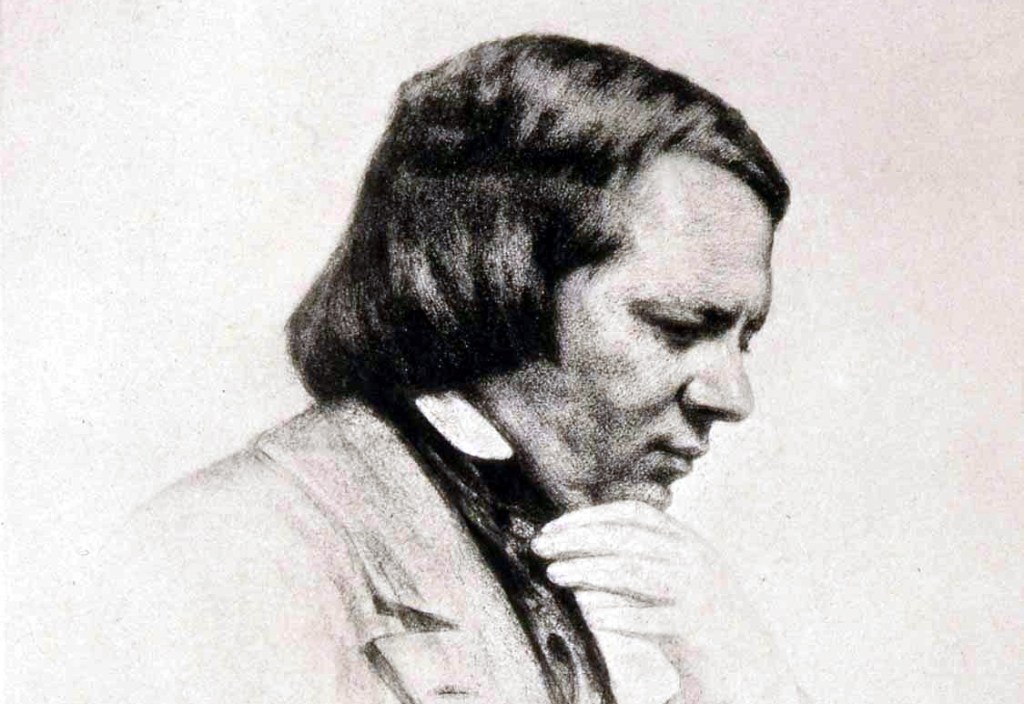
The title means ‘first loss’, and the correct form should be ‘Erster Verlust’; it’s notable that either Smith or Tolkien (as editor) or both got their German grammar wrong, so perhaps Smith was writing from memory. However, the music is quietly wistful rather than tragic. The argument of the poem is so slight as to be almost non-existent: a shadowy ‘she’ has gone and the poet’s feeling of despondency is reflected in the dismal late autumn landscape. Here, the mood is everything. This is the poem in full (with images of Schumann and Smith respectively).

Schumann: Erstes Verlust

O, dreary fall the leaves,
The withered leaves;
Among the trees
Complains the breeze,
That still bereaves.

All silent lies the mere,
The silver mere,
In saddest wise
Reflecting skies
Forlorn and sere.

Would autumn had not claimed its own
And would the swallows had not flown.

Skies overcast!
Leaves falling fast!
And she has passed
And left the woodland strown,
The woodland strown,
The silver mere,
The dying year
And me alone.

Skies overcast!
Leaves falling fast!
Does she that passed
Dream of the woodland strown,
The woodland strown,
The silver mere,
The dying year,
And me alone?

Not even the most ardent Smith fan would claim that there is anything original about falling leaves, grey skies and the wan light on a pool as symbols of human melancholy, nor is the migration of swallows as a sign of changefulness going to surprise anyone. Similarly, there is no description of individual features that would make the scene come to life in the reader’s imagination. In many poems, including perhaps some in the present collection, such stereotyping would be grounds for criticism, but not in this case. That is because the poem is intended as pure music inspired by the mood of Schumann’s piano piece.

The musicality lies above all in the sounds of the words. Since the lines are almost all short, mostly with only two main stresses each, there is frequent rhyming; in the first stanza, in fact, the rhyming words are almost reduced to single pattern, since leaves/bereaves differs from trees/breeze only by an additional soft fricative. The technique here is quite similar to that used by the French poet Paul Verlaine in his ‘Chanson d’automne’. (We know that Smith was good at French, since he acted in a French play at King Edward’s, so it’s quite likely that as a budding poet he was interested in trends on the other side of the Channel.)

Les sanglots longs
Des violons
De l’automne
Blessent mon coeur
D’une langueur
Monotone.

(The long sobs of the violins of autumn wound my heart with a monotonous languor.)

The poem comes from Verlaine’s first collection, published when he was 22 years old, so about the same age as Smith when he was writing his poems, in a section entitled ‘Paysages tristes’ (sad landscapes), which could also describe so many of Smith’s settings. Verlaine also focuses on a wind and dead leaves, but he establishes an explicit link between the landscape and himself: he feels himself being blown back and forth inwardly like leaves in the breeze, whereas for Smith, as in so many of his poetic landscapes, the scene is purely external without reference to any personal emotions.

However, the musicality comes also from the structure of the poem. In contrast to many other poems in A Spring Harvest, which conform to traditional forms and metres such as the sonnet, the four-line ballad stanza or the long narrative verse-paragraph in iambic pentameter, ‘Erster Verlust’ is much freer in form, with lines of different lengths. The second stanza echoes the first, the fifth repeats the fourth almost word for word, while the two longer lines in the middle seem to act as a pivot. What lies behind Smith’s experiment in sound?

The key is to be found in the Schumann piece that it recalls, not only through the evocative sound patterns but through the whole structure. If you listen to it played on the piano, you will recognise that the words of the first three stanzas correspond exactly to the notes and phrases of the music. The second stanza which echoes the first is the poet’s translation into words of the composer’s repetition, with an altered cadence, of the first 8 bars. As the music moves into a more flowing variation of the first motif, so the poem expands into the two longer lines.

Allan Turner sings G.B. Smith’s poem ‘Erstes Verlust’ to Schumann’s music

The relationship in the last part is more complicated, since the music develops into specifically pianistic figuration in which the two hands imitate one another before reaching a patch of chordal writing, the movement of which can only be hinted at in language, although the rhythm of the last two lines of the poem can be clearly heard in the final phrase of themusic. Furthermore, Schumann indicates that the second half of the piece is to be repeated, which provides the basis for Smith’s very atmospheric echo in the last two stanzas.

Let me be clear: I’m not claiming that Smith wanted to turn a favourite piece of music into a song, because that simply would not have worked given the pianistic nature of the composition. It’s simply an evocation of the mood of the music, using the structure of the piano piece but calling upon the resources of language. For me it is a finely crafted poem, a small work of art which can only suggest the talent that Smith might have been able to develop if he had lived longer.

Allan Turner’s impromptu performance of Smith’s poem to Schumann’s music was part of his presentation at the conference G.B. Smith and J.R.R. Tolkien: a meaningful friendship, held at Corpus Christi College, Oxford, on 21–22 March 2023, from which this post has been extracted and enlarged by Allan. To watch his whole conference talk, just go back to the beginning of the video above.

Posted in Guest post, Research tangents | Tagged , , , , , , , , | 3 Comments

Toad to Tode

I’ve posted this on social media already but I’m going to put it here too because, well, I like it.

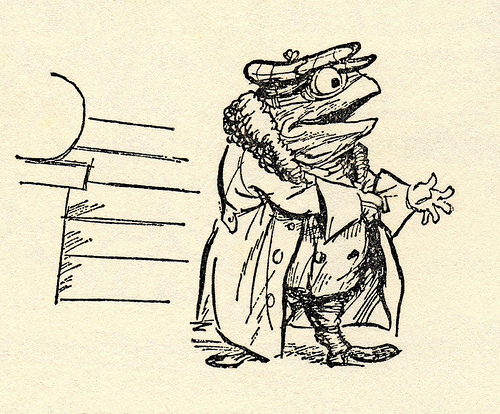
Writing about Tolkien’s unfinished Númenor time-travel novel The Lost Road, I almost inevitably mistype it as “The Lost Toad”. That would be rather a different story. His driving (“Charge ’em and they’ll scatter!”) is said to have reminded Oxford contemporaries of Mr Toad in Kenneth Grahame’s The Wind in the Willows.

Mr Toad took out his map and spread it with a flourish on the shiny bonnet of his new car while he held up the damp and mouldy invitation in his other hand.

You see, Ratty? I knew I was right. ‘Beyond the Merlock Mountains, a long and lonely road, through the spider-shadows and the marsh of Tode – here he paused to chortle to himself – ‘and through the wood of hanging trees and the gallows-weed…’ So well be there in a jiffy, you wait and see!”

Mole and Ratty threw each other an apprehensive glance.

E.H. Shephard, Mr Toad from The Wind in the Willows, in his driving gear
Mr Toad from The Wind in the Willows, in his driving gear, by the inimitable E.H. Shephard

Posted in John Garth’s writing | Tagged , , , , | 6 Comments

Making an ass of yourself, with Geoffrey Bache Smith

I’ve just returned from the first-ever conference focusing on Geoffrey Bache Smith, his poetry, and his influence on his great friend, Tolkien. In a previous post, I spotlighted an under-appreciated aspect of Smith: his sense of humour. In this new post, I will offer some more evidence – in a video this time – and simultaneously make good on a promise I made in that earlier post.

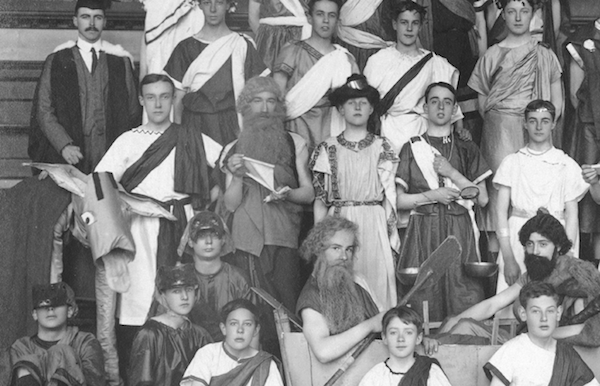
Geoffrey Bache Smith in The Frogs by Aristophanes at King Edward’s School, Birmingham, 1913
Geoffrey Bache Smith and others in The Frogs by Aristophanes at King Edward’s School, Birmingham, 1913

On the serious side, Smith persuaded Tolkien to become a poet and was therefore truly instrumental in turning him into the author we know. Smith sent Tolkien a letter from deepest danger in the trenches of the Great War to declare himself a ‘wild and whole-hearted admirer’ of the first Middle-earth writings, and to urge him to publish them. One of the many ironies of that world war is that although Tolkien could find no publisher for his own poetry, he was able to edit Smith’s poems for publication (A Spring Harvest, 1918). You see, Smith had been killed on the Somme battlefield in 1916, and (as Dr Stuart Lee made clear in his conference paper) there was a demand for good poetry by dead soldiers.

But when Smith wasn’t being serious (and often when he was, too) he could also be very, very funny. His friends knew and loved this about him, and I provide some evidence of this in Tolkien and the Great War. But I knew of nothing beyond the occasional quip… until I realised that an anonymous piece in their old school newspaper was actually Smith’s work. You can read that in earlier blog post, The dream of Geoffrey Bache Smith.

At the conference I grabbed the opportunity to unburden myself of an embarrassing secret that I’ve kept for 20 years. Now don’t get too excited – it’s not embarrassing in that way. It’s a research error that I corrected quietly as soon as I realised what I’d done. But I think it’s a useful cautionary tale for researchers in general. This is what I intended to write about when I said in that previous G.B. Smith post that ‘a mildly embarrassing tale hangs thereto, which I will save for another blog post’.

However, having now told the story at this week’s conference, with all the essential illustrations, I have decided to share the video right here… The link picks up where my seven-minute contribution begins.

The final slide doesn’t seem to have made it into the streaming video, so I reproduce it below. It relates to my final question: whether G.B. Smith (pictured top left as an adult) is one of the cadets in the same 1907 King Edward’s School photograph that Tolkien has been identified in. Tell me what you think. And note that Smith, just 13 at the time, had a 16-year-old brother at the school, Roger. Roger Smith is not known to appear in any surviving photograph, but Tolkien scholar Kris Swank has perceptively noted that the face at top centre in the picture below might actually be his.

Videos of all the talks and discussions at this week’s conference have been shared on YouTube by Corpus Christi College, which hosted the delightful event. Links have been handily gathered here by Trotter of the Tolkien Collector’s Guide.

One of the revelations was that Smith had actually managed to publish more of his poetry during his lifetime than we had ever realised, as Oronzo Cilli demonstrated after some serious detective work. Another was that during his brief Oxford University undergraduate life, he had spent much energy and enjoyed some success at the Oxford Union Debating Society, as Grace Khuri showed. In my own talk, I offered fresh information and insight on Smith’s background, friendships and prospects – including a glimpse of his roots in Mordor (!) and a surprise secret nod, in one of his poems, to his local football team, West Bromwich Albion.

I mention here only the biographical and bibliographical talks, but there was much more. Highlights for me included Allan Turner’s sober assessment of Smith’s poetry as literature – including an unexpected and beautiful rendition of one poem as a song – and Kris Swank’s exploration of a single motif from Longfellow to Smith to Tennyson. For the first time, this week A Spring Harvest received the attention it deserves. Giuseppe Pezzini, Douglas A. Anderson and Oronzo deserve many thanks for organising the conference.

Posted in John Garth’s writing, Research tangents | Tagged , , , , , | 2 Comments